Dude! Take Your Turn!
A Gaming Life
Review – Point Salad
There is a phrase in boardgaming that I’m sure you’ve all heard of (unless you’re new to the gaming scene).
When a game has a bunch of ways to get points, and where every action is going to get you some points but the trick is to figure out how to maximize these points to win the game, that game is often referred to as a “point salad” game.
You can get your lettuce to get you 5 points, your croutons over there will get you 3, and maybe even the radishes (if you like that kind of thing) will get you 25 points if you chain the three different farming icons together.
Back in 2019, designers Molly Johnson, Robert Melvin and Shawn Stankewich, along with Alderac Entertainment Group, decided to have some fun with this concept and publish a card game literally called Point Salad, where you are also collecting literal vegetables that might go into a salad.
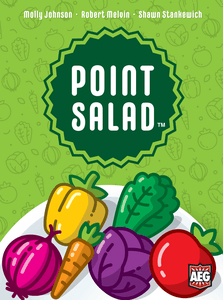
That’s like a pun squared!
(ok, not literal vegetables, but just go with it, ok?)
The artwork in this game is by Dylan Mangini (he of Mephisto: the Card Game fame).
The thing about Point Salad is that you are literally just drafting cards or goals and trying to meet those goals to score points.
The cards are double-sided with a goal on one side and a veggie on the other.

Your one action is literally to either draft two veggie cards or to draft one of the goals.

That’s it!
(I’m being very literal this morning, literally please forgive me)
Now, of course there are some things you need to keep in mind.
Since the goals are on the back of the veggie cards, when the veggie area gets refilled, those goals that were there are going to be gone.
So you can’t draft a couple of veggies hoping that you will then be able to get the appropriate goal on your next turn (and with up to 6 players, that would be pretty much impossible anyway).
That’s where the simplicity of the concept comes in, and also a bit of the randomness.

You never know what goals are going to come up, but you can rest assured that there are a certain number of each type of vegetable (6 types) in the deck based on player count. You remove a certain number of each type of veggie depending on how many (up to 6) players there are in the game.
But the goal cards do indicate which veggie on the back of it, so you can count those as “out of the game” when you are doing your card counting.
You do have a bit of flexibility, though not much, in that you can always flip one goal card to its appropriate veggie on your turn.
Though you can’t do it the other way around (flipping a veggie to a goal is a no-no!).
Say there’s a goal that you’re no longer interested in.
Flip it to the veggie!
That’s literally a strong move sometimes.
(Editor: “Sigh”)
Especially if the goal has negative points for (for example) onions and you’ve decided you want to collect onions (please don’t breathe on me if you do).

Thus, this is a basic set collection, card-drafting game where you are drafting the goals as well as the cards to meet those goals.
You do have to be careful near the end of the game, though, as you must draft something and if there are no goals left, you have to draft two veggies, even if they would give you negative points.
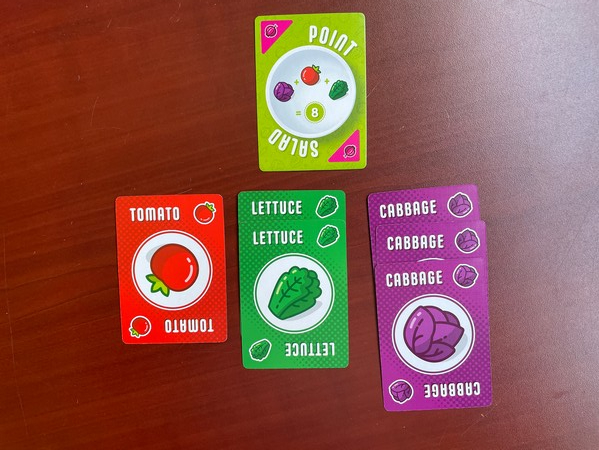
You can usually avoid that, though, even if you end up drafting veggies that don’t do anything for you.
At the end of the game, of course, you look at the goals you drafted and compare your veggies to the goals.
You total up all those points and whoever has the most is…wait for it…the winner!
You can use one veggie for multiple goals, so it’s not exclusive or anything.
The veggies are cheap dates.
That’s basically it!
There is no nuance to this game.
Instead it’s just a fun way to spend a lunch hour, or a brief 30 minutes before or after the main event on game night.
Grognards or people who live and die by super-complicated games like Food Chain Magnate need not even look at Point Salad, because they will scoff and say “what a waste of time.”
Yes, there is a ton of randomness (though nowhere near as much as many dice game fillers). The cards will come out as they come out. You have to deal with what’s available when it’s your turn.
You have no control over much of the game (except you can avoid taking bell peppers if you have a goal that gives you negative points for bell peppers. If you do, that’s on you)

The game has no pretenses of being anything other than what it is: a simple card game that entire families can enjoy, even non-gamers.
And what’s wrong with a little family time?
Or even just giving your brain a break and drafting some cards?
As long as you accept it for what it is, Point Salad can be a lot of fun.
It’s worth checking out if that’s the case for you.
(This review was written after 3 plays)
 Dude! Take Your Turn!
Pingback: September 2023 Gaming – Dude! Take Your Turn!