Dude! Take Your Turn!
A Gaming Life
Review – Twilight Struggle: Red Sea – Conflict in the Horn of Africa
Twilight Struggle is one of those long-standing classic wargames (oops…I don’t want to get into that argument) from GMT Games about the Cold War from 1945 to 1989. It’s long, it’s 2-player, but its gameplay has stood the test of time to make it a favourite among gamers.
It was the #1 game on Boardgame Geek for a long time and is still #14.
While I have played the app a number of times, the length as well as it only being a 2-player game has kept me away from actually buying it and getting it to the table.
The recent publication of Twilight Struggle: Red Sea – Conflict in the Horn of Africa, however, has made it to the table 4 times this month!
That’s because it’s designed to be a short, punchy game that gives you the feel of the cold war conflict in one dedicated area of the world over a shorter time frame.

Twilight Struggle: Red Sea (no, I am not typing that whole name again) was designed by Jason Matthews with artwork by Terry Leeds. It was published in 2023 by GMT Games.
It’s another in a series of Lunchtime Games which make great games for work and really makes it possible to pad my games-played stats get some relaxation after a long morning.
It’s also really quite good, with a few issues that may keep some people from enjoying it.
What does that mean?
Let me tell you!
Click Here if you just want the review without all of the “how to play”.
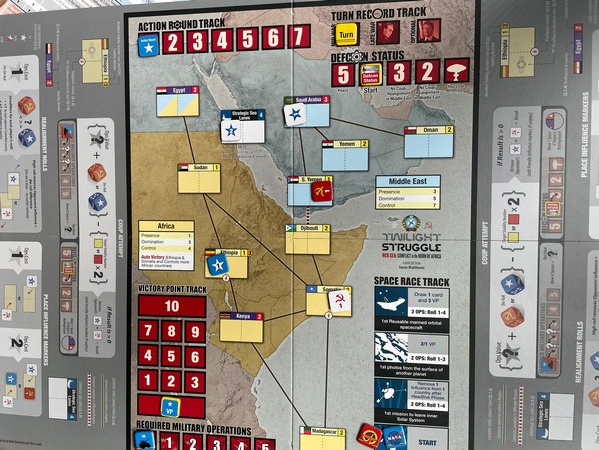
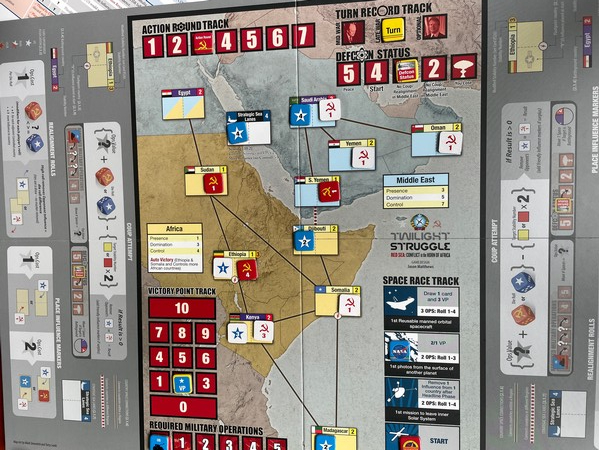
In Twilight Struggle: Red Sea, players are either the US or the Soviet Union in a power struggle over influencing countries in Africa and the Middle East, specifically in the “Horn of Africa” region.
(You can blow up pictures to make them bigger by clicking on them)
As with the parent game, players will be dealt 9 Operations cards that they will play 8 of during their turn (one for the Headline Phase and then 7 Action Rounds).
There are two turns in the game, with an optional rule for a third turn.
These cards will either have US Events on them, Soviet Events, or Neutral Events (will help either side).
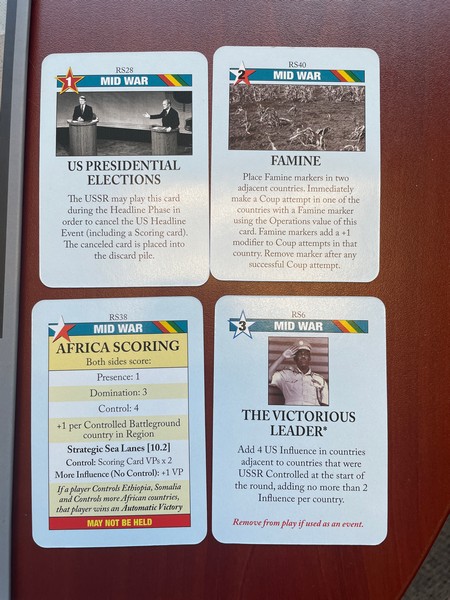
The Headline Phase consists of both players secretly choosing a card to play for the event (so make sure it’s Neutral or yours!). The higher Operations Points card goes first.
When you play a card, you can either use the numerical value in the star on the card for Operations points to do various things, or you can do the Event. You can only do the Event, though, if it matches the side you are playing.
The trick is, if you play a card with your opponent’s Event on it, they get to play the Event automatically and you can only use the Operations Points. You get to decide whether the Operations go first or the Event, but you can’t stop the Event from happening.
Scoring cards have to be played sometime during the 7 Action Rounds or you lose the game. The score is based on who controls the most countries, including Battleground countries.
How do you control a country and determine Battleground countries?
The number in the top right for each country is the Stability number of the country. If you have more influence in that country than your opponent, and the difference between the two is equal to or greater than that number, then you control that country (turn your influence marker over to the dark side).
Battleground countries have their name in a purple bar, as opposed to a yellow bar.
The board is also divided into two regions: Africa and Middle East. Egypt is a Battleground country that is considered to be in both regions.
African countries have a yellow background colour while Middle East countries have a blue background.
On your turn, you play a card. If you play for the Event, then you do what the Event says.
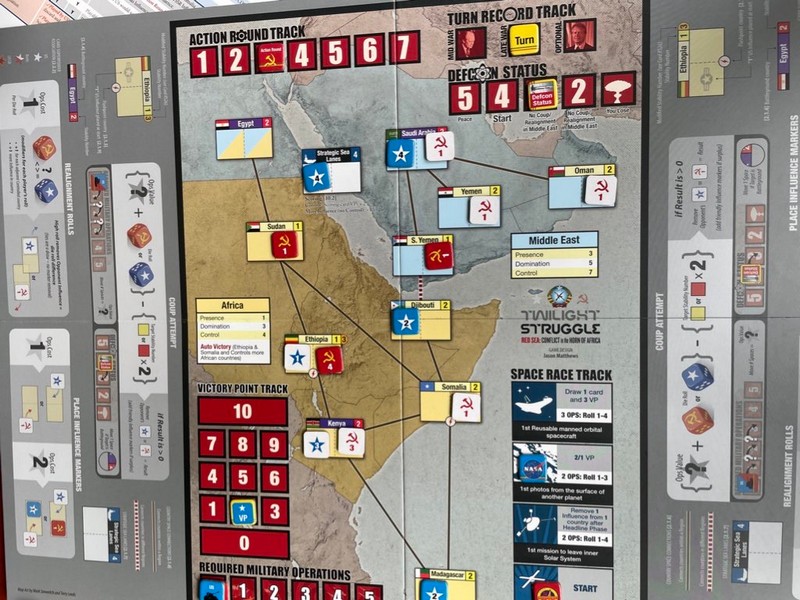
If you use Operations Points, you can do a couple of things.
You can place Influence, up to the Operations Points (OP) given by the card. This influence can only be placed in countries that you already have influence, or countries adjacent to countries where you have influence (as denoted by the lines between countries on the map).
If your opponent controls a country, placing an Influence costs 2 OP.
You can also try to perform a coup in a country where your opponent has Influence.
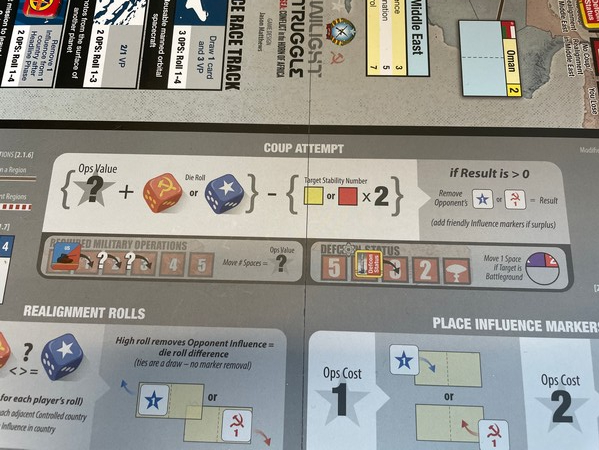
When you do that, you roll a die, add the number of OP on the card you played, and compare that to twice the country’s Stability number.
If it’s greater than zero, you reduce your opponent’s influence by the difference. If you still have a number greater than zero after doing that, you add your own!
Couping can be dangerous, though.
There is a Defcon track in the game. If Defcon goes to 1, whoever’s action it happens on loses the game (even if you played an opponent’s Event and that Event moved it to Defcon 1. You would still lose)
Couping a Battleground country causes Defcon to go down by one.
In a break from the original game, there are also two “Flashpoint” countries: Ethiopia and Somalia.
If you perform a coup in those countries, you draw the top card of the deck. If it’s a scoring card, a 1 or 2 OP card, Defcon degrades and you continue the coup. If it’s a 3 or 4 OP card, nothing happens and you continue the coup.
Finally, you can try to perform a realignment in the country. You can do this as many times as you have OP.
That’s just a roll to see if you reduce your opponent’s Influence. You don’t gain any (and could lose some if you have Influence there too!). It has modifiers based on who has more Influence in the country and if any connected countries are controlled by a player.
One way you can get rid of an opponent’s Event card in your hand, once per turn, is to play it for the Space Race.
That can get you points or let you remove Influence, depending on what stage of the track you’re on and where your opponent is, but it’s also a safety valve for your opponent’s Event.
There’s also the “Romanian Autonomy” card which begins in front of the US player. Instead of playing a card from hand, this card can be played for the OP.
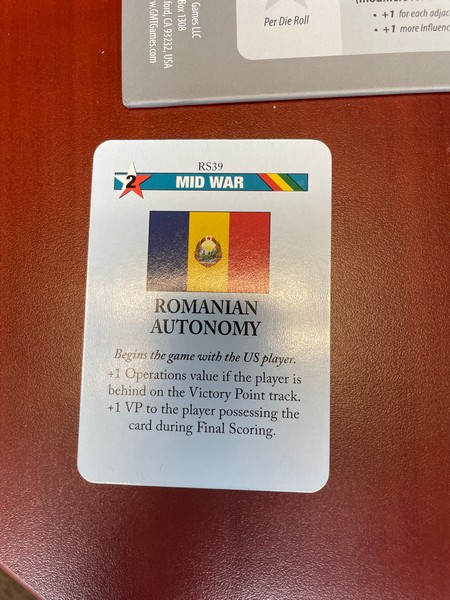
It’s then given to the opponent, facedown.
If it’s Turn 1, then the opponent can use it next turn.
Either Turn, though, it’s worth 1 VP to the player who has it at the end of the game.
If anybody reaches 10 VP during the game, they win!
If Defcon reaches 1, whoever’s action it is when that happens loses!
If the Africa card is played and somebody controls Ethiopia, Somalia, and one Battleground country in Africa, they win!
Otherwise, it’s whoever has the VP marker on their side who wins. The VP track is like a pendulum, so if you gain a point and your opponent has 5 VP, then the marker goes down to 4.
That’s the basic structure of the game, though there are a few more details that I’ve glossed over, like the Strategic Sea Lanes and other little bits.
Is Twilight Struggle: Red Sea a peaceful summit meeting between two world leaders? Or is it a nuclear meltdown because somebody accidentally pushed the button?
There’s something to be said for shorter games that still give you a lot of meaty decisions to make on your turn.
Twilight Struggle: Red Sea gives you those decisions and they are truly agonizing, depending on the hand your are dealt of course.
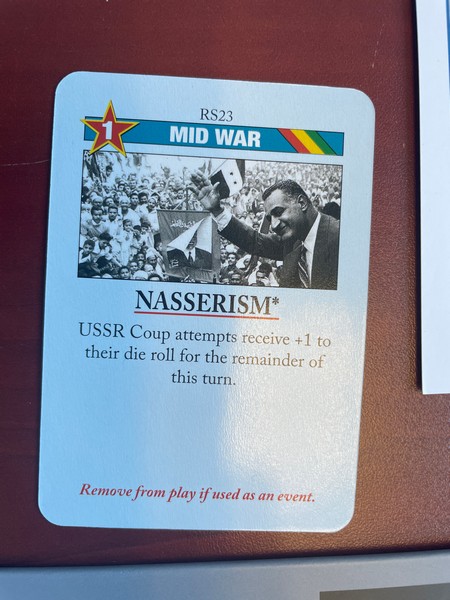
The game has some similar cards to its parent game, which for instance give you bonus OPs for the rest of the turn, or maybe +1 to coup attempts during your turn.
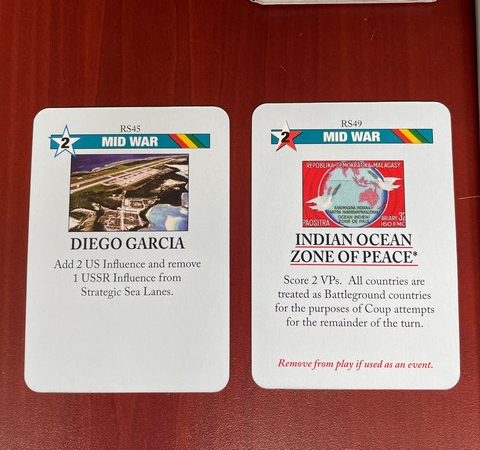
Of course, when it’s Turn 2, Defcon is at 3, and your opponent plays a card that makes all countries Battleground countries for Coup attempts this turn, Nasserism doesn’t quite help as much!
The game is tense, but you can also find yourself either driving or underneath a steamroller depending on the card play and how you spread your Influence.
A couple of events or coups that end up removing most of your influence from the map, and it’s going to be hard to recover from that.
Especially in the limited amount of time you have remaining.
Of course, that could happen in the parent game too and it could drag on for 3 hours unless you concede.
Here, you do your best and you’ve spent 45 minutes, tops.
I love that.
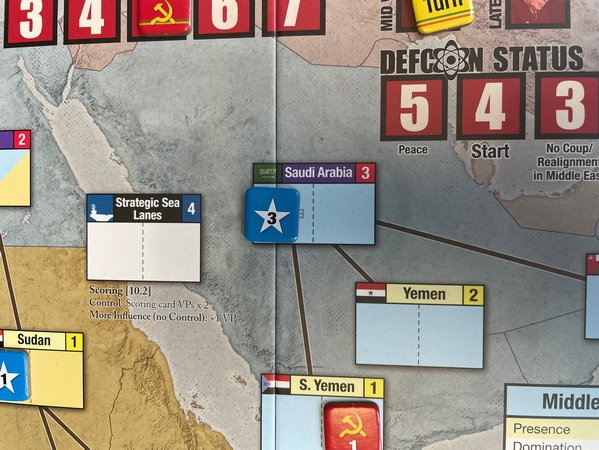
I’ve always loved this system of spreading Influence around countries, trying to chain it together and make inroads into areas that you aren’t currently in.
Or maybe the Event on a card can help you, since it could let you place Influence where you aren’t.
Coups are great for that too, though you can’t Coup in the Middle East after Defcon reduces to 3 or less.
The coups make the game really interesting because they can change things on a dime.
Or you could fail miserably.
You may have noticed a theme in these comments.
Some people (not me!) have complained about the parent game and how, especially with dice rolls deciding things like coups and realignments, it’s a bit too luck-based.
I don’t agree with that with the parent game (remember, while I haven’t played it on the table, I have played it on the app against human opponents many times), but I can see the point.
Most of the time, unless things cascade, this luck will even out. Your opponent will also draw cards that are bad for them. They may get unlucky coup rolls, or whatever. There are 10 turns for the luck to even out.
However, in Twilight Struggle: Red Sea, that is amplified by the shortness of the game.
Yes, short card-driven games like 13 Days have the same card luck issues, but there are no dice in those games.
In this game, the dice rolls can combine with getting dealt a terrible hand that consists of almost nothing but your opponent’s Events
And you only have 2 turns!
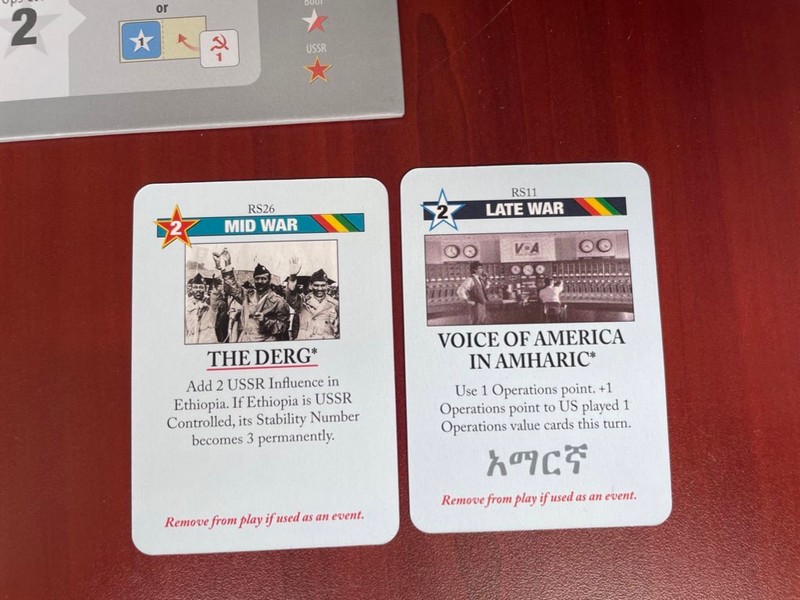
The first turn consists of the Mid War cards.
You’re not going to use them all.
On the second turn, you shuffle the Late War cards in with the remaining Mid War cards.
You will usually not come close to seeing all of the cards, and certainly not in your hands to actually play.
If you get dealt a crap hand of Events, your opponent could very well have a hand full of their own Events too, meaning you’re screwed.
Is this an issue for you?
For me, it’s a consideration, and why I don’t rate the game quite as highly as I might, but I still really like the game and recommend it for those short game periods where you want something meaty.
It’s not a deal-breaker for me, though, mainly because the game is so short.
Just like in the parent game, the better player is going to win almost every time, so I’m not saying it’s a complete luckfest or anything.
It’s just something to be aware of.
We can play it over multiple lunches or whatever. I’m not going to scream too much if I hit a really bad patch in one game.
But keep that in mind for you.
There is a lot to like in this game, though.
It’s a battle of wits with your opponent and you do have to find ways to try and mitigate that bad luck if you can. Play the events that hurt you the least, or maybe make it impossible (or at least where it won’t hurt you).
If you control Ethiopia with 1 Influence and the Event tells you to place Soviet Influence equal to US Influence there, play the Event first and then put your Influence in Ethiopia, giving you back control.
Sure, it’s a wasted turn, but it gets rid of the card that could really hurt you.
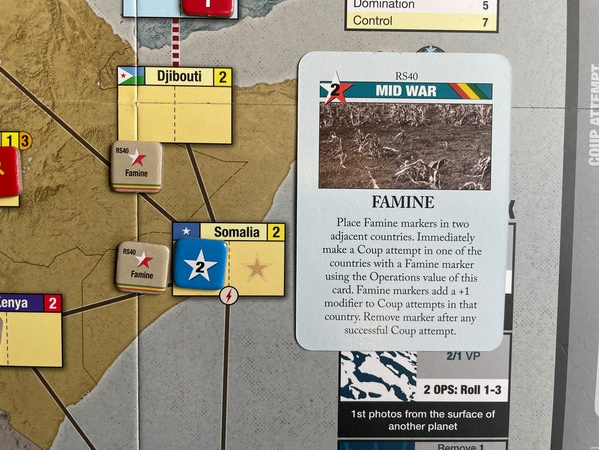
The history on the cards is a great learning-tool, something that could easily spark interest in teaching History if the game is played with a younger person (but who’s old enough to understand how to play, of course).
I do like the Space Race safety valve for shedding one of the bad cards in your hand, and especially the fact that it actually gives you some benefits as well.
Of course, that’s a bit luck-based (the benefits, not getting rid of the card) because you do have to roll!
But it’s not too bad.
You also do have to be careful and watch out for the new immediate victory conditions, namely the Africa scoring card.
The automatic victory of controlling both Somalia and Ethiopia, along with at least one Battleground country, can be devastating for the Soviets with the right sequence of card plays.
Of course, that just means that both players have to be careful, and maybe you won’t be able to do what you want to do if the other player is threatening that.
Overall, I greatly enjoy Twilight Struggle: Red Sea for what it is: a great strategy game that can be played quickly and that will give you a lot to think about during the game.
It is more susceptible to the luck element than I would like in a game like this, but given the rest of the game as well as the quick playing time, I can overlook that aspect of it.
If you are considering the game, keep that in mind.
If that doesn’t bother you, then you should definitely check the game out because the rest of it is great.
(This review was written after 4 plays)
 Dude! Take Your Turn!
Great review of small, neat and fast game!
LikeLiked by 1 person
Thank you! It’s definitely going to be a mainstay in my 2-player lunches. 🙂
LikeLike
Great review! Do you have experience with the app as well?
LikeLiked by 1 person
I have some, yes. Played about 10 games. You?
LikeLiked by 1 person
I haven’t! When it came out, I’ve read from several people that there were bugs in the app (including crashes), so I thought I’d give it some time. If you say that’s resolved by now, I’ll give it a try! (…and challenge you for a game, if you’re up for it!)
LikeLiked by 1 person
I am up for it! And one of the major bugs was the fact that the Middle East scoring card was apparently missing (maybe that was just in solo, I’m not sure). That has apparently been fixed.
I’m not sure about crashes and the like. I haven’t played it *that* much to worry about it.
If you decide to do it, let me know and I’m definitely up for a game.
LikeLike
Awesome! Will do!
LikeLiked by 1 person
Pingback: New to Me – October 2023 – Dude! Take Your Turn!
Pingback: Friday Night Shots – Catch Up Mechanisms – Dude! Take Your Turn!