Dude! Take Your Turn!
A Gaming Life
Review – Fantastic Factories
One game mechanism I really like is dice rolling and engine building (ok, that’s two mechanisms).
Who doesn’t like chucking a bunch of dice?
Ok, Len in the back, maybe.
But otherwise, who doesn’t?
Fantastic Factories doesn’t let you chuck a ton of dice, but it lets you chuck a few and it also lets you build an engine to use those dice!

Fantastic Factories was designed by Joseph Z Chen and Justin Faulkner, with artwork by Chen. It was published on Kickstarter in 2019 by Metafactory Games but now is being published by Deep Water Games.
It plays 1-5 players.
In the game, you are trying to build up a card engine of factories and other production and training buildings to get the most efficient industrial engine going and produce the most goods.
And you do it with dice!
How does it work?
Let’s take a look.
If you want to skip all of this “how to play?” stuff, click here.
The game has two resources: energy and metal.
You start the game with one metal and two energy and one player board.

You also start with four blueprint cards.
These blueprint cards are what you will be building, or spending to build or take a contractor.

What’s a contractor?
After all of these are dealt out, four blueprints and four contractors are put out on the table.

Each round, beginning with the first player (which rotates), players will choose either a blueprint or a contractor from the middle rows.
Blueprints are just added to your hand for future building or payment.
Contractors will actually be useful to you in some way, either this round or next.
To take a Contractor, though, you have to discard a blueprint with the same symbol in the top left (wrench, hammer, spade, or gear) as the symbol above that Contractor.
Contractors may give you bonus dice, or may give you bonus resources, or some other kind of assistance.
Once everybody has done this, all players will then roll their four dice and distribute them to get resources, cards, etc. They can also build blueprints.

They do this by discarding another blueprint with the same symbol on it (the same as the Contractors). They also have to spend the required resources (also in the top left). This will be either energy or metal (or both).
Most of these cards will be worth 1-3 victory points at the end of the game as well, though you mostly want them to build your engine.
On your player board, you can use the dice you rolled to draw cards, get energy or get metal.

However, the blueprints you build can also give you options!
They can either let you convert resources into something else, train your workers, or give you another option for your dice.
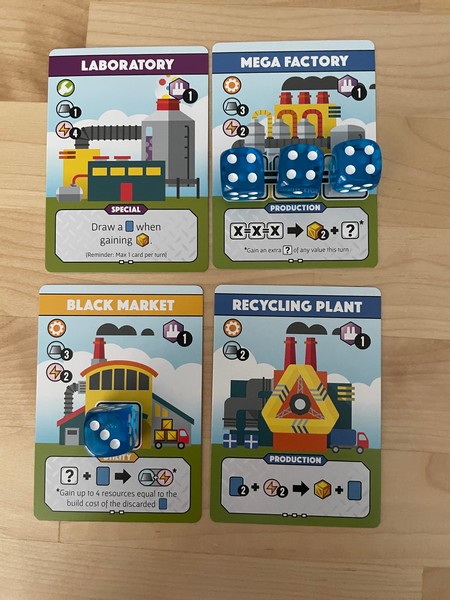
They can also have an ongoing effect, like the Laboratory above letting you draw a card every time you gain a Good (once per round, since all cards can only be used once).
What’s the point of all this?
To produce Goods (the gold cubes). Or to build blueprints, one of the two.
The game end is triggered when somebody has either produced their 12th Good or built their 10th building. The round ends, then you play one more round.
Whoever has the most Goods plus VP on their buildings is the winner!
Is Fantastic Factories something the produces the high-end goods that we all aspire to? Or does it just produce cheap knock-offs that nobody wants?
Fantastic Factories is a fantastic game for a number of reasons.
First, it’s an engine-builder.
Building your buildings from the blueprints in your hand, and then using them to make your turns even stronger, is so satisfying.
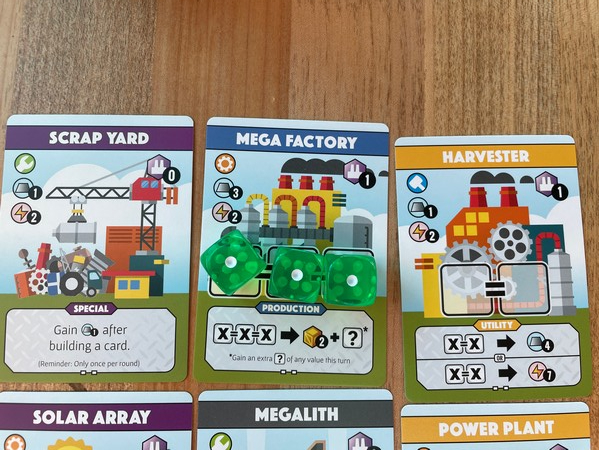
Also, all of the building types do different things, depending on their colour, which is also pretty cool.
The blue Production cards give you another place to use your dice and hopefully let you produce goods (and maybe even an extra die (worker) like the Mega Factory!).
Then there are the orange Utility cards that let you turn dice or resources into other resources or cards.
The purple Special cards give you benefits when something happens (once per round, of course, which each of these cards helpfully reminds you so you don’t have to remember the rule). Like the Scrap Yard giving you a metal after building a card (effectively a one metal rebate).

The red Training cards aren’t worth any points, but can also be very valuable to your engine.
They can let you spend resources to modify your dice, giving you some of that dice mitigation that is important in dice games.
One mild issue that some may have with the game is the dice mitigation.
If you haven’t built any Training cards, you will not be modifying any dice! Some Contractors will help by getting you extra dice or what have you, but there is no mitigation without Training.
And you can’t have a production facility that’s all Training cards or you won’t be producing anything!
Plus you won’t get any points.
It’s a Catch-22 that some people may not like.
However, you can always find uses for your dice, if nothing else than to get resources or blueprints by placing them on your player board.
You can also build Monuments as a point engine, though that can be difficult without other production in your factories.

Normally you can only build one of each type of card, but Obelisks and Beacons are the exception to that.
If you can chain them together, you can get a bunch of points that way.
I also like how you have to discard a card of the same type in order to build a card.
That can make your choices a bit harder. You want to keep that Beacon but you really want to build this other card with the spade symbol on it, because it will make your factory more efficient.

I don’t know!
The Contractors are a neat idea as helpers during the game, depending on what you need, or what you have.
If you have a ton of energy, for example, then hiring some Hired Hands could be very useful.
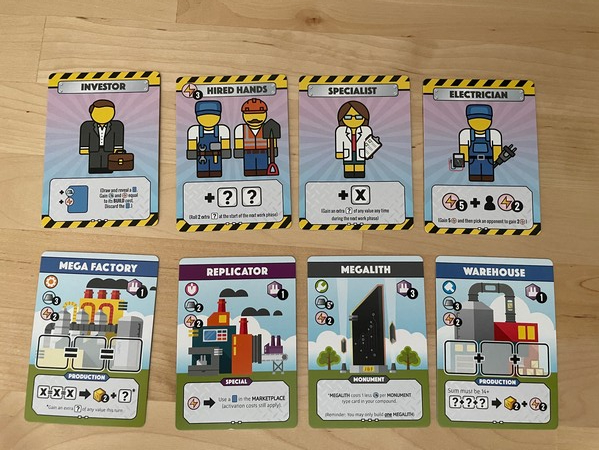
The more dice, the better.
This can also be a good thing to do if you have a bunch of blueprints in your hand. It’s not as easy to do when your blueprints are scarce, since you have to sacrifice one of them to hire the Contractor.
The artwork on the cards is really quite nice and stylized. Chen did a great job making this game distinctive.
You will always recognize Fantastic Factories when it’s out on the table.
The bright colours, both on the cards and the box, really make the game stand out.
More importantly, the iconography is really easy to understand.
Dice symbols with question marks mean dice that you roll(ed) while dice symbols with an “X” mean a specific number. Like the Specialist Contractor above, which gives you a die of any value you want, compared to the Hired Hands which just give you two more dice to actually roll.
This game is easy to teach, easy to play, and yet you do have some pretty good decisions to make depending on the cards you have, and your dice rolls.
I like that.
Some grognard who doesn’t like any luck in their games will probably hate it.
There is a fair bit of luck, especially if you haven’t built any training facilities.
Some may think there’s too much.
For me, it’s just a fun game. It doesn’t make me think too hard, but it’s not too frivolous and you can’t just turn your brain off.
I like that in a game, especially a game that can take under an hour.
As long as everybody knows how to play, this would be a great lunchtime game.

If you can get your hands on the playmat, it looks even better on the table.
It was an option in the Manufactions Kickstarter campaign in 2021, and I really like it.
But you don’t need the mat to play.
Overall, as long as you don’t mind dice games where dice mitigation can be an issue, Fantastic Factories is an awesome game that you should give a try to if you are able.
Now to go see if I can roll a couple of sixes and finance my retirement!
(This review was written after 7 plays)
 Dude! Take Your Turn!
Pingback: Friday Night Shots – Playing with Non-Gamers? – Dude! Take Your Turn! - Gaming Blog
Pingback: Friday Night Shots – How Much Luck is Too Much Luck? – Dude! Take Your Turn!
Pingback: Friday Night Shots – Player Aids – Dude! Take Your Turn!