Dude! Take Your Turn!
A Gaming Life
Book Series Recommendation – “Berlin Wartime Thriller” by Simon Scarrow
Simon Scarrow is a historical thriller author who’s best known (I think) for his novels set in Ancient Rome. His “Eagles of the Empire” series starring Quintus Licinius Cato, a former imperial slave, and centurion Lucius Cornelius Macro, is now at 25 books!
I’ve only read one of them, though I found another one in a thrift store and skimmed the first couple of chapters and was very impressed.
I wanted to start at (or near) the beginning, but I finally succumbed and read Book #19 (The Emperor’s Exile) just to see what I thought.
And it was good!
While I am still wanting to start near the beginning before reading further, I stumbled upon another small series of books by Scarrow, this time completely removed from Ancient Rome.
The Berlin Wartime Thriller series (what a weird title, but it is accurate!) just consists of two books right now, but both are really good.
The series takes place at the start of World War II and the main character is Horst Schenke, a Criminal Inspector for the Berlin police (Kripo) who has no sympathy for the Nazi regime but just wants to see justice done.
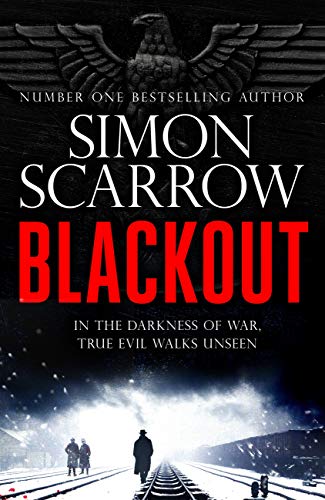
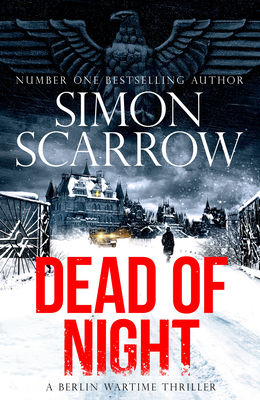
Let’s talk a little bit about them.
The first book in the series, Blackout, takes place in the brutal winter of 1939. The war is in its first few months and the Nazis are increasing their terrifying grip over the populace. To avoid aiding any Allied bombers, a strict blackout is enforced throughout all urban areas (the Allies aren’t dropping anything but leaflets encouraging the population to rebel against the Nazis at this point, though).
Criminal Inspector Schenke and his men are working on a forged ration coupons case (which seems to be ongoing since it carries through the second book and presumably beyond) when a young woman is found brutally murdered. Schenke is under increasing pressure to solve the case quickly as possible, especially when a second murder happens.
Schenke is already under suspicion for his refusal to join the Nazi party, so the slightest misstep could mean his own death, especially as the investigation starts leading into the higher echelons of the party.
Getting caught between warring factions within the party is not a safe place to be.
The second book, Dead of Night, takes place shortly after this one, in February 1940. The winter is still extremely cold and coal is scarce due to the war. The forged ration coupon case is still ongoing, but Schenke will soon have other things to worry about.
On one of the coldest nights so far, SS doctor Manfred Smesler is found in his study, dead from an apparent self-inflicted gunshot wound. The hurried and official version of the Reich is suicide.
Smesler’s widow doesn’t believe it. At the risk of running afoul of the Gestapo, neither does Criminal Inspector Horst Schenke. The warnings to drop the investigation only compel Schenke to dig deeper. Then Schenke learns of the suspicious death of a child in a remote clinic outside Potsdam.
Are they related? At first it doesn’t seem so, but soon the links between the cases not only become more obvious, but they point to a horrible secret within the Party.
As Schenke digs deeper while continuously being threatened to let the investigation drop, he has to navigate the choppy waters and factions within the party as well as the police force itself to not only solve the case but avoid dying while doing so.
This series is an example of a moral person trying to function within a completely immoral society. Schenke is a great believer in morality, right and wrong, and bringing criminals to justice.
But what happens when the definition of “criminal” begins to change due to the nature of the regime?
He’s refused to join the Nazi party, but he still has to work with people within it.
The series has a wonderful cast of characters, fairly well-rounded (considering there are only two books so far) and Scarrow does a great job bringing them to life.
In addition to Schenke, there’s Sergeant Hauser (I want him to be a cello player), Schenke’s second in command who has a family (so he’s greatly affected by events in the second novel).
There’s also the ex-Gestapo agent who was transferred to Schenke’s Kripo division, Liebwitz, who Scarrow thankfully gives some depth to and doesn’t treat him as a stereotypical Gestapo agent. In fact, while he’s kind of humourless and typically by the book, he doesn’t seem to be a “Good Nazi” and instead has shades of grey that are light enough that you wonder perhaps why the Gestapo transferred him. Was he not hard enough for them?
The second book really fleshes out why Liebwitz is the way he is, and he’s actually a really great character even though he is secondary.
Schenke has a girlfriend, Karin, who is also the niece of Admiral Canaris (German spy chief). She’s not as well-rounded, but she is vehemently anti-Nazi and highlights the struggle that Schenke has in both novels between co-existing with the Nazi government and undermining it (or at least going against it).
Ruth is a Jewish woman who helps him solve the Blackout case by being bait for the murderer, but who then gets involved in second novel as the friend of Smesler’s widow, wanting to find out the truth.
Schenke’s relationship with Ruth is complicated, as there is some attraction there, and also that he wants to protect her because she’s a Jew in 1939 Berlin. If she comes to the attention of authorities, her life is probably over.
The cases themselves are interesting, but what’s really attractive about this series is how Schenke has to navigate the turbulent waters of his job now that the Nazis have taken over. In both books, he has to deal with Reinhard Heydrich, chief of the Reich Security Main Office early in the war and, ultimately (though beyond the scope of these books, at least so far), principal architect of the Holocaust.
Schenke is such an interesting character because while he’s against everything the Nazis stand for (especially evident as things he’s investigating start involving party officials), he is one of the “typical” German civilians who are afraid to actually do anything against Hitler and the regime that is terrorizing the entire populace.
One of the main conflicts between Karin and him is the fact that he wants to hunker down and be a witness to the atrocities after the fact so they are not forgotten. Karin thinks it would be better to actively resist now.
It’s this internal push and pull, as well as how he has to outwardly deal with these people, that makes the books really interesting.
I hope there are more books coming in this series. I do love the characters (though I do hope that Karin and Ruth get a bit more depth to them) and I want to know what happens next.
Regular old crime doesn’t stop just because the party in charge has a death grip on the populace.
Schenke is comfortable when he’s dealing with that kind of crime. It’s black and white, clear as a bell.
It’s those grey areas that will kill you (and him, maybe).
Give this series a try if you like historical novels with unique settings.
 Dude! Take Your Turn!
This reminds me of Robert Harris’ first novel, “Fatherland.” Of course, Scarrow keeps his Berlin in Wartime series grounded, compared to Harris’ setting his story in an alternate reality where Germany won WWII. I have not read any of Scarrow’s novels, so I can’t compare Horst Schenke with Xavier March, but they’re both Kripo officers who arouse some suspicion because they’re not Party members.
Great post!
LikeLiked by 1 person
Thanks, Alex! Yeah, this is definitely not an alternate history. I’m really enjoying the examination of what it’s like to live under a regime like that and still try to function to the best of your abilities.
I think you’d like this one!
LikeLiked by 1 person
I love that author; I am currently reading book #21 (Death to Emperor) and could not get enough! Thanks for bringing other titles from that author to my attention!
LikeLiked by 1 person
Have you read the entire series (up to #21, I mean)? Or are you dipping in and out too?
LikeLiked by 1 person
Everything from the beginning, almost 20 years ago!
LikeLiked by 1 person