Dude! Take Your Turn!
A Gaming Life
Ships That Pass in the Night – For Points!

Sometimes watching Youtube is dangerous.
I’m not talking about when you look up “how to cook a S’More on the car fire that you happened upon on Highway 1.”
That’s pretty dangerous and I don’t recommend it.
No, I don’t speak from experience, why do you ask?
I’m talking about watching boardgaming videos, and how dangerous they can be to your wallet!
Here I was, innocent little ol’ Dave, tuning into Youtube and seeing what the latest boardgaming stuff to watch was.
I happened upon the Heavy Cardboard live playthrough of Shipyard (2nd Edition) and was enthralled for three and a half hours.
(I’m sure Edward is getting tired of me tagging him on social media, but I promise this review will be the last time…for Shipyard, anyway).
I immediately ordered it from Boardgame Bliss and it arrived a week later.
I got it to game day the next week and it was just as good as I had imagined it to be from the playthrough.
I had never even seen or heard of the first edition of this game, or even this edition until watching the video.

Shipyard (2nd Edition) was published in 2023 by Delicious Games. It was designed by Vladimír Suchý with art by Michal Řezníček and Adela Stopka.
It plays 1-4 players.
In the game, you are doing literally what the title is: running a shipyard in some nebulous turn of the century time period where smoke stacks and snooty-looking businessmen are all the rage.
(Ok, that last part could be in any time period).
What is so great about this game? (Yeah, sorry, spoilers, I think it’s awesome).
Let’s take a look.
I love games with randomness, as long as they aren’t super long and you could end your five-hour game on a roll of the dice.
But one thing that appeals to me, at least in longer games, is some randomness but not an overwhelming amount, where the randomness kind of evens out.
Maybe there’s a lot of card play but there are so many options for the cards you happen to draw (and you can usually somehow draw more if you need to) that it never feels like you lost on the lack of a card.
You just didn’t play the cards you have as well as you should have.
Shipyard (I’m just going to leave out the “2nd Edition” from now on, since you already know that’s what I’m reviewing) has that kind of randomness in spades.
There is very little randomness in the game, but what randomness there is makes the game juicy and very replayable.
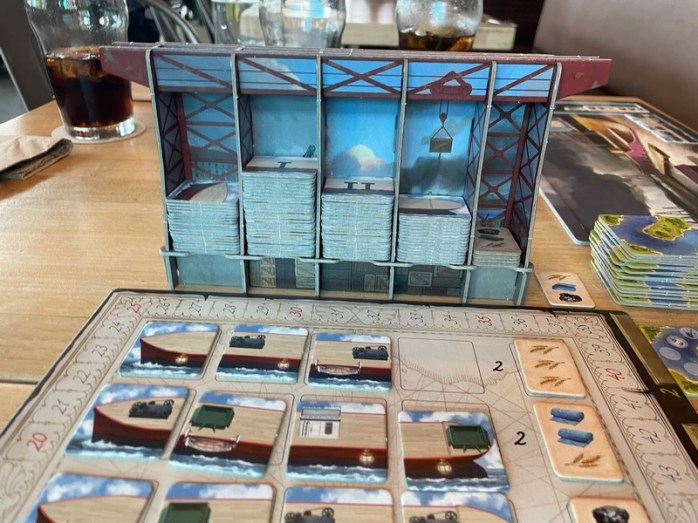
The only randomness is a few of the action markers and their initial locations (the first three are in the same positions each game to start), how the ship parts come out onto the market board, how the canals come out, the commodity tiles come out, and perhaps how the employees are distributed around the board.
Also your end game goals, but I’ll get to that.
That may sound like a lot of randomness, but it’s not!
There will almost always be something that you can use, or at least something you can adapt to, when you’re buying all this stuff.
It may cost you some florins if they’re at the top of the track, as the cheaper ones are always at the bottom, but you can make do.
With Shipyard, the action selection mechanism is what really makes this game for me.
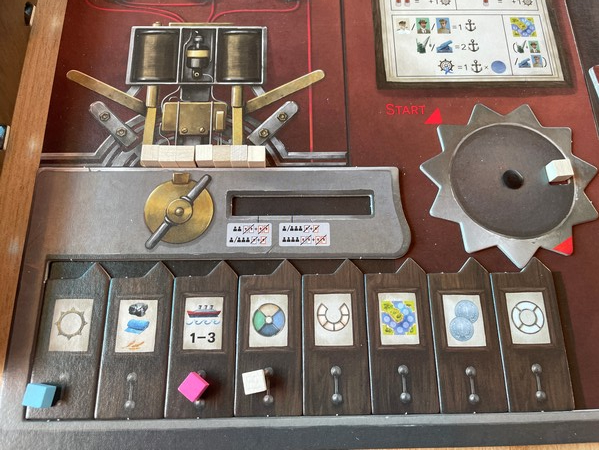
On your turn, you will be picking up your cube from the action it’s on, moving it to the front of the action row (which will also move the timer gear one space) and then choosing another action to do.
You can’t choose the one you just moved, and you can’t choose one that somebody else has a cube on.
This means that in a 3-player game you will have 3 actions to choose from and in a 4-player game you will have 4 actions (the “two florins” action is only available in a 4-player game).
Thus, while there isn’t tons of player interaction in the game, action blocking is definitely a thing in Shipyard.
I can’t count how many times I wanted to take an action but somebody ahead of me had already taken it that round.
However, as a way to mitigate that, you can pay 6 florins to take any action on the board as a bonus action, except the main action you are taking this turn.
Even if somebody’s cube is on it, you can do it.
This makes for some juicy decisions and lots of “damn it, you took my action!” exclamations (though perhaps with more foul language).
Of course, it’s important to note what these actions do, so let’s go over that a little bit.
Like I said, you’re building ships to then take them out on a test run.

Every ship needs a captain and canal space to use for its shakedown cruise.
If you don’t have either of those, then your ships won’t get you any points.
Why are you even playing this game?
There’s a lot that goes into shipmaking, though.
There’s hiring the crew, maybe the employees that will help you in building the ships.
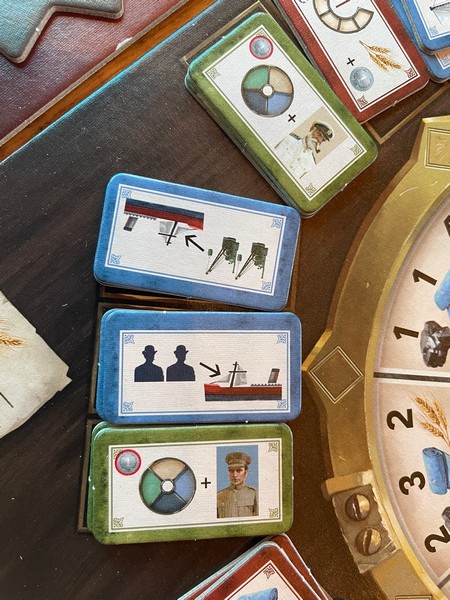
Employees will do anything from getting you bonus money when trading your commodity tokens in, to making sure you can get a specific ship part or passenger/captain/stoker no matter what you actually end up getting on the track when you choose the action.
They can even allow you to break the rules of requiring the proper connections for all of the equipment on your ship (like the wheel mechanisms that are required for sails and smokestacks, or the cabins for the Stoker which you need if you want your ship to move anywhere fast).
Then, of course, there’s the ship parts!

Getting each of these is an action, and an action that somebody may have already taken, meaning you have to adjust the timing of what you want to do (or pay a bunch of money, that works too).
You also need to build canal space for your ship to run in.
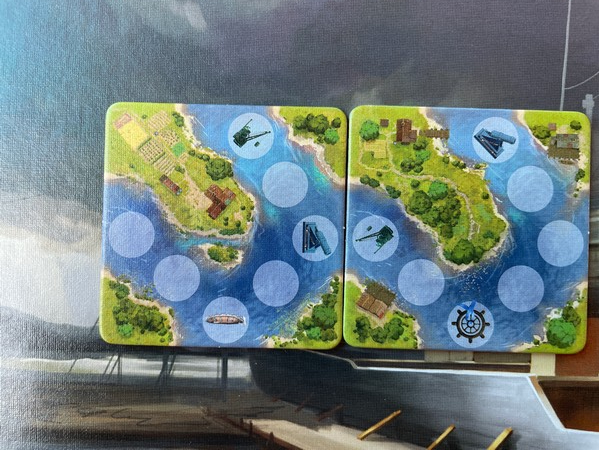
And add stuff and people to your ship in order to impress the investors as the ship sails along the canal.
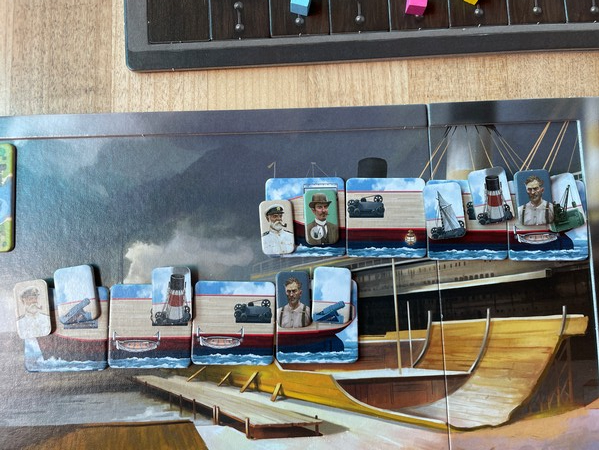
All of this is in order to make your ship as prestigious as possible when it finally sets sail.
In many of the games that I play, there are multiple paths to victory, either concentrating on certain tracks or a couple of different options as opposed to a third or fourth option.
In Shipyard, the main difference in your path to success is how big you want your ships to be.
Do you go big and build one ship?
Do you build a couple of smaller ships?
Maybe your end game contracts will help you decide that?
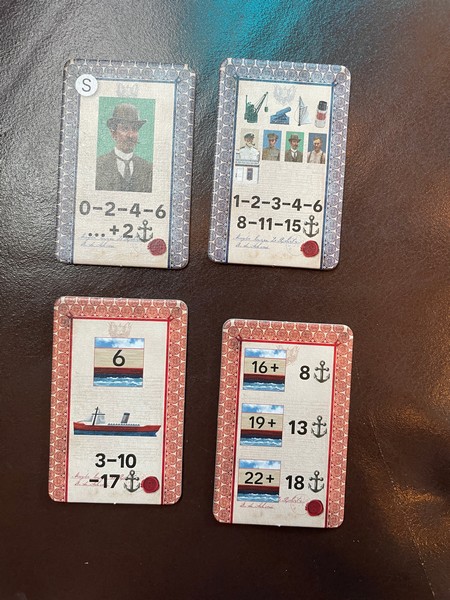
Each player will ultimately have one basic and one more advanced contact at the end of the game. You’re dealt three of each, but during the game you will discard two of each type.
The red ones will usually be about ship size or number of ships.
In fact, there’s one contract that Edward suggested leaving out and I totally agree. It gives you points based on the number of ships you build, regardless of what type they are.
If you build a bunch of really small ships (you need a bow, a middle, and a stern piece to have a complete ship), then you can easily get 32 points just from that!
These government contracts are very useful because they can guide your play a little bit. They make the game not so open-ended that somebody who’s not too experienced in gaming will just sit there slack-jawed trying to figure out what to do.
The cool thing is that all roads can win the game! As long as you do them right.
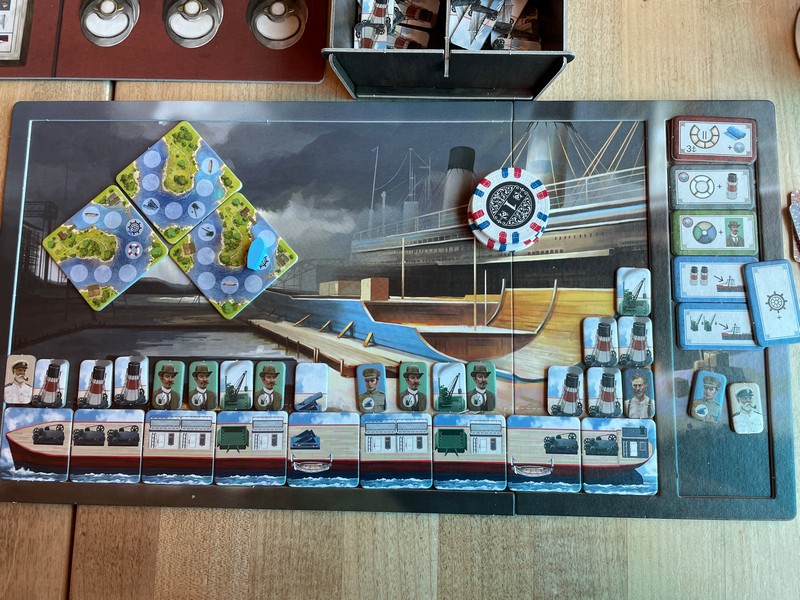
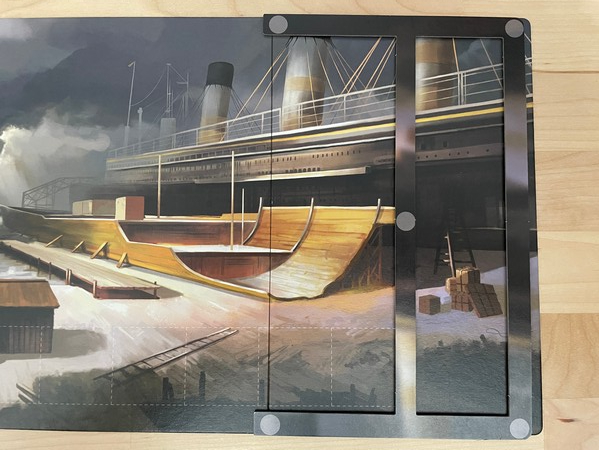
In one game, my friend decided to just build one long ship (shown above).
It took him the entire game to do it, but his contracts did make this viable.
It was big but it was also fast and had a bunch of stuff on it.
He hadn’t scored any points during the game but when this sucker sailed on the last turn, it got him over 55 points!
Counting his contracts, he ended up winning the game.
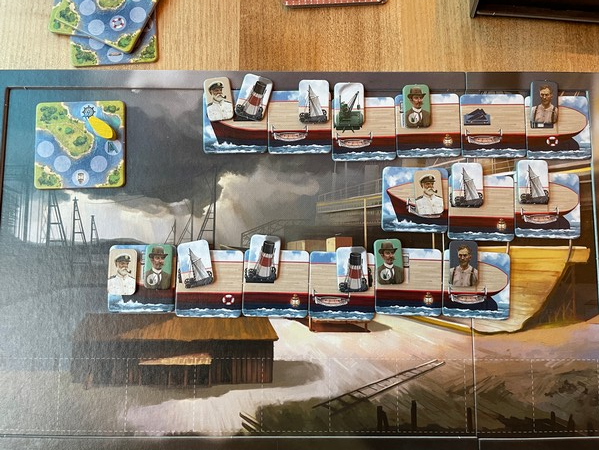
But building multiple smaller ships can win you the game too.
It just depends on how you play.
That’s what makes this game great.
The core mechanisms of the game are the same each time, so maybe they might get a bit rote if you play it a bunch.
But what you’re doing with those mechanisms can vary so much, and that’s the interesting part.
The other thing that makes Shipyard so interesting in the planning stages is that you truly do have to plan.
Like I said, each ship needs a captain and enough canal space to run (otherwise it runs aground and fails? I don’t know).
If you purchase the last ship part to complete a ship, it automatically sails at the end of your turn.
You don’t get a choice.
So plan your moves, make sure you don’t complete your ship too early, and you’ll be fine.
When moving your action piece to the front and turning the gear, the cube that’s in it will go around.
As soon as it drops into the cube-sized space, that player finishes their turn and then another cube is placed in it.
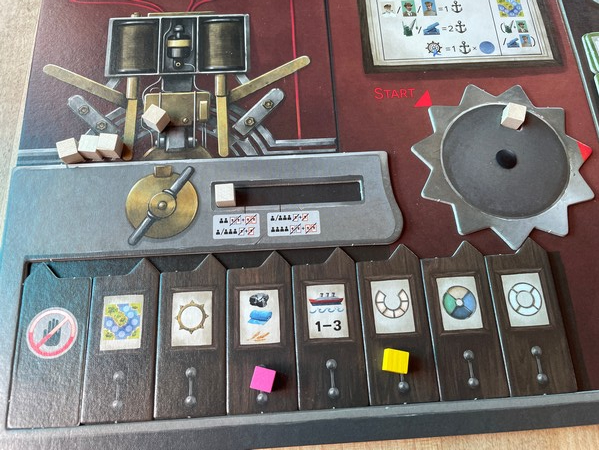
This is the timer of the game.
As soon as that happens and there are no more cubes to put out, you finish the round so each player has an equal number of turns.
Then, each layer gets one more action which can be any of them. Doesn’t matter about cubes.
Finally, if you can complete a ship by buying one tile, you can do that and send it out on its shakedown cruise.
So make sure you plan!
If you need two ship tiles, you’re out of luck.
That’s when final points are awarded for contracts and whoever has the most points is the winner.
Regarding points, while it’s easy to feel like somebody is running away with the game, that’s not always the case if you keep building ships.
The endgame, even though it’s just the contracts, can make or break it, so don’t get discouraged.
For me, Shipyard plays best at 4 players, though 3 players works out pretty well too. I haven’t tried a 2-player game or the solo one yet, so I can’t really comment on how well it plays.
The reason for 4 players being best is the “get 2 florins” action that’s not available in the 3-player game.
Money can get extremely tight in Shipyard, especially when you want to spend 6 florins to take a bonus action.
Without that 2-florin action, the only way to get money is to sell commodity tiles (which, instead of money, can also get you equipment and crew for your ship) or to choose an action behind your opponents.
You get 1 florin for each action cube ahead of yours, which also means that the maximum you can get in a 3-player game is 2 florins.
Even though the “get 2 florins” action does seem like a waste of a turn, combined with getting the income from placing your cube behind all 3 opponents (face it, the action is going to be at the back of the action track most of the time) means you’re getting 5 florins that turn.
You most likely will have enough to take a bonus action if that’s the case, unless you’re totally broke.
Just something to consider, but the game is fun at both 3 and 4 players.
The production values in this game, especially considering it’s the retail version, are amazing.
Though some assembly is required, including stuff that’s not in the rulebook!
Make sure you don’t throw away those pieces that seem extraneous. They are not.
Thanks to Edward for mentioning all of that in the playthrough video, though of course I wasn’t paying close enough attention to the video when that part came on and I still made a couple of mistakes.
I have to admit, though, that once everything is put together, they look great!
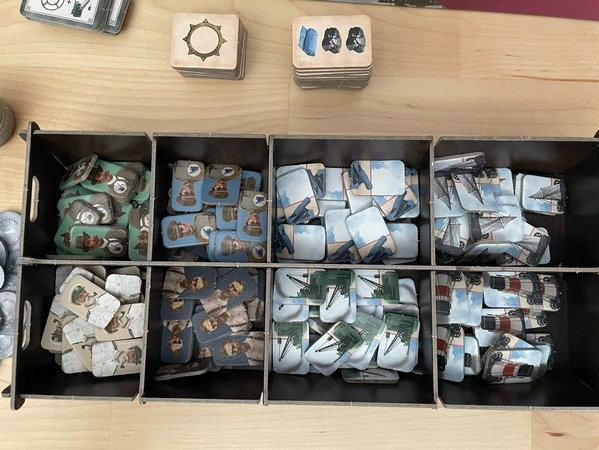
The storage container for all the equipment, crew, and passengers is outstanding.
That and the ship piece container really make the game easy to play.
Even if it’s not the easiest to actually get back into the box.
After having played through Shipyard three times now, it is definitely a game that I will play at any time.
It’s impossible to say where it would be ranked in my top lists, if it breaks the top 50.
But the decisions that are required, almost hidden in that you are doing the same actions regardless of why you are doing them, are what make the game.
So many different options.
The game clocks in at around 2 hours (my first 3-player and 4-player plays were 2:14 and the third 3-player game was 1:45, so an average) so it’s easily digestible for a game night.
If you get the chance to play this excellent game, you should definitely give it a try.
(This review was written after 3 plays)
 Dude! Take Your Turn!