Dude! Take Your Turn!
A Gaming Life
Stealin’ & Robbin’ & Rollin’ Dice
What happens when you find a game that emulates some of the mechanics of one of your favourite games and then adds a bunch to it?
Sometimes you look at it and say “nice try, but you’ll never be as good as my old girlfriend Lindsay” (or whatever her name was).
Other times, you look at it and say “you know, this is pretty cool. You’ll never replace Lindsay, but you’re definitely worth looking at too!”
For me, that’s how I felt when playing Bad Company and comparing it to one of my favourite games, Space Base.

Bad Company was designed by Kenneth Minde, Kristian Amundsen Østby and Eilif Svensson with artwork by Gjermund Bohne. It was published by Aporta Games in 2021.
The game is a dice-rolling and contract-fulfilling game for 1-6 players (which makes it a godsend for those game days where you have 6 but nobody wants to play their own game).
The dice-rolling is where the Space Base (and Machi Koro, though Space Base pretty much killed that one already) comparisons come in at.
What do I mean?
Am I being criminally obscure?
Let’s take a look.
Who knew the criminal life could be so fun?

Players are head of a gang (which is named by combining two player sheets, which can make for some interesting names, like the Emotional Hoods above) and the gang will have members from 2-12 (or, rather, 3-11, but I’ll get there).
These are the gang members you will be activating on turns.
There are a number of games out there with that same dice-rolling mechanic, where one player rolls the dice and everybody can do a subset of actions based on those dice.
In Space Base, if it’s not your turn, then you can only activate the ships that you’ve deployed. But you still get to use both dice (either in sum or individually)
In Bad Company, the active player rolls four dice and then chooses how to make them into two pairs (kind of like Can’t Stop, which is another way this game feels a bit familiar).

Once those pairs are chosen, the player then activates both gang members with the numbers matching the pairs of dice.
So if you rolled a 4-4-4-5, then you would have to choose 8 and 9, which would activate the two gang members above.
The other players get to use one of those pairs and then activate that gang member to get whatever they want to get.
The core of the game is completing heists, essentially doing that as you are on the run from the cops because that is another race everybody is taking part in.

Each player will have a certain number of heist cards, and they will be trying to activate gang members to put the appropriate symbols on those cards.
Heists can have symbols from flashlights, locks, gloves, and masks. Activating gang members can give you those symbols.
In the gang picture above (ok, two pictures above), activating gang member 8 will give you both a glove and a mask while gang member 9 will give you a glove and 2 money.
Heists are one of the timers of the game, as when somebody has completed 6 heists, the game end will be triggered.
They will also give you some points and possible other effects as well.
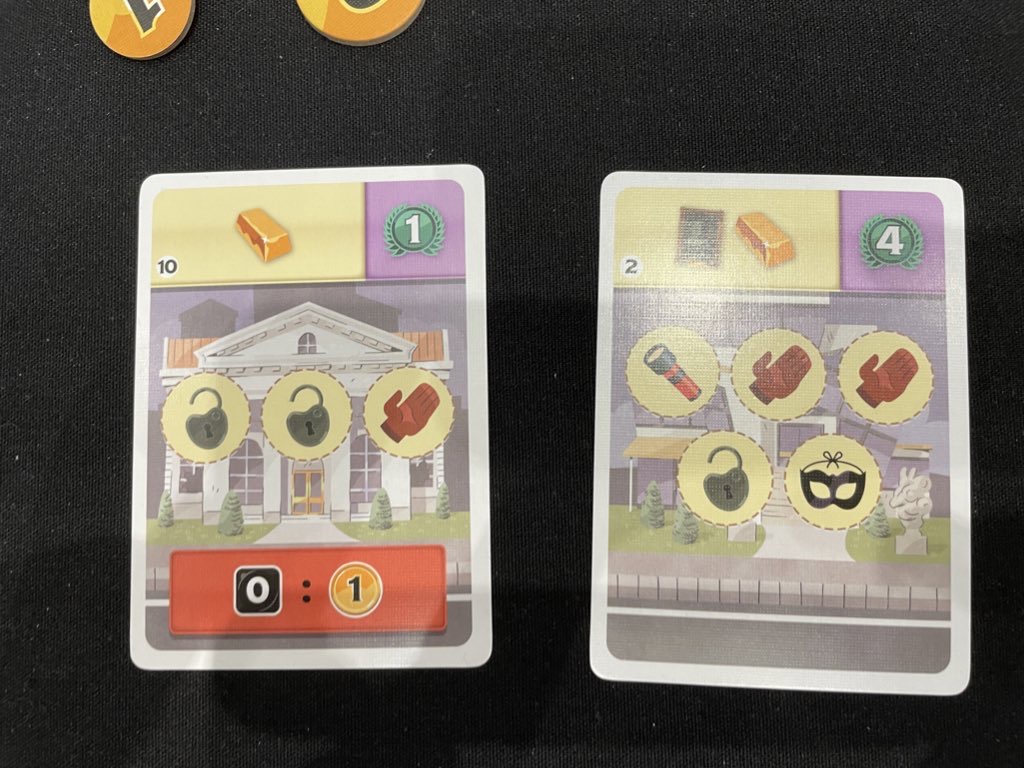
Most heists will be of a type that give you symbols like gold, artwork, or a couple of other things.
When you complete a heist, everybody checks to see how many of a certain type of symbol they have, and the person who completed the recent heist may gain a necklace (meaning they have the most heist symbols of that particular necklace).
This necklace will give you a point every time you activate the gang member on which you placed the necklace when you gained it.
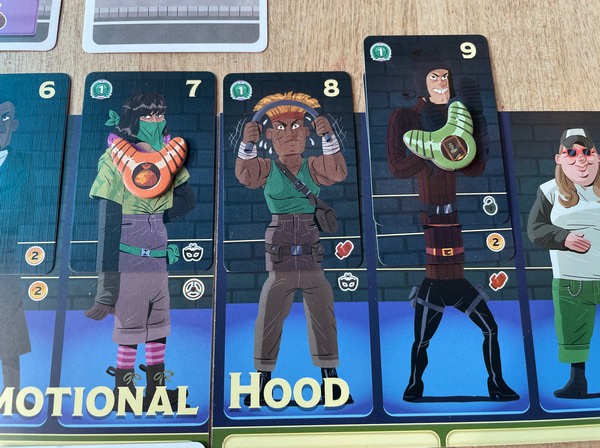
This method of activating dice is innovative and yet familiar as well. I like how the player who rolled the dice gets to choose what pairs they will use, but then each other player gets to use one of the pairs.
It gives you a bit of that Space Base feel without being a copycat version of it.
In addition, on everybody’s turn (not just your own, which is also a great innovation), you can upgrade one of your gang members if you have the money for it.
Upgrading basically does what’s shown above, where you draw 3 gang member cards, choosing one, and then place it on your board.
This has the unsettling effect of making some of your gang members have very lengthened torsos.
It’s kind of hilarious, and kind of creepy.
Upgrading them will mean, when you choose that number, they will give you multiple effects. Above, a 9 will give you a lock, a glove, and 2 money.
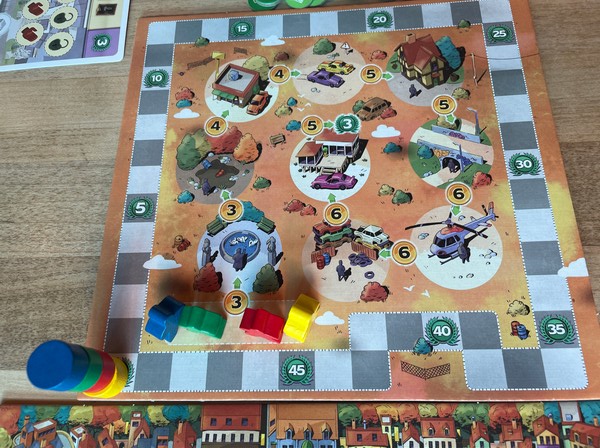
The other part of Bad Company, which sets it apart from all of the other games of the same ilk (I love that word) is the board where all of the cars (including the police car), are.
Not only are you trying to complete heists, but you are also trying to get away from the cops who are trailing you.

Everybody starts out with a certain lead on the cops, but one of the dice the active player rolls will be a police die.
That will move the police car either 0, 1, or 2 spaces on the board.
In order to move your car, you have to get steering wheel symbols on the dice you roll.
You might get lucky and the police car doesn’t move at all. But if you don’t start moving forward, the police car will catch you and it’s curtains!
Well, not really.
Something that makes no thematic sense but is nice in a gameplay sense is that if the cop car passes you, nothing happens!

It’s just that, if the cop car passes a bonus section of the road before you do, you don’t get that bonus.
Which can cause a frowny face.
In the above picture, everybody got the 2 money right in front of the starting line, but if the black cop car that’s trailing everybody gets ahead of a player, they may not get a loot card that they’re supposed to get.
The cops don’t catch you. They’re not interested in catching you.
They’re just interested in denying you points.
Because criminals don’t belong in jail. They just need to be pointless.
Driving on the board is pretty essential, though, because many of the bonuses are loot cards which can be quite lucrative, or useful if you get one with an ability on it.

The endgame condition is a bit hazy because there are two different ones.
One condition is that somebody has completed 6 heist cards.
The other is if any car (including the police car, if all players are incompetent) reaches the red zone on the board.

Once either one happens, the next turn is the last. A player rolls the dice and each player can make their own pairs and activate both of them.
You will lose points if you are behind the police car at that point.
For me, the cool thing about Bad Company is that all players will be activating something on their turn, meaning there is literally no down time (unless somebody is taking forever to make their decision, but that’s a problem in all games if you let it).
Even in Space Base (which for me, this doesn’t surpass though it’s close), you only get to activate deployed ships on your turn if you have deployed ships in the right number.
In Bad Company, you always have gang members for each number, so you will be doing something.
You may not be doing much!
But something.
The other great thing about the game is the other board where you are moving your token in order to upgrade your gang.
You have to have a certain amount of money, and the cost will increase with most steps, but if you can pay it, you will make some of your gang members a lot better.
If you push yourself up that track, which will require a lot of money (and if you’re getting that much money, are you doing anything else?), you will get 3 points each time you pay 5 coins and you will have upgraded 9 gang members.
Gang members by themselves don’t give you points, but if you upgrade them, they will give you a couple of points depending on which ones you did.
If you upgrade the harder-to-roll ones (3-5, 10-12), then you will get more points than if you upgrade the ones that are more likely to be rolled.

That’s as it should be. You shouldn’t get a bunch of points and great effects.
Upgrading your gang members is essential, though, as otherwise you’ll be getting one (or two if it’s your turn) effects a turn, and that won’t get you anywhere.
The randomness in Bad Company may be enough to turn off some players.
There are the dice rolls, of course, but there’s also the randomness of the card draws for both heists and gang member improvements.
If you draw three gang improvements that are all for the same number, I guess your choice is made!
It’s just a matter of which symbol you want to add to that number.
The police die and your inability to trigger steering wheel symbols is also part of the randomness issue.
You could find yourself completely immobilized because the dice don’t trigger any of your steering wheel symbols, yet the police car moves 2 each turn because somebody keeps rolling it badly.
That’s definitely something to be aware of, though it doesn’t bother me as much as it might bother some people.
If it does bother you, why are you playing a game with dice rolls each turn anyway?
I do also like how upgrading your gang members will give you greater benefits, and also a VP or too, but it’s not too overpowered in that respect.
Some of my fellow players were wondering if you got a VP per upgrade, but that that would be way overpowered.
Instead, you get a VP, and two VP if you upgrade a gang member that’s really not going to be rolled that often.
However, one of the neat things is if a 2 or 12 is rolled.
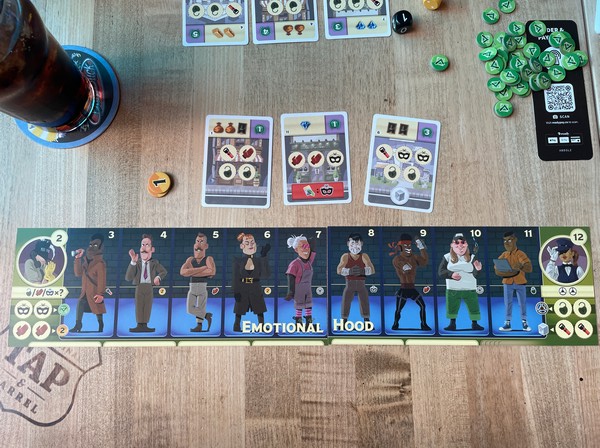
You get a marker of your choice for a 2 and you get two steering wheels for a 12, which can really help you get ahead of the cops.
Also, if you find yourself gaining symbols you don’t need, you can place them on the symbols below the 2 and 12 and possibly get some other cool benefit.
Two flashlights gets you a Loot card, and two locks get you a steering wheel!
The game basically makes it so you’re only worried about recruiting gang members for 3-11. There are no gang members for 2 and 12.
Which makes things a lot easier.
I know Bad Company is in some Top 100 games of all time list, and I can understand it!
For me, I do really enjoy the variety that the heist and loot cards give you, and I will definitely play it if it’s on offer (the usual caveat, if there’s another game I’ve been dying to play on offer, or whatever).
It’s not in my Top 50 but it’s a game that I definitely recommend trying out. It has some Space Base elements that I really enjoy.
When I did my rankings last January, it was number 72, so it’s in my Top 100!
If I had a Top 100.
Anyway, I highly recommend trying Bad Company, especially if you like games such as Space Base and Machi Koro (not to mention Valeria: Card Kingdoms).
It has a cool dice roll mechanic, but changes things up just enough that it’s not a complete copy of those games.
I like it!
(This review was written after 3 plays)
 Dude! Take Your Turn!