Dude! Take Your Turn!
A Gaming Life
Two-Steppin’ in the Woods – Forest Shuffle Review
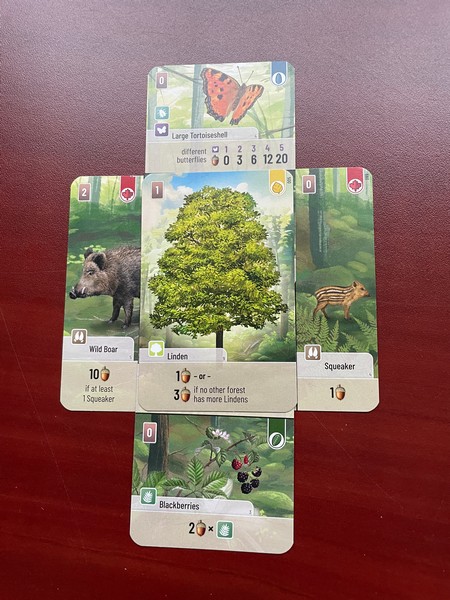
Tableau-building card games are becoming all the rage.
Or maybe they’ve been the rage and I just never noticed?
(Editor: “Doesn’t say much for your observational skills, does it?”)
One thing I haven’t seen much of, however, are tableau-building games where you are combining cards in certain ways.
Yes, set collection is a thing, but not in the way Forest Shuffle does it.
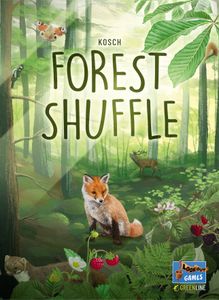
Designed by Kosch with artwork by Toni Llobet, Judit Piella, this game was published by Lookout Games in 2023.
In the game, you’re building (or growing, I guess) your own forest and hoping to attract various fauna and flora into it in order to score a lot of points.
The mechanism for doing this is drawing and playing cards to your forest, both trees that provide the basis for everything else and then the animals and plants that will gather around them.
The combination of all this makes a rather interesting-looking tableau!
Each forest starts with trees. It’s kind of hard to have a forest without them.
I’m sure people have tried!

Forest Shuffle is another card game where playing cards has a cost (most of the time) that you pay by discarding other cards (ala Race for the Galaxy or any other game of its ilk).
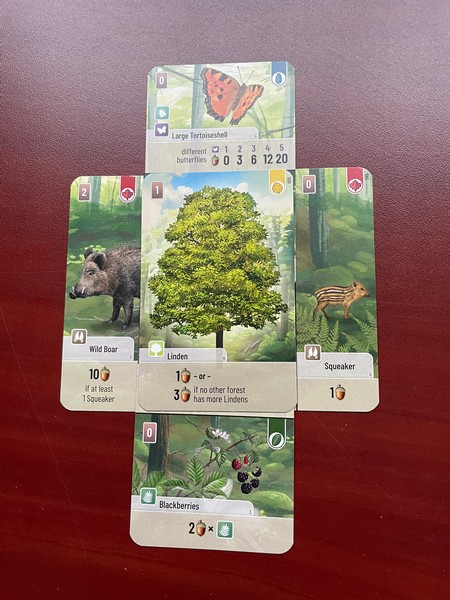
The Linden tree above costs one card to play, so you just discard another card from your hand onto the discard board.
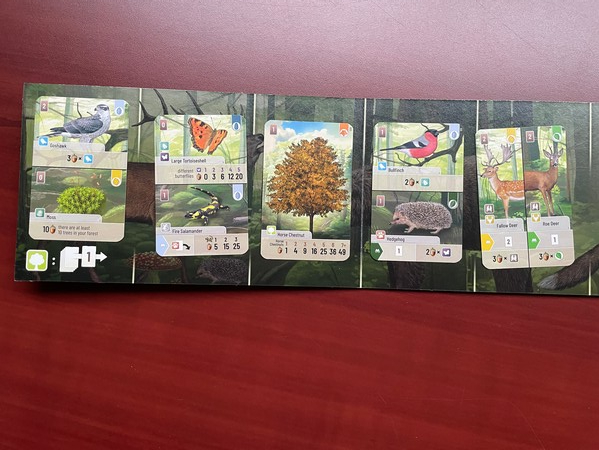
When you plant trees, you also have to put the top card of the deck into the discard tray, as helpfully noted on this end of the board.
See how some of the cards are divided, either vertically or horizontally?
That’s where the cool stuff happens in the game.
Once you have trees, you can play animals or plants to them, but you get to choose which side!

You could have this, for example.
Most cards you play will have an effect, like the Beech letting you draw a card when you play it or the Raccoon letting you put cards in your Cave (which are worth 1 point at the end of the game, but we barely use the Cave as you can’t do it without a card effect like the Raccoons).
Some cards are a bit harder to trigger, though.
The Fire Salamander requires you to pay for its play by discarding a card with the yellow symbol in the top right.
If you do, you get to play another pawed animal for free (like the Raccoon), though you don’t get its effect.
You can discard any other card to play the Fire Salamander, but you don’t get that bonus if you do.
The divided cards mean that the card you discard only has to have that symbol on one of the two sides. It doesn’t have to be both.
Of course, the reason you’re doing all of this is points. Why build a forest if you don’t benefit from it?
(Don’t ask)
This is where Forest Shuffle is a bit samey but also gives you a bit of a “What the hell am I doing?” feel to it.
Almost all cards will score at least some points, and you are chaining things to maximize your point total.
You have to concentrate on a couple of different things, because if you spread out too much, you won’t get many points at all.
Playing one Fire Salamander really doesn’t do you anything.
Five points?
Eh.
You have to try to get three in order to get 25 points. Even two won’t really get you too much.
Other cards chain together as well, and if you can manage to get them all played down, you will score a lot of points.

Horse Chestnuts, if you collect a lot of them, will get you a ton of points.
Though anybody paying attention won’t let you just pick them up off of the discard board.
If you do a good job, though, your display may look like this.
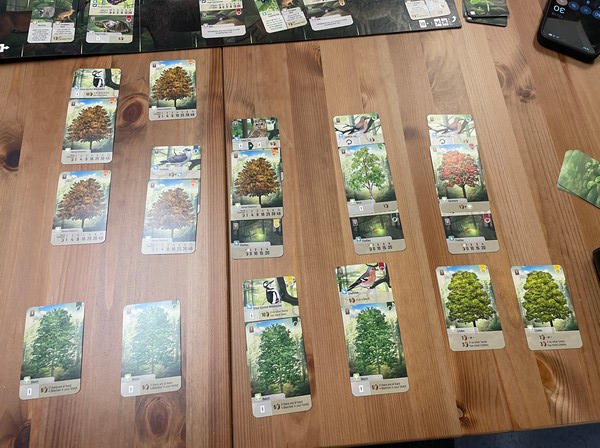
That was with another player also fighting for Horse Chestnuts.
Some other species give you points for each of a certain type.
There is one really effective combination (some people claim it’s broken, in fact) with getting deer out and the predators who hunts them.
I haven’t played this enough to have an opinion on that broken opinion, but I also know that my scores are under 200 points and other players have scored 300+.
In other words, yes, this game will get you a lot of points.
The other possible action on your turn, if you don’t want to (or can’t) play a card from your hand, is to draw two cards.
This can be off of the top of the deck or off of the discard board.
So don’t discard a Horse Chestnut to pay for a play if your opponent is collecting them!
This is the way you get more cards, though there is a danger.
When setting up the game, the deck is split in half.
Two Winter cards are shuffled into that bottom half.

One Winter card is then placed on top of the bottom half.
If the third Winter card is drawn in any way, the game ends immediately.
I once saw an opponent trying to set up a play for his next turn (or maybe 2 turns) and knew we were close to the third one. So I drew cards instead of playing something that would only get me a point, maybe two.
And drew the third Winter card!
Thus ending his hopes.
Though he still killed me in points anyway, it was still gratifying.
Anyway, that’s another attraction to this game for me, though I know some don’t like it.
The game can end on a dime.
You have to be ready for it and not make any long-term plans at that point.
When the second Winter card comes out, just try to play your cards as best you can.
The scoring can be a little complicated if you’re doing it by hand, but if you have a score tracker or something then it becomes a lot easier.
The artwork on the cards is very good, almost as good as Beth Sobel. It really brings out the nature aspect.
I also like the chain effects that scoring can have, though it can burn the brain a little bit trying to keep track of things.
You really can’t spread yourself too thin or you’re only going to be getting a few points per card. You have to do those combos.
There is a lot of randomness in the game, though for me it’s not too bad. It’s a card game, for heaven’s sake.
But it is very possible to just draw the card you need right off the top of the deck.
If that kind of thing bothers you, I’m not sure why you’re reading a card game review. This isn’t for you.
Are some of the scoring combos overpowered?
Perhaps. There are definitely some that are better than others, but they can be expensive to get played and other players need to be watchful of that.
Don’t discard a deer that’s going to give your opponent another 10-20 points.

Maybe go for butterflies instead?
Sure, you have to get all 5 of them down for just 20 points, but they’re all free to play.
Why not?
People have been raving about this game so I just had to see what the fuss was about.
It’s definitely a lot of fun, but I wouldn’t put it up there in my Top 50 games.
At least not yet.
As the game goes on, you can definitely tell who’s on pace to win the whole thing, and as they keep building their tableau, that will only steamroll.
There’s really nothing you can do about it, which is too bad.
But it does make a fun diversion at lunch at the office, which brings it up a tier in my books. It’s relatively short and plays quickly. Turns go very fast, especially if somebody’s just drawing.
That’s an attractive aspect of the game.
If you get the chance to try Forest Shuffle, I do recommend it.
It’s a lot easier than planting actual trees (though probably not as good for the environment).
(This review was written after 3 plays)
 Dude! Take Your Turn!
Thanks for this. I had seen the game before and am constantly on the lookout for Wingspan-adjacent nature themed games, so I’ve been very curious about this one. I had read something somewhere else about it, and your highlighting the gameplay elements really filled out the picture of gameplay.
I’m still very much on the fence. While I like the theme and the vision behind the game, something is whispering to me that perhaps the gameplay could have used another turn of the crank.
LikeLiked by 1 person
I can certainly see that from your perspective. I can’t honestly say whether I think you would like it or not. Wingspan is a bit meatier (but just as random!) so maybe that’s where the reluctance comes from?
LikeLike