Dude! Take Your Turn!
A Gaming Life
Friday Night Shots – What Does “Solving” a Game Mean?
Hey there! Welcome back to the bar.
It’s been a long month and a half, hasn’t it?
It’s been under renovations, but we’re back!
Until everything breaks down again.
I’m going to try and do these posts much more regularly than they have been coming out.
The first of the year being in February is not good.
But hey, at least the jukebox isn’t playing Bieber anymore!
What? It’s playing bad disco instead?

Renovations never end, do they?
(I’m not sure how typing will fix the jukebox problem, but whatever. He’s the expert)
Sit right down, grab a drink, and let’s talk about boardgames!
Namely, in tonight’s case, what does “solving” a boardgame really mean?
And what should it mean?
Typically, when a gamer says that a game is “solved,” they mean that they’ve discovered the right way to play that will guarantee a win all the time.
If you do this, this, and this, you can’t lose.
So why play the game?
(This kind of goes along with the “X is overpowered. If you do X, you can’t lose” arguments)
While I can see that, and if it’s actually true, then that’s bad game design, but I don’t like using that definition.
Allow me to make up my own definition that only I will use.
Though you’re welcome to if you wish.
For me, “solving” a game doesn’t mean that it’s not worth playing anymore.
It means that I’ve finally figured out how to play it well, even if somebody else who is better at the game (or just better than me at strategy or tactics in general) will still beat me most of the time.
It’s when I’ve figured out the various paths to winning, and there should be multiple paths.
If there’s only one path, that’s not good!
Let’s take Civolution as an example, because it’s fresh in my mind.
It’s a Feld game, tons of ways to get points.
If you just do a scattershot approach to things, getting a few points here, a few points there, you’re never going to come close to winning.
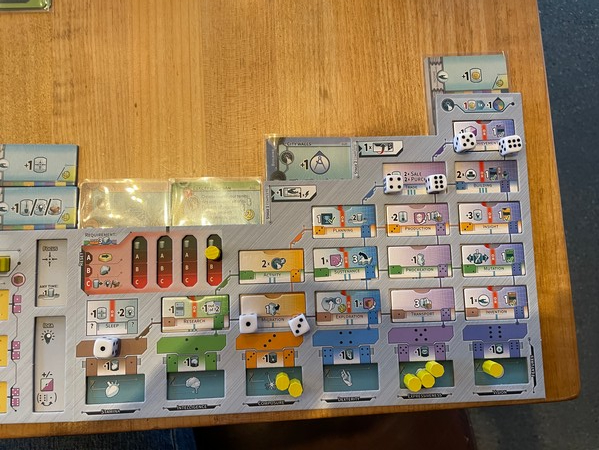
But if you focus on chaining a few different things, progressively getting more points for doing those one or two things, then you’re probably going to be able to increase your scores to where many who post on BGG are talking about (250-300 points).
Maybe cards and your console?
Maybe the research tracks?
Maybe even getting a bunch of points with migrating your tribes around the board (with some support from other cards)?
If you’re doing the scattershot thing, then you haven’t solved the game.
But when you learn to identify these focal points and exploit them, working with the cards you’re given or maybe (if your cards suck), concentrating on a couple of other aspects, then in my opinion you’ve solved the puzzle!
Not “solved” as in you never need to play it again.
“Solved” as in “you’ve solved why this game is just breaking your brain with no good outcome.”
In my opinion, if you haven’t solved a game using my definition, then you probably won’t play it more than once or twice, because who wants to keep beating their head against a wall where they have no hope for success?
Ok, let’s get the drinking out of the way.

Yes, I’m going to talk about Scholars of the South Tigris.
As with most Garphill Games, there are multiple paths that you can take to score points.
But if you translate a scroll or two, move up the research tracks a little bit but not much, and get a little bit of influence in the guilds, you’re not going to succeed.

You have to focus on one or two things and get most of your points that way.
When you don’t really know the game that well, it can sometimes be hard to decide what you want to do, and you find yourself just scattering activities hither and yon, not really accomplishing much.
Some people pick this kind of thing up immediately.
My friend who has played this game with me a few times typically just concentrates on the research tracks, barely even translating scrolls (other than the scroll that’s required to get his starting bonus).
And he’s successful!
He picked that up in his first game.
To me, he’s “solved” the game, because he knows what he wants to do and can execute it.
He doesn’t always win, but he never does badly.
A perfect example for myself is Lorenzo il Magnifico, a game that I really enjoy (it’s in my Top 50!)

The first couple of times I played it, I just couldn’t figure out how to effectively chain actions together. My play was stagnant, I usually either got punished by the Church or had to work so hard not to be punished that I didn’t accomplish anything else.
Then one play, it just all clicked together and I realized what I was doing wrong.
I am now in a regular game of it with two friends on Yucata, and I’ve actually won a couple!
And I’m always in the running even if I do lose.
Sure, I have no surefire strategy, and sometimes I don’t successfully do what I should be doing, but I can now recognize when I’m failing at that.
I’ve “solved” the game for myself.
One more perfect example of this that I’ve come to enjoy recently is The White Castle.

That game is all about chaining actions. If you’re not chaining actions, you’re failing badly.
You literally have 9 turns in the game.
However, if you choose your dice wisely, you can do multiple actions on your turn.
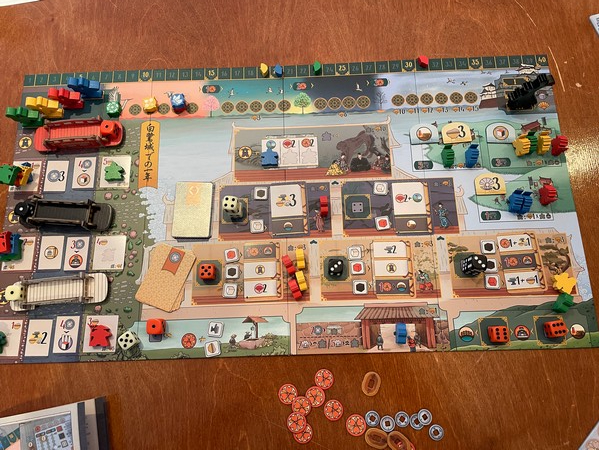
Placing a black die in the bottom right-most castle space (in the picture above) will let you do two things, both getting resources and doing an action. That action may then get you additional actions.
Moving a courtier up in the castle will get you that action card, and hey, you get to do one of the white actions on that card when you put it on your home board!
Sometimes you can end up doing three actions in a turn because of how you’re placing the dice.
If you haven’t solved the game, you can place a die, get resources, next player’s turn. Or place a die, take an action that accomplishes a little something, and then next player’s turn.
You won’t do much, though.
Once you figure out the chaining, you’ve solved it!
You may not win, especially if you don’t chain as effectively as your opponents, but you can do well.
For me, that’s what playing games is all about.
I like to win. I want to win.
But more than that, I just want to feel like I played well.
I want to be satisfied with my play, win or lose.
That’s why, to me, “solved” means that I have figured out how to do that.
It doesn’t mean “I have discovered the strategy that is a sure-fire win.”

Yes, yes it is.
Do you like my new definition of “solved?”
Do you prefer the other one that everybody else uses?
Or do you have your own?
Let me know in the comments.
 Dude! Take Your Turn!
Interesting approach! I think your definition is concerned with finding a (possible) solution, the common definition with finding the (definitive) solution (for all that’s worth – even if a dominant strategy exists in a game, it is usually non-trivial and requires substantial skill to pull off).
Personally, the moment when I solved a game according to your definition, when think now I know what I’m doing in a game is one of my favorite experiences. It is the climax of the transition from exploratory play in the beginning to competent play later on, when you have shed the frustrations of things being opaque and unpredictable, but retain the excitement of the game’s presentation before you develop tunnel vision for the best moves. I love it!
LikeLike
You got it! That’s exactly what I mean.
Sometimes when I’m trying to learn one of the more complicated games on BGA or on Vassal (Bayonets & Tomahawks, for example), I’m not sure I have a coherent strategy. I know “the rules”, but I don’t understand how they go together!
I’m glad you like it. 🙂
LikeLike
Sadly, I never “solved” how to play the 1984 version of Axis & Allies.
I rarely played it because it needs at least two players, and it’s said that having five players at the table is best (there are, after all, five belligerents represented on the board). I didn’t know too many gaming friends willing to play A&A. The most I’ve played the game since I bought it in 1985 or ’86 is…five or six times.
Part of the problem I had with solving the classic WWII game was that no one I played with could agree about amphibious landings from the United Kingdom to Northern France. Could you load your transports and unload them in the same turn or not? Was loading the transports considered a land-to-sea move? I’m sure the manual explained that situation, but the folks I played with could never consistently agree on the mechanics of D-Day-like situations in that particular part of the map.
I think this is one reason why I prefer computer games!
LikeLiked by 1 person
I get that! I’ve never played A&A (or at least not anytime in recent memory), but confusing rules are the worst. Too bad there wasn’t something like BGG back then!
LikeLiked by 1 person
The last time I played the original Milton Bradley edition from 1984 was in the late 1990s with two other players (the most players in my playing time). It was fun, but that vague bit about an amphibious landing in a narrow Sea Zone was vexing, to say the least.
LikeLiked by 1 person