Dude! Take Your Turn!
A Gaming Life
New to Me – March 2025 – Part 1
As I mentioned in my March Games played post, I played a lot of games last month.
Not only that, but a whole 14 of them were new to me!
That means this post would be monstrously long if I tried to pack it all into one.
Or I would not really say much about either one.
Thus, it’s been split into two parts, with the first seven games below.
The Cult of the New to Me gave me a little bit of a side-eye, given that so many of the games were pretty new (some even 2025!)
One’s not even out yet!
However, one was from 2017 and it was a convention where I played most of the new stuff, so I did a little begging.

Ok, a lot of demanding, actually.
They were mollified…for now.
Personally, I still think they’re plotting against me.
The life of a cult leader is never restful.
Anyway, without further ado (all of my ado was eaten by some carnivorous fish anyway), let’s begin!
Finspan (2025 – Stonemaier Games) – 2 plays

Designers: David Gordon, Michael O’Connell
Artists: Ana Maria Martinez Jaramillo, Mesa Schumacher
Players: 1-5
A 5-player game! Unless you’re Cal, in which case it’s a 4-player game because he won’t play it.
Finspan is another game in the Wingspan universe (or, as Stonemaier calls it, “a Wingspan game”).
This time with fish!
Maybe that’s better than dragons?
I don’t know. I haven’t played Wyrmspan.
Finspan is kind of a simplified version of Wingspan, though with different mechanics so it’s not like they’re related too much.
It removes all of the food, instead making you discard cards in order to place new fish (or possibly eggs or young).
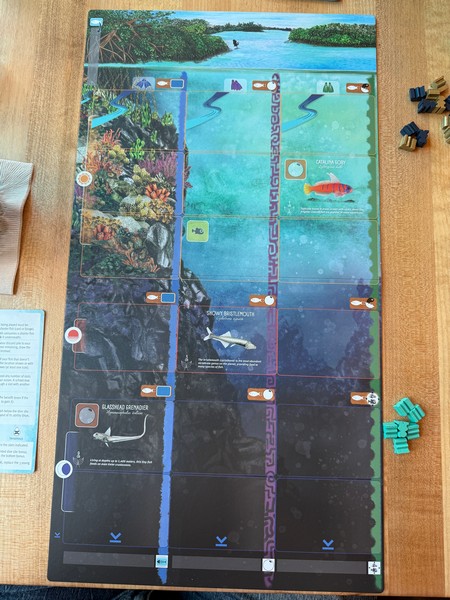
Each player has their own player board. In fact, there’s no main board, which is a good thing because the player boards are HUGE!
This game can be a table-hog because of that. You can’t have two players sitting across from each other, each with their player board. They have to be off-set.
Anyway, players can pay to place fish on spaces on their player board. Some fish require a certain depth and some require to be in one specific column, but otherwise you can put them anywhere.

Even over another fish (of which three really really small ones are pre-printed on your board).
Of course, doing that requires the fish you place to be bigger than the one already there.
The covered fish will be worth 1 point each, and some fish will get points based on how many fish are below them.
It’s a merciless world down under the sea.
The other big change from the original game is that there are not only eggs under the sea, but young fish, and then schools of adult fish!

Eggs can hatch into young, or you can use them to pay for a fish that requires an egg.
Young may also be a cost for playing a fish, but one of your actions on your turn can be to move young and schools around your board.
If three young get into the same space, they form a school, which will be huge points!

In addition to playing fish, you can do one of the column actions, which will either get you cards, get you eggs, or allow you to move young/schools around.
In addition, you will activate any fish in that column that has a “when activated” icon. Like the Rockmover Wrasse above, it lets you place a fish from your hand smaller than 30 cm underneath it when it’s activated.
There are end-of-round goals, just like Wingspan (either random or, if you play the beginner version, it’s always the same), and you’re trying to meet those as well.

After four rounds, you total up the points on your fish and through other means (schools get you 6 points, so it’s good to get schools!) and whoever has the most points is the winner!
I really enjoyed this one, almost better than Wingspan (though that may change each time you ask me). It actually would fit into a lunchtime game session, though one of those sessions would have to be the teach as the game itself takes about 60 minutes.
That, and it is incredibly easy to teach.
After playing it once, I was able to teach it with minimal consultations in the rulebook.
I really enjoyed this game and would definitely play it again.
Secrets (2017 – Repos Production) – 1 play

Designers: Bruno Faidutti, Eric M. Lang
Artist: Cari
Players: 4-8
Secrets is a game that I had only heard of in passing, but I didn’t know what it was.
However, we needed a quick and high-player count game to end the night at TCTC and my friend brought this one out.
And it is hilarious.
Social deduction (kind of) with a twist.
This is a war between the KGB and the CIA, with one (or maybe two, with enough players) hippies in the mix as well.
Each player is dealt a disc with one of those three roles on it.

Unfortunately, you can only look at it when you are dealt it, as it could change and you might not know who you are with later in the game.
Each turn, the active player turns over two cards, then secretly decides which one to offer to another player.
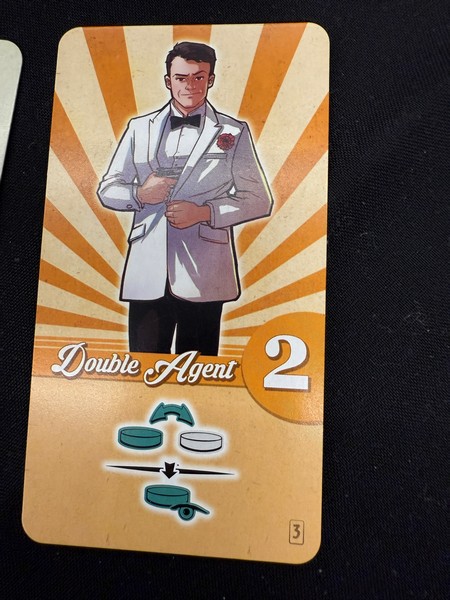
The other player either accepts it or declines it, without seeing what it is. They just know it’s one of the two that was revealed earlier.
If they accept it, it goes in front of them and they do the action of the card. If declined, the offering player gets it.
If it’s the Secret Agent, they switch their token with the one in the middle of the table, and then look at it. So not only do they know their role, but they know the neutral one too, in case somebody else takes it.
Assuming that the middle one hasn’t already been switched by somebody.
It’s also worth 2 points.
This goes on, with roles switching willy-nilly depending on the cards played, until somebody has five cards in front of them.

Then everybody reveals who they are (which may be a surprise to you, since some cards let other players switch your roles around) and the points are totalled.
Some cards will let a player give you a bullet, which can be negative points (though not always).
If the Hippie has the lowest score, they win! If there are two Hippies (possible with higher player counts), then the lowest score wins.
Otherwise, players add their totals with players from the same side, and the side with the highest total wins the game!
This is social deduction that I can get behind, because it’s chaotic!
Sure, you know how you start, but maybe not what you are at the end?
The choice of cards to offer other players is very cool too. You know what role you are offering the, so you know what you want them to have to do, so choose who you offer it to wisely.
I can’t really say that this is my favourite social deduction game right now, but considering I’m not a fan of the genre, I’d have to say it’s right up there.
Toy Battle (2025 – Repos Production) – 1 play (kind of)
Designers: Paolo Mori, Alessandro Zucchini
Artist: Paul Mafayon
Players: 2
Toy Battle is a new 2-player battling game that takes about 10 minutes to play.
A friend of mine set up a tournament for the print and play version of it at TCTC and I jumped at the chance to play with these guys.
Keep in mind that the pictures are from the print and play, so do not reflect the final product.
The tournament consisted of three quick plays against different opponents. Since they were so quick, I only really recorded it as one play.
I managed to go 2-1, so that’s not bad!
There are multiple different map types and players are vying for control of certain areas for points.
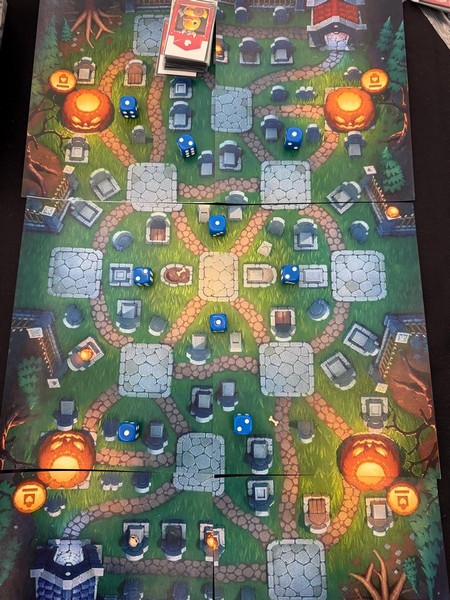
Or they can take control of the opponent’s base for an insta-win.
You’ll have a hand of cards where you can play one of them on your turn, or you can take a turn to draw a couple of cards.

These cards will put units out on the map (in the actual edition, you will discard the cards and put tokens or figures out, but the print and play we just put the cards on the map).
We used dice as the 1 or 2-VP tokens. When you have a unit on all points surrounding a VP marker, you take that marker.
Each map has a certain VP level to win.
You have to play a unit connected to your base in a connected line of units (except one unit can parachute in anywhere on the board).
You can also “defeat” an enemy unit by playing a higher-value unit onto it.
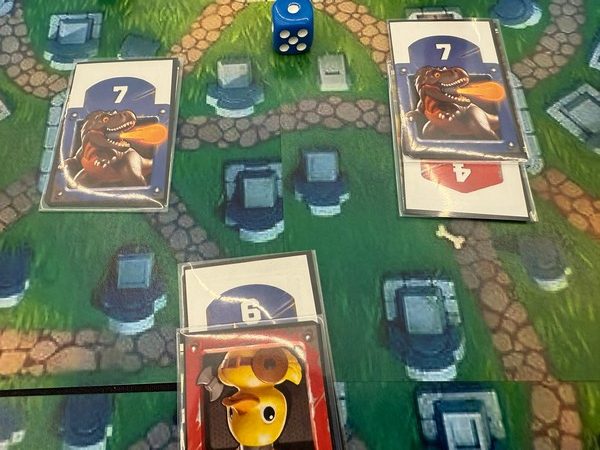
Most units have abilities, like “play another unit” or “draw a card” or whatever. The massive 7 guy doesn’t, but he’s massive.
He doesn’t need an ability.
The Rubber Ducky can be placed on top of any card, but any card can then be placed on top of it.
First player to 7 points, or if they capture their opponent’s base, wins!
It’s a fun little game. Nothing I really want to buy, but I’m glad it exists and it would definitely classify as a lunch-time game!
SETI: Search for Extraterrestrial Intelligence (2024 – Czech Games Edition) – 1 play

Designer: Tomáš Holek
Artists: A lot! (12 of them credited on BGG)
Players: 1-4
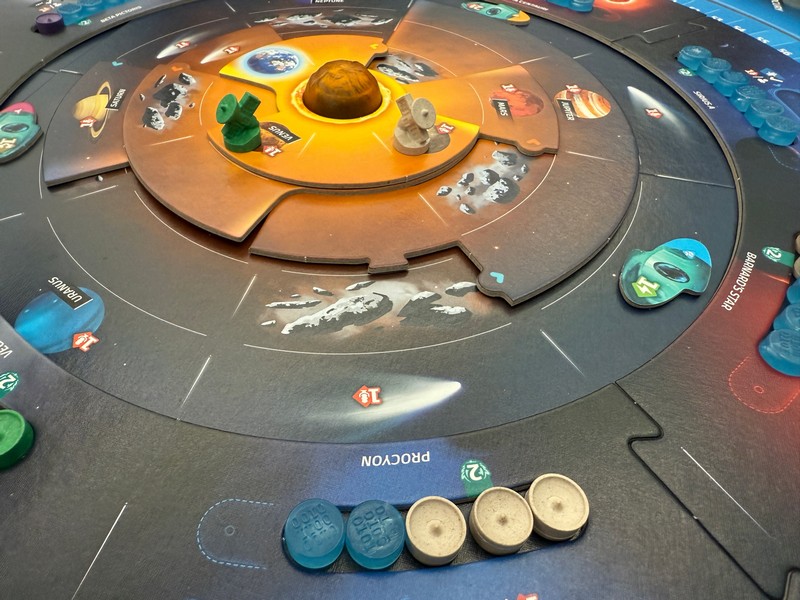
SETI is a game about exploring the solar system and discovering that alien life has been visiting us for a long time now.
Yes, you are guaranteed to discover two alien species!
In other ways, it is a typical CGE euro with action selection, multi-use cards, and a lot of ways that you can gain points for victory.
You are going to be exploring nearby planets and their moons, sending up probes to look for signal intelligence as well as possible signs of visitation on the planets themselves.

The board is a really neat concoction of pieces that form together so that you can twist certain aspects of the solar system.
This is done via actions that are on your player board as well as cards that are in your hand.
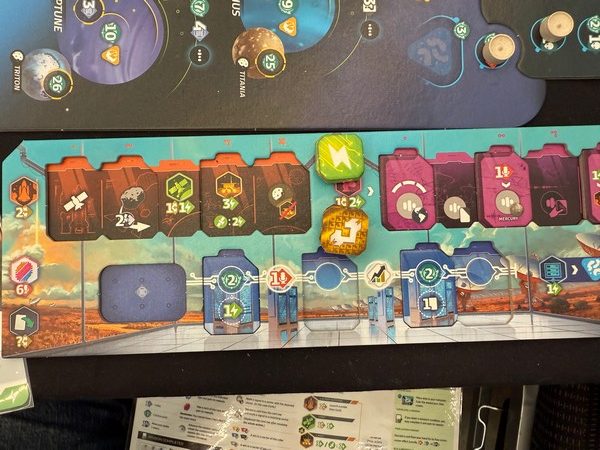
Each round (there are 5) goes until each player has passed (essentially run out of actions, though you could pass before that if it would be more advantageous to you).
You can find traces of the alien life in the data that you’ve collected, exploring planets, and using your telescopes to scour the stars around you.
And when enough information has been gathered, you find them!
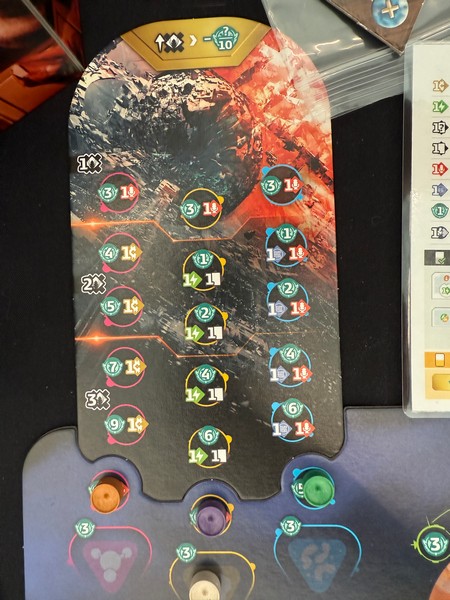
The cool thing is that there are 5 aliens to randomly choose and you only discover two of them, which really adds to the playability.
The downside is that each alien is different, which means once you discover them, everybody has some brand new rules to internalize!

The cards are really cool, though. You can discard them for their symbol/effect, you can actually pay to play them, or they could be something you tuck to get income at the end of the round.
Playing them can have some really cool effects, either one-time effects or maybe a mission that will give you cool stuff when you complete it.
Or you may just need to discard it because you need that one symbol.
The game is very intricate, so there’s no way I’m going to try and explain it all here.
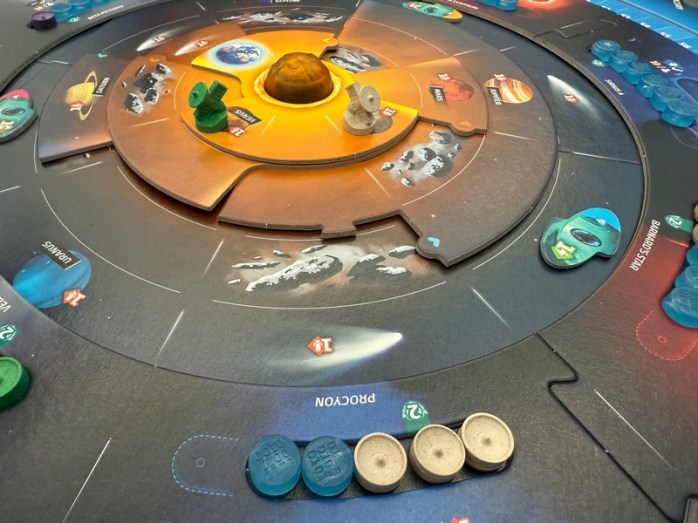
However, it looks really cool on the table, has multi-use cards that are my jam, and it’s just a fun puzzle to work out how to play well with.
Almost like Civolution in some ways, though this one doesn’t give you quite as many points for stating your name.
Not only do I want to play this one again, but I need to play this one again.
Orapa Mine (2024 – Playte) – 2 plays

Designers: Junghee Choi, Wanjin Gill
Artist: Wanjin Gill
Players: 2
This game just burned my brain.
It’s kind of deduction, because you are using the answers to questions you ask your opponent to determine where they have all of their figures.
It’s kind of like Battleship except you’re not calling out a random square.

Instead, each player has these different-coloured objects that they place on their grid. They cannot be touching.
Each player chooses an entry point for a laser (say 17? Or F?) and the other player will then mentally bounce that laser off of any objects that are there, giving the questioner the exit point of the laser and what colour it is.
What colour?
Yep, depending on what objects are hit, the laser will change colour.

For example, in the picture above, if I asked about 17, it would bounce off the red at an angle, then go up to the white object but bounce directly back. Thus it would hit red again and go back out the 17 exit.
And it would be Pink (red and white)
You can track this on your sheets (which my friend laminated and also cut out some laminated paper shapes so you can try to visualize things).

Once you think you know the layout of your opponent’s grid, you can guess.
If you’re right, you win!
If you’re wrong, you lose!
It’s guesser take all in this game.
My head hurt a bit after playing this, trying to figure out the spread of the objects.
And you have to know your physics a little bit to do the angles!
However, while the beginning of both games was kind of painful, suddenly they both just clicked in my head and I knew exactly where everything was.
It’s a really fast 2-player game that taxes your brain, but ultimately it’s a lot of fun.
Fives (2022 – CMYK) – 1 play (kind of)
Designer: 新澤 大樹 (Taiki Shinzawa)
Artist: SMLXL, 桑江 美沙穂 (Misaho Kuwae)
Players: 3-4
Fives is another trick-taking game that I hope to get a chance to really play again, as we had to cut it short (which is why it’s a “kind of” play).
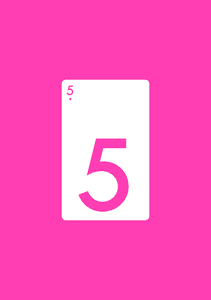
It follows normal trick-taking rules, but when you take a trick, you put the card you won with on top of the trick stack. That counts as points.

If, at the end of the round, you go over 25 points, though, you bust and get nothing.
On the back of each card is a magenta 5, which can come in handy.
It’s a must-follow suit game with four colours of cards.
I believe grey is the trump suit that will always win a trick (the only rules I can find are for a foreign version where the back of the cards are green so you can play a green 5, not a magenta 5, and there is no purple in this version while purple is trump in that one).
During a trick, one player who qualifies to can play a card face-down as a magenta five. You can do that if the led suit was magenta, if you are the lead player, if you don’t have any of the led colour, or if you only have one of the led colour (and you play that card face-down as a magenta 5).
The thing about Fives is that you have to play strategically a bit when trying to win tricks.
You want to win tricks, but not too many tricks, or at least not unless you do so with low cards.
As you find yourself approaching 25 points, you may also find yourself (like I did) guaranteed to win a trick or two with higher cards, putting you over the top.
Scoring is based on who got closest to 25 without going over. You don’t get the points actually in front of you.
We only had time for one hand before it became time to move on to the next game (mentioned below!) but I’d really love to try this one again.
Rebirth (2024 – Mighty Boards) – 1 play
Designer: Reiner Knizia
Artists: Anna “Mikado” Przybylska, Kate “vesner” Redesiuk
Players: 2-4
Let’s end this post with one of the latest Knizia games (there are so many that come out, I’m not sure if it’s the latest, but it’s definitely close!)
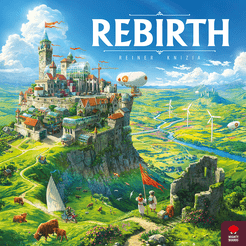
Rebirth is another one of his “lay a tile on the board, get points based on what it’s next to and maybe something else” games.
In this case, you are repopulating Scotland or Ireland after some kind of apocalyptic event.
But yeah, it’s a tile-layer.

On your turn, you pick a random tile from your supply, one of a few different types.
You will then place it somewhere on the board. Doesn’t matter where as long as it’s an open space!
Depending on the type of tile, it can only go into certain spaces (the symbols must match), so I guess it does kind of matter.
You will also get one point per connected tile of the same type that you have, so it pays to concentrate a bit.
Except you also want to play next to cathedrals to get bonus scoring cards called “missions.”

And you want to have the majority of spaces next to a castle to have one of your castles out.

Settling in cities doesn’t get you immediate points, but as soon as a city is filled (it can be one, two or three hexes large), you total up whoever has the most building symbols inside the city and score points based on a criteria at the top of the board.
As soon as everybody has placed their final tile, the game ends.
Incomplete settlements score, castles, and your mission cards, and whoever has the most points is the winner!
This is much better than the last Knizia tile-laying game I played, Havalandi.
It still has some of the same mechanics, but it just seems like there’s more to do and what you have to do is more interesting.
Knizia is a master at this type of game and it definitely shows here.
I’d definitely love to play it again.
That’s it for Part 1!
Look for Part 2 coming…soonish.
Have you played any of these?
What new to you games did you play in March?
Let me know in the comments.
 Dude! Take Your Turn!