Dude! Take Your Turn!
A Gaming Life
I Predict That I Will Not Win This Game – Seven Prophecies Review
Another day, another trick-taking card game.
What are the odds?
These days, trick-taking games need some kind of hook to avoid being boring trash.

Yeah, I know I’m repeating myself.
But it must be emphasized!
We’re in the middle of a trick-taking renaissance (thanks, Mike Delisio!) and small publishers are doing a great job of keeping that alive.
New Mill Industries has been doing their part in getting trick-taking games, as well as other types of small card games, out onto the market.
My first purchase from Daniel, after the obligatory “It’s Edward’s fault” from watching it played on Heavy Cardboard, was Seven Prophecies.

This is a brilliant trick-taking game designed by 折口 日向 (Hinata Origuchi) with artwork from Newman, Imogen Oh, Tomohiro Tsugawa and Osamu Inoue (井上磨).
It’s a 3-4 player game.
It was first published in 2017, though I don’t know when New Mill brought it over to North America.
(if you don’t know trick-taking games, how about a handy primer?)
Bidding is actually fairly common in trick-taking games (he says, hoping that he’s actually right about that “fact”).
It’s almost always “how many tricks can I take?” and if you don’t make it, then something bad happens.
Or, if you’re in the quantum realm, you just don’t get bonus points.
Seven Prophecies takes this just a couple of steps further, upping the complexity of the decision-making without really upping the complexity of the game itself.
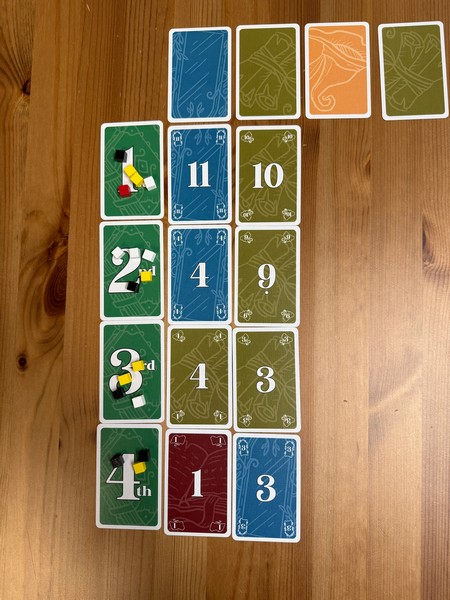
Not only are you predicting how many tricks you will win, you are also predicting how many tricks you will come in 2nd, 3rd and 4th respectively (without the 4th if you’re playing 3-player).

This can be nerve-wracking because there are 10 tricks in each round and you have to gauge just how good your hand is in all aspects.
How many times will I come in 3rd?

That’s the feeling I get all the time playing this game.
What makes it even worse?
Or I guess, better, because this is brilliant?
You don’t get to decide what to lead each trick.
That’s right, there are four coloured “suits” in the game, with cards from 1-11 (the 11s are removed in a 3-player game).
Each round, 10 of the 12 colour cards are dealt out in a row, and each trick must follow that trick’s mandated colour.
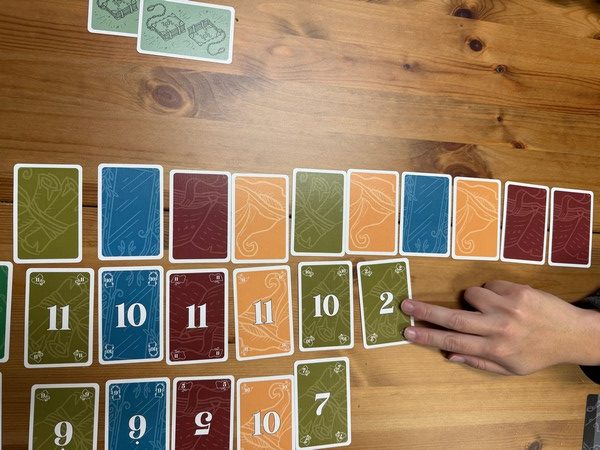
While you must play that colour if you have it, nobody is following your “lead.”
They’re following the game.
Who wins a trick is simple, but also adds some strategy to this whole outrageous bidding process.

Obviously the highest card played in the “lead” colour wins the trick, and so on for that colour.
However, as with most trick-taking games, if you are out of a colour, you can slough off any card that you want.
But now, you have to think about that.
Am I wanting to come in 3rd or 4th?
Because the number you play matters, even if the colour doesn’t.
Off-suit cards are ranked only by their number. So a six will beat a five.
If both players play a five, then the last person to play their card is actually higher-ranked.
That’s important when you are trying to come in last!
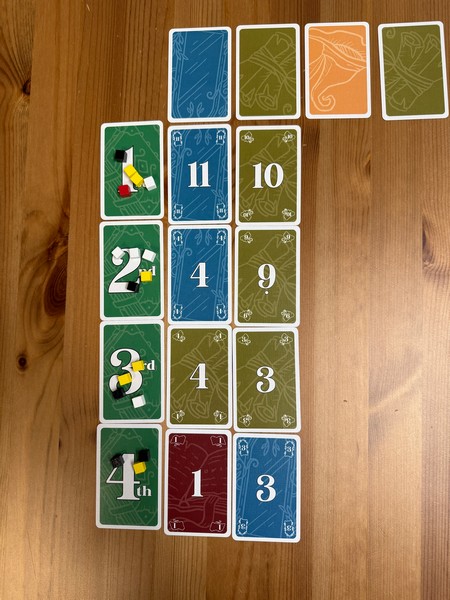
Once you’ve done your predictions, the cubes are placed on their respective cards and then, as tricks are won and predictions are correct, the corresponding cube is removed.
If you have no cube there, then sucks to be you. You shouldn’t have come in 2nd that trick.
The objective of the round is to run out of cubes as soon as possible.
If you manage to do it in 7 tricks (meaning you predicted all of yours correctly), you get 5 points!
If this happens in the 8th, 9th and 10th tricks, the points go downward.
Whoever has the fewest cubes remaining (ties are friendly) gets 1 point.
The goal is to get 7 points, so if somebody is really good at predicting, they should buy lottery tickets win the game in 2 rounds!
This can lead to a bit of lopsidedness in future rounds, though, as somebody could be just one points away from winning outright while everybody else is far in the back.
Sometimes that last round is almost an afterthought, though if they predict really badly, they can be locked out of scoring that round and somebody else could jump ahead.
Seven Prophecies is such a great game because it takes all of the trick-taking tropes and makes them even more challenging.
Lead suit?
Nah…we’ll tell you what to lead.
Win tricks?
Sure, maybe? But even if your hand sucks, you can still make predictions on that suckiness.

You’re always in the running, because you bet on the hand you’re dealt.
It doesn’t have to be a strong hand.
It just has to be a hand that you can predict outcomes with.
Typically in these games, the only decision you have to make when sloughing is whether you want to short-suit yourself in yet another suit.
Here, that doesn’t matter!
The number matters, and what place you want to take.
Nothing feels worse than getting a bunch of cards of two colours, and neither colour appears in the display until late in the round.
But maybe that blue 11 you have can get you third place as part of a slough.
Just make sure you don’t base a 1st place prediction on having that 11.
Seven Prophecies is so intricate, which is why I am so bad at it.
But I love it anyway, because you can always do something to come out ahead.
That’s what the best trick-taking games do, actually.
They make it so that it doesn’t matter how “strong” your hand is.
You can still win, or at least do something cool.
Isn’t that what gaming is all about?
This review was written after 4 plays
 Dude! Take Your Turn!