Dude! Take Your Turn!
A Gaming Life
New to Me – July 2025
It’s funny, but no matter how bad a month might be as far as playing games, I usually get a decent number of “new to me” games played.
I thought July would be slow, but it ended up being pretty normal.
I also thought, the way it started, that it would be slow on the “new to me” game front, but I actually ended up with six!
Add to that one being online with a couple of awesome friends and July turned out to be a very good month.
The Cult of the New to Me wasn’t too unhappy either.
Only one was from 2025 and there was even a 2019 game in there!

That’s what I figured. 2019 is almost ancient nowadays!
Maybe I’ll make them happy in August by playing a 2012 game!
Anyway, without further ado (all of my ado was overrun by a bunch of fascists anyway), let’s begin!
Land and Freedom: The Spanish Revolution and Civil War (2023 – Blue Panther Games) – 1 play

Designer: Alex Knight
Artists: José Ramón Faura, Ryan Heilman, Alex Knight, Ruben Megido
Players: 1-3
Land and Freedom is a wargame that I never thought I’d get the chance to actually play.
My stable of wargame partners is very thin…almost (almost?) to the point of non-existence.
Then it popped up on the wonderful online wargaming platform Rally the Troops.
Sure, maybe some asynchronous play might happen with some friends.
I’ve played Time of Crisis asynchronously 48 times now.
Then, my good friend Michal (from the Boardgames Chronicle) suggested that we, along with our good friend Clio from Clio’s Board Games, get together on a July morning (for me) and play it live.
What an idea!
They are both over in Europe, 9 hours away from me, but being off in July meant all of my mornings were free, so we picked a Wednesday morning (for me) to try this game out.
First, and this has nothing to do with the game itself, it was so great to actually play live with both of these wonderful people who have been good friends for a while now, hearing their voices for the first time (except Michal, who has a Youtube channel, though it’s not live!).
We need to do that again.
Oh, how was the game?
Land and Freedom is a semi-cooperative card-driven game about the Spanish Civil War.
Each player is one of three sides on the Republican side, trying to resist the Fascist tide trying to take over Spain.

The three sides are Moderates, Anarchists, and the Communists, and all are vying for power while trying to make sure the Fascists don’t take over.
The Fascists are controlled by a deck of cards, four of which will be revealed each year.
There are four fighting areas that are on a pendulum-type track, either with the Fascists having advantage or the good guys, and each turn’s Fascist card will send one or more of them closer to Fascist control.

Each Fascist card will not only move one or more regions closer to Fascist victory, but may also effect one (or more!) of the other tracks that determine how well one or more of the players are doing.
It will also have a test, success or failure of which is determined at the end of all the turns.
Often it’s having one of the fronts be at a certain level (Bombing of Madrid shows that the Madrid front must be at -1 or better to have a positive result, while a failure will move the Government closer to the centre).
Each player will choose a card from their hand (each player has their own deck) that they will (in turn order from whoever has initiative) decide whether to play for action points or the event.
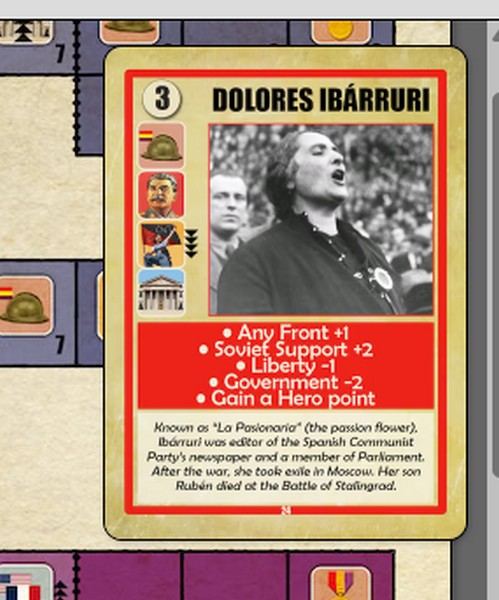
They can use the action points to move tracks or add Republican forces to a theater.
Also, if the Morale Bonus is active, the player can activate one of the icons on the played card. The strength of that activation depends on having the same symbols in their tableau.
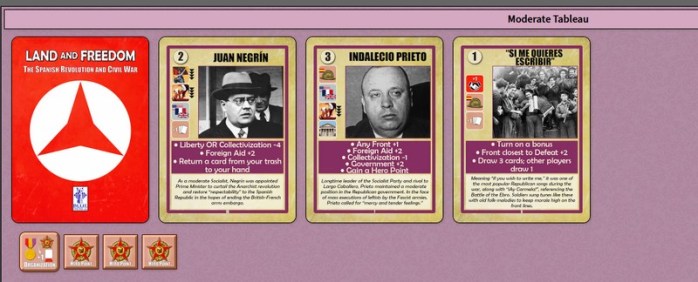
But using a card for the event will not put it in your tableau and cannot use the Morale Bonus, so not only are you deciding how important the event is when you play it, you’re also looking at the future and whether the icons (on the left side of the card) will be important.

The various tracks are very important, because some of them will determine who has initiative at the end of the turn, as well as moving tracks up to a certain point will give you medals that can either have a one-time effect, an ongoing effect, or maybe endgame stuff.
Initiative is important because not only does it determine turn order at the beginning of the turn, but at the end of each turn, whoever has initiative will put a token in the “Bag of Glory” which is used to help determine victory (assuming the Fascists don’t win, in which case nobody wins).
Each year consists of four turns like this, and there are three years in the game.
It’s semi-cooperative because sometimes you may want to sabotage things if you can afford to do so (i.e. it won’t cause the Fascists to win) because the successful test result will actually benefit one of the other players.
At the end of the third year, if the Fascists haven’t won (they win if Madrid front ever goes to -10, or if two other Fronts do, or if two fronts are at 0 or below after Year 3), then the Bag of Glory determines who actually wins.
The chits that have been put into the Bag of Glory are pulled, and when the Glory area is full, whoever has the most chits pulled is the winner!
Of course, that means it’s very important to have initiative at the end of the year because you get to add more tokens.

Some other cards might let you add more as well.
This was such an intriguing game.
You do have to cooperate somewhat, and there is a “Teamwork” bonus when adding strength to a front if more than one player contributes forces to it.
You can also gain Hero Points for contributing to the front on the Fascist test (and also in other ways) which you can spend on Track movement, regaining the Morale/Teamwork bonus tile, and things like that.
I hadn’t thought much about this game when it came out because I knew I’d never get the chance to play it.
Now that I have, I really enjoyed it.
You can play it on Rally the Troops, either live or asynchronous, and I highly recommend it!
And I really hope that Clio, Michal and I get a chance to play live again, either this game or Time of Crisis or one of the other ones on the site.
Given the time difference, only Saturday mornings (for me) really work, but I’m sure we can do it!
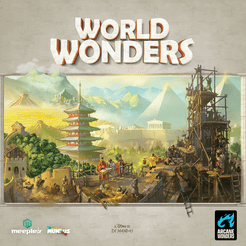
World Wonders (2023 – Arcane Wonders) – 1 play
Designer: Zé Mendes
Artists: Odysseas Stamoglou, Tom Ventre
Players: 1-5
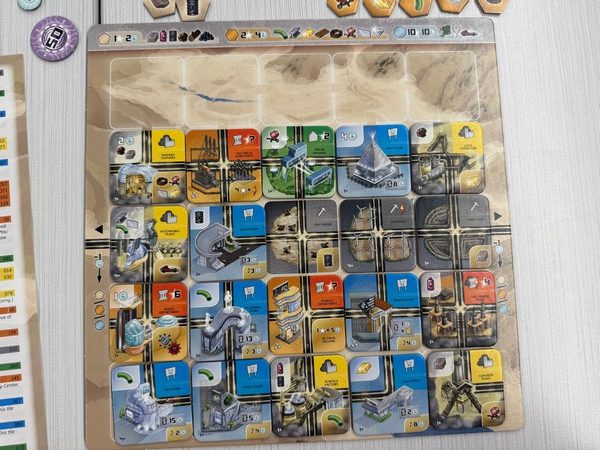
World Wonders is a polyomino game where you are building a city which, hopefully, will include a bunch of world wonders.
Polyomino games are usually not my bag, because they involve spatial relationships and trying to fit pieces into a certain grid, but this one wasn’t too bad.
It’s not my favourite, but as polyomino games go, I’d play it again.
Each player is given a board where they will be placing their buildings.
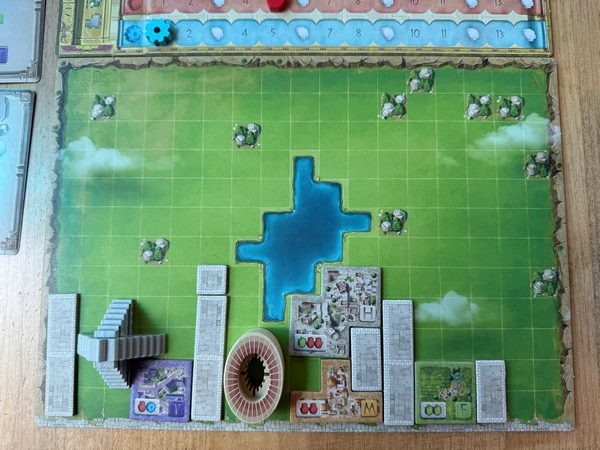
There are various options for these boards, but we decided to go with the basic since only one person had played before.
Road tiles (either long or shorter ones) must be placed either adjacent to another road tile leading to the edge of the board, or adjacent to the edge of the board. One long one is given at the beginning of the game.
Then, each round, players will use their 7 gold to buy building tiles, roads, towers, or maybe even a world wonder that can fit into their tableau.

There is one of each type of building available each round.
Each building costs the indicated amount of gold, which you track (along with your other tracks) on your player board.
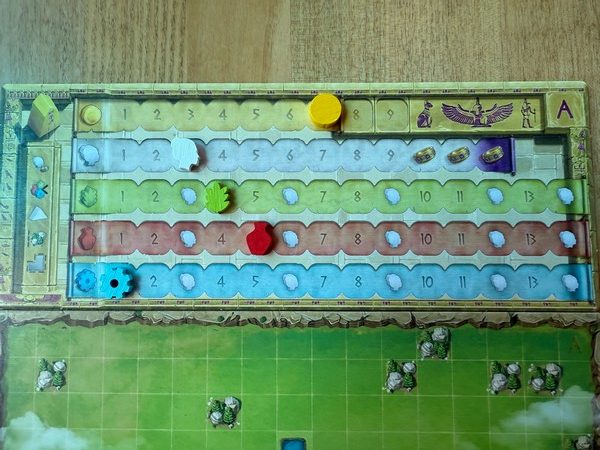
Once you are out of gold, you’re out of the round.
The one difference in cost is that, if you qualify to place a Wonder on your board, that costs all of your gold.
Maybe it’s 7?
Or maybe it’s just 1 that you have left.
Either way, it’s all.

Each Wonder does have qualifiers so that you may not be able to build it, though. Mostly these requirements are what is adjacent to it.
Chichen Itza, for example, has to be placed next to a purple building and a road.
The game goes 10 rounds and you are trying to enclose as many buildings as you can (as that’s how you score points), as well as building wonders and the lowest number of your three trackers (Hey, that’s Knizia-esque!).
There are also natural resources showing on your board which, if they are uncovered, give you points.
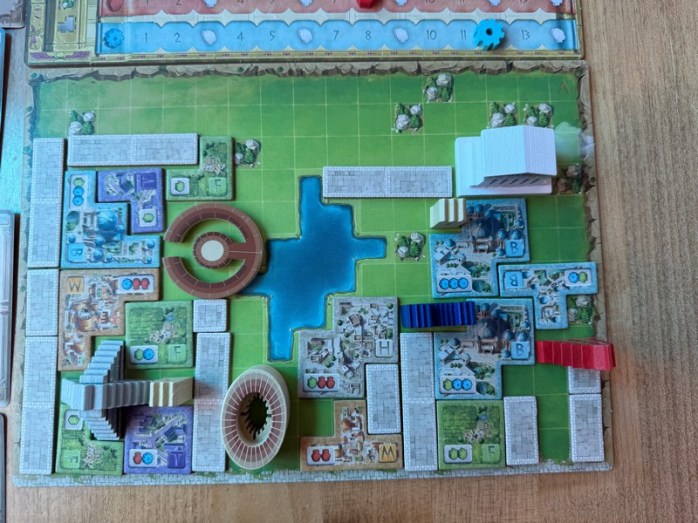
It’s a very spatial game, trying not to cover certain areas and trying to make sure your pieces fit together to enclose as much as possible.
Hence, I didn’t I do very well.
This is really not my kind of game, but my play of it was fun and I wouldn’t say no to it.
I just probably wouldn’t suggest it.
Era: Medieval Age (2019 – Eggertspiele) – 1 play

Designer: Matt Leacock
Artist: Chris Quilliams
Players: 1-4
Era: Medieval Age is kind of a roll and write, but instead of writing you’re placing 3-D representations of buildings into your tableau.
But it’s still a roll and write.
You’re rolling dice (gaining new buildings will gain you more dice) and you can reroll up to 3 times to get what you want, though there if your dice have a bad icon, you can’t reroll that one.

The rolls will gain you materials to build buildings, or maybe victory points or military capabilities that will let you affect your neighbours’ tableau.
First, each of your dice is a “worker” that must be fed during each turn.
So you have to make sure you have enough food to feed all of them, or you will lose them (I guess they go away to somebody who can actually feed them, rather than actually dying, which would be kind of gross)
You keep track of your resources on your display.
You can then use materials to purchase various types of buildings to put into your display, in a fun 3-D manner!
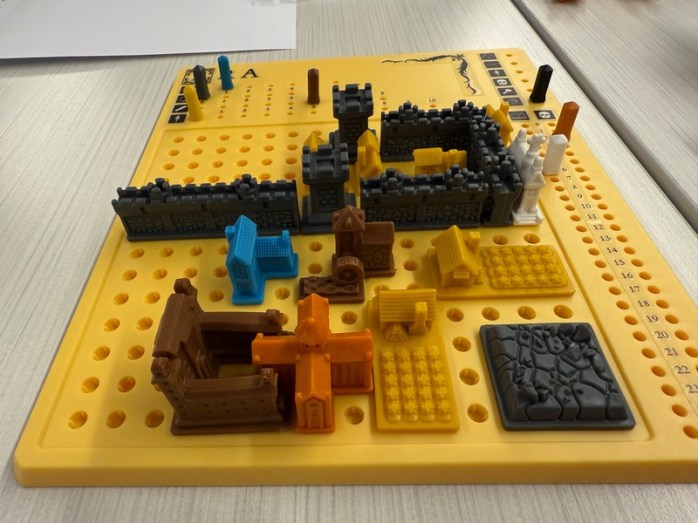
You can try to surround your buildings with walls, as the biggest surrounded section will score points (assuming nobody else has a bigger section).
But otherwise, you can have buildings outside the walls with no problems.
Putting buildings next to each other can be a problem, since there is always the possibility of a plague happening, which means that buildings next to other buildings have an issue.
Unless you have a medical centre adjacent to them (which is that cross-shaped building above, and the only reason I have those buildings next to each other).
At the end of the game (when a number of the building types are no longer available), you score up your city and the points you’ve gained during the game, and whoever has the most points is the winner!

This game is fine, but it really didn’t attract me at all.
It has that “polyomino” feel to it for me, where you are trying to picture where buildings (whether tiles or, in this case, 3-D buildings) will go and I’m terrible at that sort of thing.
So I don’t want to hold that against the game, since it’s more of a “me” thing than a game thing.
But I just found the game kind of boring overall.
If you like roll and writes and don’t mind the 3-D nature of the game, then you might not have a problem with it.
But for me, it just kind of sat there and didn’t do much.
I’m glad I played, but I don’t need to play it again.
Hot Streak (2025 – CMYK) – 1 play

Designer: Jon Perry
Artist: Cécile Gariépy
Players: 2-9
It’s been a long while since I’ve played a game where it’s just pure fun zaniness without all the trappings, and it’s so much better for it.
One of the fun things about going to baseball games are the various team mascots that are hanging around. Between innings, they sometimes have the mascots race and hilarity ensues.
Hot Streak is the game where you see and bet on these races!
Not sure why “Streak” is in the title, but just go with it.
Anyway, there are four mascots and they are racing from one point on the roll-out map to the finish line.

The deck of cards that will control the mascots is dealt out, and then each player is dealt 3 cards as well.
In player order (and then reverse player order), each player will draft a betting token on whether one of the four mascots will finish 1st-3rd in the race, or maybe the random betting tokens that are out there as well.
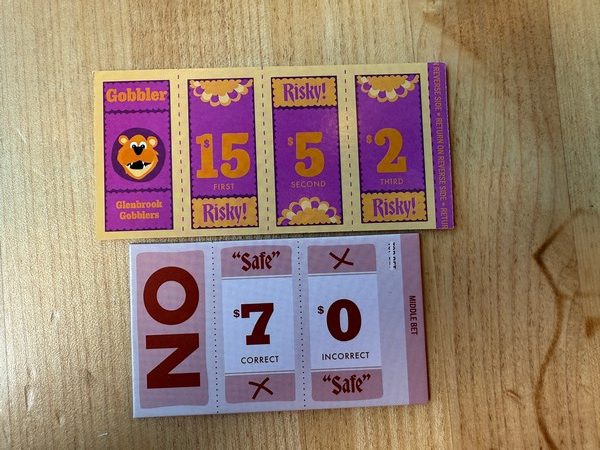
The draft order goes 1-2-3-4-4-3-2-1.
They will then contribute one card to the deck that will control the mascots.
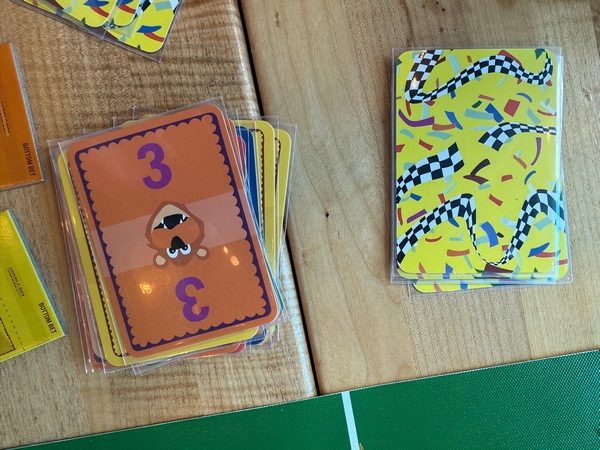
After burning the top 3 cards, each card is revealed and the mascots will behave accordingly.
The above card will have the bear move 3 spaces toward the finish.
Some cards will have a mascot fall down, though, or they could move into another lane and cause a different mascot to fall.
A card could even have a mascot turn around and run the other way!

Or just move backwards (-2 movement).
Each race ends when 3 mascots have either finished or been disqualified and points are added based on the bets.
The game goes for 3 races, and then whoever has the most money at the end of it will win!
This game gets a lot of laughs. I don’t remember laughing so much at a game before.
It’s also very quick, even with three races.
Our game lasted 28 minutes, so it’s easily a lunchtime game.
And it’s just such a blast!
It has the betting of Camel Up and the hilarity of…well, I can’t think of a game that’s this funny.

Hot Steak was a definite winner in our book.
The production values of the game are just wonderful, with chunky mascots, a roll-out race track where it comes out of the box where you’re also storing everything.

It’s all just amazing.
I’d love to play this again. I can see why it’s getting so much buzz.
Reputation (2022 – Ninja Star Games) – 1 play
Designer: Kei Kajino (梶野 桂)
Artist: Marco Primo
Players: 3-5
Reputation came to our table because there were three of us left (one person had decided to leave) and I wanted to play relatively short game that I hadn’t played before.
This is an intriguing push-pull game in that you are trying to gain money by successfully bidding on civic projects, but some of them will cost you reputation.
If you have the lowest reputation at the end of the game, it doesn’t matter how much money you have!
You have zero points.

Each round, a private and a public project will be available to be bid on.
When the public project comes out, it will have a set number of dollars on it, as well as a number of workers that must be bid on it.
This number is an exact amount, not a minimum. If you bid on the public project, then you choose how much of that money to move over to the private project.
Thus, it’s likely that the Private Project will have a bunch of money on it.
But it will also cost you reputation (I guess people don’t like you going out on your own).

Whoever wins the Public Project will then allow the two neighbouring players to bid on joining them in it.
Whoever wins that bid (and the original winning player will secretly choose who will win a tie if both players bid the same) will have access to that projects reputation gain (though only the original winner of the project will actually get any remaining money on it)
At the end of the round, up to three workers that had previously been used to win projects (one from each possible public project with both neighbours as well as one from your private project) will come back to your player card.
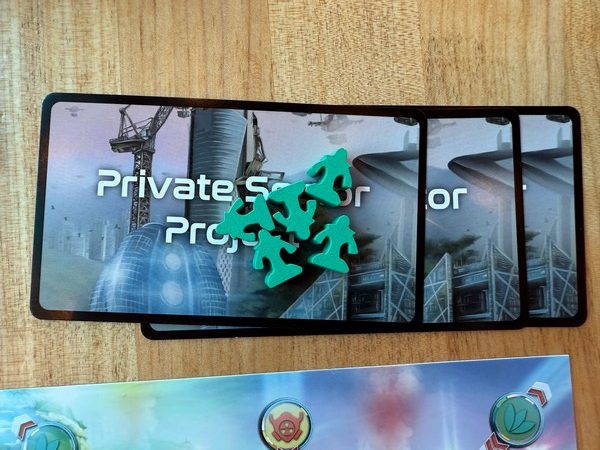
Those who were already on your player card will go back to your supply for the next round, so workers used for successful bids are actually not able to be used for multiple rounds.
After 10 rounds, total reputation is calculated (including that for remaining workers in your supply) and whoever has the least reputation will not be able to win.
Other players then count up all their money (including potentially money from remaining workers in the supply) and whoever has the most money wins.
This game is probably best at 4-5 players because, at 3 players (like we played), all remaining players are in the running for “helping” with public projects.
With more players, only a couple other players are eligible, which I think would add to the strategic decisions
I somehow managed to have the least money and the least reputation.
I’m not sure how.
But this one also isn’t really a game for me, though it wasn’t a bad game.
Just not to my taste.
Flip 7 (2024 – The OP) – 2 plays

Designer: Eric Olsen
Artist: O’Neil Mabile
Players: 3-18 (or more, if you have more than one deck)
Sneaking in on the last day of the month was Flip 7, the immensely popular press your luck card game from The OP.
The game is very simple, and a wonderful way to introduce games to people who may not have played too many games before (like our new coworker!)
The concept in this one is that each player is dealt a card and then chooses (in player order) whether or not to take another card or not.

If they get the same number, they bust and their round is over.
The conceit is that, in the deck, there is one 0, one 1, two 2s, three 3s, and so on up to 12 twelves.
So the higher-scoring cards are more likely to bust you.
There could also be scoring modifiers that will help your round.

And action cards that you can play on others or on yourself, like the Second Chance that will allow you to discard it and the card that would bust you so you can keep going.

You can stop at any time, and if you manage to “flip 7” (get 7 cards with no matches), the round immediately ends and you get your total points plus 15 bonus points!
The game ends when somebody ends a round with 200+ points.
“Hitting” or “stopping” is easy for even a non-gamer to understand and the action cards don’t add too much complexity to the game.
This is a really fun one!
It’s too bad that the publisher’s CEO is a Trump supporter even though he admits that Trump’s tariffs are harming his company.
So I can’t really suggest you buy this.
I had forgotten that The Op published this game when I bought it or I wouldn’t have.
But if you can find somebody who already has it, the game itself is quite fun for what it is.
Nothing crunchy at all, but a great way to have fun with gamers and non-gamers alike.
Even if you have 17 of them!
(The rulebook says that if you have 18 or more players, you should have a second copy of the game).
There you have it.
Six new to me games in July, which is more than I was expecting!
Sadly, not all of them were that appealing to me, but you can’t have everything.
Playing with Clio and Michal made it all worthwhile, though.
What new to you games did you play in July?
Let me know in the comments.
 Dude! Take Your Turn!
Playing “Land & Freedom” LIVE was a true blast! Really enjoyed great company as well as this game. We need to do it again for sure!
LikeLiked by 2 people
I’m always game!
LikeLiked by 2 people
Once I am back from vacations I will propose some options.
LikeLiked by 2 people
Sounds like a plan!
LikeLiked by 2 people
Awesome! Our Land and Freedom game was the highlight of my gaming month 🙂
LikeLiked by 2 people
Mine too!
LikeLiked by 2 people