Dude! Take Your Turn!
A Gaming Life
How Big is Your Camel? – Resafa Review
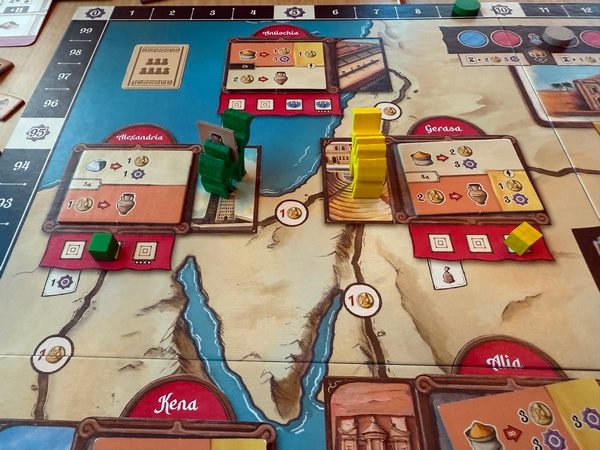
Sometimes games with historical themes throw in as much as possible regarding that theme, even when they might be unrelated.
Overcompensation?
Maybe, or maybe they just want to make sure there are enough things to do to keep the game interesting, and at least mildly thematic.
There’s a little bit of that in Resafa, the latest game designed by Vladimír Suchý with art by Michal Peichl.
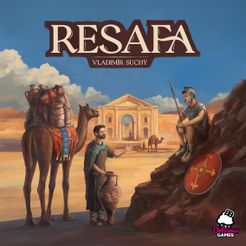
The game was published in 2024 by Delicious Games/Rio Grande Games and plays 1-4 players.
Players are traders in 3rd Century AD Syria, namely the city of Resafa, trying to establish a trading empire along the caravan routes of the ancient Near East.
They are building up their camel caravan size, moving from city to city and trading goods, establishing workshops and gardens in Resafa to make their businesses even more prosperous.
Since the city of Resafa had no local sources of water, they are also building canals and wells to help keep the city watered.
This last bit makes me give Resafa the side-eye a little bit.
Wouldn’t canals be public infrastructure built by the Roman government and/or its army?
Individual ownership of the various avenues of water distribution seems a little off in my mind.
Still, I can’t find anything definitive that says this, or that confirms the game’s conceit of individual businesses building these canals, so let’s just say that I’m concerned about this and then move on.
Because the game, just like most of Suchý’s output, is very good.
Like most of the good games out there, there’s a bunch of stuff to do and you can concentrate on one or two of them to get the majority of your points.
If you spread yourself too thin by trying to do everything, it will be like building your empire on a piece of tissue paper: it will rip apart and collapse, not achieving anything.
Also it will be very small.
The main attraction to Resafa is the card play.
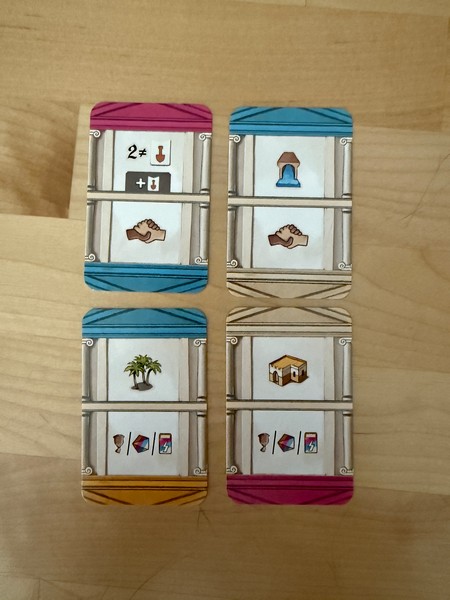
You have a set of six action cards that have actions on both ends of the card and colours above each action. You can play the card for either action.
These are multi-use action cards, in a way, because they give you the action that’s on the card but then you can also do the colour action of the card as well (the colour above your action, not either one).
The action you just do, but the colour action will let you do one of three things.
You can just draw a Sack card, which is basically some piddly resource or conversion that it’s almost like a pity card.
You can take a bonus card of that colour from the tableau that changes each round.
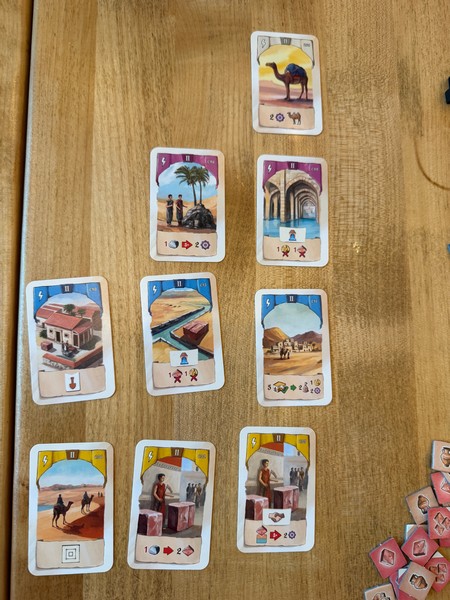
This card can be kept in your hand or used immediately and will give you some cool stuff. Maybe resources, maybe another action, or maybe a bonus when you do a specific action.
Or you can move up that colour’s Special Card track.
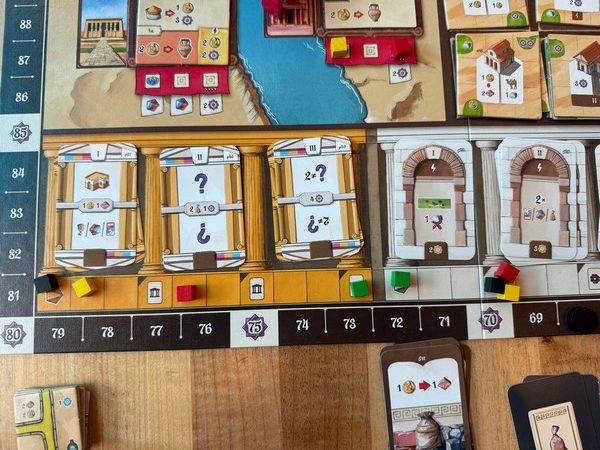
When your marker reaches certain levels on each track, you get to choose one of the cards.
These cards don’t count against your hand limit, though the bonus cards you keep do.
The theme of this game (besides trading near the Mediterranean) is choice.
You have a lot of choices, not just in what areas to focus on, but even such small choices as taking a Special Card from the track when you earn it.
If you take the top card that’s on display, you also get a bonus of a point and a coin.
But maybe you don’t want the top card? Or maybe you just want to see what else might be available?
You can look at all of the remaining cards in the stack and choose one to take. It can even be the top card!
But you don’t get the bonus any longer.
See?
Choices!
I think Suchý gives you so many choices because he likes seeing exploded brains on the table.
Sometimes there are even choices within choices.
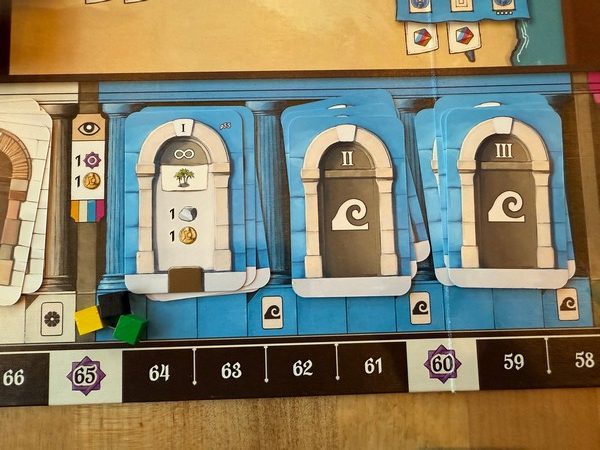
Each Special Card track is tied to one of the colours, naturally.
You can only advance so much on them, so you do want to prioritize.
Yellow cards give you upgraded action cards that replace the ones in your deck. They may be stronger actions, or they may give you bonuses when you take that action.
Some of them will even give you an “any colour” action instead of a specific colour.
The white cards give you additional immediate actions, sometimes with discounts.
Blue cards give you permanent bonuses toward actions or even more powerful immediate actions.
In the picture above, the Level 1 card showing gives you a stone and a coin when you do the Garden action.
The pink cards are endgame scoring.
These tracks are unique in one other way as well.
You can go as far as you are able on the pink track.
However, the other three colours are limited.
You can only go up to Level 3 on one of the tracks.
You can only go up to Level 2 on two of the tracks (one additional track besides the one where you went to Level 3).
The third track, you are limited to Level 1.
See? Choices!
This is all just for the cards and card play, but there are obviously other things you can do in Resafa which can be just as important.
Building your workshop and gardens can be a goal in itself because they will get you points, production actions, and bonuses that will give you the resources you need to do pretty much everything else.
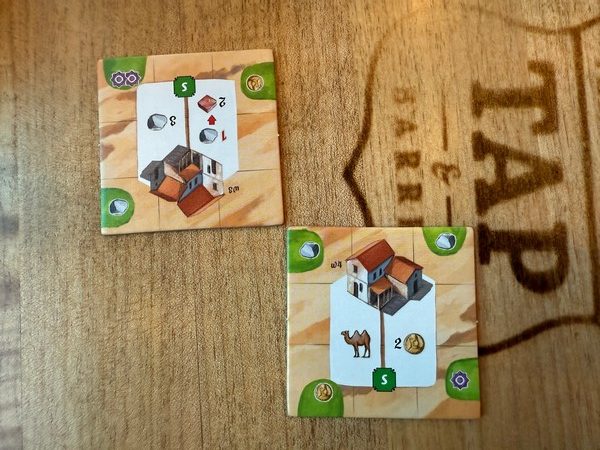
Building your workshops give you new tiles that will then have gardens attached to them (as long as you build the gardens, of course).
Workshops aren’t placed adjacent to each other, because really, who wants to be producing food when the asshole next to you is making so much noise converting stone to clay?
No, you want some natural beauty barriers separating you from the other workers.
That’s where the garden tiles come in, because another one of your actions is to build gardens.
You place garden tiles in between workshop tiles (or extending off of a workshop tile, though that gets you no benefit really).
These tiles can be either one row or two, though obviously the bigger ones cost more.
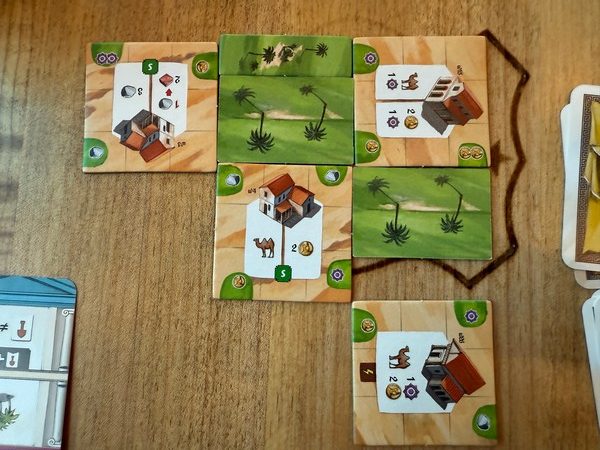
If you place a garden tile and connect it to an already-existing workshop bonus (the resource in green that’s touching the garden), you get that resource immediately.
How are you getting beautiful gardens when water is so rare?

Completing gardens will get you additional bonuses and also help with your canal building (though I’m not quite sure why?)
However, before we talk about canal building, there’s probably the most important action in the game.
Trading!
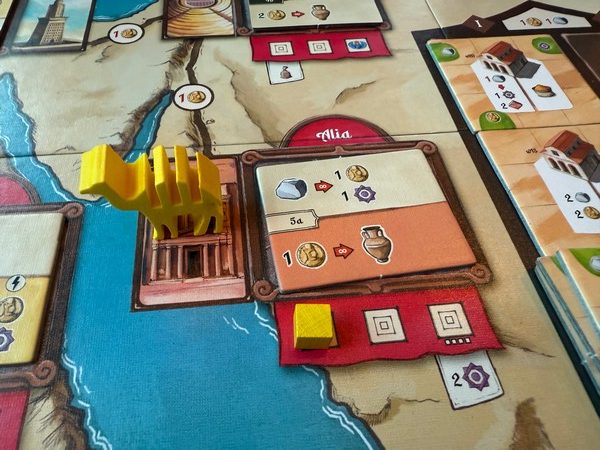
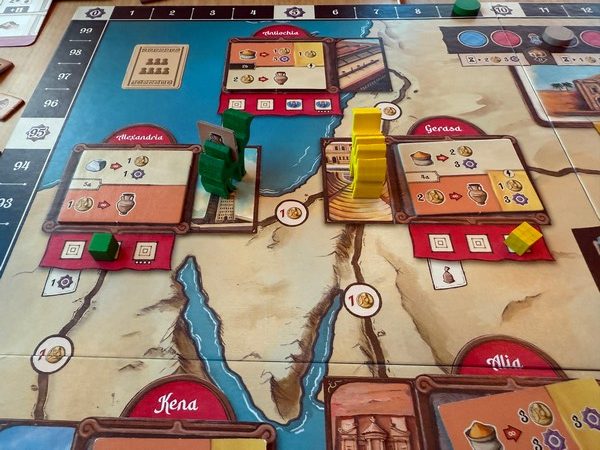
Doing a trade action makes it so you move your camel from one city to another, spending the coins required depending on your destination.
Can I just say that this is the one production issue I have with Resafa, the camel?
You are supposed to place the goods/resources you have in your caravan into the slots on its back.
It’s really fiddly to keep putting them in there and taking them out when you sell them, and if you have shaky fingers, those tiles are going to go all over the place.
But I digress.
Each city will have a good/resource that’s in demand and a good/resource that you can buy. The tiles have a bonus either for the buying or the selling transaction.
Once you do the action, that tile flips so the next person there will have a different bonus opportunity.
You can sell or buy as much as you have/can afford, though you do have a caravan capacity that starts at one and which you can improve up to seven.
That’s all your caravan can hold, so be careful of that.
Also, in a move that I really love because it forces you to make some more choices, your caravan can only hold one type of good/resource and you can’t switch unless you stop off at your workshop in Resafa.
Along those same lines, if you gain goods/resources in any other way, you can’t add them to your caravan even if your caravan is already carrying that good.
Gained goods/resources go to your warehouse and have to be picked up by your caravan.
Another thing that rewards thinking ahead in Resafa.
Trading is probably the one thing in Resafa that you have to do at least some of, because the VP and coins gained are pretty high, especially if you get your capacity up and actually carry that many.
Once per city, you can also establish a trading base there, which will give you another bonus and work towards endgame scoring.
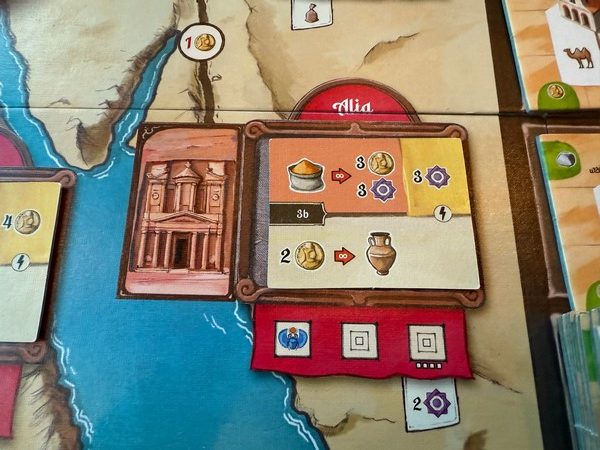
Finally, with all of this desert surrounding you, you have to think about fresh water.
So how about helping out the city by building canals?
Each player has a set of double-sided canal tiles that they can build using the Canal action and place into one of the squares (gaining the bonus resource/points/discount of that space).
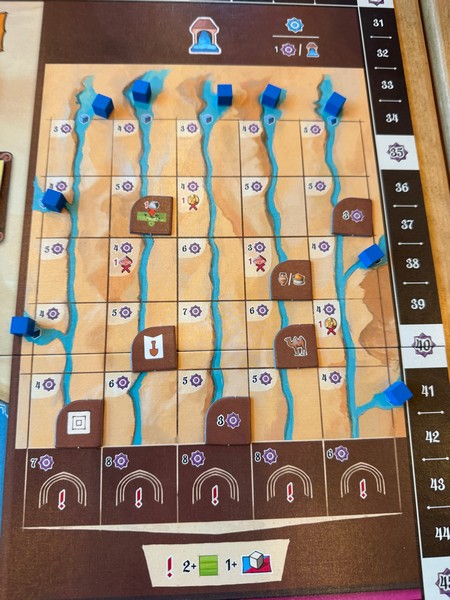
After the 2nd, 4th and 6th rounds, there will be a Rain Scoring phase which will give players points for each of their canals on the board.
Also, this is where water (the blue cubes) will flow downwards if there is a canal directly connected to them.
The player who owns that canal will then determine the water flow depending on how the other canals are placed and how they potentially branch.
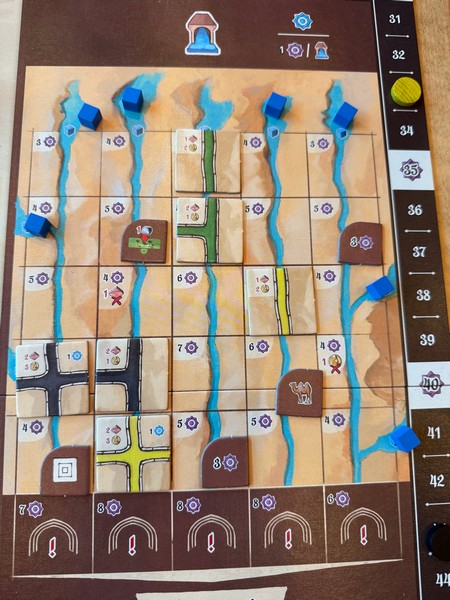
Each player who owns a canal tile that the water touches as its flowing will get a point (and perhaps bonus points depending on what canal tile is there).
Where completing gardens will help is that once you have completed two gardens, you can build a well at the bottom.
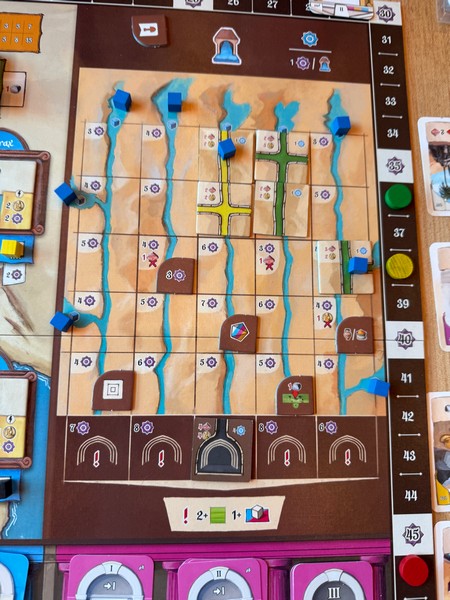
Those are major points but also quite expensive to build.
With the branching canal tiles, you can avoid giving other players points if you want to, which is always nice.
All of this comes together in an action system that does give you plenty of choices, though sometimes that is dictated by the cards you have.
While you have six cards in your deck, you only have three in your hand at any one time (plus any bonus cards, up to a limit of five cards).
It’s not as random as one of those games where you have more cards in your deck, but there is a bit of randomness in that you may not be able to do the action you’re looking for exactly when you want to do it.
Of course, there’s also the delicious feel you get in games where you want to do an action but you’ve already use both of those cards, either for doing the action previously or for doing the other action that was on the card.
Planning in Resafa is very important as well, and it’s also where getting the yellow Special cards can come in, or perhaps one of the white or blue Special cards that give you that bonus action you’re looking for.
The rulebook is laid out well for the most part, but the explanation about garden bonuses for a full garden took a few rereads and a discussion among our players to determine exactly how it worked.
Also, there is a card effects glossary at the back of the book, but not all the cards are shown there (I presume for space reasons).
I think you are supposed to look at cards with similar effects and compare them to the card that’s actually in the glossary, but there are a couple of cards I remember having trouble making this comparison with so I still wasn’t sure how the card I was looking up worked.
We figured it out for the most part, but a comprehensive card guide would have been more helpful.
Like all of Suchý’s games, there are interesting action selection mechanisms that require you to plan well and may trip you up.
Unlike Underwater Cities (to name one example), there is limited player interaction as far as these actions go, other than potentially taking a workshop or Bonus card that another player might want, or maybe placing that canal tile where the other player wanted to go.
There is no “I took this action so you can’t” mechanism, which I do like. Nobody can block you from doing an action.
I also like how the card randomness is handled.
Yes, the Bonus cards are randomized, but they will all come out eventually. It’s just that maybe the one you would find most valuable doesn’t come out in the round you want it to.
The Special cards, each level only has four of the six available cards in the stack, so there is some randomness there.
But the ability to forego the bonus coin and VP to increase your card choice when you reach a level is a really nice option.
Maybe that top card is great for you, so the bonus is great too?
My only small negative with Resafa is that there’s a bit too many options as far as directions to go, but also some of them are more important than others.
If that makes sense.
You do have a lot of choices, but if you’re not trading, then I’m not sure you will do that well because trading is so lucrative.
Cal, one of my friends who has been in all three of my games finds the Special cards almost a trap, using up actions that you could use much more efficiently to instead move up the colour tracks to get the cards.
Other than pink, of course, because those endgame scoring cards can also be quite good.
I think he’s wrong, but he has won all three games virtually ignoring them (other than pink). Two of the three games were close, though.
I definitely want to explore this game more, which is always the sign of a good game.
Many of us have said that the game gets you thinking about it after you’ve played, exploring strategies in your mind and seeing what maybe you could have done differently.
Also a sign of a good game.
Resafa is another winner in my book and I highly recommend you give it a try if you’re into these heavier euros.
(This review was written after three plays)
 Dude! Take Your Turn!
Intriguing design!
…and I get the idea that Cal is quite a shark at games! At least he seems to win a lot 🙂
LikeLiked by 1 person
I consider it a success if I come close to him LOL
Though I have occasionally beaten him. It’s always a treat when I do
LikeLiked by 1 person