Dude! Take Your Turn!
A Gaming Life
Finding the Aliens Among Us – SETI Review
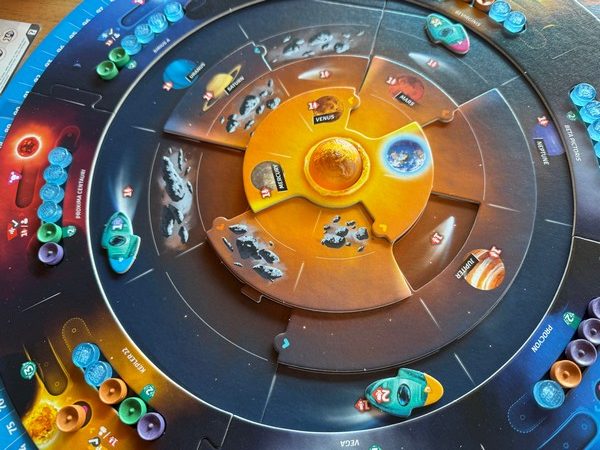
Action selection games usually don’t have a lot of theme to them, at least as far as the actions you are selecting from.
Usually it’s like “oh, I select this noble to do this thing, and oh, supposedly I’m building some part of this medieval cathedral by doing that, ho hum.”
In SETI: Search for Extraterrestrial Intelligence, you are actually choosing actions that would supposedly help achieve the theme’s goal.
Whether it’s scanning for alien signals or exploring the planets in our solar system for traces of these aliens, you are actually doing something that supposedly will help discover the aliens!
Yes, you’re still playing a card to move your probe to maybe land on a planet, or maybe you’re spending the data you’ve received to find some trace of alien presence somewhere.
But at least you can see the connection to your action.

SETI: Search for Extraterrestrial Intelligence (I’m just calling it SETI from now on) is a game designed by prolific designer Tomáš Holek (seriously, he had 3 games published last year) with artwork by a bunch of people (too many to name, but they’re credited at the BGG link).
It was published by Czech Games Edition in 2024.
(Though I have to say to stay far away from their Harry Potter Codenames because trans people deserve not being nuked by assholes like J.K. Rowling and you know that money she made is going to anti-trans causes)
Ostensibly in this game, you are using various methods to find traces of alien DNA to then discover the aliens and hopefully be able to interact with them (or their remnants) to score a lot of points.
Yes, this is a points extravaganza, though in my plays of it, it’s more a points “minor get together with one or two people who may not even be your friends”.
But I suck, so don’t let that deter you!
You’ll do fine.
Seriously, I have played this game three times and my scores have gotten worse each time, with my highest score actually being when we played it wrong and it should have been harder!
Anyway, SETI is an action selection, hand management game where you will have a hand of cards that you might play if you have enough money, or you can take other actions to do things like launch and move probes to explore the solar system, or maybe scan space sectors for traces of alien presence.

You will have a hand of cards, of which you will want to play all of them but you can’t afford that.
These cards cost money to play and will let you do a bunch of different things, including possibly actions that you might have taken as a main action rather than playing a card.
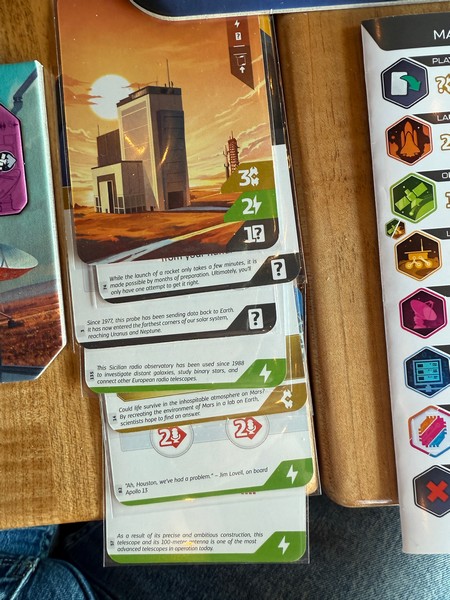
For example, Dune above (Dune? Is the designer a Frank Herbert fan?) lets you build a blue technology for free (well, you have to pay the 3 credits) rather than having to pay 6 publicity for it.
It also gives you points at the end of the game.
The board consists of the solar system, which will rotate a lot during the game (whenever that symbol on the left of the Dune card comes up), meaning you can’t always determine when you will have a straight shot to a planet.
There are three levels in the solar system, and each time things rotate, it’s only one of them that rotates, which makes the solar system rotation really cool and something you have to calculate a bit.

Another way of getting alien traces is to move probes to planets and land on them (though you can orbit them instead to get a bunch of other bonuses)

Landing takes more resources but could be more lucrative, especially if you are trying to gain traces of the two aliens.
The way you are doing this is to launch probes, send them to a planet, and then either orbit or land.
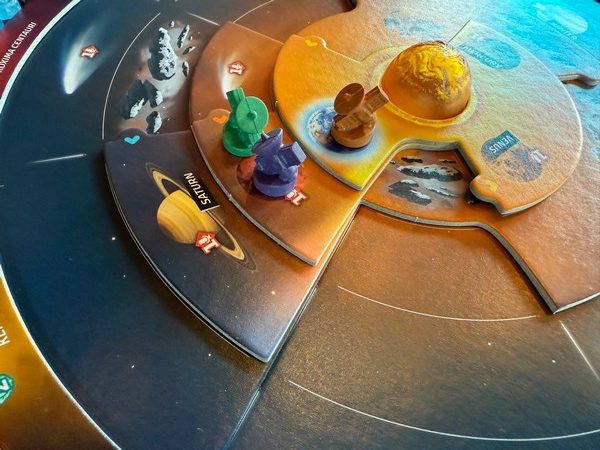
Sending probes out has its own issues, as you have to travel from Earth to wherever you want to go.
Eventually, three different types of alien traces for one of the two available species will be found, and it’s time to flip it over to see what you have.
This brings out a new deck of cards, new rules, and basically you have to learn a segment of the game on the fly.
Not that it’s too hard, but it is something!
There are five alien types in the game, of which each game will have two randomly selected (and secret until discovered).
The upcoming expansion apparently adds more aliens, which would be nice because the starting five are starting to feel a bit old, even when I’ve only played the game three times (since they are random and one of the aliens I’ve had all three times).
The aliens are all very different and can affect how you carry out the rest of your game strategy.
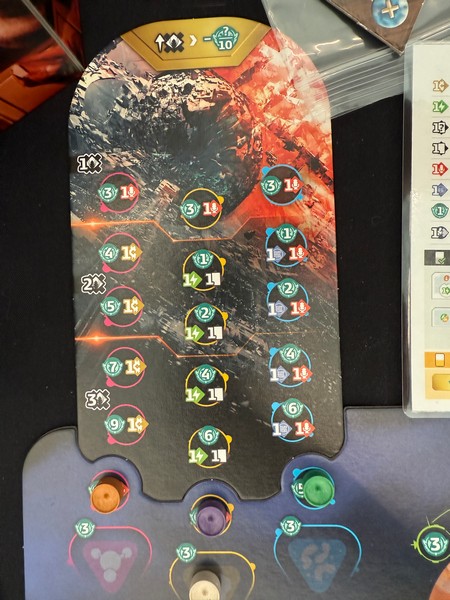
The alien shown above has endgame scoring cards that also add “danger,” along with places to find alien traces that also add danger (the black numbered 1-3 on the left side of each segment).
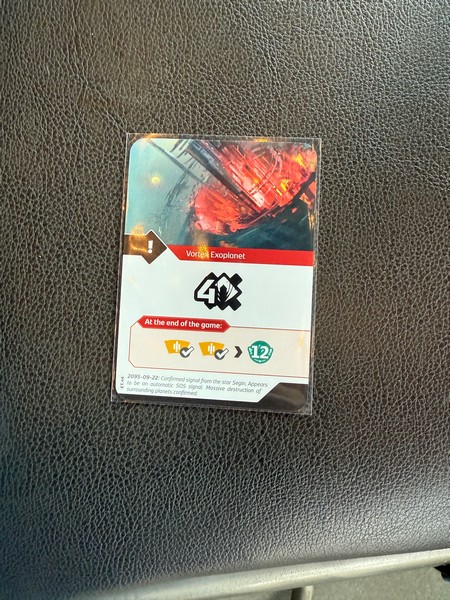
You can play multiple cards face down throughout the game at specific intervals to say that you plan on completing this requirement.
However, while you will gain the points for the card if you fulfill its condition, it also presents more danger that you are assuming.
At the end of the game, whoever has the most danger will lose 10% of their points.
That can be a lot!
But if you’re ahead by 200, then it doesn’t really matter.
Each alien species is unique and I like that a lot.
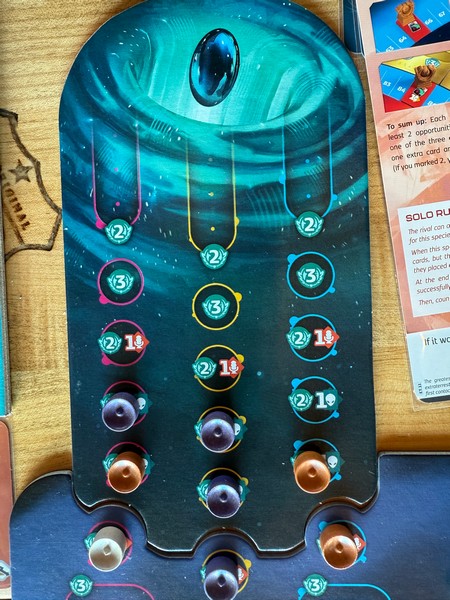
Some may give you new cards to have in your hand as well as possibly new resources.
I love the variety of aliens you might encounter and how you can’t really plan for them because they’re secret.
Sometimes you have to pivot a bit to take advantage of their bonuses.
But other times you’ll be satisfied with gaining points during the game plus the three (if you score enough points) endgame scoring possibilities that you can choose.
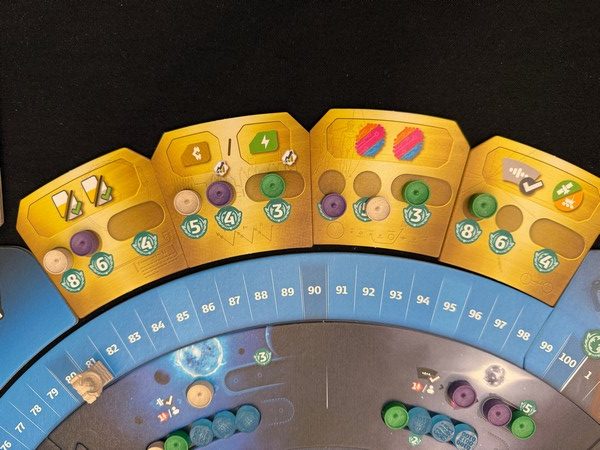
Each of these are chosen when you pass a certain point threshold, so it is theoretically possible that you can’t choose all three you would normally get to choose (which means that you are sucking in a lot of ways and will definitely not win anyway).
One thing that SETI lacks that is apparently addressed in the expansion is an interesting first round.
Usually, in the first round of the game, you should be trying to place at least one of your hand cards into your income pile so you will gain that income every turn.
In the base game, the first round is all about positioning. You may not be able to do much and it almost feels like you are setting up the rest of the game rather than actually playing it.
You’re also trying to move some things along, like landing on planets or scanning a bunch or whatever.
Like many of these games (Ark Nova, Terraforming Mars, etc), one of the things you will be doing is playing cards.
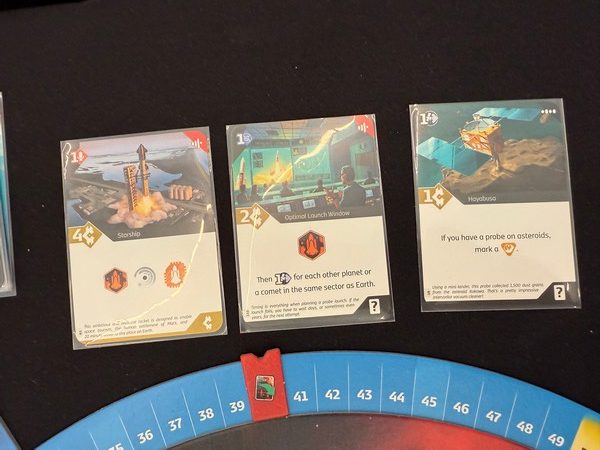
Cards can be quite lucrative if you draw the right ones.
That’s why card income can be quite helpful (though it didn’t help me much in my last game), but you also need to gain money because cards cost money to play.
I love the multi-use aspect of the cards.
You can pay to play the card.
Or, you can discard it for the effect in the top left.
This can be either moving a probe one space, gaining one data, or gaining one publicity.
Finally, when you’re scanning space sectors for alien signals, if you have the right tech you can spend one of them to scan a sector of that colour.
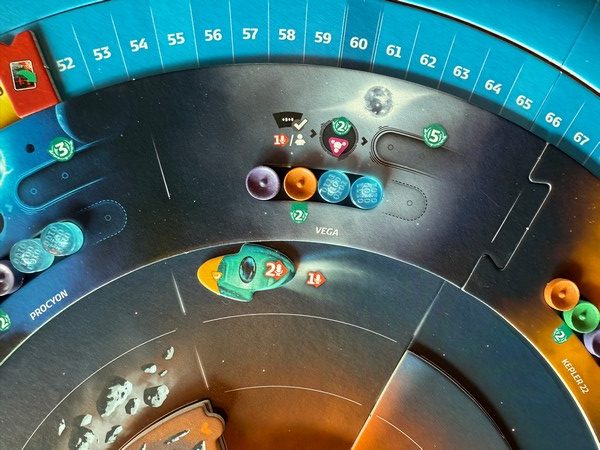
Scanning is actually another interesting aspect of SETI.
If you scan sectors, you can gain valuable data that you can then spend (as an action, of course) to get a “blue” alien trace.
However, the act of scanning itself can gain you a red trace if you have the majority of scans in that sector when scans are complete.
Once all of the blue chips are gone, then whoever has the most scans in that sector gets a bonus, and the first person to do so usually (but not always) gains a red specimen.
There are so many things going on in SETI that I, as the gamer who has trouble concentrating on one or two things, really find myself unable to decide where I should do so.
That’s the cool thing about SETI. There are so many avenues to get points, and the other stuff gets so distracting that you may end up spreading yourself too thin.
If you find yourself unable to focus, this may be a detriment.
For me, though, I love that, even if I’m not very good at it.
The aliens themselves are also very cool because they are so different.
The “Danger” aliens can get you a ton of points if you can satisfy the requirements of their cards, but you have to be aware of that 10% penalty.
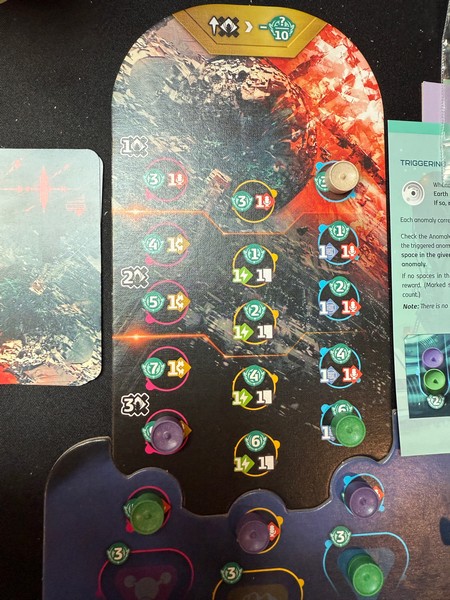
The trace spaces can also get you a bunch of points, but they can almost ensure that you’re going to get the penalty.
Looking at that alien trace tracker, you can get 7 points and a credit if you get a red trace!
But that’s 3 danger, so keep that in mind.
In our last game, the person who got the most danger was also miles ahead of everyone else, so the 10% penalty was not a big deal.
But you have to plan for it.
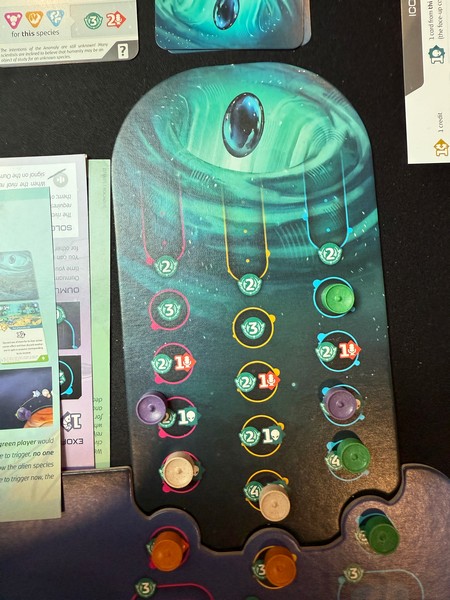
Another alien produces anomalies on the solar system board and has a deck of cards that you may be able to draw from.
These are more enhanced versions of the base game cards.
I also really like how different actions have the potential to get you different kinds of alien traces, and also how getting traces is still valuable even once you’ve discovered both aliens.
The scanning from Earth can get you red traces as well as valuable data which will get you blue traces.
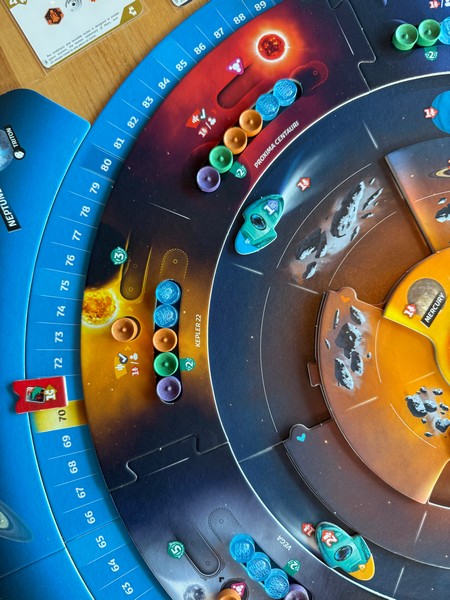
The “area majority” of scanning certain sectors is pretty interesting. While you can’t really concentrate on that to win, it can be a great helper with any other strategy.
The game can almost be overwhelming in its pathways to points, to the point where some people may not be able to do well and may not enjoy it.
I could be one of those!
Though I enjoy it just the same.
Everything links together really well and the game offers so many great choices that you will be agonizing over what you should do.
A lot is player-driven, though obviously the card drawing is not.
But even the rotation of the solar system is not random at all, but instead depends on the players.
If you research a technology, that rotates one part of the system.
The first person to pass triggers a rotation.
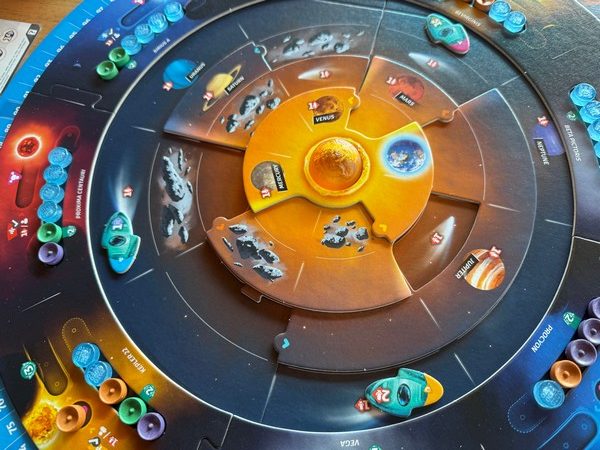
You can have a probe on a beeline for Saturn, then suddenly something shifts and you have asteroids facing you instead (which cost an additional probe movement to get through unless you have the appropriate technology).
Speaking of technologies, you can spend publicity that you’ve earned (or maybe a card will let you do it) to research a technology and gets its benefit for the rest of the game.

This can be anything from making your probes more efficient (you require a certain technology to even be able to land on a planet’s moon, for example) to making your scanning much better, or getting bonuses when you collect data from scanning.
These slot into your player board quite easily.
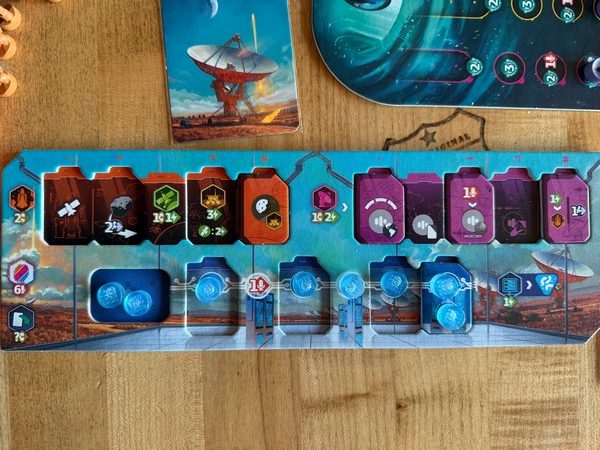
SETI is much more player-driven than many of these card-playing, action selection games usually are.
That’s a benefit to the game too.
There is just something about SETI that intrigues me, even though I keep doing worse every time I play it.
I want to do better.
I want to explore strategies that will make me better.
This game has put its tendrils into my psyche and it won’t let me go.
I think there is enough here that almost any kind of gamer might find at least something to attract them to it (except those that just love party games and fillers).
It’s a complex game, maybe not for the faint of heart, but like most of the best games that’s because of the depth of strategy, not because the rules are hard.
SETI is such an excellent game that I highly recommend giving a try if you have the time for it. You’re looking at about 2.5 hours or so, depending on player count.
But it’s worth the effort.
Now if only something could be done about that boring first round.
Which apparently there can be, given the expansion!
(This review was written after 3 plays)
 Dude! Take Your Turn!
Pingback: Morrendo nas Amarras – Final Girl – Crítica Carnificina no Carnaval – Cara! Faça a sua vez! – Mentede Ouro