Dude! Take Your Turn!
A Gaming Life
Making Everybody Hate You – The Prodigals Club Review
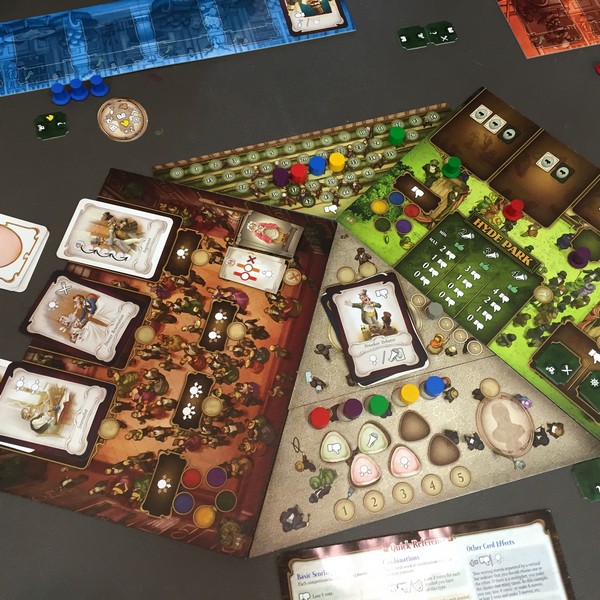
Anybody who has followed this blog for any length of time knows that The Prodigals Club is one of my favourite games.
So this review may be a bit superfluous.
However, I’ve never really talked in detail about the game, so why don’t we rectify that?

The Prodigals Club was published by Czech Games Edition in 2015 (wow, 10 years old now!).
It was designed by Vladimír Suchý with wonderful artwork by Tomáš Kučerovský.
Suchý has gone on to design so many wonderful games, some of which are near (if not in) my Top 50 games that he’s close to my favourite designer (though I guess Shem Phillips and SJ MacDonald from Garphill Games probably steal that category).
This was an extension (not an expansion) of the wonderful Last Will, in which you are trying to blow all of your money, just like in the movie (both of them) Brewster’s Millions.
In fact, you can actually play Last Will as the Possessions module in The Prodigals Club! Though I’ve never tried it.
The Prodigals Club takes that basic premise and expands on it.
Not only are you trying to go broke (though you are), you are also trying to have everybody hate you in the political sphere (getting down votes) as well as your position in society (exemplified by your standing with four friends, two male and two female).
In classic Knizia fashion (or at least some of his games), these three spheres are all scored and your score is the most of the three.
Unlike Knizia, though, you want a low score, so the one you score is the highest.
Trust Suchý to turn even that on its head.
It’s hilarious that you are trying to engender the hate that others want to avoid.

How do you do all of this?
Let’s take a look.
The Prodigals Club is a game that can fit your needs, both in time as well as in space.
There are three modules in the game: Political, Society, and Possessions.
You can play with just two of those three, and there are cards that are in the game to cater to that.
But the game plays best with all three, and I don’t think I’ve ever played with just two after I tried three the first time.
It just fits so perfectly, and it doesn’t really add much rules load to new players.

The game goes over five rounds (unless someone bottoms out one of the two or three modules before that) and it begins with action selection.
You are placing Errand Boys (top hats) out to either take that space’s cards, that action, maybe just do a small action, or what have you.
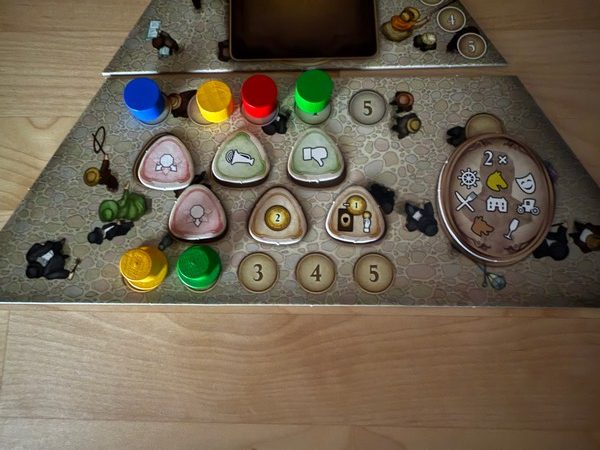
In the above picture, for the Possessions module, red has decided to trade a possession in, or maybe to sell two of theirs.
Green has decided to trade possessions.
Yellow has taken the cards from that space!
Everything is a balance, because it doesn’t matter how much you tank one or two of the areas, if your third area has a high number of points.
You can have negative votes, or negative society standing, but if you still have a bunch of possessions, you will still lose.
That’s where the card play and action selection comes in.

The card in the centre will always have to do with any of the two or three modules that you are dealing with in the game.
In a nice twist, the cards available for the centre are based on which modules you are using, so you will never have a Political card if you’re not using the Political module.
Each module will have its own board (the above picture is one of our rare games with only two modules), and the cards there will only have to do with that module.
In the picture above, the cards on the left will only affect the society module, where you are trying to tank your reputation with your friends circle. The right board is the political module
Let’s look at the modules individually.
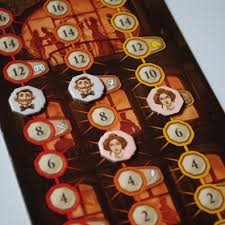
The society module has four of your friends on the track, and you are trying to lower your relationship with each of them using cards or other actions.
Some of the cards you will play or gain, as well as some of the actions you choose, will lower these markers, either straight down or diagonally.
What will really be annoying about this, though, is Dame Beatrice is always trying to talk you up to whoever she meets.
This won’t help you lower your standing!
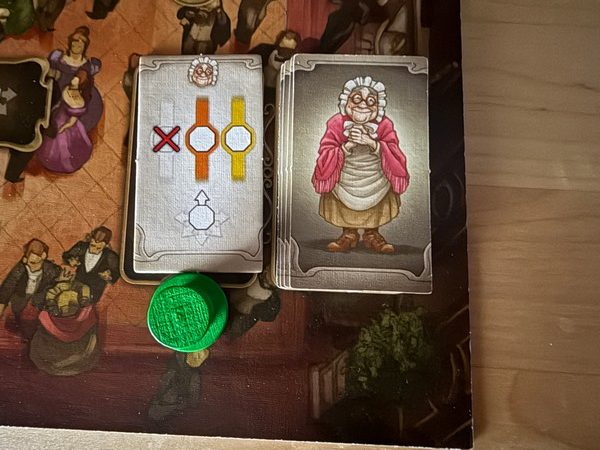
Each round, any of your friends who are in the columns or the situation on her tile will move up one space.
You don’t want that!
On the Political front, you are trying to get down votes (really just losing votes, as you start with a bunch) to have people not want to vote for you.
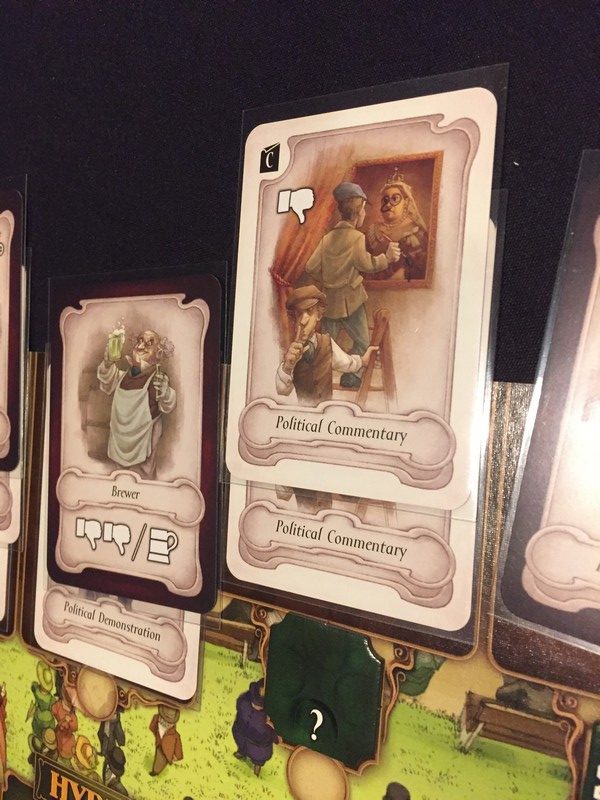
You can gain cards to play that will give you down votes, either for starting a karaoke session in a local bar, or maybe just writing (or being featured in) various political papers.

And sometimes people will decide not to vote for you because you’re obnoxious at dinner or you leave your mansion in terrible condition.
The Political module also has tiles (the green ones in the picture above) that you can take and place together to get symbols you need and, if you are able to do it, form political circles that will also tank your reputation.
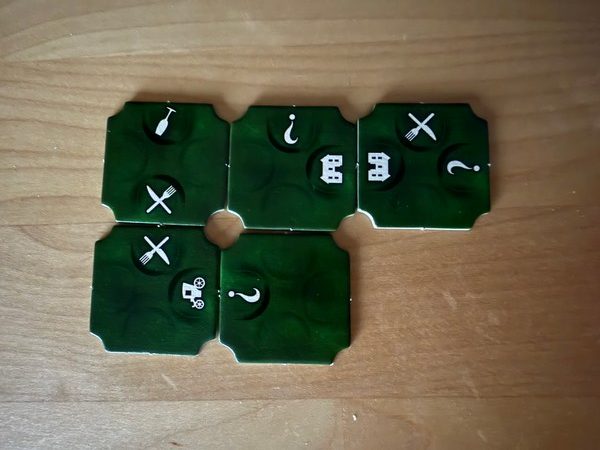
Forming a circle (the little circle when you have four tiles in a square) will allow you to lower any one of your standings in any module.
The trick in politics is to be as obnoxious as possible.
That’s why, at the end of each round, whoever has the most megaphones will lose votes, with others coming in second or third losing fewer.
Whoever has the fewest megaphones will actually gain votes!
Mainly because with everybody else being so annoying, you look good in comparison.
Finally, you are trying to go broke by selling all of your possessions and losing all of your money.
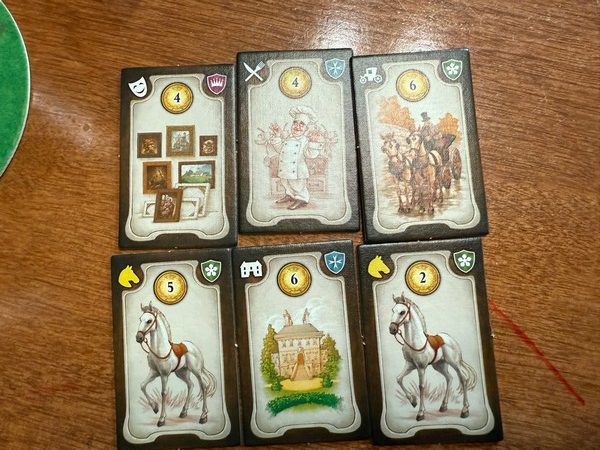
You start with some expensive possessions, and you are trying to either sell them (and then get rid of the money), or downgrade them to cheaper possessions before selling them.
Ultimately, you will probably get at least some money for selling them (though not if you’re good!) so then you have to spend your money on other stuff.

All of this results in a push-pull where you have to decide what area you want to focus on in that turn.
There are also actions that you can take with the Errand Boys (top hats) that you are putting out.
You can take a tile that lets you move one of your friends down in certain ways, or you can just put your Errand Boy on a space that will let you spend a pound, move a friend, or gain you megaphones (or political tiles).
In the picture above, on the left, you can just place an Errand Boy in that space (there’s a space for all players, so it’s not blocked) to spend a pound, plus one pound for each “Extra Time” card that you have.
The card play in The Prodigals Club is what really makes the game shine.
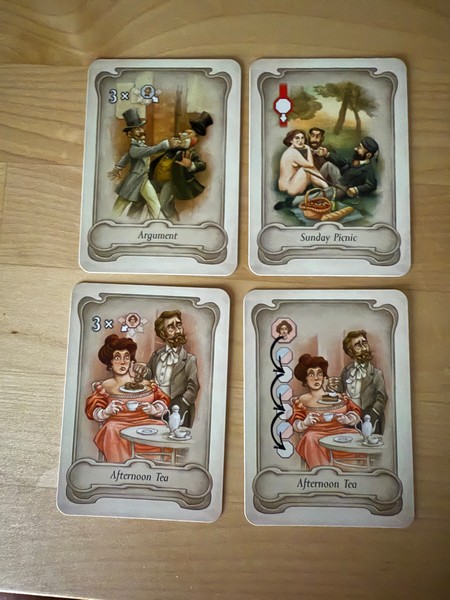
Some cards you take are white, which means you have to play them for an immediate effect and then they go away.
The brown cards are played to your player board (maximum of 6, but you can always remove somebody if you need room for another).

These will give you once-per-turn affects that will let you do things like sell a possession, give you a down vote, or maybe move your society friends down their tracks.
Sometimes both!
These cards (and even some of the one-time cards) are where the various symbols come in.
There are a number of symbols in the game (wineglass, dogs, horses, ship’s wheels, etc) and some cards will have you lose stuff based on how many of those symbols you have.
You can get those symbols in a number of ways.
Political tiles have to be joined together with matching symbols, which will give you an eternal symbol. In the above picture, the tiles give you a permanent dog, house and wine glass.

Also, where your friends are might give you certain symbols.
The rightmost female friend will give you a horse symbol, while the central male friend gives you a car.
That’s why you have to time your actions and card play to make sure you get the symbols you need before you actually move the friends.
Also, your possessions will give you a symbol as well.
So don’t sell that possession with the dog on it until you have used the cards that require dogs!
That’s the beauty of The Prodigals Club: the intricacies of how everything goes together.
Timing your movements so that you get the symbols before then moving them off the symbol or selling the possession that gives it to you.
Moving your friends so that they are not affected by Dame Beatrice (or just placing an Errand Boy so that you’re not affected by her compliments).
This is kind of a worker placement game as you are putting your Errand Boys out in player order, so turn order can be quite important.
Somebody could easily take the cards, or the tile, or whatever, that you were counting on.
You can place an Errand Boy out to just determine next round’s turn order, and that also gives you a tile to let you do one of a number of things, which is a nice benefit so you’re not just wasting him to get first player next turn.
After all of the Errand Boys have been placed, you can play all of your cards (or as many as you want, though your hand size at the end of the round is four and you have to discard extras). This can be done simultaneously if you just want to keep the game moving, or if you want to revel in what each player is doing, you can do it in turn order.
I can go either way on that, but I like the option of simultaneous to keep the game from stretching beyond a good time limit.
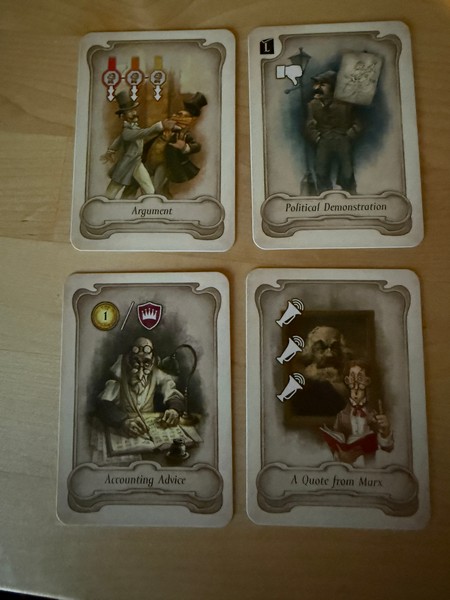
During the card play segment, you can play any number of white cards for their effect.
You can also play the brown cards to your tableau (discarding a now-useless one if you need to) and then use their effects as well.
The white cards can be quite lucrative depending on your situation in that respective module.
The card that lets you leap frog a friend over your other friends takes pains to set up, but it can move the friend down a great deal if you can do it!
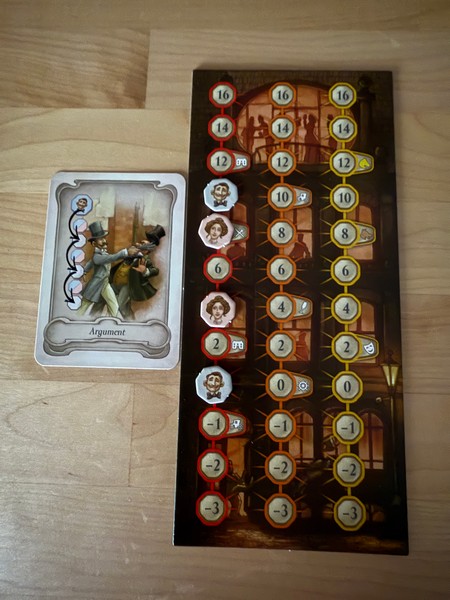
Hold on to that card until you can set it up.
In the above setup, the topmost male friend will jump down from 10 value to -1!
The kick for me in The Prodigals Club (and, to an extent, Last Will) is that you are actively trying to get the lowest points.
Usually in games where you don’t want points (many trick-taking card games), you are trying to avoid gaining points.
It’s rare that you are actively trying to lose points, and that’s another thing that makes The Prodigals Club so good.
It’s that push-pull between the various modules that really holds my attention.
I’ve mentioned this before, but this game is great because I often feel like I’m not doing enough in one (or even more) module but then I seem to have balanced things enough to do relatively well.
I’ve won games where I thought I was doing terrible in a module.
I’ve also done well but not well enough, which is fine.
This is just an impression from memory, but it’s very likely (but not certain, if you are that good) that if you are the person who ends the game by going broke/getting negative standing/losing all of your votes, you’ve likely not done well enough in at least one of the other modules to actually win the game.
Which is another positive for me compared to Last Will, where all you are trying to do is go broke so having negative money will most likely mean you win (but not always).
I think there’s just something about being a miscreant that’s appealing, as long as it’s within the fantasy of a boardgame.
The society module can be quite daunting, trying to move all of those friends down (and avoid Dame Beatrice), but sometimes that’s the easiest to do because with the right cards, or just actions, you can move your standing with them down quite easily.
But you do have to pay attention to it.
Overall, I think this game will stay in my Top 10 (or at least Top 20) for a long time because it is just that good.
Intricate mechanisms, hilarious stories (if you’re one to create a story about how you are pissing people off), and a game where turn order can matter a lot, this is a game for you.
I will say that setting up the game can be a bit of a bear, making sure that you have all of the right cards shuffled and placed in the right order (this doesn’t have as much deck shuffling as Eldritch Horror, but sometimes it feels like it), and it can be easy to somehow miss where a card should be placed each round.
Our last game, we ended up with one extra card (you do end up using all of the cards, which is also a nice feature) because one hadn’t been placed properly in a previous round.
If setup is the only major negative in a game, though, you know you have a good game.
It also plays 5 players really easily, which can be valuable for those game days where you are faced with that situation.
You should definitely try this one out if you can.
(This review was written after 9 plays)
 Dude! Take Your Turn!
This sounds like such a fun twist on games and life in general. Tempting me!
LikeLiked by 1 person
You know you want it!!!!
LikeLike
I’ll have to check to see how much it is…
(usually the first step to a package on our doorstep)
LikeLiked by 1 person