Dude! Take Your Turn!
A Gaming Life
New to Me – January 2026
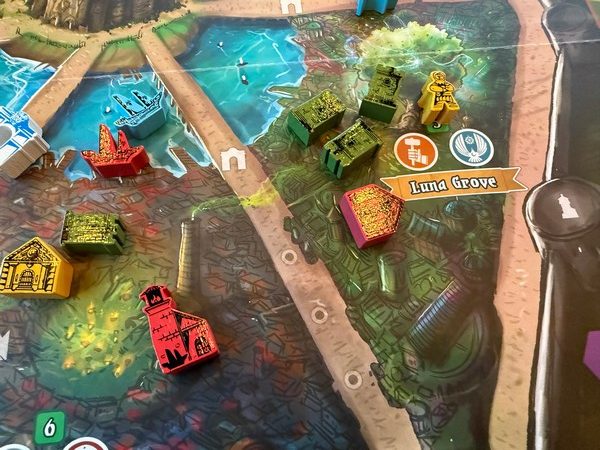
January 2026 wasn’t a huge month for new to me games, though the ones I did play were very fun.
That may change in February, though, since a friend of mine has bought a few games I’ve never played, so we’ll get some of those done!
In the meantime, though, there were only four new to me games in January, and the Cult of the New to Me was not very happy with me.
That’s because two of them are from 2024 and two from 2025.
That’s too new!
They were giving me the stink-eye when they saw the list of my games played.

I weathered the storm, though.
Buying them new PS5 consoles might have something to do with it.
Just sayin’!
Anyway, let’s move on.
Without further ado (all of my ado was used to move up some track anyway), let’s begin!
Castellans (2024 – Daily Magic Games) – 1 play
Designer: Isaias Vallejo
Artist: Mihajlo Dimitrievski
Players: 1-5
Castellans is the “latest” (as in I got it a year ago but am just now playing it) game in Daily Magic’s “Don’t you dare say ‘of Valeria'” system.
(What that means is that future Valeria games will be in the “Valeria Universe of Games” instead of having a title include “of Valeria”. Which I will kind of miss)
Anyway, this is an area control game of sorts and is probably the most complex game (or at least the game with the most different things to remember) in the whole line.
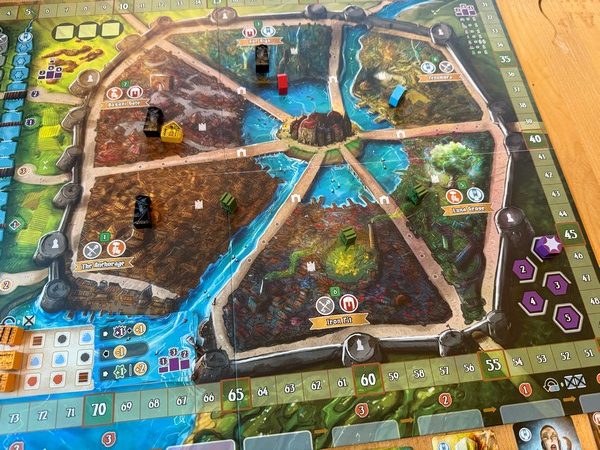
Essentially players are competing to build the most prestigious areas in the city of Kosk (I forget whether Kosk has been mentioned before, and why the heck am I using so many parentheses?).
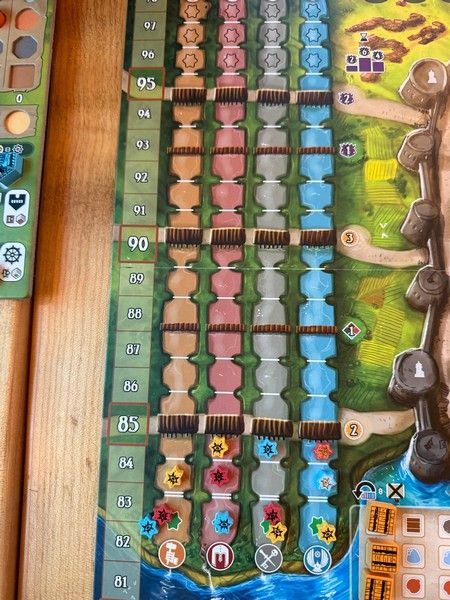
Doing that will require drafting dice, taking actions, and trying to move up the four different guild tracks to try and get the most prestige.

Yep, there are tracks!
Each player board has a bunch of different types of player buildings that you will spend actions to put out on the board.
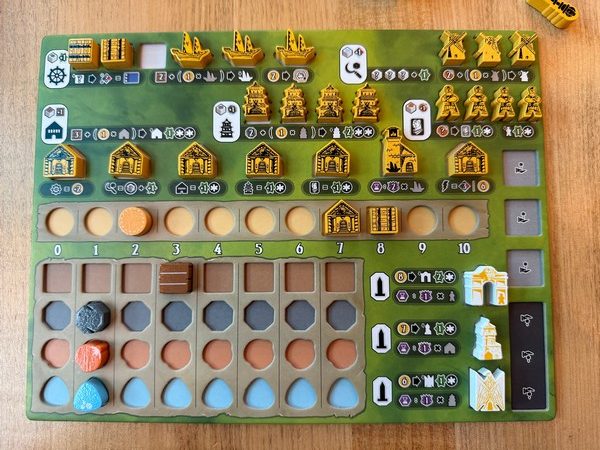
It looks really pretty!
The dice drafting is essentially the first player rolling all the dice (3 dice per the number of players plus 3 more, so 4 players would get 15 dice).
Then they take turns drafting a die, getting the resource on it and then gaining the die to use for an action during that part of the turn.
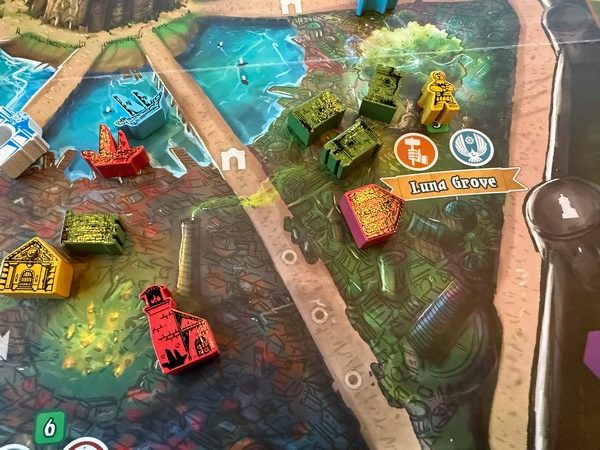
Building in areas of the city will get you track bumps in each guild that is housed in it, and you can get extra track bumps pretty easily.
In the first four rounds, once all actions are done, three different districts will score (the scoring districts rotate, but essentially each will score twice).
In the final round, all of them will score.
The scoring is done by who has the majority of pieces in the area, with certain caveats, like a Windmill that’s bordering two districts will give you 0.5 influence points toward control in both both districts.
The number of different types of actions in this game can be a bit brain-burning, and trying to focus will get you working hard.
Many actions will have secondary actions as well that you can do, if you can afford them.
And using the right type of die for an action will also get you bonuses.
In our game, we only got through round 4 because we had to leave, but I’m looking forward to getting a full game of this in to see how it works.
The Hobbit: There and Back Again (2025 – Office Dog) – 1 play
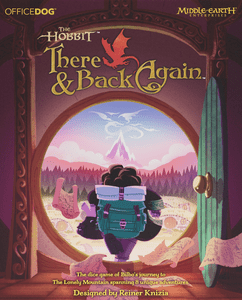
Designer: Reiner Knizia (solo designer: Marceline Leiman)
Artist: Lorenzo Colangeli
Players: 1-4
The Hobbit: There & Back Again is a kind of roll-and-write and kind of dice-drafting game.
What does that mean?
All of the dice are rolled, you take one and use it to draw a path or mark down resources or whatever.
When all the dice are gone, the next player rerolls them all.
Is it the best of both worlds?

Go, Sammy!
(I’m really dating myself, aren’t I?)
Anyway, the production quality in this game is wonderful, where players will have a book that they can turn to each scenario and the dice mean different things for that scenario.
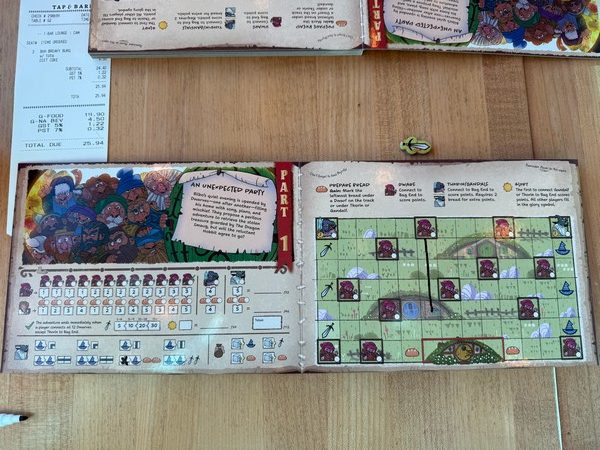
We only played the first scenario, where you are trying to guide Gandalf and the Dwarves to Bilbo’s house (you did know that this is a Hobbit/Lord of the Rings game, right?), an event that happened in the first part of the book.
The dice have many different faces, though some dice have different ones (or a different orientation, anyway).
They can give you swords, bread (you need bread to feed the dwarves as they arrive, though the bread may do something else in subsequent scenarios), wizard hats (which can give you a one-time bonus drawing, bread, or swords), and most importantly, movement!
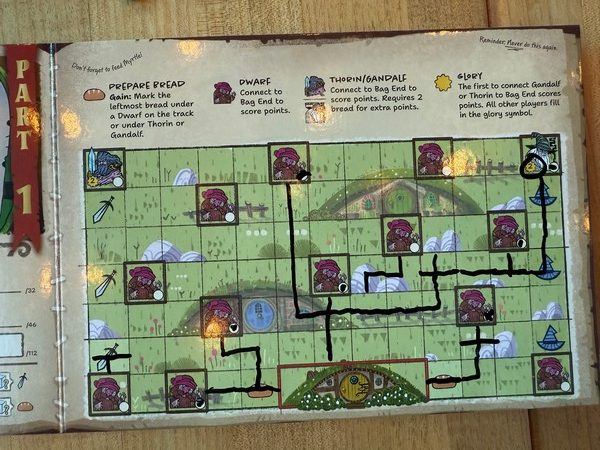
The movement paths on the dice will indicate what you have to draw and what the orientation of it is (if it’s a bend.
You will be getting points for getting the dwarves to Bilbo’s house. If you can feed them, then you get even more points!
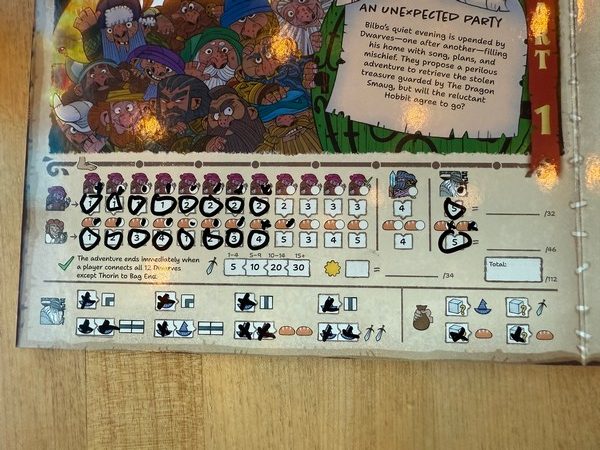
All of this is marked off in an orderly fashion.
Once the scenario ends (however it ends, and whichever scenario you’re playing), total up all the points scored and whoever has the most is the winner!
This game was very pleasant and fun, though it would not be a go-to game for me.
It’s not something I would say no to, especially because it’s only a 45-minute game (though I make no claim to whether future scenarios are longer or not).
I’d like to give it another try.
Spectacular (2024 – Chilifox Games) – 1 play
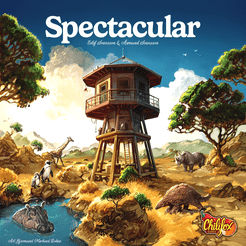
Designers: Eilif Svensson, Åsmund Svensson
Artist: Gjermund Bohne
Players: 1-6
Spectacular is another game about creating a zoo (or “animal park” in this case) that involves tile-drafting and dice-drafting in order to optimize your points.
This one involves making sure animals are together so they can breed, because otherwise they might die out.
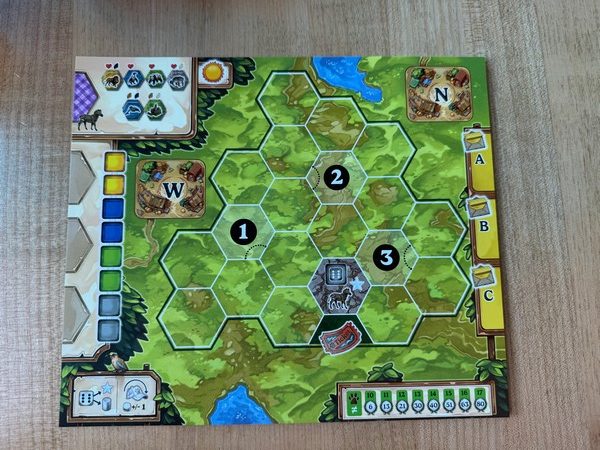
You’re going to be putting these tiles and dice on a player board.
Boards with dice and tiles will be passed around, though you will also have your own tiles and dice to choose from as well.
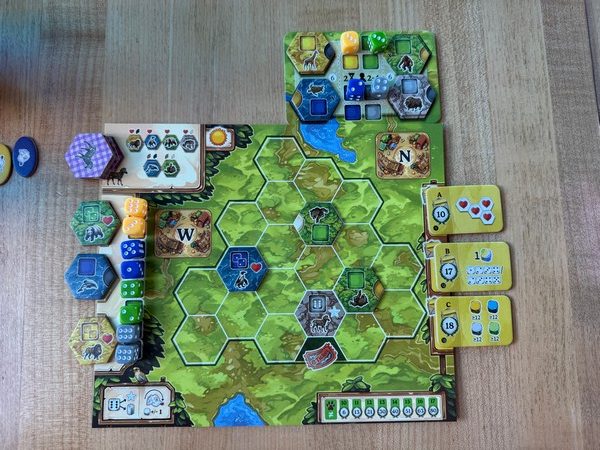
The “pass-around” board is at the top right while your tiles and dice are on the left side of your board.
You will take a die or a tile and place it on your board (the die has to go on an already-placed tile, of course)
You are trying to form connected tiles of the same colour, with as many breeding hearted-tiles (tiles with hearts on them) as you can, because that’s the multiplier for scoring.
The trick is that scoring involves dice values and breeding tiles can only take a 1 or 2.
You also have three goals that you are trying to meet, like above where four breeding tiles are together for 10 points, or a sector with steadily increasing numbers on it for 17.
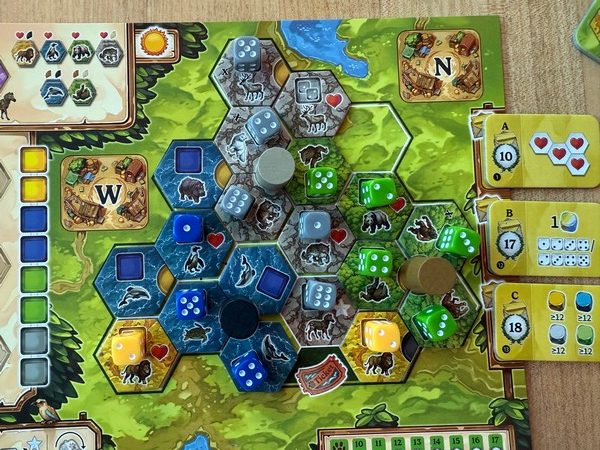
Finally, you’re trying for species diversity, because each tile has a species on it.
The more different types of species you have, the more points you will get.
Oh, also if you connect tiles with the same colour of pie-shaped circle segment in the corner, you can put a tower out, which will also score you points based on the dice around it.
You can see a grey, yellow and black tower above.
There’s also an intermediate scoring round that’s completely based on tiles linked to your opening gate (the big “Ticket” sign at the bottom of your board).
The game was fine, but the scoring seemed very weird, the intermediate round being completely different from what you’re going for in final scoring, and overall the game was just ok.
I wouldn’t say no to playing it again, but it’s not really on my “must play” list.
The Glorious Guilds of Buttonville (2025 – Ravensburger) – 1 play
Designers: Christian Kudahl, Erik Andersson Sundén
Artist: Matt Owen
Players: 2-4
The Glorious Guilds of Buttonville is a weird game.
That’s not necessarily a bad thing!
But it’s weird.
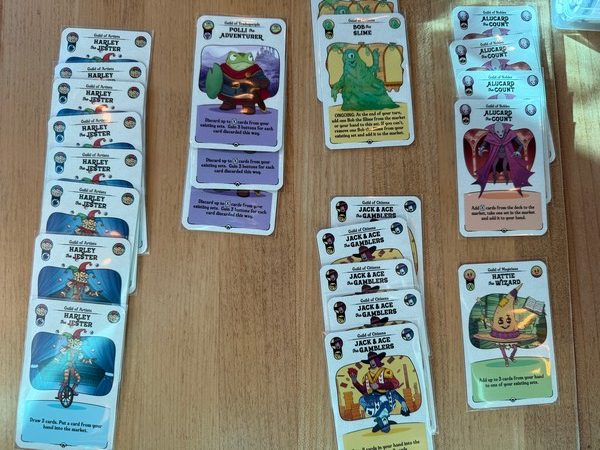
You’re trying to populate your town of Buttonville (or your own part of Buttonville, because everybody’s in the same town? I don’t know)
On your turn, you’re taking two cards, either from the market or from the top of the deck.
You’re trying to collect sets of the same person (who knew cloning was a thing in Buttonville!)
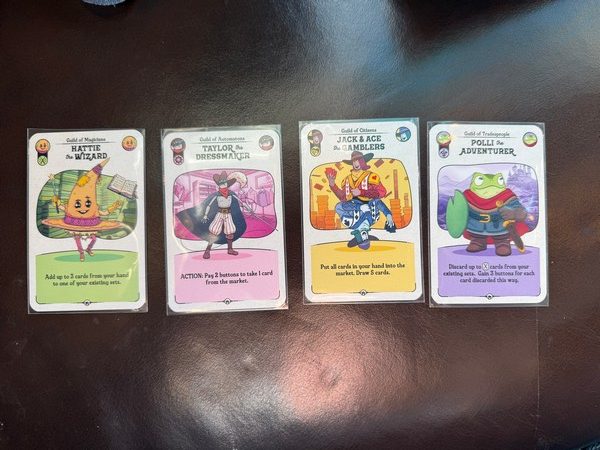
When you have enough in your hand, you can lay them down as a set and they may have an instant effect, an ongoing effect, or a bonus of some kind.
They may even have an action that you can do once per turn.
Hattie the Wizard, when you play her set, will let you add more cards to a set you’ve already put down (as long as they match, of course).
Buttons are also points (2 buttons per point) and can be used for certain actions, like Taylor the Dressmaker’s action.
What’s really cool about the game is there are a number of characters to choose from and you only use a small portion of them, which means almost infinite variety!
Ok, not infinite, but a lot.
Anyway, during setup, you set aside a bunch of cards as outlined in the rulebook.
When the draw deck you are using is empty, you use the set aside cards for a new draw deck, finish the round, and play one more round.
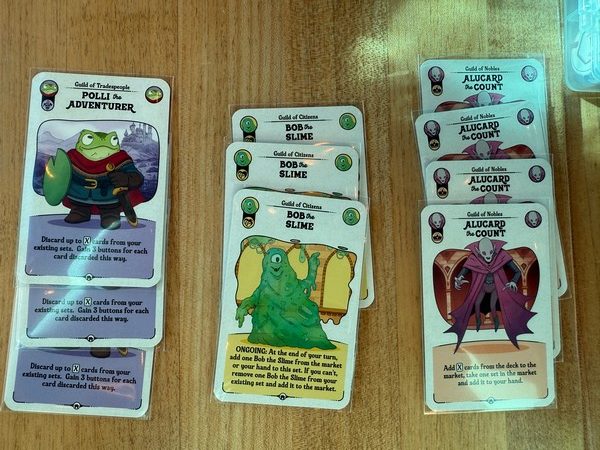
It’s an interesting mechanic because you get more points the bigger your sets, but you only have a hand size of 7 and you may not be able to get that many of just one character.
You have to lay down smaller sets because you want their actions or effects.
It’s an interesting game that I wouldn’t mind exploring more.
It’s also a very quick game, with ours taking 20 minutes plus the teach.
Perfect for lunch!
But yeah, it’s weird.
Anyway, those are the new to me games I played in January 2026.
I’ve also used up my parentheses budget for 2026, haven’t I?
I will have to put in for a budget advance for next time.
What new to you games did you play in January?
Let me know in the comments.
 Dude! Take Your Turn!