Dude! Take Your Turn!
A Gaming Life
Book Review – A Death in Berlin by Simon Scarrow
Since I did a “book series you should read” post about the first two books in Simon Scarrow’s “Criminal Inspector Schenke” series, I should probably review the third book now that it’s out and I’ve read it.
Right?
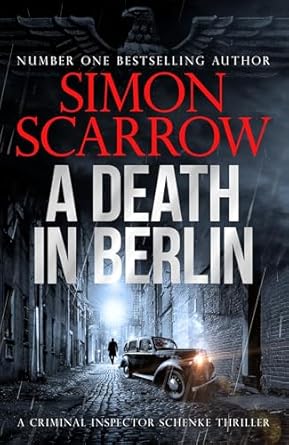
The third book, A Death in Berlin, finally resolves the Ration Coupon investigation that’s been going on throughout the first two books, in an intriguing and explosive conclusion that brings Kripo Inspector Horst Schenke to ally with some unsavory people in order to safeguard not only the German populace who are trying to get by, but also his own life when his Jewish lover gets caught in the crossfire.
This series continues to be incredible, as we see Schenke have to wrestle between being a cop who wants to do well by the populace but also has to weigh his position in an increasingly authoritarian state with the Nazis taking over.
The Kripo (the police force) have so far been fairly independent of the Nazi party apparatus in 1940 Berlin, but a new precinct commander, Oberfuhrer Radinsky, is overseeing Schenke’s division now, and the first thing he does with Schenke is tell him that he should join the Nazi party like many of his compatriots have done.
This is something Schenke has no desire to do.
He’s a law and order man, a justice man, and the Nazis have nothing to do with justice.
However, the counterfeit food ration coupons are a national problem and the government wants this dealt with as soon as possible.
Investigation of this results in Schenke getting immersed in the Berlin underworld and how its adapting to cope with the new Nazi regime, as well as corruption in that same regime.
When Schenke gets near underwater with one of the crime bosses who is using his Jewish lover as leverage to get Schenke’s cooperation in aiding him, he has to make a terrible alliance with another underworld figure to try and get out from under that thumb.
A Death in Berlin delves into the German underworld, with criminal organizations that are adapting to dealing with the new regime so that they can survive, spreading money and influence around so that they can maintain the status quo as far as they are concerned.
Schenke gets involved when a member of one of these crime organizations, a nightclub owner and his girlfriend, are ambushed in a dark alley. The mobster is killed but the girlfriend manages to live.
Further investigation leads to corruption among the food ration coupon production process and Schenke has to navigate all of that in order to make sure the Party doesn’t come down hard on the whole process.
The “Berlin Wartime Thriller” series continues to shine, even though this book is probably the least of the three. It was still enjoyable.
Watching Schenke have to navigate the Nazi party protocols, trying to maintain his distance while still trying to make sure justice is done, is incredibly gripping.
It’s extremely fun to watch his uncomfortable feeling as Radinsky invites him to a party at his place where numerous Nazi officials will be attending, and especially his meeting with Hitler that makes him extremely uncomfortable..
Scarrow doesn’t hide away from how hideous the Nazi regime is, but he concentrates on Schenke and his attempts to keep himself at arm’s length.
The other two characters on his team, Sergeant Hauser and Liebwitz, are still extremely interesting. Liebwitz is an ex-Gestapo agent who is slowly becoming a part of Schenke’s group and realizing what the rough waters of party membership is producing.
He’s hilarious as he’s so earnest in his desire to stick to the rules, but yet he also sometimes thinks outside the box.
Hauser has no use for this regime, but he’s also not one to rock the boat.
I was a bit sad, and this is why this book isn’t as great as the original two, that the two female characters don’t really have much to do.
Schenke’s former girlfriend, Karin, who kept pushing him to oppose the current Nazi regime when they were together, has left him and is now with a Luftwaffe soldier.
There’s no indication in the one meeting between Schenke and Karin that she has any problem being with a German military officer, and what her current views are regarding the regime.
Have they changed at all? I would presume not, but we have no idea.
They meet at a party, they both express their regret that things turned out as they did, and she disappears.
I hope future books actually bring her more into the narrative, especially because she is the niece of Nazi spy chief Wilhelm Canaris.
Ruth is a Jewish woman who helped in the first book, and Schenke has since developed a relationship with her, even while knowing that Ruth is forever in danger because of her ethnicity and the Nazis in power.
The two of them now have to carefully arrange meetings in Berlin or elsewhere, because Schenke can’t afford to be seen with a Jewish woman and Ruth could very well be swept up by the authorities.
Things haven’t reached the point where all Jews are automatically sent to the concentration camps, but they are all extremely inhibited, unable to get many jobs and live a normal life.
There are a couple of meetings between the two, where Schenke declares his love for her and Ruth continues to say that they can’t keep meeting like this until something really important happens, but then one of the Berlin mob bosses gets wind of the entire thing and uses Ruth against Schenke.
In other words, she’s mainly a plot device for Schenke, and a motivator for him to continue in the plot.
It’s too bad, because I do like Ruth’s characterization, but I would love to see more of these two women where their actions and motivations don’t have anything to do with Schenke (or at least make them independent of him and he just gets caught up in the crossfire since the series is about him overall).
That being said, the rest of the characters are great, and I love Schenke’s machinations in trying to get to the top of the coupon scandal.
The book ends with an assault on a criminal compound that is gripping but also brings the best parts of the book to a screeching halt.
Schenke gets put into an impossible situation, and the ending just kind of rescues him from it without him having to decide much.
Which is too bad.
All in all, A Death in Berlin is a great conclusion to the overarching ration coupon investigation, but I don’t think it all came together in as cohesive a whole as I would have liked.
The characters in this series are still standout, though I wish the women had more to do.
Scarrow’s prose and plotting is still top notch and this is an excellent addition to the Berlin Wartime Thriller series.
I do hope there’s at least one more book that takes it further into 1940 and beyond, when the Nazi regime is further tightening its grip on the German populace, and to see how Schenke navigates those waters.
At some point, you have to piss or get off the pot (to use a massive cliche, and sorry about that), and what level it gets to before Schenke does that will be fascinating to see.
While this is the least of the three books, I still highly recommend it.
 Dude! Take Your Turn!