Dude! Take Your Turn!
A Gaming Life
Wanna Join the Circus? – Scout Review
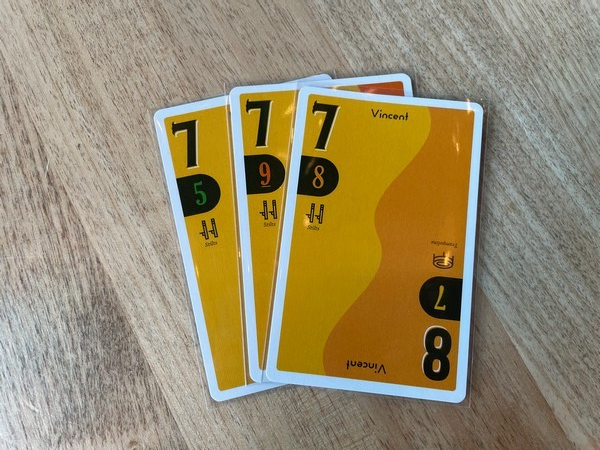
Joining circuses can be fun!
But who knew the process of joining was just playing a bunch of cards?
Do the cards with people’s names and circus skill set represent them being rejected when they are placed on the table? Or are the combinations of these cards placed down the groups of circus performers who are actually hired?

Ok, let’s forget the theme. No more circus talk.

Scout is a card-shedding game published by Oink Games in 2019. It was designed by Kei Kajino with art by Kajino, Rie Komatsuzaki, Jun Sasaki, and Shohei Asaoka.
Like many card-shedding games, players will be trying to lay down sets (same number) or runs (sequential numbers) in order to empty their hands.
This is called “showing”
However, Scout has some unique mechanisms that make it stand out in this crowded arena.
(That was a gladiator reference, not a circus one)
The first one hits you over the head as soon as the cards are dealt.
You don’t get to change the order of the cards!

The only thing you can do is flip your hand upside down (not your actual hand, but your hand of cards, because the former would probably be very uncomfortable).
Thus, any runs or sets will have to be there from the beginning.
Then the first player lays…something down…as a show.
If they don’t have even two cards that make a set or a run, then they can just lay down one card.

But hopefully they have at least two.
As in most other games of this type, the next player has to try and beat it.
If they do, they take the cards in the show they’re beating, each card being a point, and place their own show down.
If they can’t beat it, in Scout anyway, they must then…well, scout!
They can take one of the cards in the show (has to be one of the end cards if there are more than two) and put it into their hand.
This is the only time you can actually change anything in your hand, as you can choose either number on the card and then can put it anywhere in your hand.
That’s your turn, though.
The next player now has a smaller set of cards to deal with, so hopefully they can!
If they can’t, then they scout too, further diminishing the show.
Once per round, you can “scout and show.”
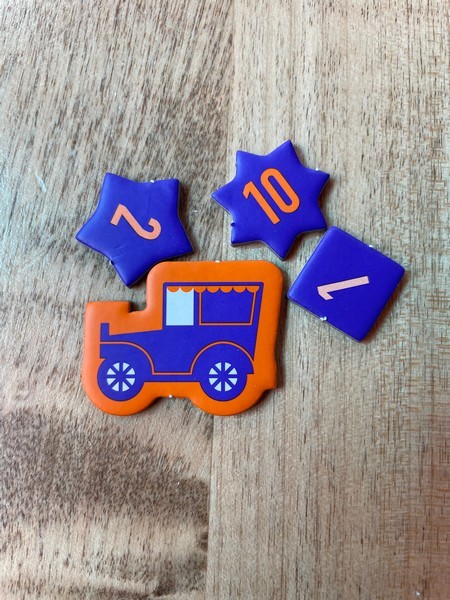
This means that you turn over your little car, scout (taking a card) and then immediately show cards that will beat what’s left on the table.
Whenever you do scout a show of cards, however, the player does get a buck.
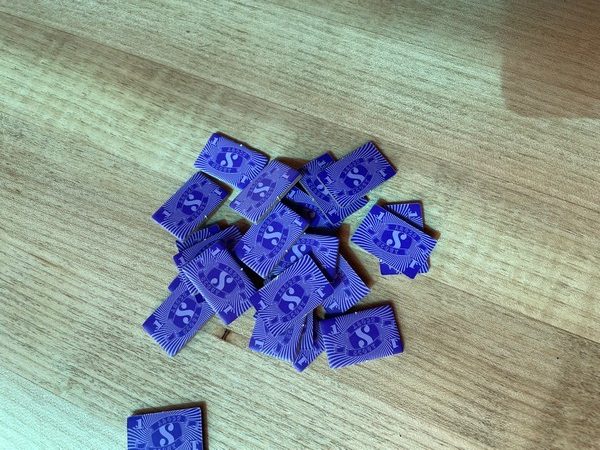
These bucks are points at the end of the round, so it’s not a bad thing for them.
(I know they’re not bucks, but they’re shaped like dollars, so just indulge me).
As soon as somebody shows their last card(s), the round ends and you total up your points.
Alternatively, if somebody shows a run of, oh, I don’t know…6 cards, say…and it gets back around to them with nobody being able to beat it, the round also ends.
I did that twice last weekend, but still didn’t win.
Is there no God?
Anyway, everybody else loses a point for each card in their hand (if the round ends by nobody beating the current show, the person who played the show does not lose points for their cards in hand) and then gains a point for each buck and each card that they captured.
Do you capture circus people?
Asking for a friend.
You play a number of rounds equal to the players and then total up all your points.
It’s that simple, though some people do have trouble with the “no moving your cards around” rule.
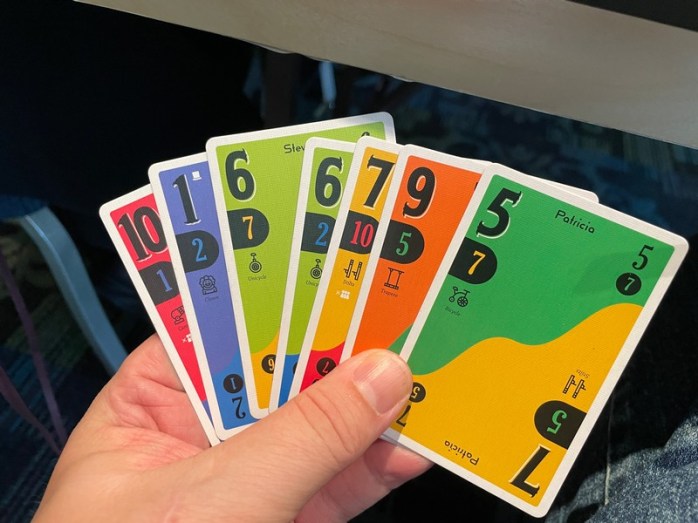
Don’t do it!
What you can do, if you want to be really annoying, is shuffle up your cards before you actually look at them, maybe because you don’t trust the dealer or something.
Paranoia can be a bad thing.
But once you’ve looked at them, they’re set.
I love this game so much. It’s a card game, randomness abounds!
But if you embrace the chaos, it’s just a hell of a lot of fun to play, and it plays fairly quickly too, depending on how many players you have.
Which brings me to my one caveat.
To me, this is a four or five player game.
Boardgame Geek says it can play 2, but I think that’s a variant?
It does play 3, but I don’t like it with that small a number of players.
If somebody shows 3 cards, the first player may have to scout, and there’s still two cards left.
If the second player can’t beat those 2 cards, the round’s over!
Just like that.
With four players, the hands that end the round prematurely have to be bigger, which is my preference.

The scout mechanic just makes this game sing, shrinking the show but giving the player a point, and letting you modify your hand some.
There are times when you might be able to beat the show, but scouting would give you a card that would let you play a huge show.
Sure, you’re giving them a point but you’re setting yourself up for something good.
There are a few tactical decisions to make in this game.
Not many, which is why I can see the game turning off some people.
But those people are turned off by card games anyway.
Euchre, anybody?
I didn’t think so.
The cards are beautiful and well made and the box is nice and compact.
Some people buy deck boxes for card games because they want to reduce the size of the game in order to transport it better.
If you did that with Scout, you’d actually increase the size.
There’s also a Target edition of the game, sold at…guess where?
This edition is nowhere near as good, in my opinion.
You don’t get the score chits and I don’t think the bucks are nearly as good.
But it is cheaper, and possibly more available, so there is that.
If that’s what it takes to get this game, then go for it!
But try to get the good edition.
Scout is an amazing card game that is perfect for work lunches, or as a start or end game for a game day/night.
You can’t go wrong with this one.
(This review was written after 7 plays)
 Dude! Take Your Turn!