Dude! Take Your Turn!
A Gaming Life
Seeing the Northwest Sights – Cascadia: Landmarks Expansion Review
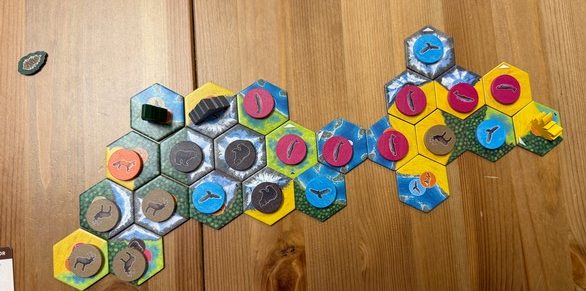
Having lived in the Pacific Northwest for over 25 years, I can definitely say that it’s one of the most beautiful areas on Earth, both on the US side and the Canadian side of the border.
Cascadia brought that to life with beautiful tiles, with prairies brimming with salmon (sorry, that never gets old…for me at least).
The only thing that game was missing is something notable to actually see when you’re travelling through all of that glorious nature.
What really captures your eye and makes you stop?
Landmarks.

Here comes Cascadia: Landmarks, the first (and so far only) expansion for this great game.
The expansion was published in 2023 by Flatout Games and Alderac Entertainment Group. It was designed by Randy Flynn, Molly Johnson, Robert Melvin and Shawn Stankewich with artwork by the incomparable Beth Sobel.
Landmarks add a bunch more habitat and starter tiles to the game, new animal scoring cards, along with the aforementioned landmarks and the ability to play with 5-6 players as well as the usual 1-4.
Thankfully, there are faster play rules if you want to use them at all, either for regular player counts or, especially, for the 5-6.
I can see 5-6 playing normally to be really slow, and definitely chaotic.
The new scoring cards are just variations on the usual theme, with a few interesting little quirks, like the Elk patterns where at least one has to be on a Prairie tile.

These just make you have to think about things a little differently.
The major additions to the game, of course, are the landmarks, and they add a little spice to the usual tile-placement gameplay.

Each habitat type will have three landmarks laid out that players can qualify for. They can only qualify for one of each type, even if they meet the qualifications type in the same habitat type.
The gaining of these landmarks is where the tactical decisions come in.
You qualify for a landmark when you place your a habitat tile so that one of the habitats now has five connected tiles in it.

When you place that tile, you can choose one of the landmark cards for that habitat, taking the marker and placing it on the tile you just placed.
That’s why it’s a decision.
Maybe you placed that tile because you want to eventually put an animal on it?
Too bad. If you take the landmark, that tile is now used up.

Thankfully, you don’t have to take the landmark this turn. You can wait until you add a 6th (or even 7th or 8th) tile to that habitat and take the landmark then.
Assuming nobody’s taken it already.
The landmark bonuses aren’t going to score you a ton of points, at least for the most part.

Some of them will just give you straight points while others will enhance your habitat scoring somehow.
This one basically makes you score two of your Forest habitats together!
There is another consideration with landmarks that actually is affected by a change in the setup process, so let me talk about that first.
In addition to a 3-hex starting tile, players will be drafting a fourth Keystone tile (a tile with just one animal on it that gets you a nature token when you put an animal on it).
This gives you four tiles to start with without any animals, or lots of options for animal placement.
However, each landmark you take will reduce those open spaces because you’re using up a tile along with placing an animal (unless you’re discarding the animal, anyway).
I didn’t really notice this too much in my first two games when I only had two landmarks, with the second one being gained really late in the game.

However, after I took my third landmark in my last game, I realized that I now only had two choices for placing an animal token out when I took my turn.
That made choosing a tile/animal combination a lot harder!
I almost took a 4th landmark (really late, so it wouldn’t have mattered that much) but I didn’t, since I realized that doing that would mean I would have to be able to place the animal token I took onto the tile that I had taken as well.
Otherwise the animal would have to be discarded because I would have no place to play it.
Landmark decisions are even more tactical than I had guessed!
I really enjoy what Landmarks brings to the Cascadia universe.
The decisions are even deeper and the nature tokens become even more valuable as your options diminish since they will let you adjust the animal tokens out there (or take a different animal token than the one beneath the tile you took).
Take note, though, that the game will take longer than it used to. Our original plays were fairly short, maybe 45-50 minutes.
Our Landmarks plays have taken an hour or slightly more.
Setup time is also affected because there are now 130 habitat tiles to use.
Our plays have all been 3-player games, which means we only use 66 of those tiles.
That’s barely half!
Sifting through all of those tiles and finding Keystone tiles to let people draft adds time, as does shuffling all the cards and dealing them out.
Not to mention the fact that, in lower player counts, you are removing a bunch of habitat tiles so there is the possibility of skewing some animal/habitat types.
I wouldn’t worry too much about that, as there are tons of tiles of each type, but it is something to keep in mind.

Overall, I would definitely recommend the Landmarks expansion if you’re playing Cascadia.
You don’t even have to use the landmarks themselves if you just want a bunch of new habitat tiles to add to your possibilities.
You never have to remove them once their integrated, as they don’t change any of the rules at all.
The landmarks themselves are a fun addition to the game, though.
Adding some points and some options, as well as some choices.
It’s just not quite as much of a lunchtime game now.
Which isn’t necessarily a bad thing when you can go over time a little bit.
(This review was written after 3 plays with the expansion)
 Dude! Take Your Turn!