Dude! Take Your Turn!
A Gaming Life
Creating a World From Scratch – Ecos: First Continent Review
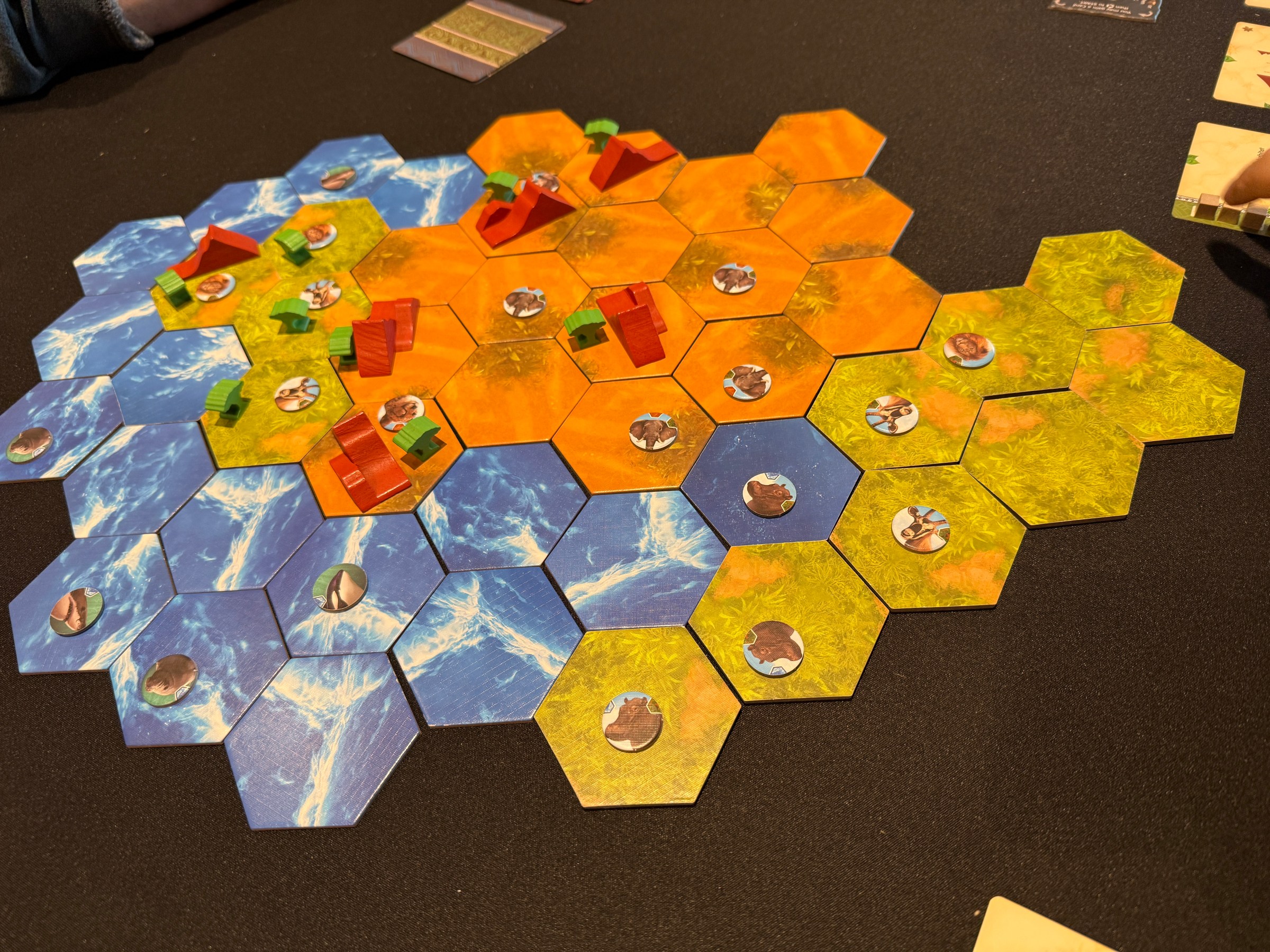
There was a farmer had a dog and Ecos was his name-o.
E..C..O..S….Uh, Mr. Clair? We need another letter please?
Thank you.
Why do I reference this old children’s song?
Are you a fan of Bingo but think you need something a bit more cutthroat that doesn’t involve old grandmothers “accidentally” knocking their neighbour’s bingo chips off of their card?
(Really, Grandma was ruthless)
Ecos: The First Continent may be the game for you.

Ecos: The First Continent is a world-building game (or continent-building, I guess. Maybe the other continents are already there, whose inhabitants are just waiting to exploit this one once it’s complete? Is that too dark?).
You are playing cards in front of you, having elements shouted at you, and then when the card is full, implementing the card.
(Hopefully they’re not actually being shouted at you).
The game was designed by the incomparable John D. Clair with artwork by Sabrina Miramon. It was published by Alderac Entertainment Group in 2019.
It’s also tile-laying as you build the continent with grasslands, oceans, and deserts (Oceans? So maybe those other continents don’t exist yet? It does say “first continent,” after all)
Confused?
You won’t be, after the next episode of…wait, sorry, wrong segue.
Let’s just get on with it, shall we?
(Can anybody younger than 45 tell me what that reference is?)
Let’s work through the references above piece by piece.
Bingo?
Yes, because you have cards in front of you with spaces to put a token.

You have a caller (or “harbinger,” because “ooooo fancy”) who is pulling tiles from a bag and naming the element on it.

When an element on one of your cards is called, you put a cube on the space.
When you’ve filled a card, you shout Bingo Ecos! (ok, try not to shout)
Or, you could shout “Yoinks!” or “Done!” or “Me!” or whatever you want, and even change it up each time!
You do you. I’m not here to judge.
When that happens, in turn order from the Harbinger, players execute their card.

Most cards will have you either adding to the continent, or adding animals to it, or sometimes both.
Soon you will be getting a fully-fledged continent that’s ever-expanding.

Or sometimes changing!
Some cards let you replace a tile with another type of tile (like the top left card in the card picture above…I’ll wait while you scroll up).
All cards will get you some points based on some criteria, and some even give you new elements to place on other cards so you can chain your Ecos calls together (please don’t shout “Ecos!” again, though).
Did I say “points based on some criteria?”
Let’s get to the cutthroat part that I mentioned above.
In our last play, one of us (was it me? I’ll let you guess while I sit over here in the corner crying) had a card that placed a land tile and then earned a point per tile for the smallest landmass (all adjoining land tiles).
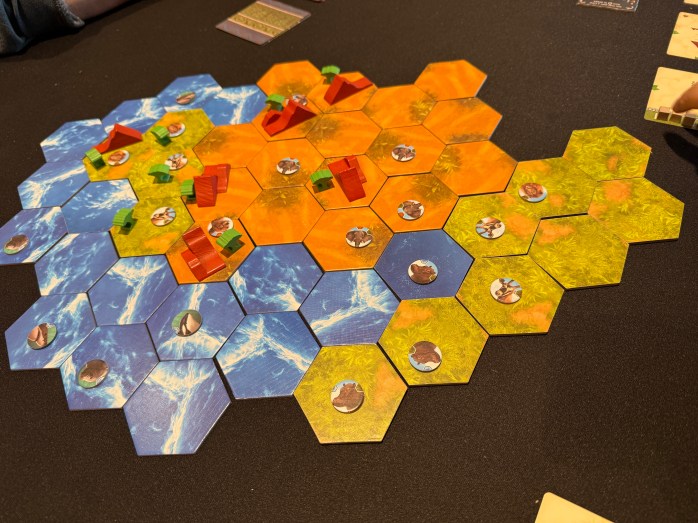
That got me him a whole ton of points because there was only one landmass (yes, this is the map in that game).
All it would have taken to neuter that would be for one of us to place a single land tile somewhere else adjacent only to oceans.
Suddenly his “mess of points” would have turned into…one point.
But we didn’t do that.
If we had, we would have been cutthroats!
Instead, we…weren’t.
But that’s the thing about Ecos: the cards you activate can really fuck with somebody else.
Have a player whose card keeps on letting them have antelope running in one direction to get a bunch of points?
It would be a shame if your card let you put leopards down who then proceeded to gobble up said antelopes.
No home on the range for them!
Really, Grandma had nothing on an efficient Ecos player.
All cards have a set number of activations before they leave your tableau, as indicated by the number of sides of the card with leaves on it.
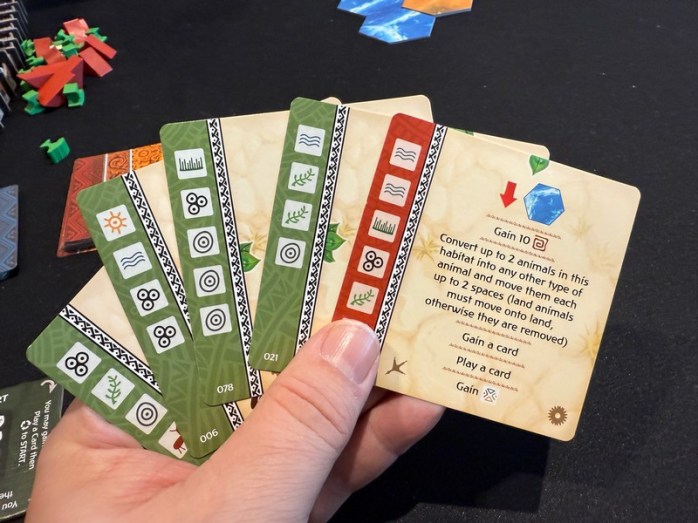
Some of the more powerful cards can only be used once (such as the red one in my hand above), as shown by the one leaf.
That card gets you 10 points right off the bat and also lets you convert two animals from what somebody else wants to what you want, lets you move them, and then you gain a card, can play a card, and you gain a Wild element on another of your played cards.
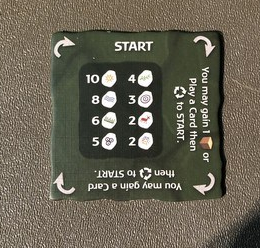
Having an element called that’s not on any of your cards does allow you to turn your tile (on the left side in the picture).
Once you’ve turned it twice, you can gain a card and reset it if you want.
One more turn will let you either get a cube (cubes are limited and you start with 7, though you can always move a cube from one space to another if you really need that Ecos call) or play a card from your hand.
Maybe play a card with that element on it that you don’t have out?
I like that pity action.
As soon as the Harbinger pulls a Wild element, the element bag moves to the next person and (after all Ecos calls have been resolved) the next person draws from the refilled bag.
In Ecos, you can play either a short game (60 points) or a long game (80 points). When somebody reaches that level, then play continues until the Harbinger pulls a Wild.
So a comeback is possible!
At the end of the game, you have a beautiful tableau of some kind.
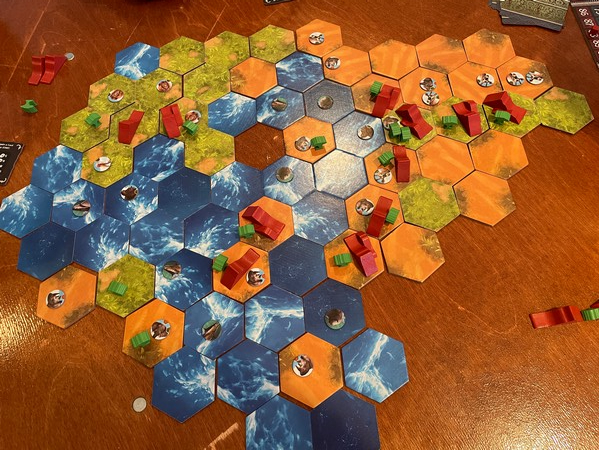
That is one bountiful continent.
I’m of two minds on Ecos: the First Continent.
I really do love the tile-laying, Bingo-calling, cutthroat nature of the game.
However, the game can really drag with downtime if multiple people are getting Ecos calls simultaneously.
Especially if they chain them.
Also, some of our plays, especially of the long game, have gone on extraordinarily long as well.
Some of that may be player-driven and not the game itself, but it’s something to be aware of.
The final round is really susceptible to that, if a player gets Ecos on one of the first tiles drawn and the Harbinger doesn’t draw a Wild token until the bag is almost empty.
There have been a couple of times where all of us were dragging and just wanting the game to mercifully end.

However, the last two 80-point games we’ve played, we’ve raced to 80 points and finished in just over 90 minutes.
Ultimately, the game is roughly 90-105 minutes long in our plays (with one outlier that took over 2.5 hours), but the game just feels long sometimes.
Whether the gameplay is worth that time commitment and feeling, that’s up to you to decide.
It may be too simple for that length.
What can add to the length issue, at least the impression of downtime if not actual length, is drafting your initial starting cards (you do have the option of just dealing them out if you want, though that can result in some imbalance if somebody gets great cards).
You’re drafting four blue cards and eight brown cards.
That’s a lot of waiting for people to decide on what card they want.
In reality it doesn’t take that long but it can sure feel long.
For me, though, the game is just a nice, leisurely world-building game with some fun bingo-calling.
The game is easy to learn though some of the cards do have some edge cases that require looking up how to implement them.
Not many, though.
I do want to reiterate that you can definitely screw with your opponents, so if you don’t like take-that in a game, stay far away from this one.
You will not be happy.
The artwork is gorgeous, the plastic mountains and trees have a nice tactile feel, and you can make a beautiful panorama out there, (or you can break it up into a lot of little oceans or grasslands if you are messing with your opponent).
Ultimately, Ecos: First Continent can be a restful game of world-building, as long as you don’t mind that hidden knife that’s suddenly in your back.
What’s not to like about that?
(This review was written after 8 plays)
 Dude! Take Your Turn!