Dude! Take Your Turn!
A Gaming Life
Hating on HATE
(Editor’s Note: A previous version of this post said that HATE was designed by Eric Lang. Actually, the Kickstarter page says this: “Created by the same design team who brought you the Zombicide series, under the supervision of Eric Lang…”. I regret the error and the post has been amended)
Yesterday saw the Kickstarter launch of one of the most divisive games that I’ve seen in a long time.
Why do I say “divisive?”
Because every boardgame content creator that I follow on Twitter (and I follow a lot) universally condemned the game but it also hit almost $500,000 in the first few hours, with almost 4500 backers.
What game am I talking about?
The new design from CMON Games, HATE.
HATE is based on the Chronicles of Hate graphic novel series by Adrian Smith. The world of HATE is a brutal post-apocalyptic world where tribes viciously fight each other for resources.
(All pictures are from the Kickstarter page)
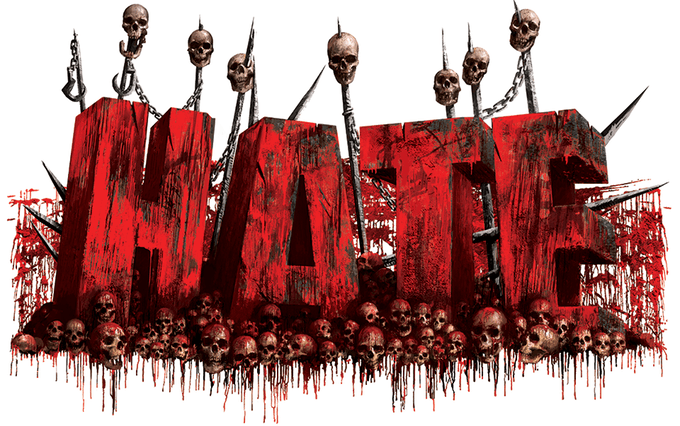
The first indication that this was going to be a divisive game was the trailer.
The trailer is full of sadistic and foul language in an effort to earn its “Mature Audiences” rating. The narrator emphasizes every “fuck” like he’s an 8-year-old who just heard the word, realizes that it pisses off his parents, and wants to keep using it as much as possible.
App Review – Patchwork
Patchwork is a game of grid-management, putting puzzle pieces into your grid in a much more efficient way than your opponent.
That’s basically what it breaks down to.
Since I am not the most spatially aware person around (I once tried to push a 5-inch object through a 1-inch hole), I don’t really care for these games.
In fact, when I played Patchwork on the table for the first (and only) time, I really didn’t like it.
When Digidiced put out an app for it, even though I’m a fan of their work, I had no interest in picking it up.
Then the other residents of the wonderful Stately Play web site forums decided to do a decathlon of various mobile games, and Patchwork was chosen as one of them. I told myself “fine, I’ll learn the game just to participate.”
Lo and behold, I ended up loving the game.
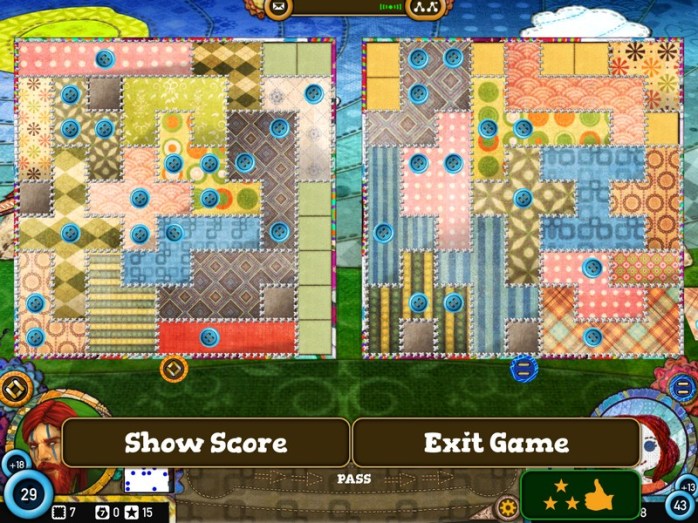
How can you not like a game where you make ugly quilts?
Top Games Played in 2017 – Honourable Mentions
I managed to play 100 games in 2017. That’s a record for me, I think. Some were new to me (58 of them) while others were old favourites.
Seven of my Top 10 games played were actually new to me, so they couldn’t have appeared on my list last year.
When I was going through the 100 games, I marked off the games that I felt might make my Top 10 and then checked to see how many I had chosen. Turns out that I had chosen 16. From that, I formed my Top 10, but that leaves 6 really cool games that could conceivably have made the Top 10 but didn’t quite do so.
So why not tell you what those are?
Hell, I need content, so why not?
Here they are, the Top 11-16 games I played last year, in no particular order.
Great Western Trail (2016) – Stronghold Games
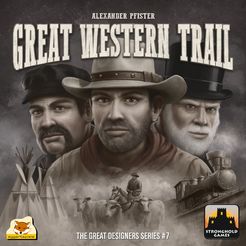
Designer: Alexander Pfister
Artist: Andreas Resch
Top 10 Games Played in 2017 (5-1)
Thankfully this post isn’t coming to you really late, like in mid-February. That would be a bit stale, wouldn’t it?
I wanted to get this posted last week, but a bad cold did me in.

Yes, Gollum, I agree.
I know you’ve been waiting with bated breath. I’m sorry for those of you who may have keeled over waiting.
Hopefully it will be worth it.
What were the Top 5 games I played in 2017? These are games not necessarily published in 2017 (though the oldest is 2015, actually), but just the top 10 games I played.
The top #10 – #6 can be found here.
The honourable mentions (11-17) can be found here!
Let’s find out, without further adieu (I think I generate a lot of adieu when I have a cold)
New to Me – December 2017
Posting this in between the two posts for top games played in 2017 because, well, reasons that will become apparent when the 2nd post comes out later this week.
It was a lean month for “new to me” games in December, but it was fuller than I expected it to be. I missed two Sunday game days, but had a couple of unexpected week day game nights to make up for it.
In a delightful coincidence, every new game I played in December was actually published in 2017, which gives me a tinge of “Cult of the New” as well!
Just don’t tell anybody, please. I don’t want to besmirch my reputation.
Here we go!
Clank! In! Space! (2017 – Renegade Games) – 1 Play (owned)
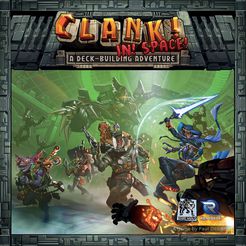
Designer: Paul Dennan
Artist: N/A
Top 10 Games Played in 2017 (10-6)
It’s the end of the year, and everybody in the boardgaming world is doing their “top picks of 2017” or some other variation of that.
However, I don’t play enough brand new games to make a list like that. This year was a record-breaking year with me playing 18 games that came out in 2017. Given that, though, over half of the games would be on the top ten list, and that really isn’t that interesting of a list, is it?
So instead, just like last year (on a different blog than this one), I’m going to do the “Top 10 Games Played in 2017” instead. I played a grand total of 101 games, so I think this can be a pretty good list.
This does not include any games that I only played online or in app form, so games like Race for the Galaxy and the like won’t be there (even though that app is killer and you should definitely buy it).
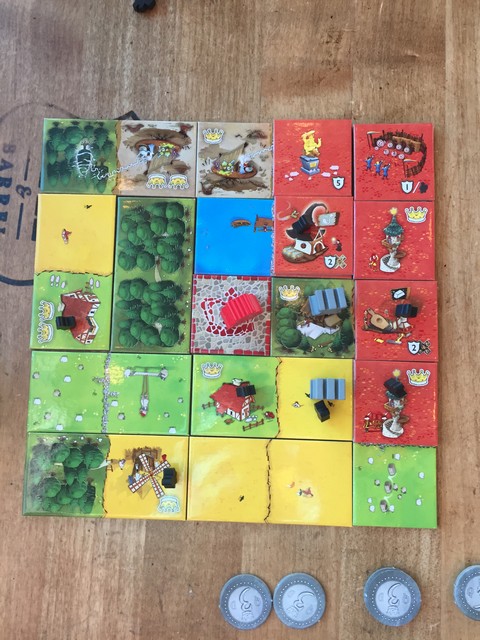
To prevent a too-long post, I’m splitting the list in two, and I had enough games that I was considering for my top 10 that I may even do an appendix as well.
So without further adieu, here are numbers 6-10!
App News – Race for the Galaxy goes to the Brink of War
I’ve been seriously neglectful of writing about boardgame apps recently, and it’s time to rectify that (I think I’ve been intimidated by Stately Play).
So how about a big announcement (though late, of course, since I was on vacation) about one of the best apps of the year?
That’s right, Candy Crush Saga has something new I’m sure.
But wait! That’s not what I’m talking about.
Race for the Galaxy by Temple Gates Games is certainly in the running for best new app of 2017, and it has a new expansion dropping tomorrow.
That’s right, I said tomorrow! (That’s what a vacation will do to you).
(Editor’s Note: Apparently, a vacation will also make you not able to read dates. December 14th is the release date, and your humble writer thought that was tomorrow)

Tomorrow will see the release of the Brink of War expansion for Race for the Galaxy (my fingers keep wanting to type “bring of war”) and it looks to be a doozy.
New to Me – November 2017
November was not looking like a good month for “new to me” games, but the last two weeks really picked it up.
I managed to end up playing four new games and two new expansions.
What is the Cult of the New to Me? Read about it here.
So let’s jump right into the gaming goodness.
Azul (2017 – Plan B Games) – 1 play

Book Review – The Bloody Triangle by Victor Kamenir
When I was a kid in Elementary school, I studied World War II history like no other subject. I totally exhausted our school library’s books on the topic.
Some even called me a warmonger (What? We were in 3rd grade).
That love of studying military history has never gone away. It’s just expanded to other eras.
But World War II is still my favourite.
So when I saw The Bloody Triangle by Victor Kamenir (2009), I had to pick it up.

This book is about the first days of the German invasion of the Soviet Union, namely a triangle of land stretching from the cities of Lutsk, Dubno, and Brody in the Ukraine. It’s considered the 2nd greatest tank battle of World War II, but it’s not really talked about much other than in general overviews of the German invasion.
It’s also well worth a read.
Boardgamers & Free Shipping – A Question
It’s Thanksgiving week in the United States, and we all know what that means.
Yes, yes, lots of turkey and family gatherings, and maybe some board games with said family (except Uncle Joe, who always seems to cheat).

But I’m not talking about the holiday itself.
I’m talking about Black Friday sales.
All of the online game retailers have started their Black Friday sales already (because nothing says Black Friday like a full week of deals!).
If you subscribe to the Boardgame Geek “Hot Deals” forum, you’re inundated with all of the cool sales stuff, along with those who have to post “Geez, nothing good in this sale. I’m glad I was able to save money. And why does it have to start at 2:00 am?”
One comment made in a thread the other day made me stop and think, though.
And you don’t like it when I stop and think (actually, I hope you do because that means you’ve read an interesting blog post).
Is “free shipping” worth it in all cases?
(Scroll down to the bolded question below if you are feeling “TLDR”)
 Dude! Take Your Turn!