Dude! Take Your Turn!
A Gaming Life
Review – Skies Above Britain
Solo air war games are pretty common out there in the wargaming field.
Of course, one of my favourites (though my sample size is admittedly pretty small) is the great Storm Above the Reich, designed by Jerry White and published by GMT Games.
But some people don’t like playing as the Germans in a solo game, rooting against the Allies.
Or maybe you think that game is a bit too straightforward and on rails?
Whatever your inclination, White and Gina Willis have produced a new game that literally (ok, maybe not literally, but it might as well) blows that first game out of the water in my mind.
Skies Above Britain is also published by GMT Games and came out in 2023.
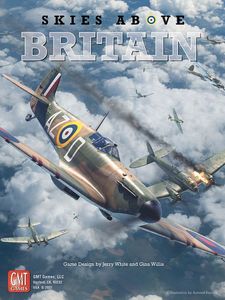
The artwork is by Antonis Karidis, Mark Simonitch, Jeremy White and Gina Willis.
It allows you to run a British squadron of either Hurricane or Spitfire fighters through the Battle of Britain in multiple chapters, trying to stop the Germans from bombing the hell out of Great Britain.
And it is amazing, if you like solo games.
Let’s see how it plays (a bit, as there is too much stuff in there to cover in total).
(You can avoid the “how to play” stuff by clicking here)
The first thing I have to say about this game and its rule book is that I loved the programmed introduction to the entire game.
You read the rules on dogfights with other German fighters, and then you run a couple of scenarios that just use dogfights and nothing else.
Yes, they’re a bit anti-climactic (most literally take you a few minutes), but they get you through the dogfighting rules.
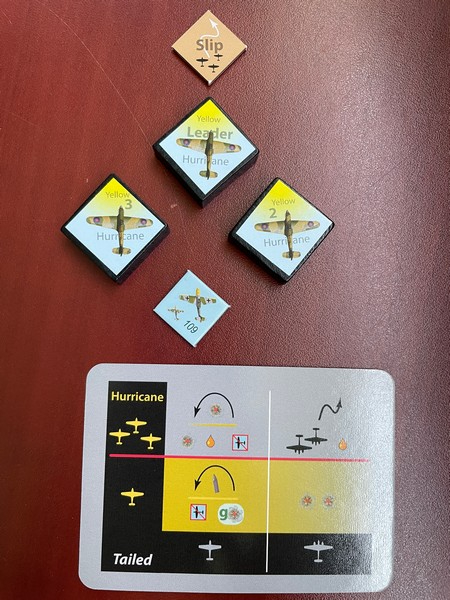
Then comes the Bomber cycle and how to attack bombers in the bomber formation.

Then how to intercept them.
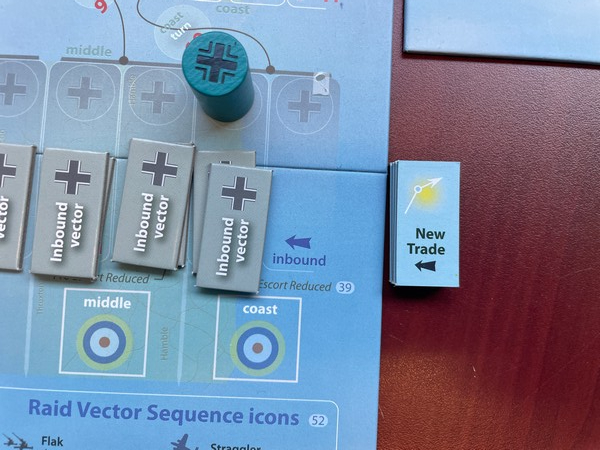
Finally it teaches you the Raid Vector sequence for how a bomber raid progresses and the British squadrons try to intercept them before they can drop their bombs (though that’s more of an example as you don’t run through any scenarios).
Once you’ve gone through the 11 scenarios, it’s time for the campaign!
The campaign is done in a series of chapters, each of which has a number of patrols in it.

You start by creating a roster of 20 pilots.
Unlike White’s previous games, you have to take into account fatigue when choosing pilots for a patrol. Pilots can only do two missions in a row before they start to become tired and need some rest.
Sometimes, if your pilot bailed out in the previous patrol, they’re not available for the next mission.
That’s cool!
You then get the Raid Vector markers ready to start flipping them over, one by one.
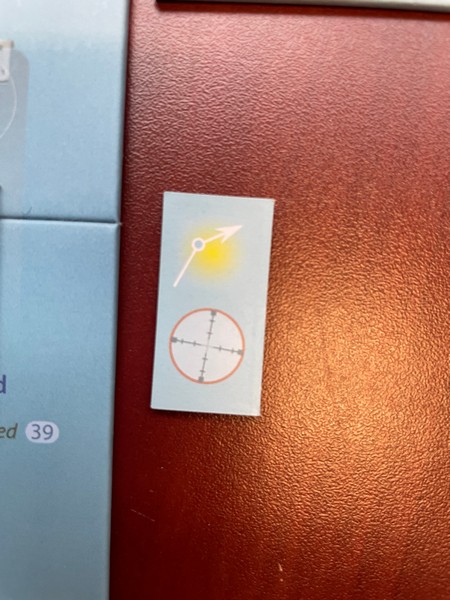
Some results on these tokens will begin the Raid sequence and if you get two of them, the bombers have already dropped their bombs and turned for home.
Meanwhile, you’re trying to get your formation into position to intercept the bombers before that happens.

Eventually you will get a chance to try and intercept them.
If successful, then it’s time to move to the Interception map!
This is when you also discover what German fighters are escorting the bombers.
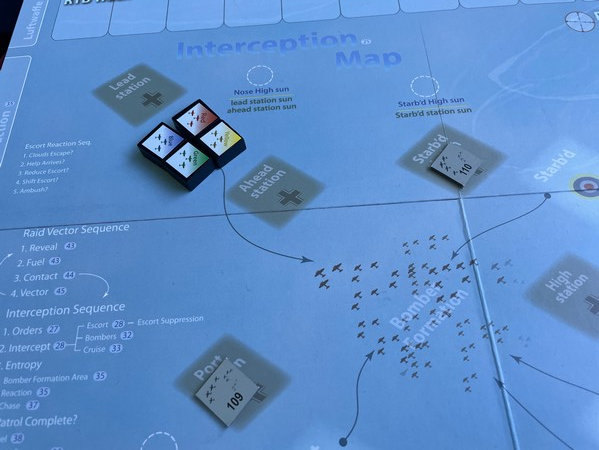
At this point, you are designating orders to your fighters to either try to enter the bomber formation or try to suppress the escort (because suppressing them may make it easier later, and definitely makes it easier to intercept bombers).
If you manage to get into the bomber formation, that’s when it gets fun!
You will then roll (if you haven’t already due to earlier events) to see what kind of bombers are attacking and how they are situated.
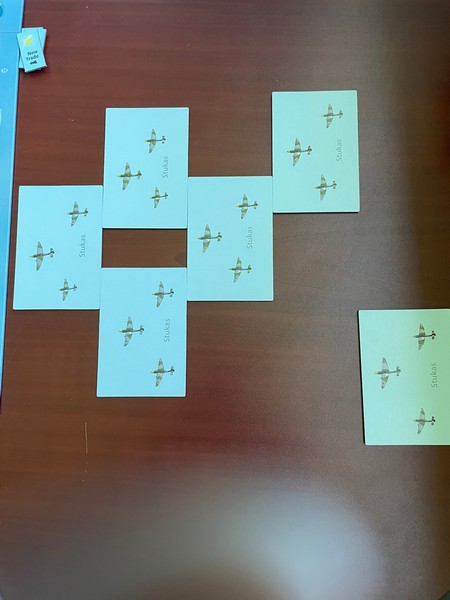
And you assign your fighters to attack individual bombers.

As with the other “Skies” games, you aren’t rolling dice on tables for results. You are drawing cards.
Essentially, prior to the bombers dropping their payloads, you are trying to isolate the various tiles in the bomber formation because each isolated tile gets you a VP.
Isolating tiles after they’ve dropped their bombs doesn’t get you anything.
Destroying bombers also gets you points, of course.
You may get into dogfights with some of the escorts, and that’s another interesting part of the game.

Destroying four fighters will get you a point, but you won’t usually down that many of them.
A lot of the time, there will be one pass, maybe two, and then the fighters will disappear.
You will also start running out of ammo pretty quickly.
The patrol continues with you hopefully destroying bombers (or at least damaging them), some of your fighters taking hits and getting knocked out, and possibly everybody getting jumped by German fighters if they stay in the bomber formation too long.
This happens until either the raid ends or you end up deciding to have all of your fighters return to base (or they’re knocked out due to being hit).
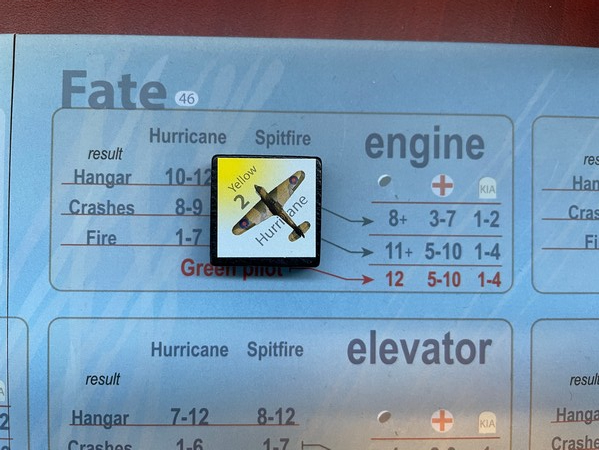
You then total up your VP and check to see the status of your knocked out fighters.
Hopefully they landed safely with their damaged Engine, or at least were able to bail out.
So far, after three patrols, I haven’t lost anybody and have had only one wounded.
Fourth patrol is ongoing, so that might change.
That’s a really bare-bones explanation of how to play the game, but I don’t want this post to go on for 5000 words.
Is Skies Above Britain a tale of heroism and accomplishment? Or is it a tale where my Uncle Nate claimed to shoot down 20 German fighters when he really sat at a desk for the entire war?
As much as I love Storm Above the Reich, I love Skies Above Britain even more.
It’s much more detailed than the previous game, providing even more of a story that’s fun to tell.
However, with that detail comes a lot more complexity.
There’s a reason there’s a programmed instruction method of teaching this game. If you try to play this game straight from the rulebook without doing the scenarios first, you will flounder.
Even with the programmed instruction, I’m still looking through the rules a lot.
The main player aid card has a detailed step-by-step through the phases that will guide you very well.
It’s just the specifics of things that I have to look up.
(That could be because my plays are interrupted a lot and go over multiple days because I’m playing at lunch and going back and forth to my computer to document the patrol for my AARs, though).
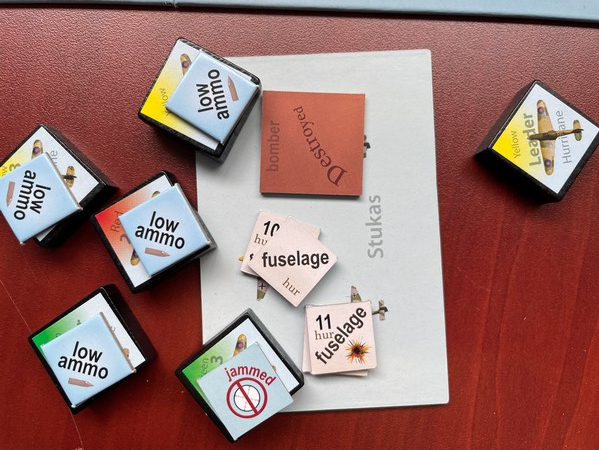
Using bomber tiles and getting points for isolating them (as long as you do so before they dump their load) is pretty genius, and helps mitigate how hard it can be to bring one of these bombers down.
Unlike the previous games, when you do use dice you will be using 12-sided dice in this one.
It seems like there are a lot of 10+ catastrophic damage markers (that could just be my impression, though) so I have rarely blown a bomber out of the sky.
However, isolating them (either an entire tile or each individual bomber) actually makes it easier to bring down.

You are seriously hunting these bombers.
You just have to hope the patrol lasts long enough (and your fighters have enough ammo) that you can actually shoot some down.
You are constantly weighing the chances of things happening and whether or not you should push on for just one more bomber round.
Those German fighters can be anywhere! It’s easy to get jumped.

And when you have fighters on your tail, it’s easy to end up in the Fate Box.
There is a lot of stuff to keep straight in this game (enough that maybe a good storage solution is the answer!) and it will take time to learn the intricacies of everything.
I wouldn’t say that it’s an overly complex game as far as the rules go, but there’s so much in there that it’s complex in that way.
It’s volume complexity, not rules complexity.
Thankfully, the player aid cards are really helpful in that respect, and they’re pretty well-organized too.
The inside of the Sequence of Play player aid has all of the icons that come up in both dogfights and attacking bombers, enough that once you have them down you won’t need anything else.
There are some details in some of the icons where the rulebook is very helpful, but the player aid is a good shorthand resource.
In a nod to both types of solo players, there are two sets of pilot rosters: a historical one and a blank one that you can fill your own names in.
That’s some customer service.
I enjoy making up my own names, and I managed to get 20 names with different first letters. I’ve grown quite attached to them in my first three patrols!
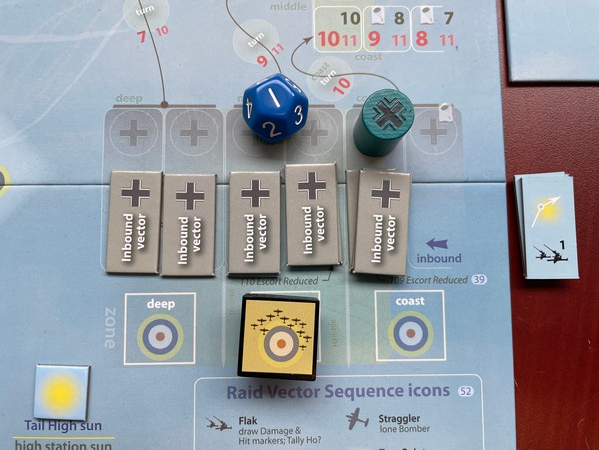
The Raid Vector sequence (and the part of the Intercept sequence where Raid Vector markers are turned over once you enter that sequence) is probably the hardest to get straight.
It’s not always clear exactly how you do this, when you stop turning counters over, when you start again and how it works once you are in the Intercept sequence.
Again, the sequence of play is pretty straight forward, but I’m talking about difficulty internalizing it so you don’t have to continually be checking the player aid.
However, it is a great addition to the genre and I like what it represents.
Flak hitting the bombers may do some damage which will help you when you finally intercept them, and oh by the way the flak may actually help you intercept them!
Your pilots are seeing the flak bursts and saying “oh, the bombers are over there. Blimey, let’s head over there and mix it up!”
You might run into a straggler bomber or two, which usually aren’t worth chasing because you will lose contact with the rest of the formation, but if you have Lost Contact fighters anyway, you might as well give them something to do.

I thought having my FW-190s buzz the American bombers in Storm Above the Reich was exhilarating, but having a bunch of British Hurricane fighters flying around a bunch of tiles of German bombers was even more exciting.
People talk about solo games and the narrative that they bring. Some solo games are nothing but narrative and really play by rote (I’m looking at you, Aces of Valor), but Skies Above Britain has a bunch of meaty decisions where you are weighing the odds of bad things happening and what you might accomplish before they do.
In the 4th patrol that I haven’t finished yet, I have a few Hurricanes still mingling with the bombers. Two bombers have three hits on them (four hits will kill them), but a few of my fighters are almost out of ammunition.
Sure, the first couple of Escort reactions (Heavy Me-109s) haven’t resulted in bad things happening, but the escorting fighters have now moved into a better space so the next reaction may get me jumped.
The bombers have also dropped their bombs already so they’re heading for home.
Do I stick around for one more sequence, definitely (or almost definitely) destroying two bombers, but risk getting a few of my fighters shot down as well?
Or do I just return to base with the 6 VP that I already have?
I’m not sure!
This is the kind of narrative I like, one where my decisions really feel like they’ve made a difference. Even if those decisions can be affected by bad card draws or dice rolls.

The dogfights do almost feel like an afterthought as nothing much happens in them before the Germans go away (usually).
However, you can get shot down, or maybe have your pilot get a kill, so that’s nice.
I think the only kind of negative thing I can really say about this game is in the dogfights and when they happen.
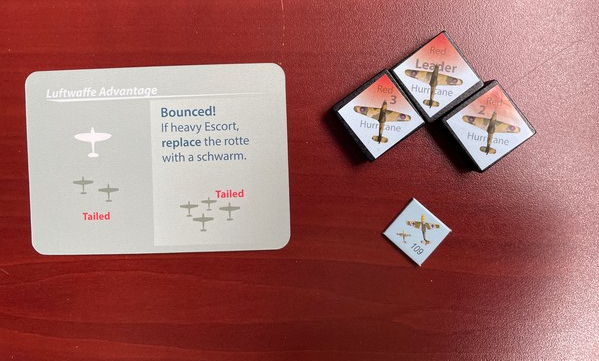
Depending on how they happen, you draw either an RAF Advantage card or a Luftwaffe Advantage card to determine how everything starts out.
While the RAF Advantage usually puts you on the German tails while the Luftwaffe Advantage cards get fighters on your tail, the events on the RAF Advantage card seem to have a lot of pro-German effects!
That’s kind of an impression, so maybe I’m wrong.

Anyway, I have to say that Skies Above Britain is an amazing solo game that if you’re into solo games, you should definitely give it a try.
Now that I’ve done my review, look for some AARs of my campaign to show up later.
Let me know what you think about all of this in the comments.
(This review was written after playing all of the scenarios and three campaign patrols)
 Dude! Take Your Turn!
Good review based on extensive experience!
LikeLiked by 1 person
It’s too bad that I forgot to really log my first patrol, so I’ll have to reconstruct it via my photos. LOL
LikeLiked by 1 person
Was in similar situation couple of times…
LikeLiked by 1 person