Dude! Take Your Turn!
A Gaming Life
Review – Underwater Cities
It would be cool to live on the ocean.
Beachfront property, your back door opening right onto the beach, listening from your balcony to the ocean waves crash on the shore, watching the lightning from a storm out over the water.
That would be amazing!
How about living under the ocean, though?
That would be very wet and hard to breathe…unless you had domes!
That’s kind of the premise of Underwater Cities.

The game was designed by Vladimír Suchý with artwork by Uildrim and Milan Vavroň.
It was published by Delicious Games and Rio Grande Games in 2018.
With population booming on the surface, it’s decided to try and colonize the ocean depths to help ease the burden on the planet.
You’re essentially building a network of domed cities that is self-sustaining, earning victory points in the process.
Because you know victory points will save the world one day.
But I digress.
When the game first came out, some people called it a Terraforming Mars killer.
And in the sense that you are now going under water and foregoing actually terraforming Mars, that’s true.
But as a game?
I don’t really see a lot of similarities.
The key concept in the game, and one that I find really intriguing, is the action selection and the card play and how they’re all intertwined like a fluffy hug that makes us all feel good.

There are three colours of cards and there are colour-coded action spaces on the board, also in the same three colours.
Each round you’ll get three actions, taken one at a time, though you can’t take an action that’s already been done in the round.
You’ll also have a hand of cards.
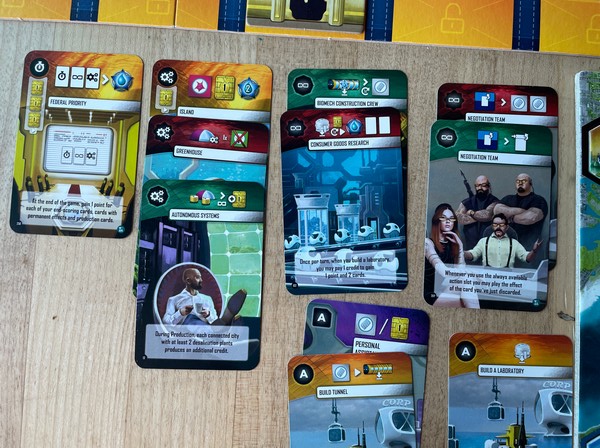
For each action, you’ll have to play a card when you choose the action.
If the action colour matches the card colour, you’ll actually be able to use the card!
If it doesn’t, then you just discard it.
Hence, you are not just selecting an action (ideally). You are also selecting a card that you want to have for its effects.
Some cards are production cards. There is a production round after each era (the first era is 4 rounds and the next two eras are 3 rounds each, for a total of 10 rounds, or 30 actions).
When Production hits, these cards will add to your network’s production.
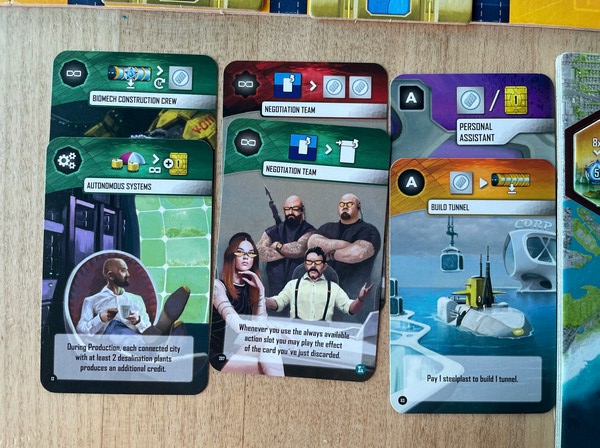
Some cards are instant effects.
And some cards are ongoing effects.
For example, the green Negotiation Team will let you play a card instead of discarding it when you take the “Always Available” action slot (which has you discard a card to draw 2 cards and get 2 credits).
Then there are the Action cards.
When you take an action space that lets you use an Action card, you tap one of your “A” cards and do that effect (like spend one steel to build a tunnel, which usually costs 1 steel and 1 credit and you have to go to the correct action space to do it).
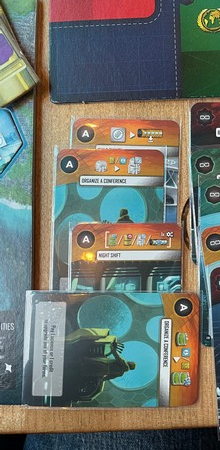
They untap at Production.
(Editor: “Wizards of the Coast lawyers are on line 1…did you want to stop using that word, please?”)
I really do like how these Action cards work.
You can see how one is tapped above because I had just used it.
(Editor: “I give up…let them sue your ass”).
But the other three are available, and they’re pretty good!
They can have some amazing effects, from doing an action that you would normally need a space for, to being able to do a discounted action.
That is the beauty of the action selection system, that it forces you to have the correct cards to play if you want to do well in the game.
It also forces some hard choices on you, as you may not have the resources to do what the card says when you are able to play it.
Do you spend an action (and another card, hopefully of the right colour) to get the resources for this other card?
Will that action space be available if you do that next turn?
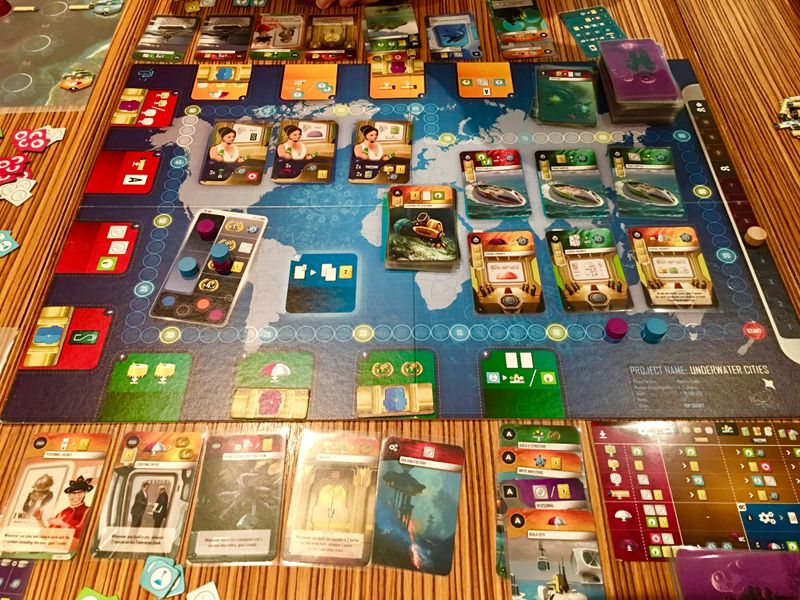
The thing to remember about the game, which has been pointed out to me a couple of times (it’s not obvious unless you really sit down and look at the board and the cards) is that the yellow actions are the strongest while the yellow cards are the weakest.
Green is the exact opposite.
And red is kind of in the middle.
But each action can be valuable depending on what you need to do.
That’s what’s really juicy about this game.
Everything is dependent on what you need, and what is available as well.
There has been a lot of cursing going on when somebody takes somebody else’s action spot just as they were about to use it.
(Ok, most of that cursing was mine).
There are also “Special” cards available. You can pick these up when you take the appropriate action space, and they are a card in your hand just like all the other ones.
This does mean that you may have to discard something else you’ve been keeping, as your hand size at the beginning of the turn is 3.
However, you have to pay to play them.
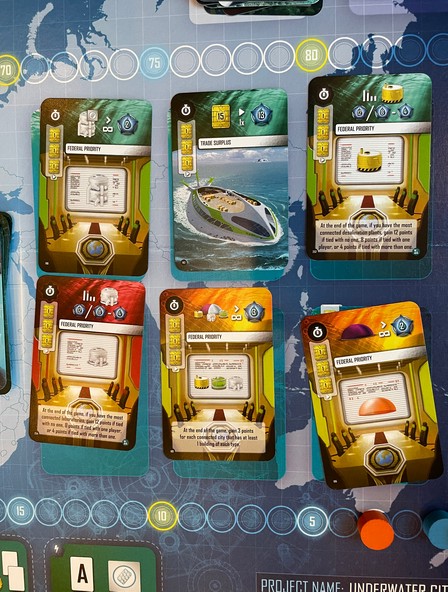
There is a deck of 1-2 credit cards, and then there are a certain number of 3-credit cards (based on player count, I believe). The latter are endgame scoring while the former are cards that are a bit more powerful than the ones that are in the normal deck.
All of this and I haven’t even talked about the player boards yet.
Each player has a player board where they are building their network.
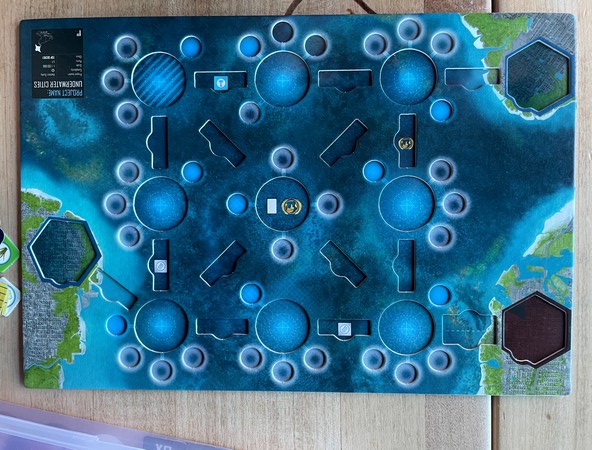
I’m not sure if the recessed boards come with the expansion or with the base game, but I wouldn’t play without them.
You can also play with the more advanced boards, which are asymmetrical (at least slightly) and actually may require you to pay extra for something but then you will get a much better reward for them.

This is where you will be building your cities, along with the extra stuff attached to them (kelp farms, desalination plants, and laboratories) that make your cities run more efficiently, as well as the tunnels that will connect them all.
Of course, there is a touch of Uwe (sounds like a gothic novel title) in Underwater Cities, as each connected city in your network requires one kelp (or biomatter) to feed it during each Production phase.
You can’t get away from feeding!
What really makes each player’s network interesting, though, even on the symmetric boards, are the three metropolises (metropoli?) which are randomly dealt out.
Once you connect them to your network, two of them will give you a production bonus and/or an instant resource bump (or maybe both).
The third one in the top left of your board and farthest from your initial city, is your endgame scoring metropolis.
This will give you points based on what it’s asking for, whether it’s a number of tunnels in your network, or two points per Special card that you’ve played during the game or something else.
It pays to connect everything.
You don’t even have to have cities connecting them. You can just have tunnels through places that will hold cities.

I really feel like I’m accomplishing something as I see all of the stuff show up on my player board, as my network grows and cities start to blossom.
I could do without the structures (farms/desalination plants/laboratories) being little tiny discs, though.
Placing one disc in the slot for it is fine. But when you upgrade them, rather than placing a bigger structure in the slot, you put another disc on top of the first one.
This is not secure at all.
Considering how well the recessed boards work and all of the nice structures available, that seems like an oversight to me.
It’s way too easy for things to get knocked over, or just fall over.
My hands aren’t as steady as they used to be!
As with most action selection games, turn order can be very important and most of these games have unique ways to determine turn order in a round.
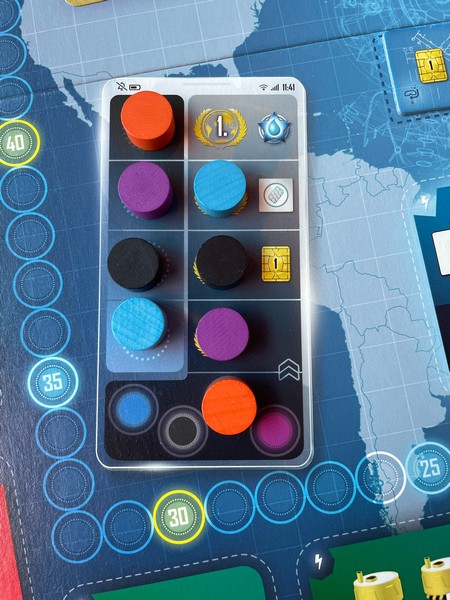
For Underwater Cities, this is the Federation Track.
Some actions will let you move up on the Federation track. For each level beyond the first that you move up, you will also gain a benefit.
After a round is over, turn order is based on position on the Federation track, so you can really make a play to go first if you’re getting tired of people taking the space you want to take.
The player aids are really helpful, outlining both how much each structure or city costs as well as what they will give you at Production.
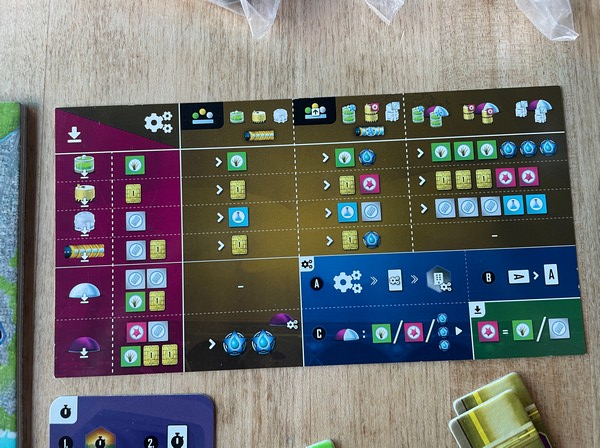
It also details how all the Production phases in order and there’s another card (you can just see the top of it) that details how to score at the end of the game.
I love a game where all of the actions and card play connect like you just found your soulmate and you realize that they actually live in the same city as you.
The dance between the cards and the actions in Underwater Cities is so intricate and involved. It takes good planning (remember, there are only 30 actions in total, unless you are able to play a card or two that lets you take another action).

You have to organize well.
There is a bit of luck involved as you do have to try and adapt to the cards you get as you can’t always get what you want (thanks, Mick!).
Sometimes you have to improvise.
Because you can’t win if you aren’t playing any cards, instead just taking actions and discarding the card because the colour doesn’t match.
All of this is why Underwater Cities is in my Top 20 games played of all time.
And it’s why I highly recommend at least giving it a try if you are able to.
Now excuse me, as I have to duck out the back because there are lawyers knocking on my front door.
(This review was written after 3 plays)
 Dude! Take Your Turn!
Love Underwater Cities, but I haven’t played it enough! I believe the expansion Underwater Cities: New Discoveries is what gives you the dual-layered boards. As well as some other niceties.
Also I kind of get why people call put it in the same basket as Terraforming Mars, given it’s a slow methodical engine builder. Although, Underwater Cities is a lot more active. However, pretty sure they ruined any chance of it taking over because copies were so sparse when it was released.
LikeLiked by 1 person
I think that is true, and I can understand the TM comparison you’re talking about, though I don’t think it’s as blatant as some people were making it out at the time.
LikeLike
Pingback: March 2024 Gaming – Dude! Take Your Turn!
Pingback: Friday Night Shots – Reviews vs First Impressions – Dude! Take Your Turn!