Dude! Take Your Turn!
A Gaming Life
New to Me – June 2024
May was a really boring month for new to me games, so much so that I was wondering how I could correct that for June.
How about seven?
No, that’s no my winning lotto number, though it should be.
That’s how many new games were played in June, and two of them were mine.
That just adds to the goodness.
That being said, the Cult of the New to Me was not impressed, at least at first.
The oldest game was from 2022!
That’s not good, and almost sparked another rebellion.
Being a cult leader is a tough job sometimes.
However, the last two weeks of June, I managed to get a 2019 game played and, on the last day of the month, a 2014 game played.
They reacted a lot better to that.

Too bad they weren’t drinking the good stuff.
Canadian Club or nothing, baby!
Without further ado (all of my ado was lost in the canal during my ship’s shakedown cruise anyway), let’s set sail!
Shipyard (2nd Edition) (2023 – Delicious Games) – 3 plays
Designer: Vladimír Suchý
Artists: Michal Řezníček, Adela Stopka
Players: 1-4
I know I’ve said this multiple times on Twitter, but Edward and the Heavy Cardboard channel on Youtube just keeps costing me money.
Shipyard was the first time that happened, where I decided to watch a playthrough of the new 2nd edition of the game and fell in love with it.
I ordered it shortly afterwards.
In Shipyard, you are doing exactly what the name of the game is. Running a shipyard, building ships, and then sending them out on shakedown cruises to impress investors.
Buying the game, there was a bunch of assembly required, some of which wasn’t actually mentioned in the rules.
I have to say that it looks impressive, though!
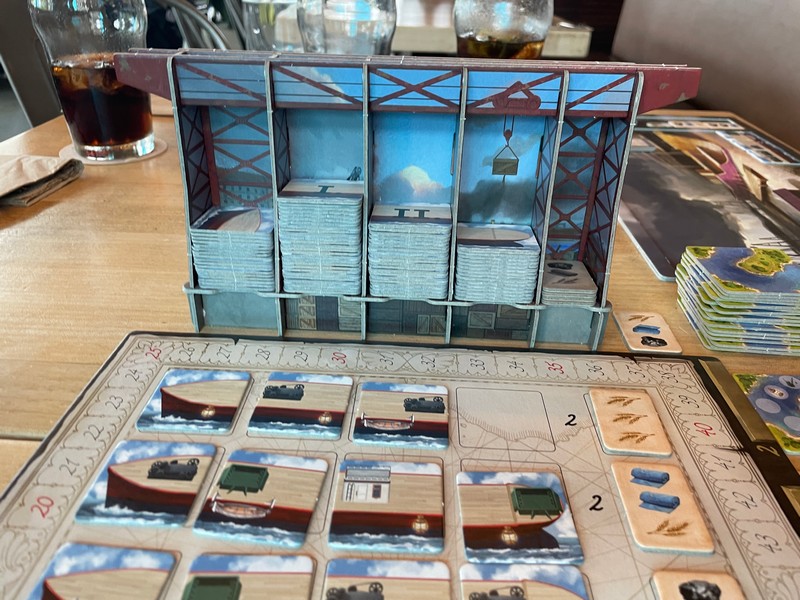
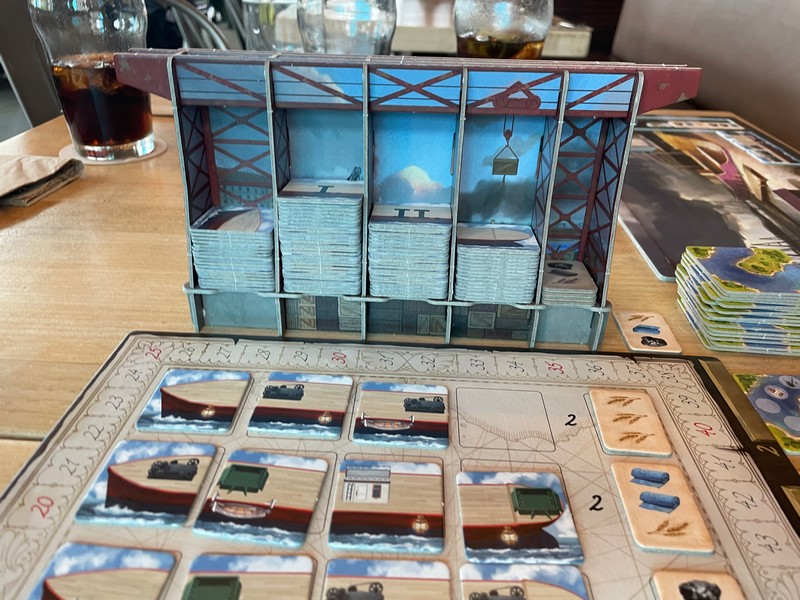
Look at those ship pieces!
It’s very impressive on the table.
Anyway, the action system in the game is what really makes it interesting.
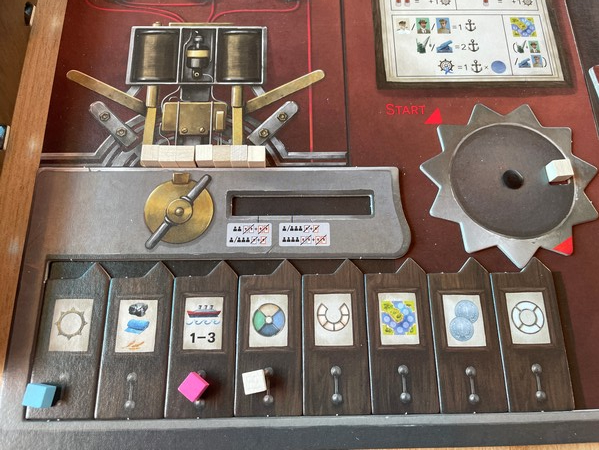
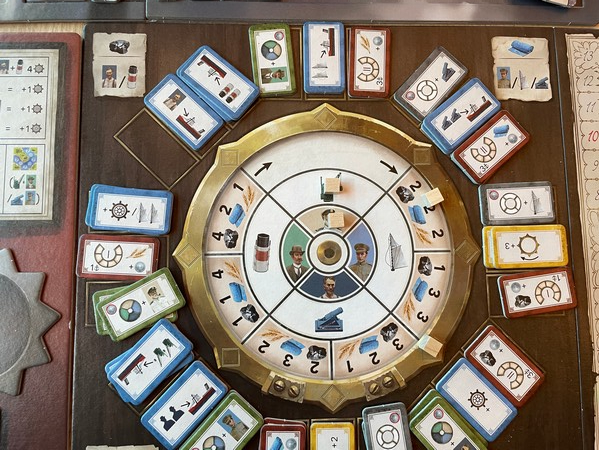
There are a series of action tiles, and you place your cube on an action to do.
When you take your cube back at the beginning of your turn, you move the action tile to the back (or front, I guess technically), which moves the gear one step forward.
You can’t take the action you just moved, and you can’t take the action that anybody else has a cube on. So your choices are a bit limited, but you still have a bunch.
When the cube in the gear (you can see it above) drops into the cube-sized hole, that’s the end of a phase. The current player finishes their turn and then the cube is removed. A new cube is placed in it for the next few turns.
This is the timer of the game, which is actually very cool.
You can take an action to buy ship pieces for the ships you’re building, employees that will give you special abilities, or maybe even canals which you will need in order to send your completed ship out on a test run.
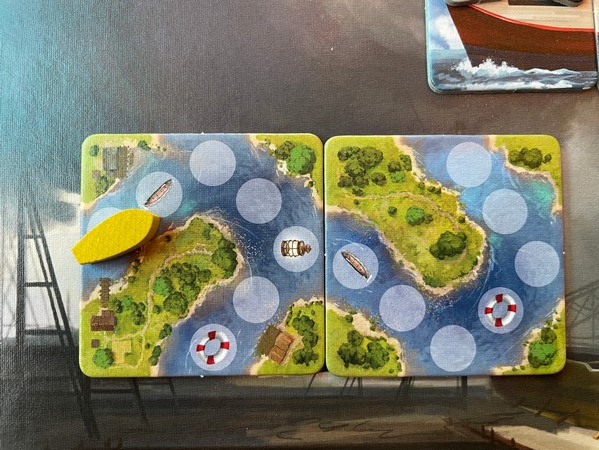
Building the ships is the point of the game, but there are a bunch of other things going on too.
Your player board is where you are going to be putting your ship pieces. You have to make sure you have a captain on your ship, but otherwise you can have whatever you want on it, as long as you have the connections or cabins for them. You can have pieces which let you put sails on it, or maybe cabins for guests, which will give you points on your voyage.
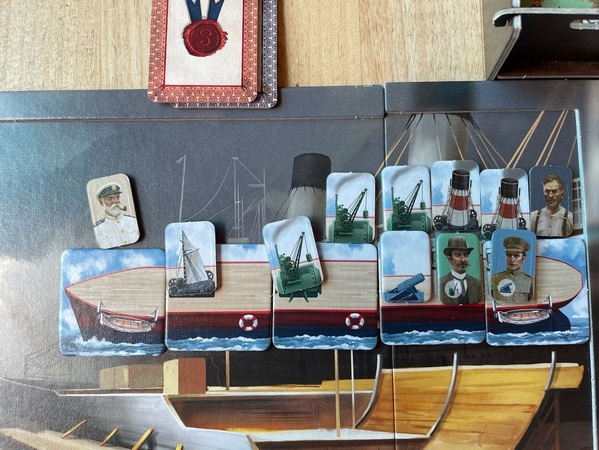
Once you buy ship pieces and place them in order to have one front, at least one middle piece, and one end piece, then the ship sets sail.
So you’d better make sure you have the canal space for it as well as the captain! Otherwise, you get no points and the ship just goes away.
One really cool thing is the employees that can help you do a bunch of things.
The ship above, I have employees that let me have multiple smokestacks and cranes on the ship without needing a place for them.
The game is quite intricate and you need to plan a lot. The only randomness is how the ship tiles and canal tiles come out. Also, the initial order of a few of the actions is random too.
But for the most part, you have to plan well.
There’s a lot more to the game, but I do like how there are multiple paths to victory.
One of my friends decided to build a huge ship during the game. That was the only ship he built and it didn’t get built until basically the last round.
It got him a huge number of points and he ended up winning.
But you can also build a bunch of smaller ships, and that can work too.
I’ve played it three times now, so a review of it will be coming soon.
I completely see why this is one of Edward’s favourite games.
I’m not quite there yet, but it’s definitely high up there.
Ezra & Nehemiah (2024 – Garphill Games) – 2 plays

Designers: S J Macdonald, Shem Phillips
Artist: Sam Phillips
Players: 1-4
Ezra & Nehemiah is the latest game from Garphill Games, part of their Ancients line. I haven’t played any of the other ones, so this is my first exposure to that.
Then again, I don’t know if there is a lot of similarities in this line like there is in the West Kingdom and South Tigris trilogies.
Anyway, this game is ostensibly about the rebuilding of Jerusalem in ancient times, and its mechanisms are quite a bit different than I’m used to.
Much like their other games, though, there are multiple (in this case, three) areas to concentrate on, letting you either try to do a little of all of them or concentrate on one or two.
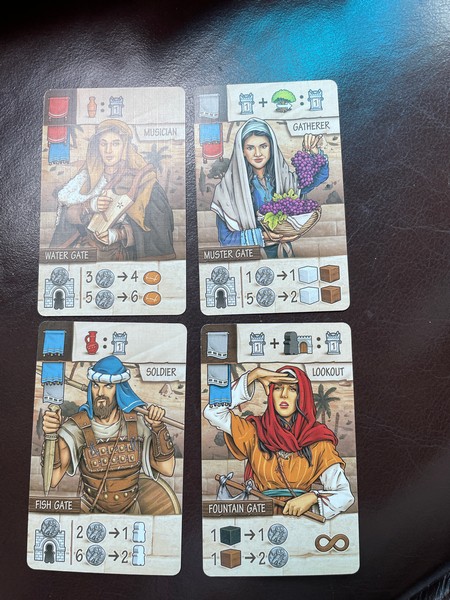
In this game, each player has a deck of 10 player cards, and you will be playing one at a time, using the banners on the card to do various actions.
The red banners help you rebuild the temple and keep the altar fire burning. The blue banners will help you employ scholars in order to interpret the Torah, as well as send your teachers around the city teaching scripture.
The grey banners will help you rebuild the walls and the gates.
The player boards (with recessed spaces for all the upgrade tiles, the elders and traders, and the blessings, which is really cool) are where you will be putting the cards (maximum of two per stack on the bottom) as well as placing your workers to give you banners or other resources you might need.
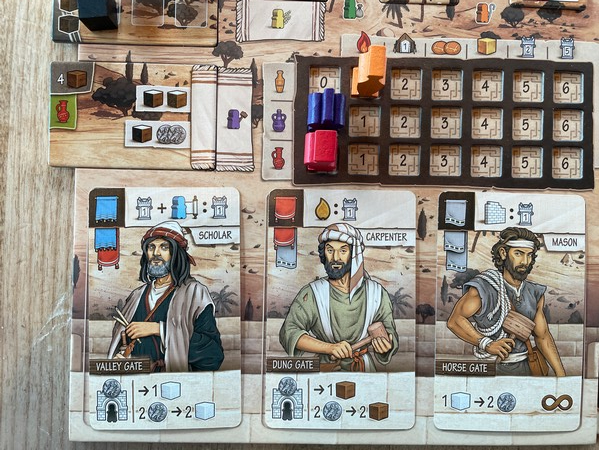
When you play a card, you can use all of the revealed banners on your board, so keep that in mind when you have to cover one up with a new card play.
What I’m not used to with Garphill Games is that basically every action you can take will give you a benefit. Not just a long-term benefit (like placing workers in Architects of the West Kingdom to get more and more stuff), but an immediate benefit.
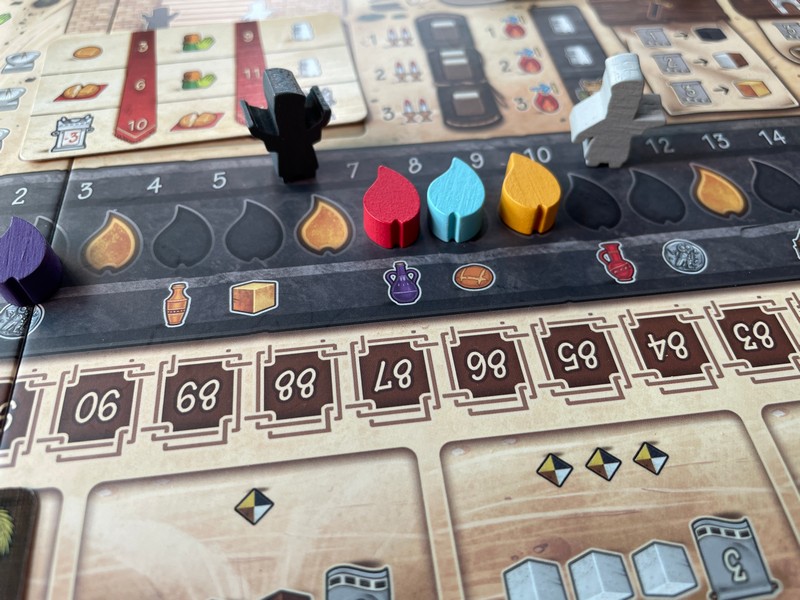
Moving up on the altar will usually give you a bonus of some kind. Building in the temple will give you points and, unless you only use one red banner, will give you another bonus.
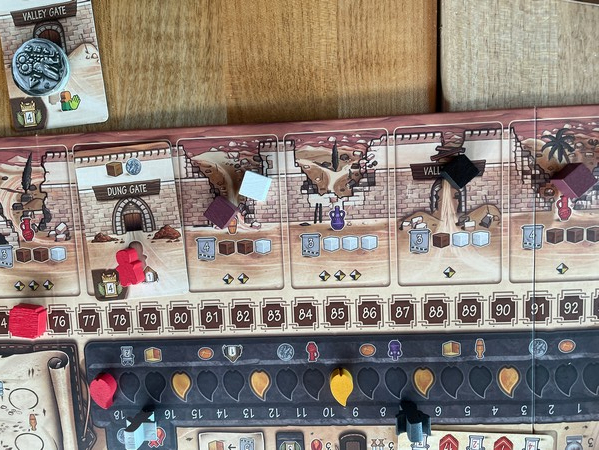
Removing rubble from the wall area will get you a blessing, unless you don’t remove all of it (and why would you only remove some of it?).
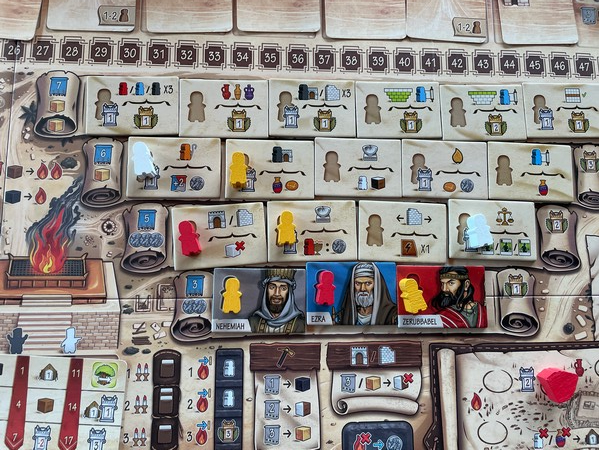
Placing a scholar is the only thing that doesn’t give you an immediate benefit (though a few of them do you give you a point, and if you’re the first to place a scholar on a row, you get bread), but the in-game benefits of the scholars are so lucrative that it’s not a surprise.
Each round consists of six card play turns, and at the end of the round, you assign any unused workers to your farms or mines to get you food and resources. You then have to feed your people (something I surprisingly didn’t mind in this one) and do a few other things.
After three rounds (weeks), total up all the points and whoever has the most is the winner!
I’ll be reviewing this one as soon as I get a 3rd play in, so I’m not going to go into any more detail than that.
However, I do have to say that while this is a fun game, just like all of the other Garphill ones I’ve played, it’s probably not going to reach my top tier. It’s very fiddly, probably their heaviest game, and there is a lot going on.
The actions are interesting, but it just didn’t grab me as much as the others, though I do want to play it again and would never turn down a play.
Plus it doesn’t fit in the box very well!
That’s a problem too.
Cascadero (2024 – Bitewing Games) – 1 play
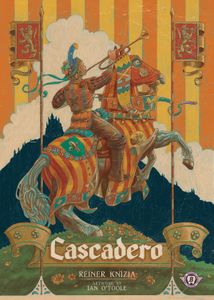
Designer: Reiner Knizia
Artist: Ian O’Toole
Players: 2-4
This game was a lot of fun, but I won’t say too much here.
Because I already have!
Check out my first impressions of the game here.
Harmonies (2024 – Libellud) – 1 play
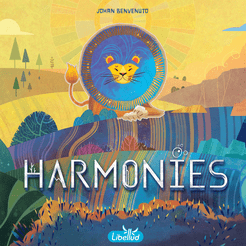
Designer: Johan Benvenuto
Artist: Maëva da Silva
Players: 1-4
Won’t go into detail about this here, since I already did a First Impressions post!
But suffice to say that I would love to play it again.
Doomlings (2022 – Doomlings LLC) – 3 plays (make sure it’s 3!)
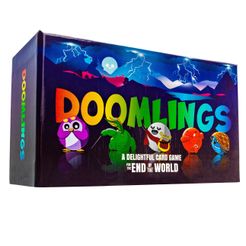
Designers: Justus Meyer, Andrew Meyer
Artist: Justus Meyer
Players: 2-6
Doomlings is a card game that the publisher sent me in exchange for an honest review, so you know one is coming.
But the basics of the game is that the world is ending in a number of ages, but there will be catastrophes and good/bad ages before that happens.
Players are doomlings who are trying to build their genetic makeup by adding traits to themselves to get them points.
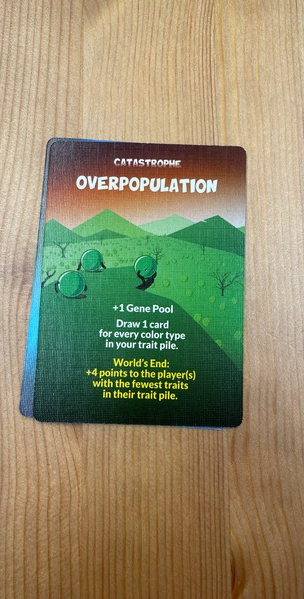
Each round, a new Age card is flipped, which could be a catastrophe or may be something fairly benign.
Players will have a Gene Pool that’s set initially at 5, and this is the number of cards that you will have in your hand at the end of your turn.
Either because you drew up to 5 cards or you discarded cards to get down to 5.
However, your Gene Pool can go up and down depending on traits and catastrophes.
After the Age card is flipped, players will play a trait to their tableau, resolving the effect of it happens to have one.
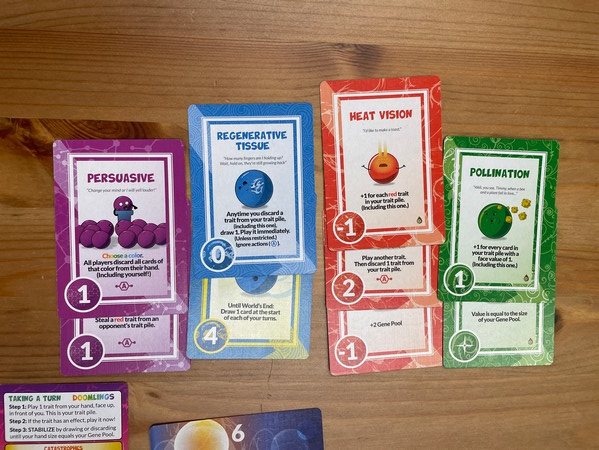
Each trait is worth points, positive or negative, and also some of them may get bonus points depending on the condition on the card.
When the 3rd Catastrophe hits (and while you know it’s one of the four bottom cards, you don’t know exactly which one), the game ends immediately without any turns being taken.
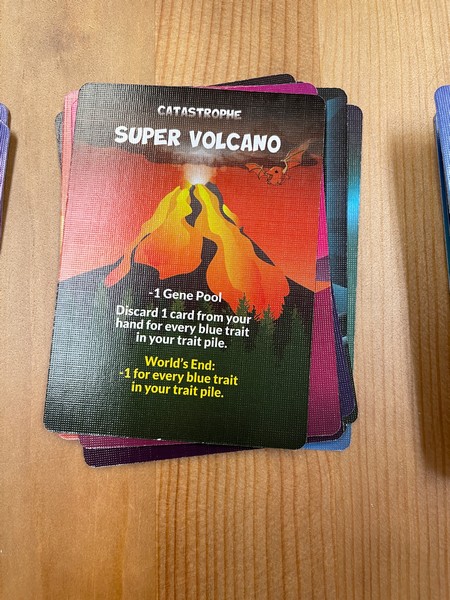
This Catastrophe is the only one where you resolve the “World’s End” part of the card too.
Total up the points and whoever has the most is the winner!
This is a really cute, family-level game.
I’ll say more in my review about it, so don’t want to spoil it here.
But keep an eye out for it!
Town Builder: Coevorden (2019 – First Fish Games) – 1 play
Designer: Eric Raué
Artists: Fellipe Martins, Gordon Oscar
Players: 1-4
Town Builder: Coevorden is a game that apparently flew under the radar in 2019 because I’ve never heard of it before. (Editor: “Yeah, because you’ve never heard of it is a sign that nobody else has”)
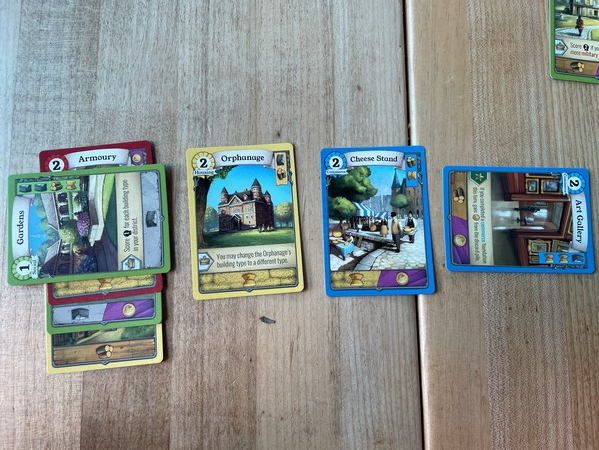
That being said, it’s an interesting tableau-building game with multi-use cards (which is becoming almost universal in games!) where the card can either be a building that you are building, or a resource for building other buildings that you are building.
The game comes with a stack of building cards that also can be used as resources.
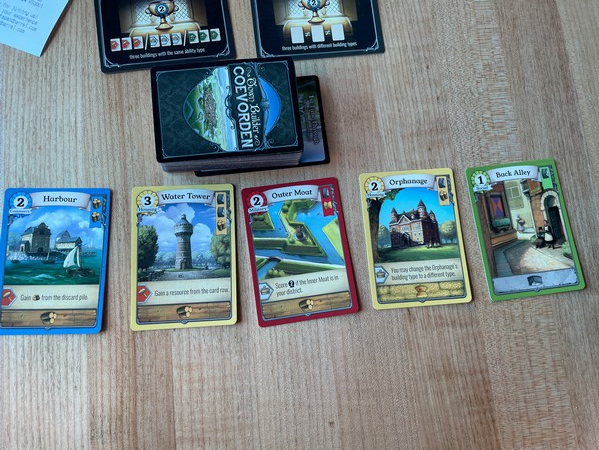
On your turn, you have two actions.
You can take a card from the row and use it as a foundation of a building.
The resource requirement is in the top right corner of the card. So the Water Tower above requires two stone and a wood.

You can also take a card and use it as a resource for a foundation you have already taken.
The VP you get at the end of the game for a building is in the top left.
Most buildings also have an ability, which can either be endgame, when built, or maybe a “star” action. You can take one star action in a turn, no matter how many star actions you actually have.
The Orphanage above has an endgame ability of letting you change the type of building it is. Some buildings or awards give you endgame points based on the building types, so this gives the Orphanage some flexibility.
Once you’ve put all of the required resources on the building, it’s built and is in your tableau. The resources get discarded.
This continues until you’ve gone through the deck a number of times depending on player count (keeping in mind that the more buildings and foundations are out, the fewer cards that will be in the new deck).
Once that happens, finish the round and each player gets one more turn after that.
Whoever has the most points is the winner!
This is an older game and nobody seemed to be talking about it even in 2019 (at least not that I saw), but it was actually pretty fun.
Pretty basic, of course. Nothing truly noteworthy.
But it was fun and I certainly wouldn’t say no to playing it again.
La Granja (2014 – Spielworxx) – 1 play
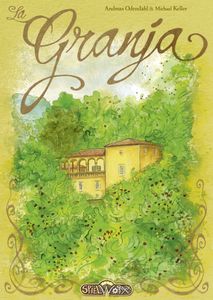
Designers: Michael Keller, Andreas “ode.” Odendahl
Artist: Harald Lieske
Players: 1-4
La Granja snuck in under the wire as I already had this post mostly done and ready to go.
We played this on Sunday, June 30, and it was back to the drawing board!
La Granja is a farm development game where you are running a farm and trying to deliver goods to local merchants, as well as maybe more far-flung customers who might want something a bit more elaborate.
It’s also an interesting mix of action selection/dice drafting, all in a neat stew that you just have to let simmer for a bit.
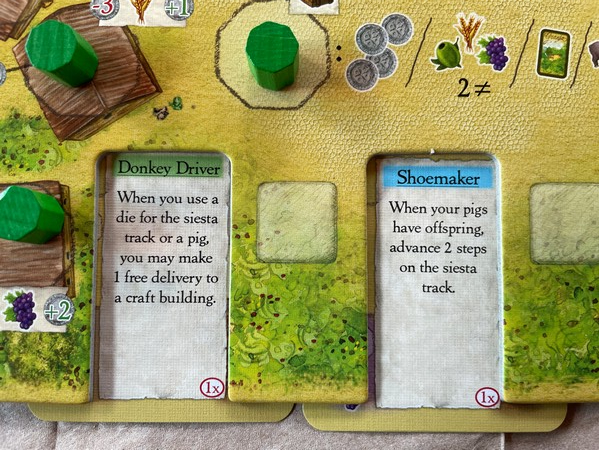
I’ve heard of multi-use cards, but cards that have four different uses?
At least you’re not using them for money.
You can play them to be a worker that will give you a benefit during the game.
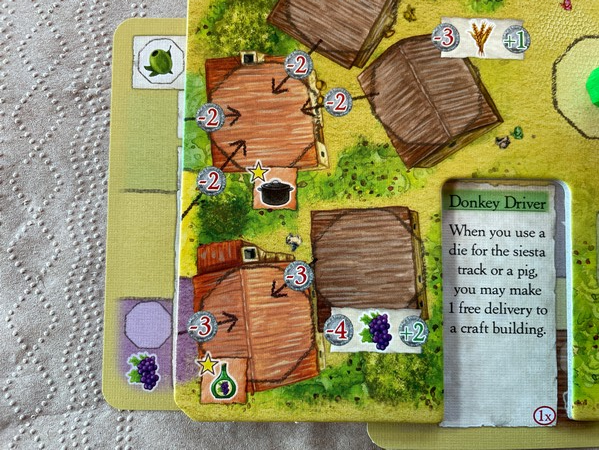
Or they can be a farm addition which lets you grow additional crops (and actually grow crops rather than just buying/acquiring them).
You could also pay a resource of some kind to make them give you income and other benefits.
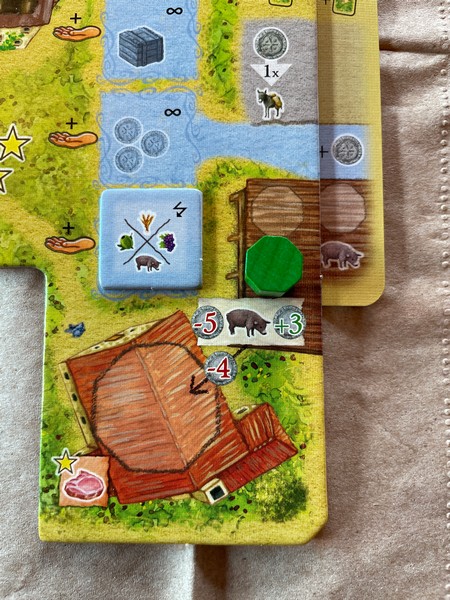
Or, you can use them for wheelbarrow deliveries, which are the major point-getters in this game.
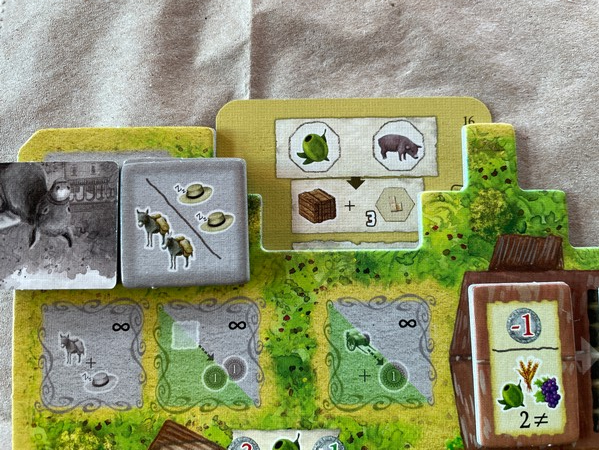
Once you’ve played a card, there’s income and pig reproduction (don’t ask) and the ability to purchase a Roof tile which will give you a one-time benefit.
Then it’s time to roll the dice and choose actions!
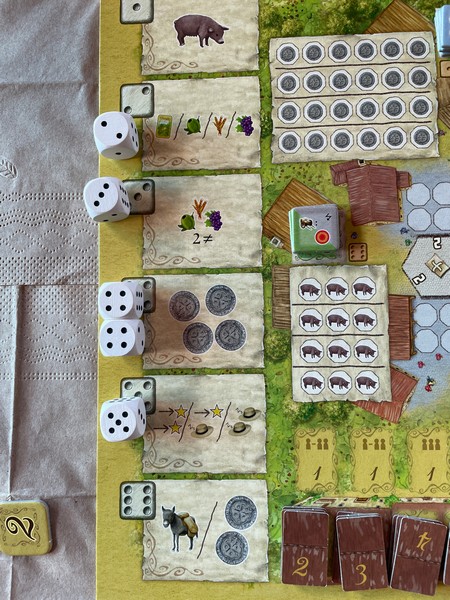
Each player will get to take two actions and then the final die’s action will be done by everybody.
After all that is done, the siesta track (which will determine turn order beginning immediately with deliveries) and deliveries are done.
Delivering to market buildings on the board will get you a bonus once you’ve completed them all, but no points typically.
The points will come from the wheelbarrows.
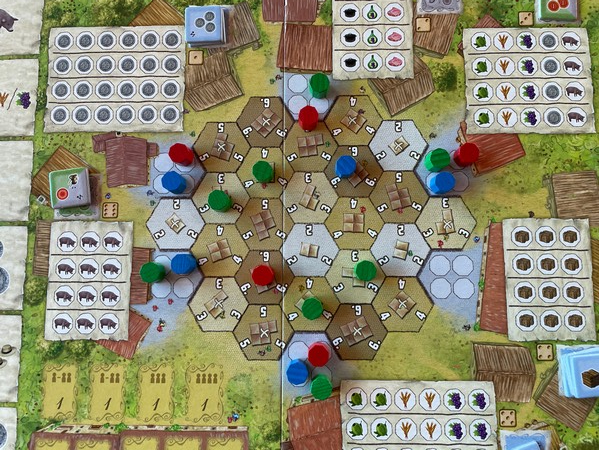
Once those are complete, you get to place a marker out on the board in the appropriate space (possibly displacing other players’ markers) and get a bunch of points.
You also get points at the end of the round for where you are on the siesta track and how many markers you have on the board.
There’s a bunch more, but suffice to say that you go through this six times and then determine the winner!
In a way, I once again have Heavy Cardboard to thank for wanting to play this, though at least it didn’t cost me any money.
They played a new game called El Burro: a La Granja Game which is very similar to this. The shipping mechanisms are different, but the multi-use card play and the dice actions are virtually the same.
It looked cool!
So when my friend said that he had brought the original La Granja on Sunday, I jumped at the chance to play it.
Of course, I thought I was playing one of the BGG Top 100 games, adding another notch in my goal of playing as many as possible, but then saw that La Granja is #263 currently.
It was El Grande that I was thinking of.
Too many games with similar names!
There you have it. So many new to me games played in June!
If I keep this up, I may have enough games played to do a Top 50 in 2025 instead of waiting for 2026.
What new to you games did you play in June?
Let me know in the comments.
 Dude! Take Your Turn!
New to me in June: MLEM and Wyrmspan, both of which I enjoyed!
LikeLiked by 1 person
I need to play Wyrmspan! Glad it was good
LikeLiked by 1 person
It’s different enough from Wingspan to provide a distinct experience… but I think having one of them in the collection is enough for me! Wouldn’t turn down another game of it, though 🙂
LikeLiked by 1 person
Pingback: 5 on Friday 05/07/24 – No Rerolls