Dude! Take Your Turn!
A Gaming Life
Travelling on 3 Cards a Day

I’ve never been to Japan. I hear it’s a fun place to visit, but that hasn’t been me yet.
While Let’s Go to Japan will not give you the feel of travelling to Japan, it will give you the feeling of planning your trip!
And then not going…but that’s ok.
It’s the planning that counts, right?

Let’s Go to Japan was designed by Josh Wood with art by Chaykov, Kailene Falls, Toshiyuki Hara 原としゆき, Magdalena Pruckner and Erica Ward. It was published by Alderac Entertainment Group in 2024.
When you break the game down to its basics, it’s a card drafting game where you are trying to match icons in certain ways and choosing which card will give you the best bonus at the end of the day.
That all sounds kind of dull, but in reality it’s…well, it kind of is.
But not to the extent where it’s a bad or unenjoyable game!
It’s just if you don’t play it right that it’s dull.
Let me explain.
The reason I say that is because of the theme, though that may not be enough for some people.
The theme comes through exceptionally with the cards.

There are two decks of cards that you are choosing from, Kyoto and Tokyo, representing things you can do in…well, Kyoto or Tokyo.
I love the flavor text that goes on the cards, talking about what each place or event is, and all of it is very thematic.
Shopping in Shibuya gives you some shopping experience but it also gives you a bit of financial stress because it’s expensive.
Meanwhile, visiting the Otagi Nenbutsuji Temple in Kyoto gives you some temple experience.
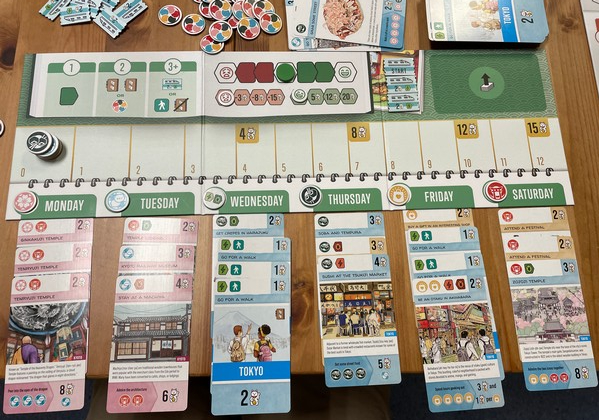
Players will be playing these cards and planning their trips using their own player boards, choosing activities to do on each day from Monday to Saturday.
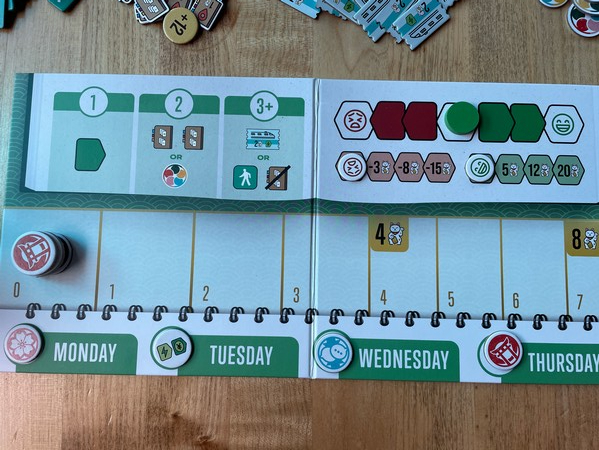
Let’s Go to Japan uses a basic card drafting technique, though unlike some drafting games, it’s very unlikely that you will be hate-drafting because your opponent might want a good card.
Each round, you will draw a Kyoto and Japan card, or perhaps two of each. You will then choose one (or two in certain rounds) activity to place on one of your days’ outings and then pass the remaining card(s) to the left (or right eventually).
You will be collecting these passed cards, so on some rounds you will take the cards that have been passed to you and choose one (or two) of those to play, passing the rest.
All basic Drafting 101, but with only 18 cards to play, you won’t be taking a card just because your opponent wants it.
Hell, you’re probably not even paying attention to what your opponents are doing.
Let’s Go to Japan is the very definition of multiplayer solitaire, not because you don’t interact with your opponents. You will be getting cards from them and giving some of yours to another.
But you don’t care what those cards are.
You just don’t care what they pass you and you also don’t care what you’re passing to them.
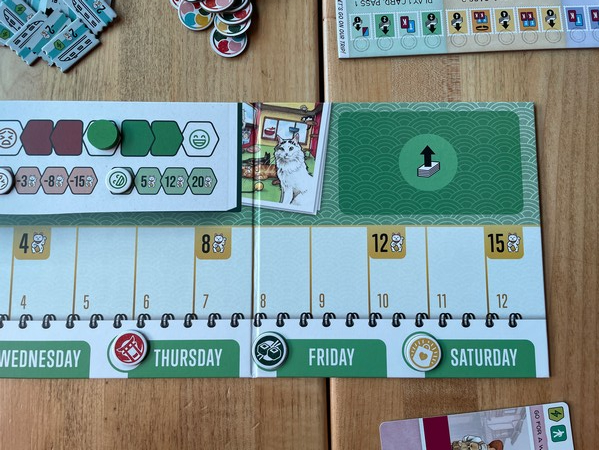
At the beginning of the game, one person randomizes the experience discs and places one on each day. These discs are: Temple/Shrines, Food/Drink, Nature/Gardens, Shopping/Goods, and Unique Experiences.
There’s also a sixth disc with Happiness (either general happiness or monetary happiness).
These represent the types of experiences you’re looking for on that particular day, though it’s not terrible if you don’t match them with the cards you play.

The activity cards you play will have one or more symbols at the top, and one goal is to match the symbol with the experience disc on that particular day.
Once you’ve placed three cards in a day, that day’s plan is complete and you look to see how many card symbols match the disc on that day.

Depending on how many, you will get a happiness bump, perhaps the ability to research (i.e. draw more cards), get a Wild experience token for use later, or maybe even a luxury train ride!
The train ride can be important because each time you change cities from Kyoto to Japan or vice versa, you have to take a train.
You start out with a basic train, but any subsequent trains will lose you two points.
What’s fun about taking a regular train? All the crowds and people just trying to get from one place to another?
But if you earn a luxury train ticket, you are travelling in style! This is a fun train ride!
It will get you two points and a happiness bump.
The other bonus option if you’ve matched three symbols is an extra Walk for free.
What’s a Walk?
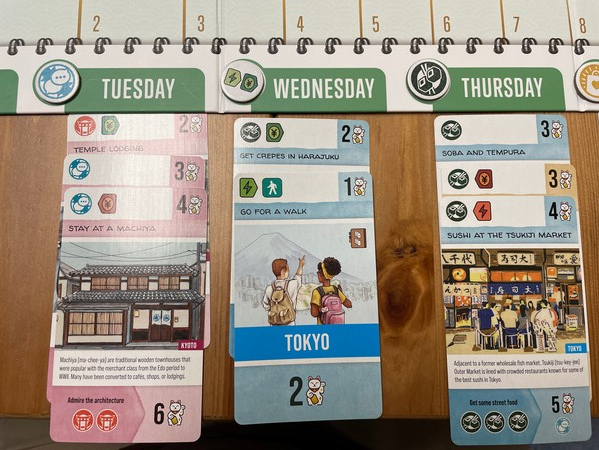
If you don’t like the cards in your hand, you can discard a card (any city) and draw a Walk card (again, any city) and place it in your itinerary (the backs of the cards are your Walks).
Thus, you don’t know what activity is actually on the card.
This represents you just setting aside time to go for a leisurely stroll around the city.
If you have three of the required symbols on a certain day, your final option is to take an extra Walk.
This is the only way you can have 4 cards on any given day. I guess it represents how much of an expert you were on planning that day?
When you’re playing your cards, you can place the new card anywhere on the day’s itinerary. You don’t have to place it on top, though you can’t rearrange the activities you’ve already placed (which is very gamey since there’s no way you couldn’t totally adjust your itinerary in real life, but it does make for a better game).
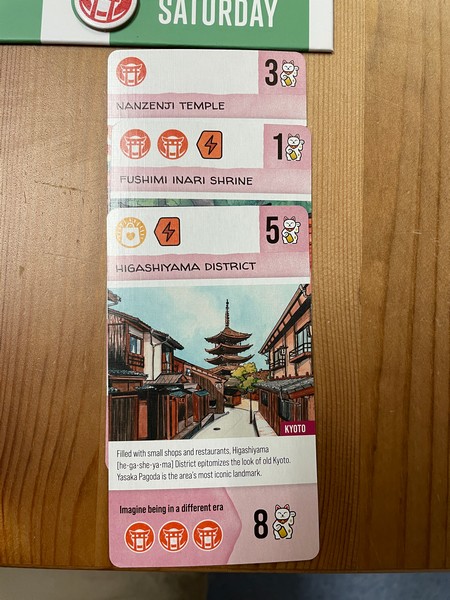
This becomes important because one of your big scoring opportunities is going to be the Highlight of the Day bonus points.
In the picture above, the Highlight of the Day is thinking about your temple trips and imagining yourself in the past.
If you have moved your Temple experience score marker at least three spaces, you get 8 more points (in addition to the points that are on the top right of all the cards in the day).
The Highlight of the Day doesn’t just take into account that day’s activities. It takes into account everything you’ve done up to that point (but not something you haven’t done yet).
Rest assured, if you don’t get at least some points from your six highlights, then you will not win this game.
Once all 18 cards have been played, all players will take their trip, counting up each day’s points, along with bonus points due to research tokens, luxury trains, and how much of each experience that they were able to do on their trip (essentially, totaling points from where each experience scoring marker ended up).
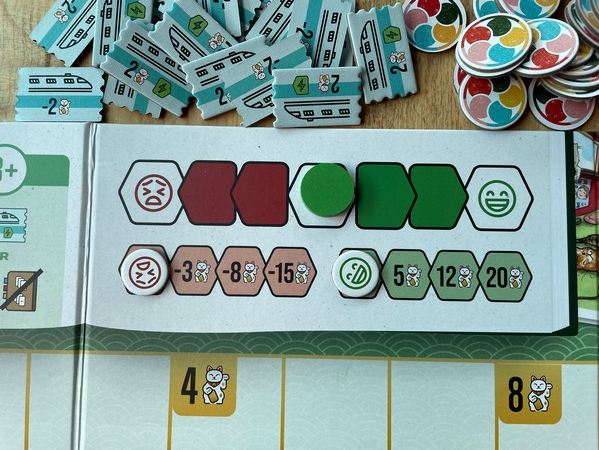
You may also get happiness points or lose stress points if you’ve geared your vacation towards one of those. Your mood will fluctuate with each activity, possibly, but if you reach a certain point, you will have permanent happiness/stress and your current mood will reset to zero.
This is where the dullness of the game can set in, or where you can make the game a phenomenal experience.
When you get to this point, you can either have each player just total up their points and report them to the scorekeeper.
Which is kind of boring.
Or, you can do it one at a time and actually narrate your trip.
“In the morning, I went to the Nanzenji Temple and took it all in. Then I went to the Fushimi Inari Shrine and did the same. Finally, I was in the mood for some shopping and headed to the Higashiyama District for some luxury shopping. It was a bit crowded so I got a little stressed. But I just kept thinking back to the historic impact of these shrines and felt blessed.”
Ok, you don’t have to be that poetic about it, but you get the gist.
Part of the narration can actually be your walks, because when you are executing your trip, you flip over the Walk card and see what activity it was.
This represents something you just stumbled onto while you were out walking.
Maybe you decided to partake?
In which case you keep the flipped card and get points for it.
Or maybe you decided to pass and just kept enjoying your morning saunter.
That will get you some points, though not as many.
Bringing that into your narration is wonderful!
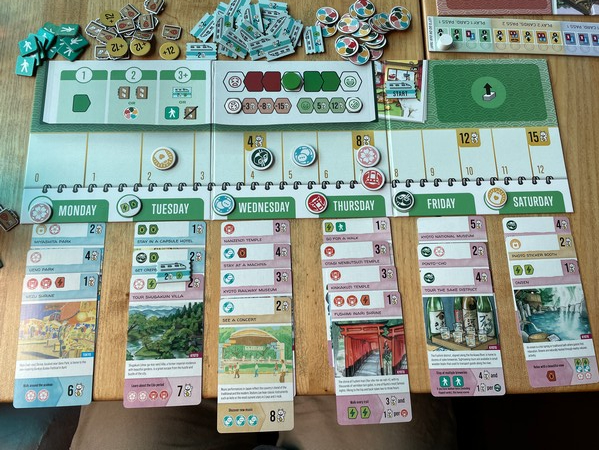
This is where Let’s Go to Japan shines, bringing your trip to life.
But it adds a bunch of time to the game.
We finished our three games in 30-40 minutes.
Narrating each trip individually is going to add some time to that. We didn’t do it in our games because we were running up against the clock.
And it lessened the experience for me.
By itself, this is just a simple drafting, point optimization game like we’ve seen so many times.
It’s fine, though sometimes the randomness in the game can really come back to bite you.
You may go for a walk and find an amazing point-getting card that puts you over the edge!
Lucky you.
But overall the randomness isn’t too bad. If you get research tokens, you can draw a bunch of cards so hopefully you can find something you want.
Or you can go for a walk. The walk will most likely get you at least a few points.
The theme of the game is what carries it.
Without allowing yourself to embrace the theme, the game isn’t really that exciting.
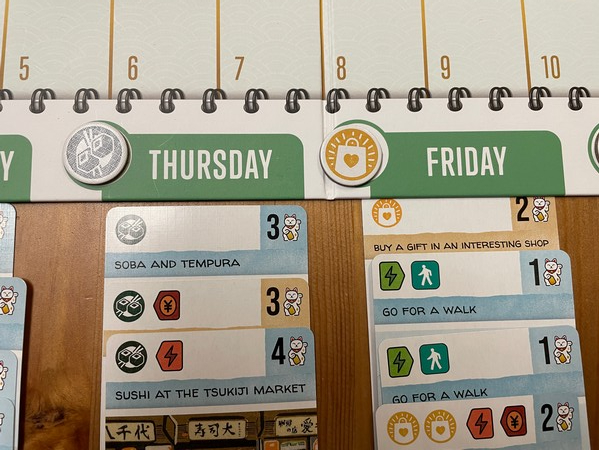
The artwork and cards really enhance that feeling and make it a lot easier to do. I could spend a lot of time just reading the text on the cards and seeing myself doing that activity.
The experience symbols on the activities are also very thematic. Going to a crowded shopping district can be fun! But stressful too. Staying at an awesome hotel can be a great experience, but a little bit financially stressful as well.
I love all of that.
The other issue with the game, which isn’t necessarily bad but it’s something to be aware of, is that teaching the game can be difficult.
There are so many ways that the cards will interact with each other to get you points, and so many little thing in deciding where to place a card, that it can be a bit overwhelming at first.
The teach can take almost half the time that the game itself takes (if you’re not narrating).
After your first play, though, all of this becomes second nature and you won’t need to worry about it.
Let’s Go to Japan is a game that I really suggest you try. If you do, try to really bring the theme to your heart.
Otherwise, it may feel too similar to other games you’ve played before.
That theme, though.
Oh, that theme
It saves everything and makes this a game that I will always willingly play.
Even if we don’t narrate our trip, I will be doing so in my head and thus will still have fun.
(This review was written after 3 plays)
 Dude! Take Your Turn!
Shame you only came away lukewarm on this one. I was excited about it because, like you, I love the theme, and kind of think it’s underrated. Planning a trip in real life? Boring. Planning a trip in a board game? So much potential for fun!
LikeLiked by 1 person
I do really enjoy it! But I don’t think I would as much without the theme. I bought both mini-expansions so we’ll see what they add to it.
LikeLike