Dude! Take Your Turn!
A Gaming Life
The Apocalypse Will be in Technicolor

Post-apocalyptic games are all the rage, and Radlands is yet another entry into the increasingly-crowded genre.
The question becomes, is it worthy of recognition in that genre and beyond?
Radlands is a 2-player battling card game designed by Daniel Piechnick with artwork by Delia Arnone, Lina Cossette, Damien Mammoliti and Manny Trembley. It was published by Roxley Games in 2021.
When it first came out and hit Kickstarter, it was all the rage and a ton of people backed it.
Hell, I almost did.
But something about the cost and the ability to get it to the table stayed my hand and I backed out.
I recently received it in a math trade though and I’ve already got it to the table three times.
And it is quite impressive!
Also it’s very colourful.
Almost blindingly-colourful if you object to bright colours in weird art.
I love weird art! Don’t get me wrong.
I love the artwork in Radlands.

The gameplay also has a lot of strengths.
Radlands is essentially a 2-player column battler but with a bit of a twist.
Instead of the rather boring “this column attacks that column, destroy a unit there, etc” combat mechanic, you will be using the three water you get every turn (and perhaps extra water you can get during the turn) to either play new people to your tableau or activate abilities of people and camps that are already in your tableau.
These abilities allow you a lot of latitude in what you want to do, as long as you are able to draw and play the right ones.

The Gunner, for example, will wound all unprotected people in your opponent’s tableau. The Assassin will destroy an unprotected enemy person, though both of them cost two Water to activate.
What does “unprotected” mean?
Let’s back up a bit and explain how the game starts.
Each player will have 3 Camps, which will be chosen from six that are dealt to them.
These camps are the objectives in the game. Destroy all three opponent camps, and you win!

The camps will also have abilities that you can trigger with your water, or maybe have some other ongoing effects.
Two of the above camps have abilities that require water, but the Oasis just gives you a bonus in playing a person in front of it.
“Unprotected” cards means that there are no cards in front of them.

When you build a tableau, only the front cards are actually vulnerable to being hit with a basic attack, though some people’s abilities let them attack any card, whether its protected or not.
This is how you protect your camps, though you may have to be wary of cards that let your opponent bypass the front cards.
That’s the lovely give and take with Radlands, where you are paying water to play cards because you want to protect the camps and perhaps even the people behind them and it informs the strategy of the game (assuming you can draw the right cards).
You essentially want to spend water to play people because that not only protects the cards behind them, but also gives you another ability you may want trigger with your water.
You can activate any ability in your tableau if you have the water for it. It doesn’t matter where they are in your tableau.
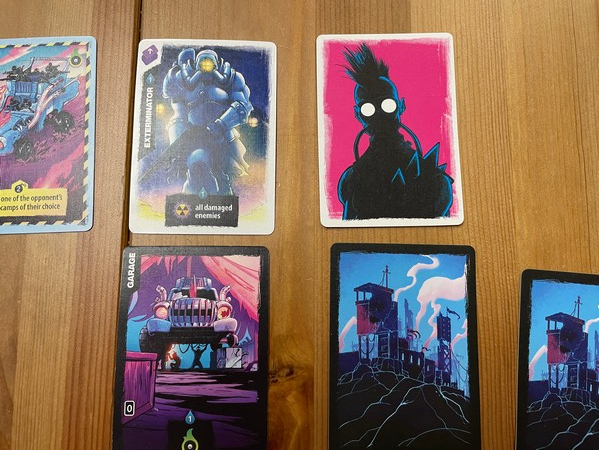
So your opponent is trying to minimize what you can do and also work on destroying your camps.
Because destroying people doesn’t move you toward victory. It may just be stopping them from hurting you as much.
Another interesting aspect of Radlands is the Events.
When you play an Event, it has a “bomb” number, which indicates where you put in your tableau. There are three rows, with “3” being your back row, and then the two rows in front of them.
If it’s a “0” event, then it goes off immediately.
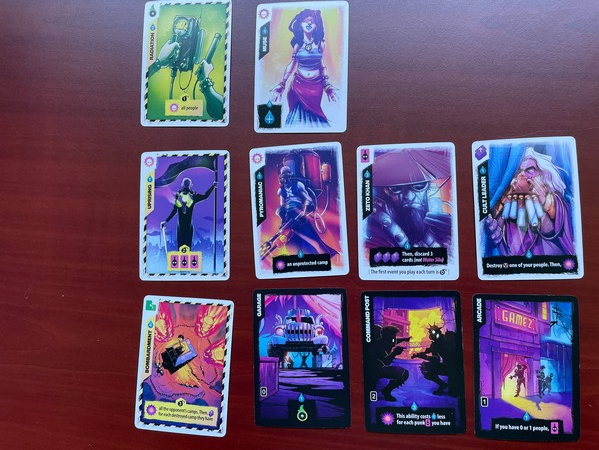
Otherwise, each turn, your event will advance one row until it goes off, so you’re essentially planning something big for the future.
Other than a few cards that will let them push back an event, there’s nothing your opponent can do about them. They will go off.
Eventually.
These could be adding to your Punk level (like one of the events above) or maybe doing some massive attack (like the back event).
It’s imminent! Let them dread it as it approaches.
I also like the “punk” effect, speaking of that.
Some cards will let you put “punks” out in your tableau.

When you place a punk out, you take the top card of the deck and put it into a people space on your tableau face-down. You don’t know what it is, and it only has one “hit point.” Usually, if a card is damaged, it gets turned on its side and you can’t use its ability anymore. But it’s still alive and can be recovered.
It takes two hits to destroy a person (or camp).
Punks, however, only take one hit and then they get put back on top of the deck unrevealed.
Some cards will let you put some or all of your people back into your hand.
Punks are included in that! You can then play it later as its actual card rather than a punk.
Otherwise, punks are basically cannon fodder to protect your other cards.
This whole “protected cards” thing really makes Radlands rise above its other 2-player battler brethren.
Suddenly playing cards to a column is quite strategic. If you leave cards unprotected, they’re liable to get damaged and potentially destroyed.
When you play a card, you can place it in front of or behind another already-played card. So if it’s a powerful one, maybe place it behind so it’s protected?
Not only is it important what cards you draw, but how you use them becomes imperative as well.
Cards also have a discard effect, which is a free action that doesn’t cost any water.

On the top left of the card, the symbol shows what happens if you discard it. You might be able to wound an enemy person, or perhaps draw a card or recover one of your wounded people or camps.
It also will deplete your hand, so you will want to use this sparingly.
Cards are important!
It would seem that it would be easy to get set up in a stalemate situation when there are a lot of cards protecting your camps, since that is how you win.
That’s where the standard Raiders event that each player has available comes in.

This can be put into play when you have a card or action with the green symbol on it.
When you do that action, if not already placed, you place your Raiders event on the 2nd row of your Event column.
It will move forward just like other events at the beginning of your turn.
But you can move it forward yourself by using that green action again (if you have another card with it).
The Raider event is important because it will damage a camp automatically, though it is your opponent’s choice which camp gets hit (which doesn’t make a lot of sense thematically but in a game sense it definitely does).
One thing I really do like about Radlands is that, unless the action is a “Destroy” action, damaging or wounding a card just turns it onto its side (don’t say “tapped”!) as mentioned above.
This gives players a lot more opportunity to recover and perhaps lay down their own smacking since their cards aren’t necessarily out of the game.
You can’t use the card’s action if it’s wounded (though camps, you can use), but at least it’s still alive.
Of course, like any two-player back and forth game, it is very possible to find yourself falling behind and unable to do much. You will always have 3 water, but if you find yourself without that many cards, it may be difficult to establish a defense for your camps.
Thankfully the game is fairly short, at 30-45 minutes and you are never totally without options.
Not only that, but often you only have yourself to blame for putting yourself into that position!
Though not always. Sometimes the cards just don’t work for you.
In the three games I played, my two losses kind of felt like that, where my opponent was getting stronger and I was having trouble keeping up.
But even then, I actually came close to pulling the game out.
Radlands is a game that I will keep coming back to when it’s just me and another player.
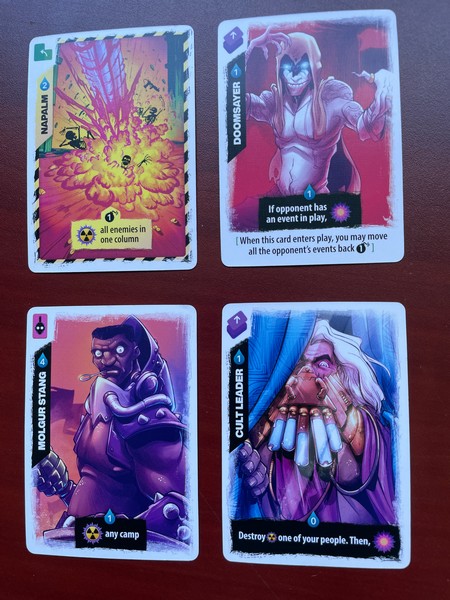
The art is gorgeous, in a retro psychedelic way. The rulebook is pretty clear and easy to understand, so much so that it’s actually easy to gloss right past a rule or two and forget about them (like I did in my first play!).
The player aids are really helpful as well.

It’s a card game, so of course there’s going to be randomness, but there are plenty of ways you can work to win.
Also it’s just fun, making a play that ends up hurting a bunch of your opponent’s people, or playing that event that just fills them with utter dread as it slowly advances turn by turn with no way for them to stop it.
I’d definitely give Radlands a try if you’re into 2-player games.
It’s on a number of Top 50 lists and who knows? It could make it on to mine in 2026.
But I do know that I will be playing it lots in the meantime.
(This review was written after 3 plays)
 Dude! Take Your Turn!
It may be a crowded genre, but its a colorful and welcome addition. I’ll have to pick it up!
LikeLiked by 2 people
The thing about the “crowded genre” is that there are so many different variations!
Wasteland Express Delivery Service is a great pick up and deliver game after the apocalypse.
There are so many choices and so many of them are different!
Thanks for stopping by and leaving a comment.
LikeLiked by 1 person
Had a chance to play this game twice; very nice card-based design!
LikeLiked by 1 person
I know, right? It’s just as good as I thought it would be
LikeLiked by 1 person