Dude! Take Your Turn!
A Gaming Life
Sex, Candy, and Rock & Roll

In the 70s, I wonder how many kids wanted to grow up to be rock stars.
I wasn’t one of them. While I am a child of the 70s, I wasn’t really listening to much rock music when I was growing up. My parents listened to Country.
I started listening to the radio (and Casey Kasem’s American Top 40) in the very late 70s or early 80s so grew up with more pop stuff than anything else.
Since then, I’ve become a fan of the 70s music scene through my wife, who is a fan, and I’ve learned to love it a lot.
So when it was announced that Jackie Fox, the bassist for the 70s group The Runaways, was designing a game about become a rock star, in 1977, that sounded amazing!
The game has finally appeared.

Rock Hard 1977 is the game where you are an aspiring musician trying to drag you and your bandmates into fame and fortune (and hopefully not ignominy, though thankfully the game doesn’t really go there).
Designed by Fox, it has wonderful artwork by Jennifer Giner that really puts you in the 70s mood.
The game was published by Devir Games this Summer (2024 for those of you visiting in the future) and plays 2-5 players.
Rock Hard 1977 is basically a worker placement game with a little bit of push your luck, set collection, all of that good stuff.
While each player gets three actions a round (Day, Night, and After Hours), you can get additional actions, possibly, by spending Candy to do them.
So let’s talk about that big thing first before getting into the meat of the game.
This is what the rulebook says about Candy.
“Sometimes, rockers need a little something extra to get them through their difficult, busy day, even though they know it probably isn’t good for them in the long run. Whether it’s too much coffee, adoration from an ever-greater number of fans, or anything else that gets your heart pumping, ‘Candy’ is just the boost your character might need – a way of potentially getting extra actions in one turn, at the risk of long-term consequences.”
I get that there are a number of things that can really get you going, and slamming 5 Red Bulls so you can go to your job and then go clubbing afterwards may result in having a really bad morning the next day, but the clear analogy for Candy is the rock and roll drug scene.
That’s made even more obvious when going to certain Hangouts, or certain gigs (like a private concert for a millionaire), can get you more candy.

Considering there are references to hooking up and sleeping around a bit in some of the nightclub cards (though mostly through euphemisms as well), it would be interesting to know whether this was a design decision or a publisher directive (like Kevin Feige telling the writers of Deadpool & Wolverine that extremely bloody violence and tons of “fucks” were allowed but no explicit cocaine use).
Anyway, that’s not really an issue with the game, more just a curiosity.
What’s interesting in the game is the effect that Candy has.
But we’ll get to that.
As I said, the game is a worker placement game, where you will placing your character standee on various places and getting the effects of that space.
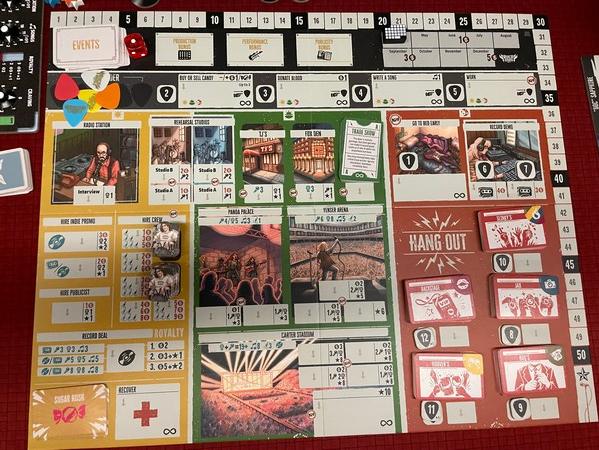
That’s pretty much Worker Placement 101, right?
(as an aside, I know there are some schools that have degrees or courses in board game design, but why not any that have courses in improving your board game play? I’d attend those!)
The board is divided into Day, Night, and After Hours sections, with a handful of “Anytime” actions above them, where you can do them at any time during the day.
Those are also the only spots on the board (except the Random Gigs and a couple of others) where multiple players can go at the same time.
The game also has a bit of asymmetry with each player getting a choice of random characters, each with its own ability.
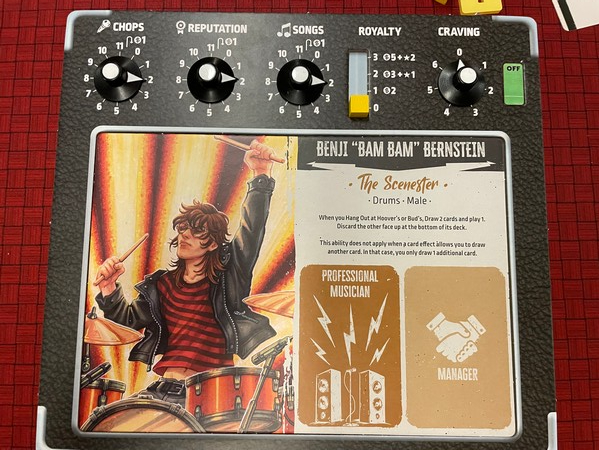
They’re also either male, female, or androgynous (“trans” wasn’t really a word used back then) and various types of musicians (drummer, guitarist, keyboardist, vocalist). This won’t make much of a difference in the game, except a few Hangout cards where you might get an extra benefit if you happen to meet that extra criteria.
But it’s neat background.
More asymmetry comes from your manager (who you can’t fire and have to pay three times a game or you lose fame points).
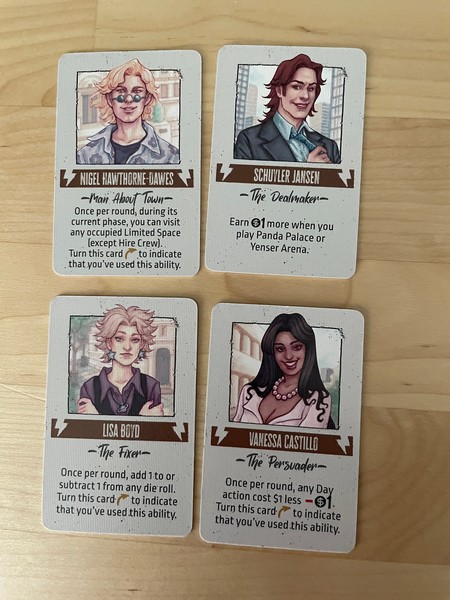
Your manager will give you an ability as well, and one of the faults in the game for me is that there are so few choices of Managers.
There are only six, and the game plays up to five players.
Fox has been talking about an expansion and I really hope more Managers will be part of that.
Like most aspiring rockers (unless you’re a member of the Jackson family or something), you have to have a day job to make ends meet while you’re trying to become famous.
This will require you to take a Work action during whichever phase your job actually happens in.

If you miss work three times during the game, then you lose your job.
However, if you’ve started playing gigs for money and you have a record deal, who cares, right?
You’re still getting your money.
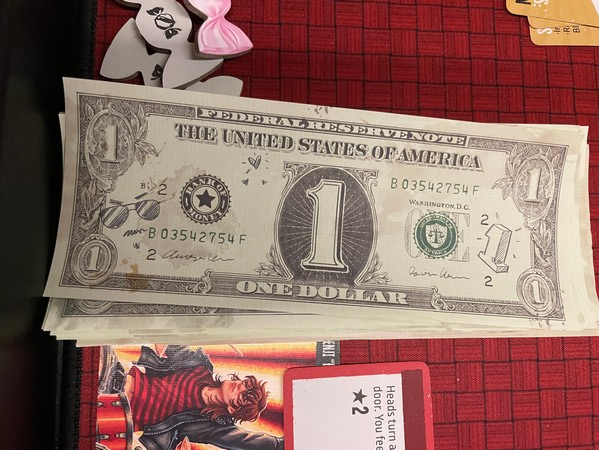
(Incidentally, can I just say that Devir has provided probably the best paper money in a game I’ve ever seen or felt?)
This is often where the Candy comes in.
If you’re taking a Work action, you can’t do anything else to further your career.
You’re going to need extra actions, and taking candy will do that for you.
Hopefully.
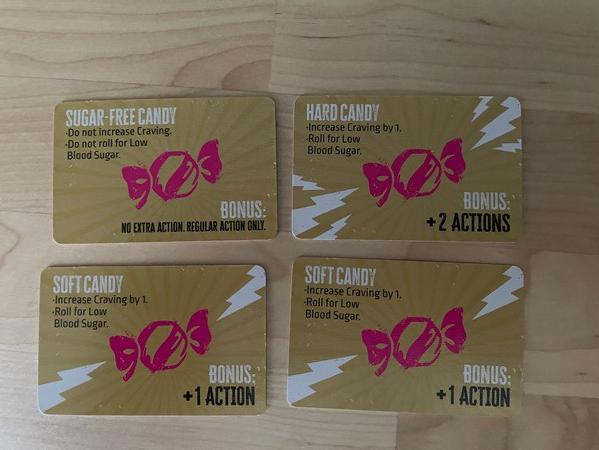
When you spend a Candy at the beginning of your turn, you draw one of the eight Candy cards. Six of them will give you an extra action.
One gives you two extra actions!
And one is sugarless and gives you nothing.
You just wasted your Candy.
But at least you don’t get cravings and have to check for low blood sugar.
This is one place where the game gets really random, which may turn off some traditional Euro players.
It’s a combined random card draw and push your luck element.
You might get great stuff! You might get nothing and the big turn you planned will come to naught.
With each successful Candy use, your craving goes up and you have to roll a die.
If you roll lower than your craving, then you get Low Blood Sugar and your next Day action will have to be spent in Recovery.

If you did it early in the day, you can still take the rest of your actions that day, but you can’t use Candy again until you go to Rehab Recovery.
This push your luck element does add a bit of spice to the game, but I can see how it could turn some people off.
If you’re a Euro player who likes to plan out your moves and the only thing stopping you is that somebody might take your space, this could be a deal-breaker.
In two of the three games I’ve played, one player has drawn Sugarless Candy twice.
Another major random element in the game (if you choose to use them) are the Event cards.
Each day starts with a random event, and these can be major bonuses or major problems in your game.

Some have nice discounts on actions, or can just give you money.
Others will make certain spaces blocked for the current day.
Or perhaps make using or gaining Candy impossible!
There goes your whole plan for the turn, right?
These can be real game-breakers for some people, but personally I do like some randomness in my games.
If I didn’t want any randomess, I’d play Chess.

Yes, there are plenty of worker placement spaces that will increase the three personal stats that you are trying to crank to 11 (Chops, Reputation, and Songs), but for me the most interesting part of the game is the After Hours Hangouts (along with other actions you can do After Hours).
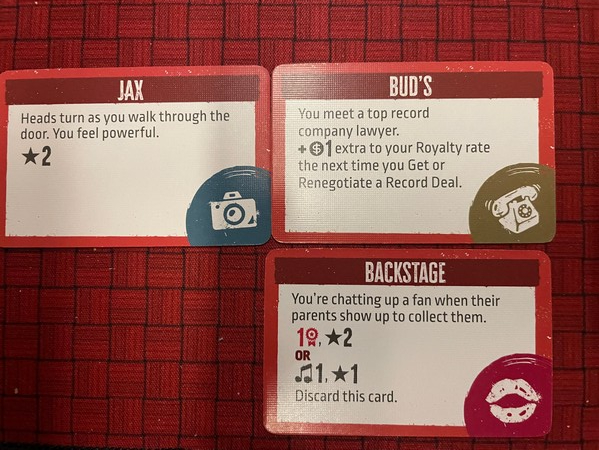
You can go to an empty Hangout space and draw the top card, and something will happen.
These cards can do everything from getting you money or Candy, or maybe increase one or more of your stats. One Hangout (Bud’s) actually will give you a potential rule-breaking ability (most of the time just usable once).
What each Hangout typically can give you is illustrated in the rulebook, but for some strange reason isn’t listed anywhere else, like the board or on a player aid.
After three games, my rulebook is already getting worn out from people asking this question.
Maybe something else for the expansion?
A major design boner from Devir.

I also really like how the After Hours Hangouts and other actions will also result in changes of turn order the next day.
The guitar pick icons are randomly placed each round and turn order for the next round is determined by those numbers.
The Anytime actions have their own that aren’t randomized, of course.
And you can just Go to Sleep, not doing anything late at night, so you can ensure that you go first the next Day.
You gotta wake up early to beat others to the punch!
Rock Hard 1977 is pretty much a standard worker placement game, as shown above.
It has spaces you can be blocked from, turn order is really important and can change each round depending on the players’ actions and how important you feel it is to go ahead of others. Some spaces are open to everybody.
I know a lot of players who like that kind of thing.
But those players don’t always like a bunch of randomness in their games, which makes me wonder a little bit about the audience and how accepting they will be of the mix.
The game’s already a hit, so I guess that question has been answered, but you do really have to decide how much of each type of mechanism you can take in your game.
I have a friend who really doesn’t like worker placement games.
Is there enough other stuff in this game to overcome that?
I’ll be interested in finding out.
So, pretty standard fare with some dessert on top as well.
Sounds like a lukewarm review, right?
Not at all.
This game is dripping with theme, so immersive that you really can feel like an aspiring, but struggling, rock star.

Everything from the Hangouts to the gigs, including the random gigs, trying to better yourself so you can qualify for those gigs, it all comes out in the game.
You feel immersed in 70s rock culture, even with actions like radio interviews (who does radio interviews anymore?) or Indie Promo actions to improve your reputation.
You can tell this game was designed by somebody who lived that culture.
I love the theme of this game and it’s the best part in what otherwise could be just a regular old game with nothing new to say.
Sometimes theme definitely wins out.
I do have a few concerns about the replayability of the game, though there are definitely mechanisms to help with that.
Essentially, it feels like there aren’t that many paths to winning.
You have to improve your three abilities to qualify for certain gigs, and if you’re never able to play those gigs, getting enough fame is going to be difficult.
There are only a few certain ways to do that, though you could get lucky in certain Hangouts as well.
You almost certainly have to use at least some Candy to take extra actions (though I think Fox has mentioned that she’s seen people win without using it so maybe not?).
The progress through the game does feel like it could become a bit rote.
That being said, there are a couple of mechanisms that address that, mainly your Personal Goals and Bonus cards.
Bonus cards are randomized though there is one of each type (Publicity, Performance and Production) and they can guide players in a certain direction.

Some are endgame goals and some (like the two above) are scored as soon as they’re achieved.
Personal Goals give you something to aim for that nobody else will.
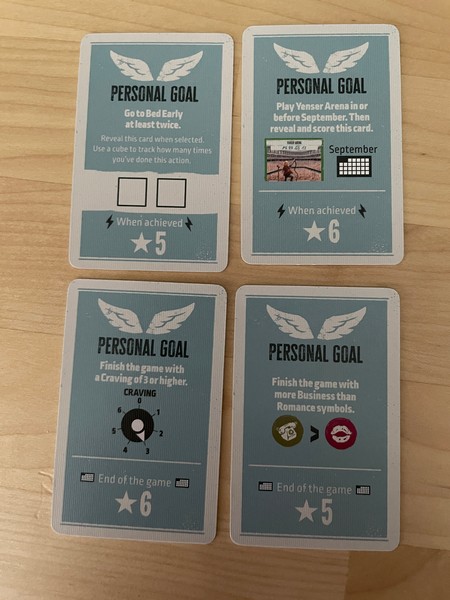
Are these enough to mitigate the potentially rote nature of the game play?
I would need more plays before I can make that evaluation, and the expansion may add some interesting things as well.
For now, though, I have to say that Rock Hard 1977 is a really enjoyable game that really takes me back to that year (though not personally as I was only 7, but you get the idea).
The game is a lot of fun, as long as you’re not one of those players I mentioned above who doesn’t like a Reese’s Peanut Butter Cup of games (you got your worker placement in my random card draws!).
If the theme turns you off completely, I don’t think the mechanisms can save it for you.
But if you don’t mind the theme, I think it’s an interesting mix that’s well worth checking out.
And if you love the theme, why aren’t you out there getting this right now?
(This review was written after 3 plays)
 Dude! Take Your Turn!
Thank you for playing several times before writing your review. And I think you are spot-on about who the game is and isn’t for! I appreciate your time and the guidance it gives to potential purchasers.
LikeLiked by 1 person
I’m so happy you liked the review!
It is a really fun game and I’m glad that I captured that as well as the potential audience.
LikeLike
Very nicely done, Dave. Fair review. The candy mechanic certainly is interesting. 🙂 I feel like the multiple paths to victory element is something that pops up in a lot of games and can eventually limit their re-playability, as you mention. But this seems like it could be fun. I’m not sure it’s something for me, but I can see more musically inclined people really liking it.
LikeLiked by 1 person
Thanks, Zilla!
Yeah, maybe not your type of game. 🙂
But it is a fun one!
LikeLike
I love this game so far, but the thing i appreciate the most about it is how the candy mechanic fits the theme! It’s not just a way to get an extra action, it’s potentially career-killing. JUST like drugs. On our third(?) play through i couldn’t play Yenson arena and hit it big (for 10 points) because couldn’t hire a third crew because i was in rehab! – does ‘drugs ruined a rock star’s career’ sound familiar? Oh and because of how the addiction mechanic works, drugs don’t really hurt you at the start but can really mess you up later…
You don’t see game mechanics that fit the theme too often. Usually the theme of a board game is just a skin slapped on that could be interchanged with any other theme. Not here though!
Replayability could become an issue though given how tight the funnelling through the various steps could be. Don’t know if that’ll matter since it seems getting to know the game better will lead to everyone enjoying trying to optimize their actions based on their character’s and manager’s abilities and the various random events that occur instead of boredom with repetition. So definitely not in the medium turn, but maybe eventually?
LikeLiked by 1 person
“So definitely not in the medium TERM, but maybe eventually?” is what i meant to write, sorry.
LikeLiked by 1 person
Thanks, James! I am happy you enjoy it because I’m sure I will be bringing it again 🙂
LikeLike
Pingback: Essen SPIEL 2025 Recap | Clio's Board Games