Dude! Take Your Turn!
A Gaming Life
New to Me – November 2024
At last, almost a week late, one of the probably longest posts I’ve written, because there are so many freakin’ games on it!
Yes, this is the list of the eleven (!) new to me games I played in November 2024.
December is not looking high on the new to me list considering the holidays and everything, so if you’re interested in new to me games (I mean my new to me games), absorb this one because next month’s post is going to be pretty lean!
The Cult of the New to Me was really happy with this month’s collection of games, because there were five games that are 10 years old or older.
Yes, I mean really happy.

I’ll bet you didn’t know we even had that many members, did you!
Ok, I didn’t either. I think maybe some brought friends?
Or maybe Taylor Swift was in the house and I just didn’t notice.
Anyway, sure there are some 2024 games on here too (including one that I have no desire to play again), but that’s not a bad ratio!
So without further ado (all of my ado was shaved and sold for all of its wool anyway), let’s get this monster started!
Great Western Trail: New Zealand (2023 – Eggertspiele) – 1 play

Designer: Alexander Pfister
Artist: Chris Quilliams
Players: 1-4
The Great Western Trail games have always (for me, anyway) straddled a line between “Man this is fun!” and “I don’t get how to succeed in this game.”
That mainly applies to the first one, though.
The second one, Great Western Trail: Argentina, I actually got fairly well and almost won my first game a couple of years ago.
Whether that would last if I played it again?
Who knows?
Now I’ve finally played the third in the series, Great Western Trail: New Zealand, and it’s about sheep instead of cows.
While I did come in last out of three players, I was within 10 points of the leader!
And man, was it fun.
I’m not sure how I would rank it versus Argentina (need to play that one again), but I definitely enjoyed this one a lot.

It follows the same pattern as the other games, with a rondel/ratchet system where you move your rancher along a winding trail (1-3 spaces to start, but that can increase during the game), stopping at various buildings to do actions.
You are building your deck (of sheep, not cows) to try to assemble a high-value hand to sell when you get to Wellington to sell them.
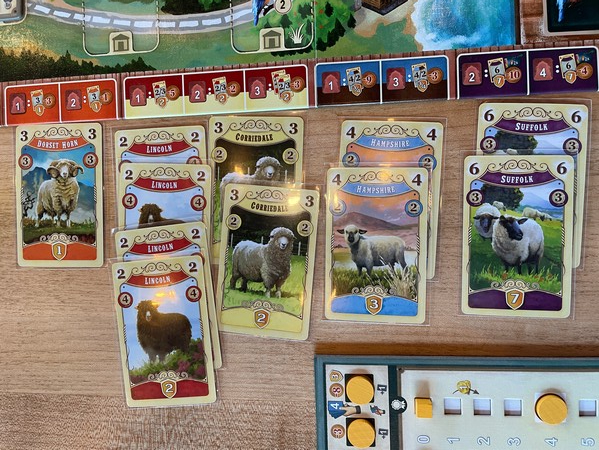
Some interesting differences, though, including the “Shearing” action, which lets you discard a card and collect money equal to its wool value. Some of the lower income cards for selling sheep may actually have decent wool value, so they actually become useful as something other than just “sheep to use when I have to discard two sheep of the same colour” actions.
Another cool change is moving your ship, which has some similarities to Argentina but which does add a new twist to traditional Great Western Trail mechanics.
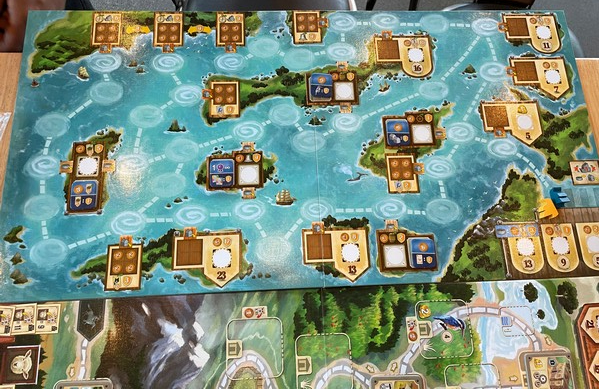
Not only are you opening new trading post opportunities for selling sheep (you can only use the local trading posts until you have established a post on one of the islands), but you can also upgrade some of them to get various bonuses.
Small harbours will let you place a storehouse there and collect the bonus card to your discard pile. Placing storehouses from your player board may unlock other bonuses for you.
Medium harbours let you place a disc out (like on a train station in the original game) to collect that bonus card and endgame points.
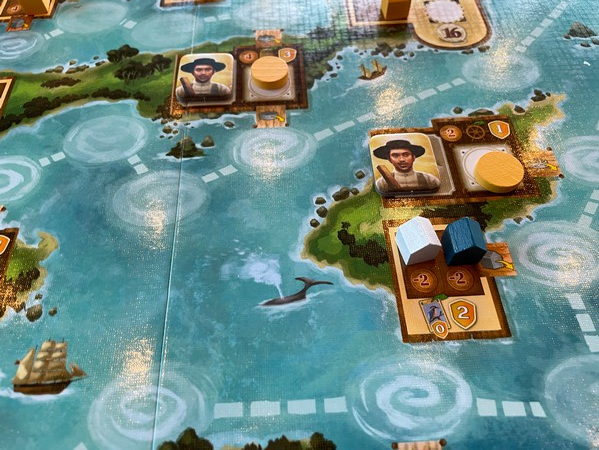
Once again, on some harbours, you can place one of your workers into the Harbourmaster space to get that Harbourmaster tile.
Finally, large Harbours are like small harbours but they have no upgraded cost and you can also pay to place a disc out.
The other major change is the Pathfinder track. Moving up this track will sometimes let you collect gold (monitored on your player board), increase your step limit (how far your guy can move), and even possibly let you ignore all fees for moving for the rest of the game!

You also get VP based on how far you’ve gone.
There is also one additional worker that you can hire: a shearer who will let you shear additional sheep in that action (you can only shear one sheep per shearer). If you don’t want to use all of your shearers, you can use one (or more) to draw a card and discard a card.

Even while these changes don’t sound huge, they do make a huge difference in my enjoyment of the game.
What I really liked was how the new workers are placed in the market. This doesn’t determine the length of the game like it did previously.
Instead, you just put the new worker (placed when you delivered your sheep) in the highest (and most expensive) available worker slot for that type of worker.

It’s the bonus tile placement that becomes the timer for the game.
Bonus tiles are awesome, and I used them very well in my game.
(Editor: “Obviously not that well if you lost”)
I especially loved the “wild” worker (yeah, she’s pretty wild…sorry) which can be used as any type of worker, for only one gold! While gold is a valuable resource, I sometimes found it easier than having enough money to actually hire a worker.
Overall, I really loved this game, if you couldn’t tell.
I want to play it again to solidify it in my mind (and maybe do better at it).
Let’s give this one a thumbs up.
Rebel Princess (2nd Edition) – (2024 – Bezier Games) – 1 play

Designers: Daniel Byrne, José Gerardo Guerrero, Kevin Peláez, Tirso Virgós
Artist: Alfredo Cáceres
Players: 3-6
I’m a huge fan of trick-taking games, becoming even more of one over the last few months where I’ve picked up a bunch of them.
Rebel Princess is the latest that I’ve been able to get to the table.
(for a primer on trick-taking games, and why I love them, see here)
This is basically Hearts on steroids, because it follows the same general gameplay rules as Hearts, but with a bunch of stuff added to it.
Theme doesn’t really matter in these types of games, but basically each player is a princess attending the Royal Ball. They don’t want any stupid marriage proposals wrecking their fun evening, so all of the princes of the realm are barred from attending.
But the princes want to sneak in and distribute some proposals. Who they marry doesn’t really seem to matter to them.
The cads.
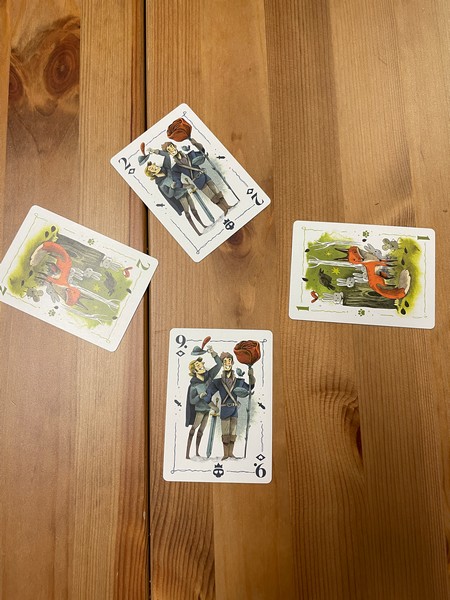
Anyway, just like in Hearts how you are trying to avoid winning hearts in your won tricks (and the Queen of Spades, which is worth a bunch more points and is really bad), in Rebel Princess you are trying to avoid taking Princes and the proposals that they are offering.
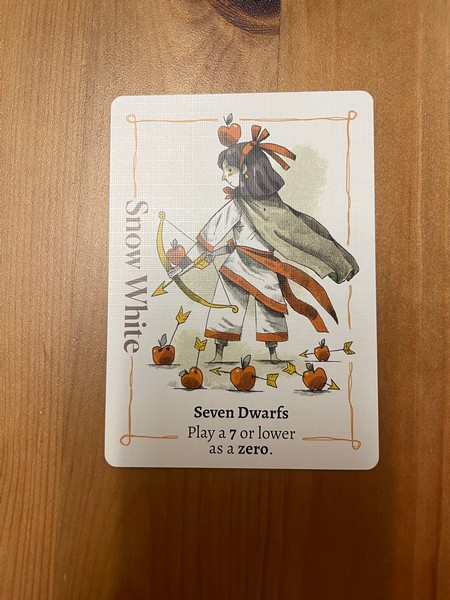
Each player is a specific princess from fairy tales (though I think most, if not all of them, are from fairy tales adapted by Disney, so most people should be familiar with them) and that princess has a once-per-round power that can be used.
Snow White can play any card that’s 7 or lower as a zero instead. That can prevent you from winning a prince (or Frog!) that you didn’t want to take.
I’ve used that quite effectively many times!
There are four suits (just like in a normal deck of cards): Fairies, Animals, Queens, and Princes. The 8 of Animals (the Frog Prince) is the equivalent of the Queen of Spades, giving you five proposals if you take it!
Not cool.
Rebel Princess does add another wrinkle to the whole Hearts thing, though: a new effect for each round.

Each round, you turn over the new round card (or event, or whatever you want to call it).
The “Late for a Very Important Date” event will really make you adjust how you play, since there are three fewer tricks in the round and then you keep and score what you have left!
So don’t keep that Frog until the end of the round.
The round card will also tell you how many cards you will pass to a neighbour at the beginning of the round and which direction, which also changes things up a bit.
You can also “Shoot the Moon” I mean become the “Rebel of the Ball” by capturing every Prince and the Frog as well.
Instead of getting positive points (which are bad), you’ll get negative points for that!

The game goes over 5 rounds, with the 5th round’s event card being especially nasty, or great (assuming you are following the guide to use a black-backed event card as the 5th round’s event).
This one makes each Fairy card worth -1 proposal!
So not only will you be trying to avoid Princes, you will be trying to get Fairies.
Mind-bending.
This is an awesome trick-taking game. Not surpassing Schadenfreude yet, but it’s definitely up there.
Review will be coming when I get a couple more plays in, but for now, this is a keeper.
Spring Cleaning (2024 – Little Dog Games) – 1 play

Designer: Jonathan Cox
Artist: N/A
Players: 2-5
Spring Cleaning is a card-shedding game with some similarities to the brilliant (I guess I really should review it one of these days) Scout.
Much like in that game, you can’t change the order of the cards in your hand.
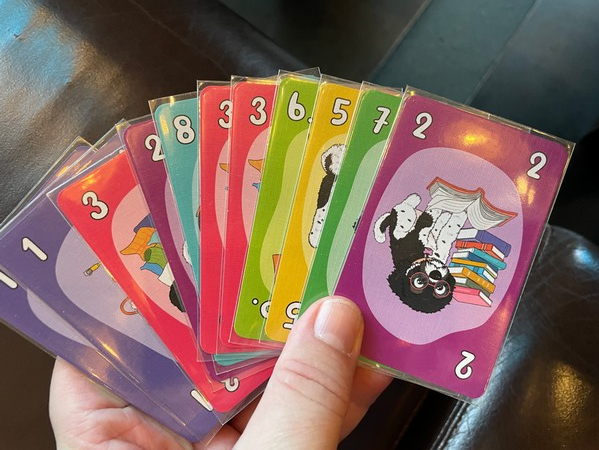
However, you can offer cards to your opponents! While that will help them shed cards, it gets one (or two) cards out of your hand too.

Not all cards will be in play, though, as there will be a draw pile where you draw cards from.
Which is bad! Since you want your hand to be empty.
Much like Scout, a player plays cards in front of them, either a single card, a set of 2+ cards with the same number, or a run of 2+ cards (in any direction, though it has to be consecutive, so it can be 4-5-6 or 6-5-4).
The next players have to lay down a stronger play or they have to draw a card (placing it anywhere in their hand) and then offer a card from their hand. This is a good way to form combos that you can play later.
The twist in this game is that you can use other players’ offered cards for your plays (except if you are leading the trick), even multiple cards! So if James has a 5 in front of him and Vicki has a 7, you can play the 6 and 8 that you have together in your hand as a 5-6-7-8 (or 8-7-6-5) using their cards!
Offered cards are still considered “in your hand” until they get played, so just because the hand you’re holding is empty doesn’t mean you’ve ended the round if you still have offered cards in front of you. You just draw them into your actual hand if you are out of cards.

When somebody runs out of cards, the round is over. Those who still have cards are ranked by how few cards they have compared to everybody else.
Whoever has the fewest gets 1 Trash, second fewest gets 2 Trash, etc.

The game ends when a player has collected a certain amount of Trash, depending on player count.
This was a fun little game. Not really equal to Scout in my eyes, but still reminiscent enough that I really enjoyed it.
I do like the offered cards!
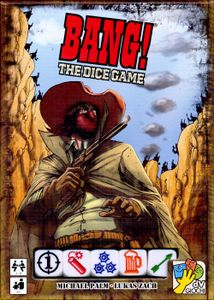
Bang! The Dice Game (2013 – DV Games) – 2 plays
Designers: Michael Palm, Lukas Zach
Artist: Riccardo Pieruccini
Players: 3-8
I really didn’t enjoy Bang! that much, mainly because it was just too long (depending on player count) and you could get eliminated fairly quickly and not have anything to do for the rest of the game.
Bang! The Dice Game changes all of that!
Well, not the elimination part, but the “too long” part, meaning being knocked out of the game isn’t really a tragedy.
Each player gets a role card, like the original game, and the Sheriff is known to everybody. The other players’ roles are secret. They could be a Deputy, or perhaps an Outlaw, or even a Renegade!
Which I was in both of my games.

Instead of playing cards, though, you roll dice on your turn.
You can roll three times (one of the roles can do it a fourth time, I think) and you can always choose what you want to reroll and what you want to keep (except you have to keep Dynamite, which I didn’t actually picture in my dice picture. Whoops!).

For each Arrow you roll, you collect an Arrow token.
Arrows will do damage to all players who have Arrow tokens when the last Arrow token is taken, and then all players give them back.
This can be catastrophic to your health!
(the expansion we played with in our second game actually had another way to mitigate this).
Beer will grant you (or somebody you choose) a life point, which will come in handy. Only up to your maximum health, though.
Bullets (the 1 or the 2) will do one damage to one of your neighbours, either one or two spaces away from you (you choose which player gets hit).
If you roll three of the blue “Gatling Gun” sides, everybody but you takes a hit!
Oh, and you discard all of your arrows, so it would be good to do that if you can.
Three Dynamites ends your turn and does a point of damage to you.
So try not to do that.
This was amazingly fun! It’s quick and easy, no “oh, I’m out of the game and it’s going to last another 45 minutes so woe is me” feeling.
Our games lasted 20-30 minutes and it does take a while before the first player is eliminated.
I’d definitely play this again.
Great filler game!
Panamax (2014 – MESAboardgames) – 1 play

Designers: Gil d’Orey, Nuno Bizarro Sentieiro, Paulo Soledade
Artists: Filipe Alves, Gil d’Orey
Players: 2-4
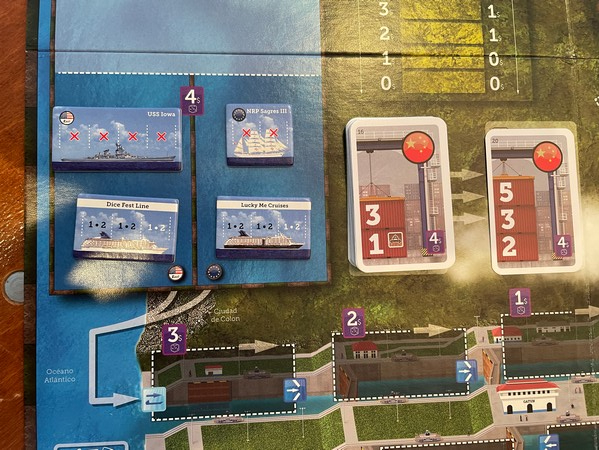
Panamax is an older economic game where you are shipping cargo through the Panama Canal.
It does have the whole 18XX “company money is separate from personal money” thing and you can also buy shares in your own or other players’ companies, which will issue dividends at the end of each round.
It also uses dice!
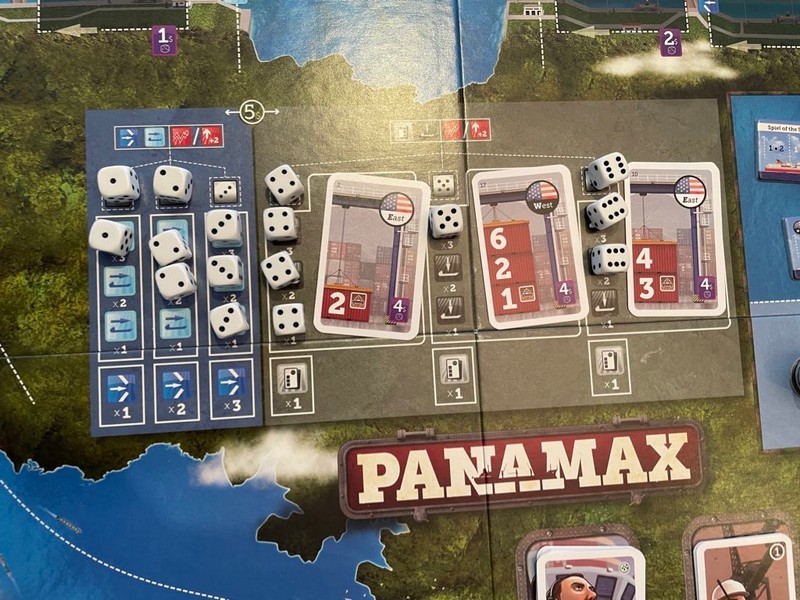
Yes, an economic game that uses dice, and actually not in a bad way!
Instead, all of the dice are rolled at the beginning of the round and placed into their action areas.
On your turn, you’ll take a dice and do that action, the strength of which will be based on how many dice are still left in that action space.
The actions on one side (1-3) have to do with moving ships through the various sea or canal areas, while the other side (4-6) have to do with loading goods onto ships.
There is a way to make use a die from one side to do an action on the other side, but for the most part that’s how it works.
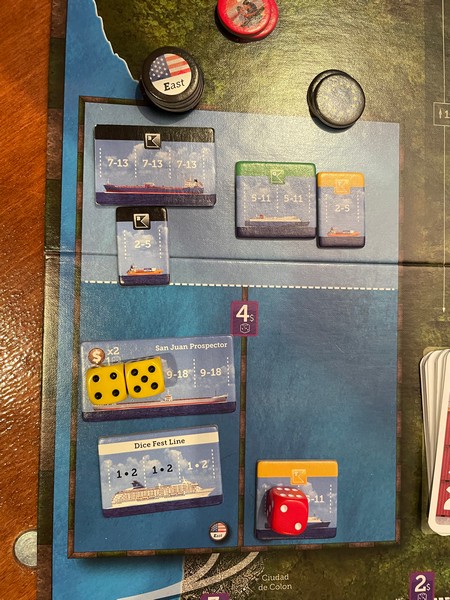
While this isn’t a cooperative game, you will be putting some of your cargo on other players’ ships in order to get things from one side of the canal to the other as efficiently as possible.
Having your cargo on their ship doesn’t mean they’ll lollygag though.
They will get some benefits for moving any cargo to the destination port.
It’s a win-win!
You also may be spending some time moving cruise ships (with cargo that you’ve put on them) or military ships (just to get extra benefits) through the canal.
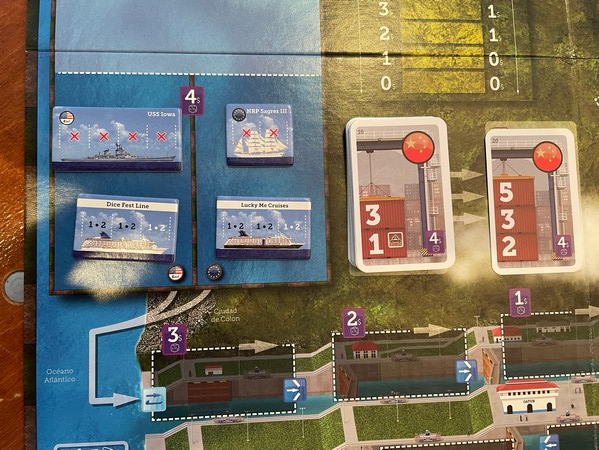
There’s also a bit of set collection in that you are trying to collect discs from the four main countries (well, USA-East, USA-West, China and the EU) onto your player board to get various benefits and possibly fulfill scoring cards at the end of the game.
Cargo is also dice, but this time in your player colour.

When you do a loading action, the card you use gives you the value of the 1-3 cargo dice that you will be placing on it, and the load action will let you place a certain number of dice on ships depending on how many dice are left in the action space.
The fun part of this is that you cannot load two pieces of cargo onto the same ship!

The ships need to be in one of the two waiting areas, and you have to choose which side of the canal you are using (you can’t place one cargo on a ship in the east and one cargo on a ship in the west).
This is one reason why you will probably be loading cargo onto other players’ ships.
You don’t have enough to just use your own.
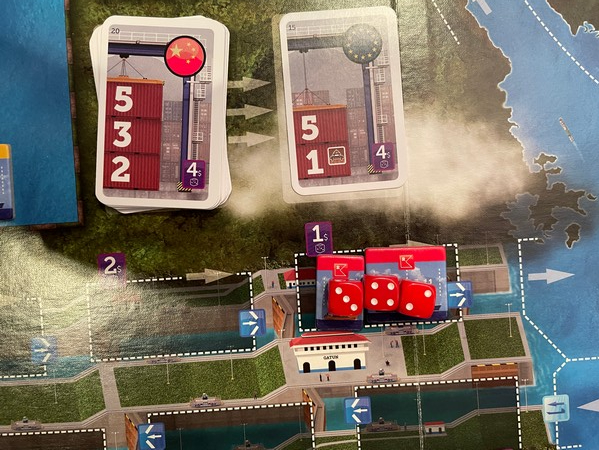
Moving ships through the canal zone requires a certain type of movement allowance to enter each space.
Some require “lock movement” and some require “waterway movement.”
The strength of your move action is based on how many dice are left in that action space, and it will tell you how many of each type of movement you have.

(yes, using the same picture as above…I didn’t take a second one!)
Even better, you have to use your full movement!
This may matter because, at the end of the round, and before you pay dividends to your stockholders, you have to pay upkeep on all of your cargo dice. The ones on ships or in your warehouse.
The amount you owe for each die is printed on the space, so moving a ship an extra space may increase your required payment.
Or your opponent’s! Don’t forget about that, since you can move any ship.
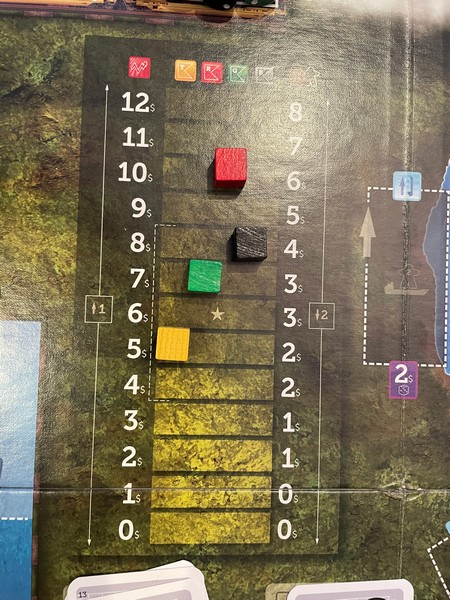
There are a bunch of other things in the game, like the paying of dividends (and how your stock price goes down if you can’t pay out completely) and increasing your market price, the intricacies of deciding what ships to move when, collecting certain card types after your ship reaches its destination depending on a number of factors, but I could be here all day if I got into all of that.

Thankfully we had somebody teach us the game who has played it before because apparently the rulebook is not the best.
It was a fun game. Not really my type of game, but I did enjoy it and could be persuaded to play it again.
Brew Crafters (2013 – Dice Hate Me Games) – 1 play

Designer: Ben Rosset
Artists: Jaqui Davis, Christopher Kirkman
Players: 2-5 players
Brew Crafters is another economic game!
We played this after a really long game of Merchant of Venus (ahem: which I won) so I’m not sure if playing another brain-burning economic game was a good idea for me, but it wasn’t too bad.
In Brew Crafters, you are brewing beer.
Shocking, I know!
You are running a brewery, trying to make money by brewing it, bottling it, and selling it while also trying to expand your business with stuff that will help you do all of that stuff in some way (like an extra storeroom to store your ingredients!)

Each round (year) is divided into four seasons and you will be taking two or more actions during that season.
There are a bunch of different types of beer that you can brew, including the basic Ale, Porter, and Stout recipes along with six advanced recipes that are randomly drawn (but two of each type).

You start with two “market action meeples” that you will use to take your actions.
You could hire more, but you will be paying even more money at the end of the year, so be careful!
Each extension to your brewery (well, most of them) also add to the cost you pay at the end of the year.
Market actions will let you collect ingredients that you need for brewing (keeping in mind you can only store so much in each storeroom) or hire a skilled worker (which will give you some additional benefit to your actions).
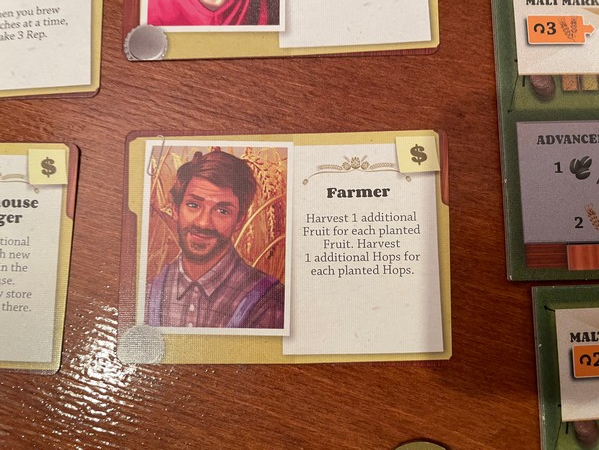
You can also hire a new brewery worker (and, if you use one of the optional complex actions, hire two temporary interns that you keep until you use them).
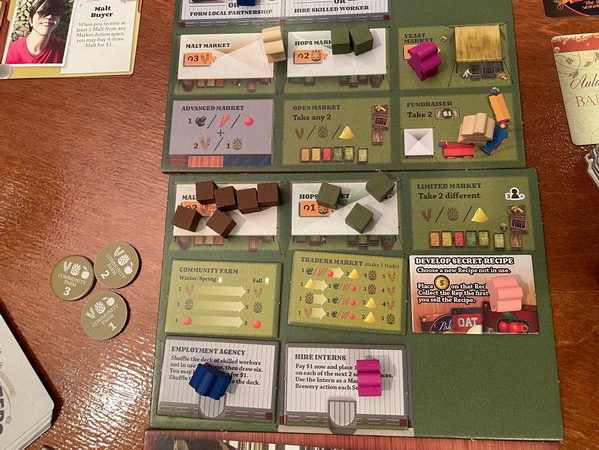
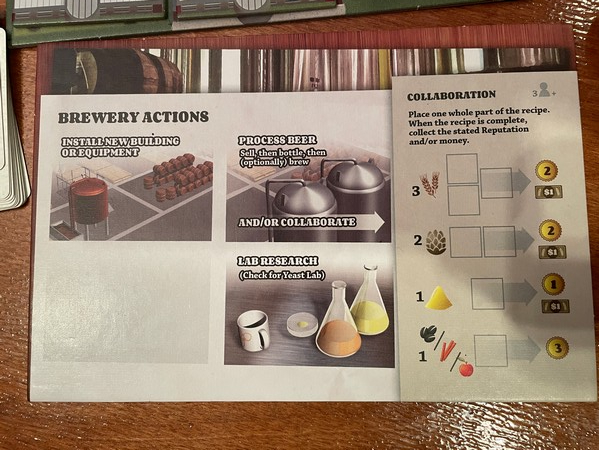
After the Market Action phase, you can use your brewery workers to brew beer, bottle it, sell it if you’ve already bottled it, do some lab research to brew better beer (or make other things more efficient), or install a new building or piece of equipment.
After each Winter phase, you pay all of your costs (all the $ on your buildings/rooms/brewery workers), taking a loan if you can’t (which you can’t pay back, you just lose VP at the end of the game).
Each time you sell a beer, you get the beer token which will give you reputation points at the end of the game. If you’re the first to sell one of the advanced recipes, you’ll get the gold label for that and it’s worth a bunch of reputation as well.
Do this for three years, and whoever has the most reputation is the winner!
Cash is the tie-breaker, so while you want a lot of cash during the game, it doesn’t matter too much if you end the game with nothing (unless you managed to tie somebody else).
This is a fine game for an economic game and I did enjoy my play of it.
I’m not a huge economic game fan, so it won’t be high on my “must play” list, but it’s not something I will actively avoid or anything.
It’s a great example of what it is.
I do recommend playing with at least some of the complex action buildings, as they do make things a bit less tight, especially the intern space.
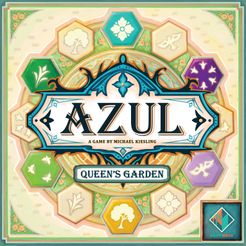
Azul: Queen’s Garden (2021 – Next Move Games) – 1 play
Designer: Michael Kiesling
Artist: Chris Quilliams
Players: 2-4
This is a game that’s hard to evaluate, mainly because we were learning the game on the fly.
I usually don’t like doing that (and certainly don’t like doing it when it’s a surprise!), but there were only three of left on Thursday night at Bottoscon and we decided to give it a try.
This is not your grandkids’ Azul, that’s for sure.
It’s a lot more complicated, but also has a bit of elegance and as we continued on and fumbled through the rules, it all started to make a kind of sense.
In this game, you are still drafting tiles, but you you’re not just drafting squares that look like candy.
Instead, they are hexagonal candy tiles and you are just drafting them to your player board to place in your storage. There is no “this row is for red swirls, this row is for black cotton candy, etc” rule.

Nope, just to your storage.
You are also not tiling a bathroom (sorry, I just can’t stop saying that about Azul).
Instead, you are creating the perfect Queen’s Garden, not just placing the tiles themselves, but also new landscaping to place those tiles!

You’ll start with a stack of garden expansions with four tiles on it.
On your turn, you can choose to take either a colour or a pattern and you take all non-duplicate tiles of that colour or pattern.
So if you choose purple, you take all of the purple tiles with different patterns on them. But you don’t take two purple trees, for example.
If you took a tile from the top garden expansion on the stack, you move the top garden expansion with the remaining tiles onto the table and put four new tiles on the new top garden expansion. This will expand everybody’s future tile choices, of course.
Once a garden expansion doesn’t have any more tiles on it, you flip that garden expansion over. It has one hex out of six that is the same as a tile (a colour and a pattern).
From now on, if you choose to take a pattern or a colour, the garden expansion is considered as well.
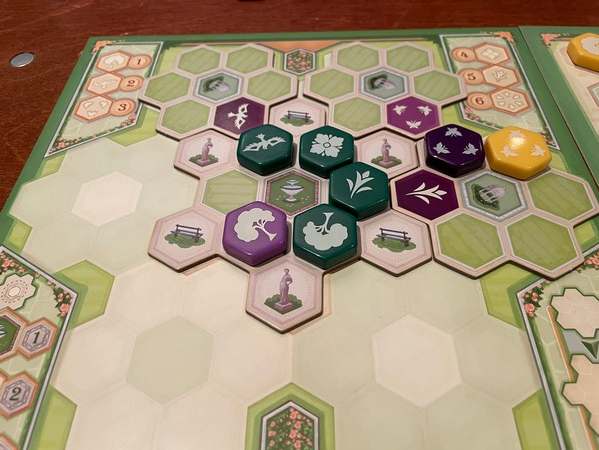
Your storage only holds 12 tiles and two garden expansions, so you have to have room for them in order to do a “take tiles” action.
You can also place a tile or expansion on your player board.
This is what really made my brain burn trying to learn the game.
To place a tile or garden expansion, you have to pay a certain number of tiles of the same colour or the same pattern, depending on the cost of that pattern. That could be anywhere from 1 to 6, but always includes the tile you’re placing (so if you’re placing a 1-cost tile, you don’t have to actually discard any other tiles).
The problem is that the payment has to all be different colours or patterns of the same colour!
You can’t discard two green tiles if you’re discarding colours. You can’t discard two trees if you’re discarding patterns.
It can get so frustrating!
There are jokers available to help offset that cost and you earn those in certain ways.
The placement rules are also a bit hard to grasp on the fly, though in hindsight it’s not that bad.
First, you can always place a tile on a space not adjacent to any other tiles.
But if you do place it next to one or more tiles, at least one of those tiles must match either the colour or the pattern on the tile you’re placing.
That’s fine, but then you have to take into account the groups of tiles that are already on your board.
Placing the tile can’t make it so that a group of tiles has two of the same colour (for pattern groups) or pattern (for colour groups) in it.
What the hell?
Wow, this really did give me a headache.
Placing garden extensions is the same, if the actual “tile” that’s on it is next to any other tile groups already on your board.
This all goes on for four rounds, and eventually you will have a pretty full (and fully pretty!) garden with tiles that quite possibly are illegally placed because you couldn’t wrap your head around the placement rules.
But that’s why we play the games!

Oh, and you score all of this, of course. Each round ends with a scoring phase based on where the time marker is for each round. So you only score certain colours and patterns each round, though endgame scoring encompasses all groups.
And don’t forget that if you have anything left in storage at the end of the game, you lose points based on the value (cost to play) of each tile/garden expansion.
So be efficient or be prepared to lose a bunch of points!
Now that I’ve played it once, I’d like to try it again just to see what I really think of it.
But based on this first play, this is a bit more complicated than I want my Azul games to be.
11 Nimmt! (2010 – Amigo) – 1 play
Designer: Wolfgang Kramer
Artist: Oliver Freudenreich
Players: 2-7
I like 6 Nimmt!, but it is a bit too chaotic to me. Having to play a card, predicting when you will place it and whether what somebody played before you will cause you to take a row of cards (which is bad!) or whatever, can really be difficult.
It’s fun, but it’s more of a “willing to play” than “I want to play!” thing.
Then I learned 11 Nimmt!, and I would much rather play this one!
Though it’s rarer, so I still won’t say no to 6 Nimmt!.
You have a bit more agency in this one, which I like a lot.
Each player starts with 10 cards in their hand that they’re trying to get rid of.
The top card of the deck is turned over and that is the first Discard Stack.
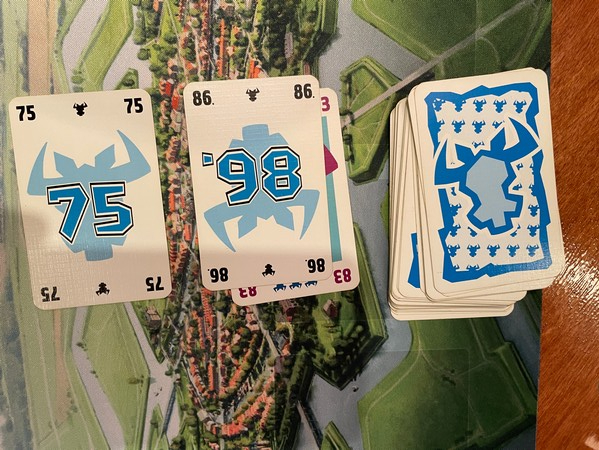
On your turn, you have to play a card to the top of a Discard Stack (yes, that is “a,” not “the”).
The thing is, you can only play a card that’s higher than the top card of the stack, and it can only be up to 10 higher.
If it’s 11 or more, then you have to take the stack into your hand!
When that happens, if the stack had at least three cards in it, you get a Bull card which lets you do something neat.

Then two cards are turned over from the deck, giving two more Discard Stacks (yes, that’s why I said “a” above).
The Bull card has a special power.
It will allow you to play multiple cards onto one stack! If you have them. You still can’t go more than 10 higher than the original top card (it doesn’t chain, in other words).
If you get a second Bull, you can play on multiple stacks!
Each stack, when it reaches 90-99, will roll over to single digits, so if a 96 is displayed, you can go up to a 6 when you play a card.
As soon as somebody runs out of cards in their hand, everybody else scores the number of ox heads on the cards in their hand.

That could be a lot!
Another round then begins, until a number of rounds equal to the number of players have been played.
The lowest score (or highest if you want to count the ox heads as negative points) is the winner!
This was a lot of fun and so much better than the original.
Since you are putting the collected cards in your hand, you still have the opportunity to get rid of them rather than just being stuck with them.
Also, getting stuck with cards can be beneficial because you may be able to then play multiple cards if you have a Bull.
Sometimes you take a stack of 3 cards just because you want that Bull.
The decision space is so much better in 11 Nimmt!.
It’s still a very light, quick-player card game, but it has just that much more depth that I really enjoyed.
Star Trek: Lower Decks – Buffer Time: The Card Game (2024 – Modiphius) – 1 play

Designer: N/A
Artist: N/A
Players: 2-6
Buffer Time (I’m just going to call it that, ok?) is a cooperative push your luck card game that really sucks at two players.
Would it be better at higher player counts?
Maybe.
But even that seems like it wouldn’t offer enough options.
Players are part of the Lower Decks crew of a starship, trying to complete assignments given to them by officers, as well as some…side projects that the officers may not really want them wasting their time on.

There are five main assignments in the deck and you are trying to gain Leisure Points (the Star Trek insignia) by completing them, drawing Shift cards to give you Effort Points (the amount of work done). When you have enough Effort Points to meet the target, then you can declare the assignment completed!
However, doing that won’t get you enough Leisure Points to win (I think you have to gain 18 points in a 2-player game to win, and higher for higher player counts), so you’re going to want to play some Side Projects.
Doing that will add to the amount of Effort Points you have to gain before you can claim the assignment as complete, but it will also get you more Leisure Points (usually).

On your turn, you can “Get to Work” by drawing the top card of the Shift deck.
If there is a red Officer symbol on there, that’s bad!
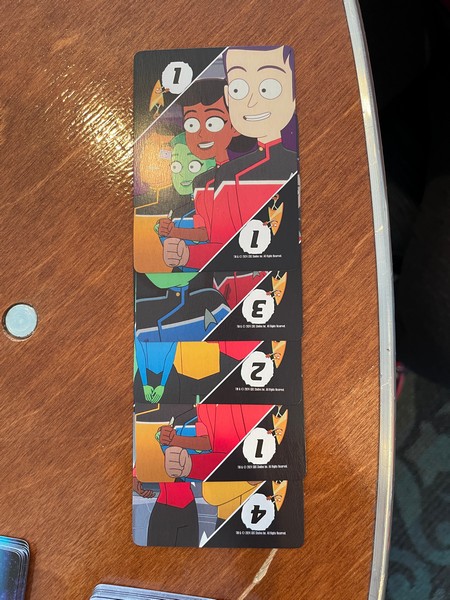
But otherwise, the cards will give you a certain number of Effort Points to count towards your target.
Instead of working, you can play an Alpha Shift ability card.

This will let you do something else!
Or you can play a Side Project.
If you have enough Effort Points to complete the assignment and all of the Side Projects, then you can also decline the assignment complete.
This lets you draw an Alpha Shift ability card (and apparently that’s the only way you can draw new ones?)
If you draw four Officer icons from the Shift deck, you get reprimanded and you failed this task. Not only that, you lose the highest-value already-completed Side Project!
The game goes over 5 Assignments. At the end of the round, each player draws Side Projects until they have two in their hand.
But no Alpha Shift ability cards!
The only one who gets a new one of those is the person who declared the assignment complete.
I just do not understand this game at all, and the rulesheet is simple!
I should say that I understand the game, but I have no idea how you win other than getting really lucky with the Shift deck.
The Alpha Shift cards are going to run out quickly if you use them (which is why more players might be better, as more ability cards might be played).
When only one person will get one new Alpha Shift card each round (and that’s only if you successfully complete the assignment), you apparently just have to get really lucky with the Shift deck.
Playing Side Projects is the only way to get real points, but that just makes how lucky you have to be even more important.
Maybe I’m missing something in the rules?
But I don’t think so.
I have no interest in playing this game again, other than maybe trying it with a higher player count to see whether that adds anything to it.
But I’m not hankering for it.
Qwixx (2012 – Gamewright) – 1 play

Designer: Steffen Benndorf
Artists: Oliver Freudenreich, Sandra Freudenreich, Tom McKendrick
Players: 2-5
The final new to me game in November (literally!) is an old roll and write dice game from 2012 where you roll dice and hope to score!
Qwixx involves rolling four dice on your turn: two white dice and then the four colours that are on the score sheet (blue, green, red and yellow…good luck colour-blind people!).
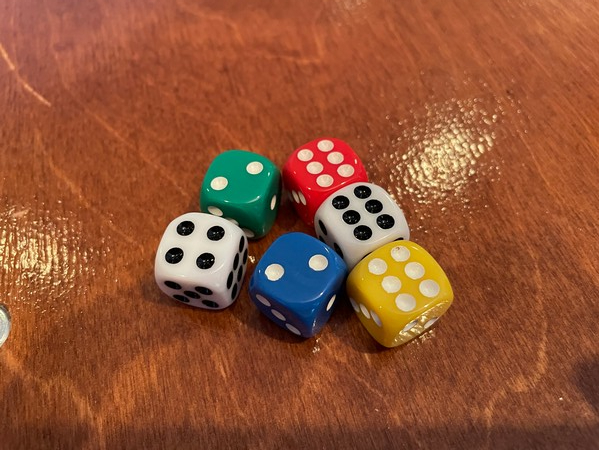
On your turn, you roll the dice and then try to fill in your scoresheet.
First, you can use the two white dice (if you want to) to fill in any legal space on your sheet.
Then, you use one coloured die and one white die to fill in a legal space on that coloured row.
Both are optional, though if you don’t do at least one, then you have mis-rolled and will lose 5 points.
You can only do that four times.
Other players can do the first thing option with the two white dice but not the second.
What’s a legal play?

You have to fill in a row from left to right.
Once you’ve filled in a space, you can’t fill in any empty spaces to the left of it.
As soon as you’ve crossed out 5 spaces in a row, you can lock that row.
Nobody can roll or fill in that colour anymore.
The game ends when two rows are locked or somebody has misrolled four times, the game ends and you score.

You score points for each row depending on how many spaces you’ve crossed off, then lose 5 points for each misroll.
Whoever has the most points is the winner!
This is a fun little filler. Quick and easy, I’d definitely play it again.
I wouldn’t outright request it, but if it’s available and we need a game that takes 10-15 minutes, I’d go for it.
So that’s all of the new to me games I played in November.
Conventions definitely add to that total!
I hope you enjoyed the read, even though it was long.
What new to you games did you play in November?
Let me know in the comments.
 Dude! Take Your Turn!
The only new-to-me game this month was Xenon Profiteer. Heard about it on the Board Game Hot Takes podcast a bit ago. I liked the idea of a deckbuilder that was more in-flux than a normal deckbuilder – part of why we tried FORT but we bounced off that one – and also, I literally work with liquefied products of distilled air all the time, so the theme was a winner. It’s gone pretty well with the work crew in three plays so far.
Can’t believe you didn’t know QWIXX yet! I really enjoy that one, it’s been a big hit with my wife’s family. We also invested in the QWIXX MIXX score sheets, one of which shuffles the colors around among rows, and one of which shuffles numbers around within rows.
LikeLiked by 1 person
I’ve played the app, but not on the table. It’s a fun one.
LikeLike
That’s a lot of games! Rebel Princess looks pretty interesting (I also like classic Hearts)!
My only new-to-me game of November was Washington’s War (Mark Herman, GMT Games) which is pretty interesting for how ground-breaking it (or rather, We the People of which it is a remake) was.
LikeLiked by 1 person
That’s always looked like an interesting game
LikeLiked by 1 person
It’s on Rally the Troops! as well!
LikeLiked by 1 person