Dude! Take Your Turn!
A Gaming Life
New to Me – February 2025
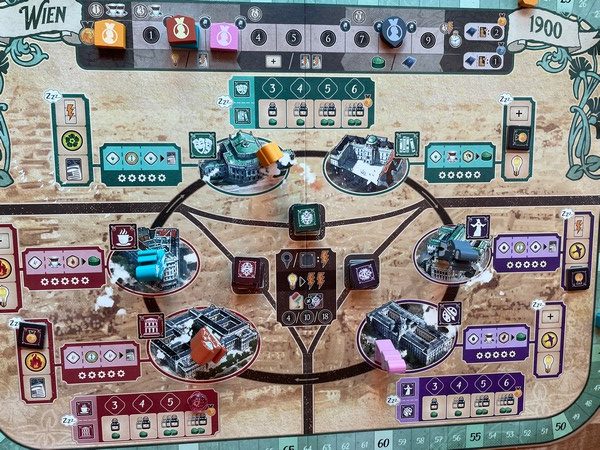
Welcome to another in the continuing series (8 years and running!) of “new to me” boardgames posts.
In a few days, I’ll be celebrating 8 years of blogging, and one of the things I am proud of is that I have never missed a month posting about the “new to me” games I played the previous month.
There have been some months where there weren’t any (or the one that I did play wasn’t really worth talking about, but that was just during COVID when my blogging motivation really hit rock bottom). But if there were new to me games to talk about, I was there!
Even if sometimes, in my worst blogging lulls, it was posted during the last week of the next month.
I’m also quite proud of the fact that the “Cult of the New to Me” has kind of caught on a bit. Ok, maybe it was just one podcaster who may not even be around anymore, but it was nice to get some recognition anyway!
In February, we missed our first Sunday game day due to some event going on, and so I thought it would be a lean month.
However, an all-day Saturday marathon game session, plus some interesting new games coming to our Sunday (and a lunchtime new to me game, which is unusual!), made it so I have a lot to talk about this month.
Sadly for the cult, all of the games were either from 2023 or 2024, so there were rumblings.

But I kept them in check by placating them with some awesome sushi (I was lucky since I don’t know what awesome sushi looks like!)
I should probably play at least one older new to me game in March, though.
Just so they’ll shut up.
I didn’t say that out loud, did I?

Anyway, without further ado (all of my ado was sliced up by a lightsaber anyway), let’s get started!
Star Wars: The Deckbuilding Game (2023 – Fantasy Flight Games) – 2 plays
Designer: Caleb Grace
Artists: I’m not listing 35 different names
Players: 2
There are so many Star Wars games out there, and I have barely played any of them!
Rebellion is still on my want list.
When I saw the Dice Tower review of Star Wars: the Deckbuilding Game, I was a little intrigued, but not really enough to go out and buy it.
However, at the Saturday marathon this past February, it was in the library and a friend and I were looking for something fairly quick to learn and play. Neither one of us had played this before.
It was surprisingly fun!
And very easy to learn.
Like many of these deckbuilding games, it’s a duel between players where you are trying to damage your opponent, this time of course as the Rebellion and the Empire.
It has a standard card row that you can buy from and a stack of “always there” cards that you can buy if nothing else looks good.
However, there are a couple of interesting twists in this one.
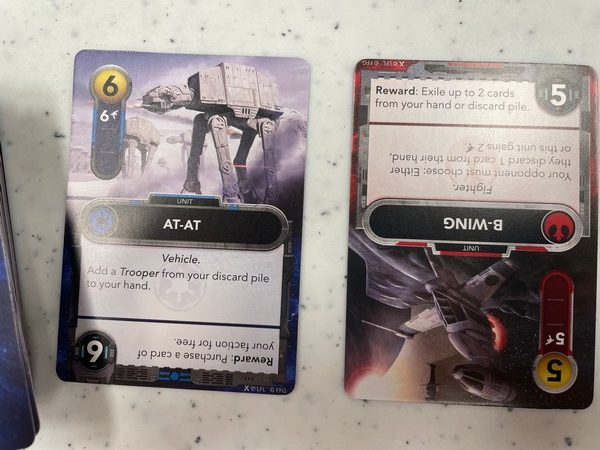
First, there are Empire cards, Rebel cards, and neutral cards in the card row.
The Empire player can’t take Rebel cards and vice versa, though both players can take the neutral ones.
The cards are oriented towards the player who can purchase them (the gold number at the top left).
However, if the card row is full of your opponent’s cards, you’re not locked out!
See the pistol symbol under the AT-AT’s cost?
When you play cards, they will be giving you guns or “currency” or maybe even force points that you can use during your turn.
If you want to remove your opponent’s card from the row, you can spend as many guns as the number facing you (if you’re the Empire player with the picture above, you can spend 5 guns to destroy the B-Wing).
You get the reward shown next to that.
Secondly, instead of player “health,” you are trying to destroy three of your opponent’s bases.
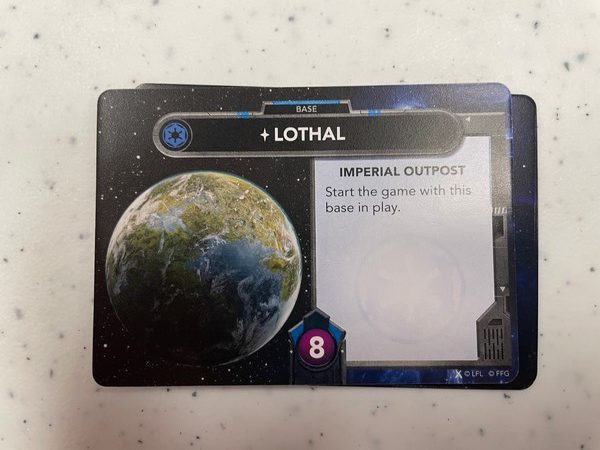
Each faction starts with a specific one, but when it’s destroyed, you can then choose another one from those available.
You can buy capital ships (either your own or neutral ones) when they appear in the market row, and then when they are in your hand, you can play them in front of your active base.
Some are just defense (they must be destroyed before your opponent can attack your base), but some of them have offensive abilities or other effects of their own on your turn as well.
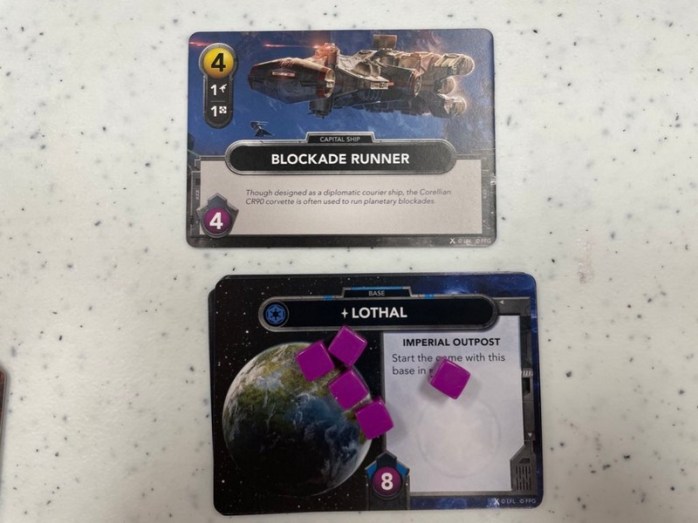
The Blockade Runner above gives you one resource (for purchasing) as well as one gun.
Capital ship guns must be used against other capital ships and/or bases. They can’t be used against cards in the market row.
Otherwise, this game is pretty much like other deckbuilders as you are buying cards, building up your deck, and hopefully exiling your starter cards so the better cards will come out.
There’s also being one with the Force. There’s a Force track that goes back and forth like tug of war.
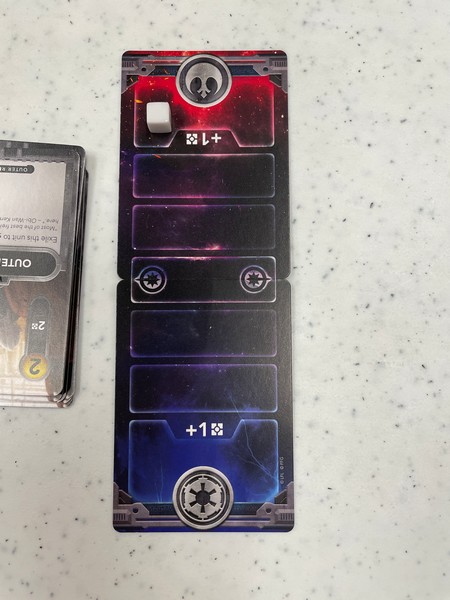
If either side has it all the way to their side, then some cards will be even better (like the X-Wing below, where “if the Force is with you, draw 1 card”
All of the usual suspects from the movies are available in this one, including from Rogue One!

This game was fun and it’s reasonably quick once you get the hang of it. Our first game took a while, but the second one moved pretty fast.
I’d play it again, but I have so many deckbuilders that I probably don’t need to own it.
If anybody else wants to buy it, though…?
Hint hint.
The Lord of the Rings: Duel for Middle-Earth (2024 – Repos Production) – 2 plays

Designers: Antoine Bauza, Bruno Cathala
Artist: Vincent Dutrait
Players: 2
Another movie tie-in!
Or in this case, a book tie-in, as the game is very obviously based on the books and not the movies.
Lord of the Rings: Duel for Middle Earth takes the already well-established 7 Wonders: Duel system and turns it a little bit on its head.
It incorporates some things (like the “take one card from the display and either sell it or buy it) but then adds a mini-board where you are going to be spreading your armies around.
You don’t have a military track. Instead, you are trying to do area control to dominate all seven lands in Middle Earth.
You don’t have a Science victory. Instead, you are trying to gain alliances with the six different factions on Middle Earth.
It’s actually quite good and, dare I say it (though I would have to play it more) even better than the original?
Not sure yet.
Anyway, each age’s cards (“chapters” in this game) are displayed much like the original game.

On your turn, you draft one of the unblocked cards.
However, if you have the resources available, you can buy a Tower tile (which puts a Tower in that space on the army board) instead of drafting a card.

So you can actually force your opponent to take the next card if you can do that.
Building a tower will also give you other benefits as well, some of them quite good!
They may let you put armies in that space as well, or maybe move some armies around.
Or even take another turn!
Finally, there is the Ring track, which has either Frodo & Sam trying to get the Ring to Mt. Doom, or the Sauron player to catch them.

The track for this is really cool. Frodo & Sam can never increase their distance from Sauron’s forces.
The track is a two-piece track with the Nazgul marker slid into it. So if Sauron moves forward on the Ring track, the Nazgul will move one space closer to the hobbits.
If the hobbits move forward, however, the whole track moves forward. This maintains the distance between them, just getting the hobbits closer to the end.
It’s quite cool!
The map is pretty neat too, and the area control system is really easy to implement.
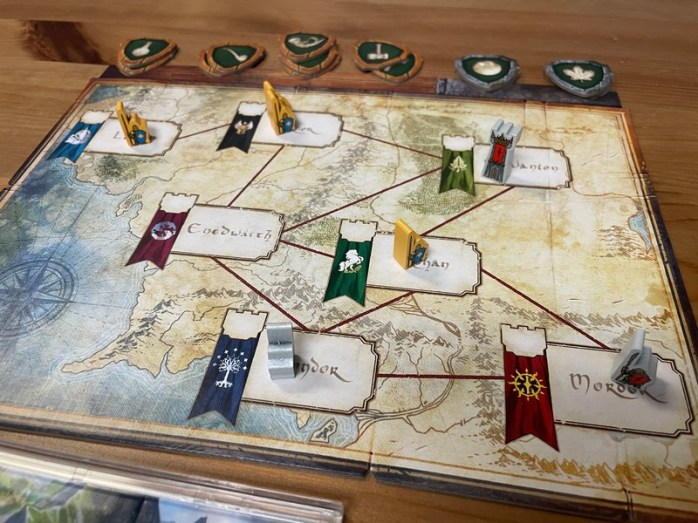
If both sides have units in an area (not towers, which don’t affect anything except giving you presence in the area), then each side removes a unit until only one side has units left.
The faction alliance system is pretty interesting too, giving you some really nice abilities for the rest of the game.
What I really like about this game, though, is that it has simplified the money system for buying cards.
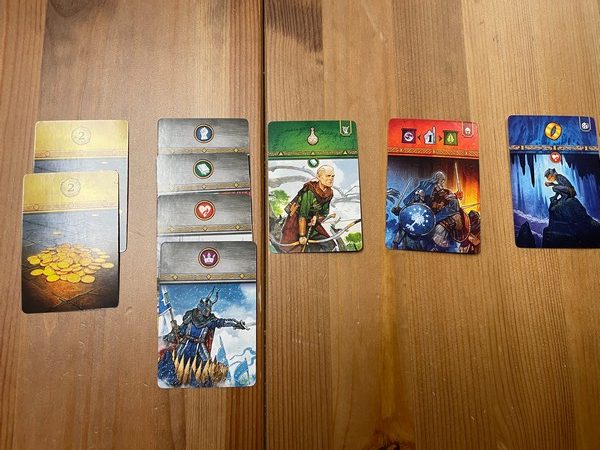
Just like the original, each card (most cards, since some are free, like the military one above) will have a resource cost that you must have in your kingdom. Some will cost coins too.
The Elves above, for example, require a Book resource, which I have (those are on the left). The blue Ring card, you must have a bleeding heart (which I also have).
For each resource you don’t have, you have to pay 1 coin.
That’s it!
None of this “how many of that resource does my opponent have, so I have to calculate how much gold it costs” nonsense.
It’s just one coin per missing resource.
I really love that.
This is a really great game and it’s going to be a 2-player staple of our lunch time games for a while, I think.
Unconscious Mind (2024 – Fantasia Games) – 1 play

Designers: Laskas, Jonny Pac, Yoma, Antonio Zax
Artists: Andrew Bosley, Vincent Dutrait
Players: 1-4
Unconscious Mind is a game that’s been receiving rave reviews, so much so that I knew I wanted to try it at some point.
The theme of the game sounds like it might be kind of boring.
Fellow psychiatrists in the age of Sigmund Freud are trying to become the most prestigious psychiatrist around by treating prominent patients and publishing prestigious works about psychoanalysis.
All of this in what is essentially a worker placement game.

I do love the rather unique worker placement mechanic, where you are placing “ideas” (the speech bubble markers) in a space, pointed at an action, in order to do that action.
Nobody can go to the same space as you, but they can still do the action by taking another space (notice how the bubbles point to an action?).
You also can’t do the same action twice until you recall all of your “workers” (oh yeah, that mechanic is in there too).
You’re also going to be treating patients, of course. Instead of placing a worker, you can treat one of the patients that you drafted.
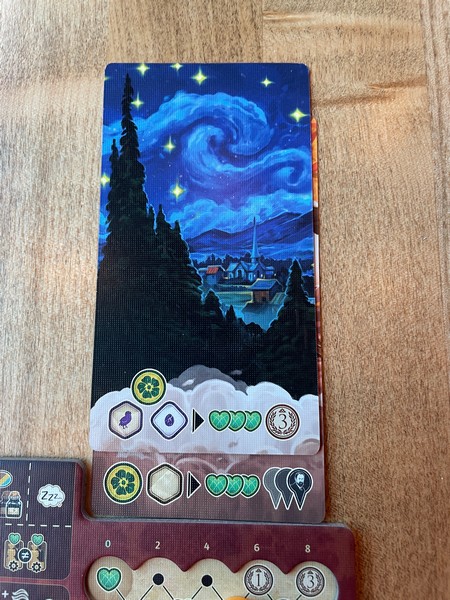
You do that by matching the symbols on both the initial trauma as well as the underlying problem.
This is done by a rather unique method of taking a card and then taking a plastic overlay that will add other requirements to the patient.
During your worker actions (or other avenues), you will be gathering “resources” (basically different aspects of psychology? I don’t know).
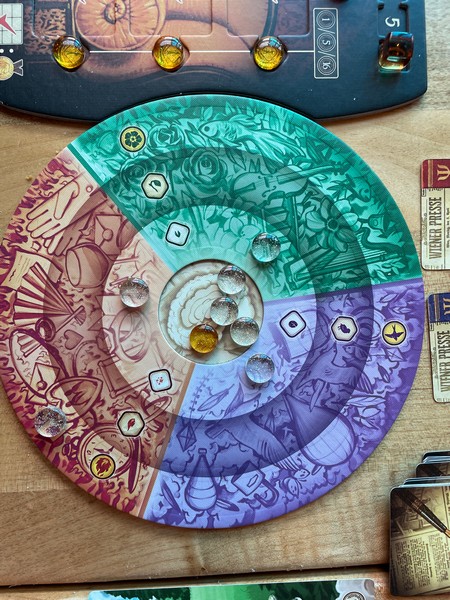
You’ll have to spend these in order to treat first the initial trauma and then the rest of the patient’s issues.
Treating some patients will give you in-game abilities while treating other patients will give you endgame scoring.
One thing I do really like is that “resting” isn’t just “take back all of your workers.”
It also includes the possibility of getting more great stuff depending on the different icons you’ve collected in your patient and card tableaus.

On the main board, you have a meeple that’s moving around the board, and Freud himself is moving around the board too.
When you rest, not only do you take back all of your ideas, but you also get the benefit on the main board of either where you are or where Freud is.
This can get you some really great stuff, depending on your icons.
There is a lot more going on in this game, but I don’t want to overdo it so I’ll just end there.
The game ends when Freud’s reputation reaches a certain level (it moves up when you do, since you are his students!).
This game has a lot of aspects, from worker placement, to icon chaining, to card drafting and other things.
I did horribly in this game because of how inefficiently I did all of my actions. Other players were getting a bunch of different actions from having a bunch of the same icons, and I was getting one or two piddly actions.
It was frustrating.
But I did enjoy the game!
I can see the appeal of it and I’d really love to play it again.
Endeavor: Deep Sea (2024 – Burnt Island Games) – 1 play

Designers: Carl de Visser, Jarratt Gray
Artist: Fahed Alrajil
Players: 1-4
I wouldn’t say that I was necessarily “frightened” away from this game.
However, my first couple of plays of Endeavor, many years ago, didn’t really make me want to play it again.
Even when a new version came out.
When I saw the name of this game, I thought it was related and I just thought “eh, I don’t need to play this.”
But it came out as an option this last month, a relatively quick, 60-90 option, and I said “what the hell?”
I discovered that this has nothing to do with that game, and it’s actually quite fun!
In Endeavor: Deep Sea, each player runs a submarine (and then a series of submarines) who are exploring the depths of the ocean floor for research and conservation.
You start with a team leader and each round, you will be drafting a new crewmember.

These crewmembers will allow you to take actions in the ever-expanding undersea expanse.
All of your resources and abilities will be tracked on your player board.
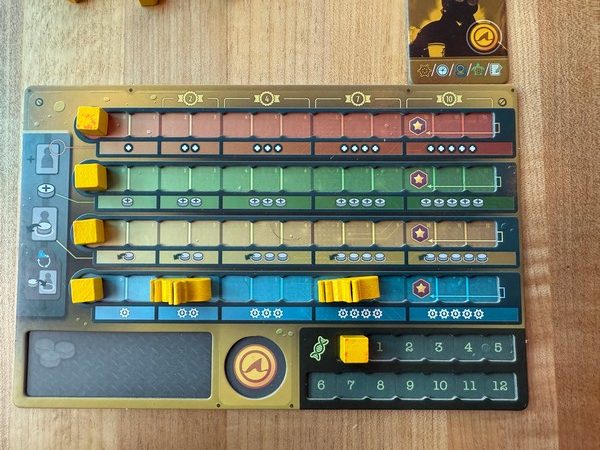
This includes the level of crewmember you can recruit, how many actions you will receive, how deep your sub can go (which also unlocks additional subs), and how many action discs you can retrieve from your workers each round.
That’s right, action discs stay where you put them unless you retrieve them during the start-of-round phase where you do that.
If you don’t improve your “recall,” then you will have crewmembers who can’t do anything.
Basically what you are trying to do is explore the ocean depths in the area where you are.
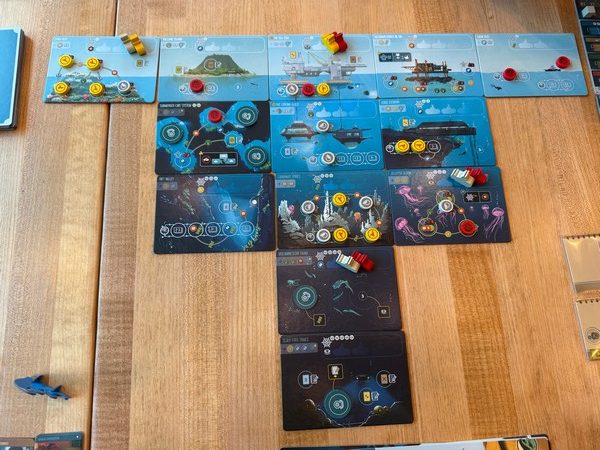
You do this by using sonar (one of the actions you can do if you have the right crewmember).
Just discovering the tile will get you icons that will boost the abilities on your player board. But then moving your sub into them (assuming you have increased the depth your subs can go) will get you more of those icons.
These tiles will have sonar icons that let you delve deeper, or maybe conservation projects which will let you spend the “money” (I think it’s research points? But I’m not sure) to place a disc on that tile and get some bonuses.
Or maybe it will have a space where you can do a log and get some cards that will greatly help you out.

These cards can give you a one-time strong action, or maybe an effect, or who knows?
Often these cards will let you upgrade one of your crewmembers as well.
If you do and they have an action disc on them, you will lose the disc. But that crewmember becomes free to do another action at some point.
It’s all quite intricate, especially as you are trying to place discs on the research board.
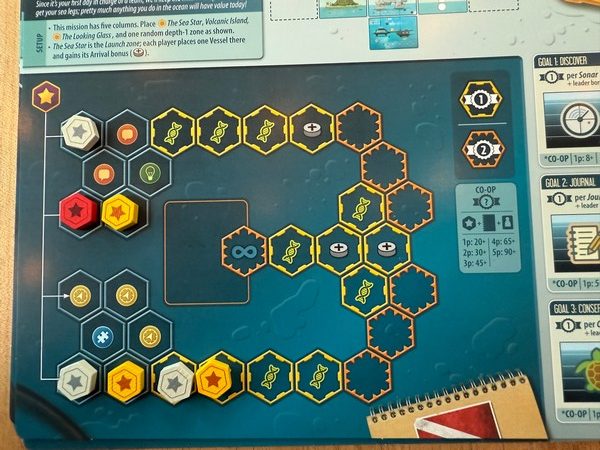
These spaces may give you an icon boost on your player board, or other things. But the yellow and orange spaces are worth endgame points as well.
The game goes seven rounds, with a lot of endgame scoring (there really isn’t any in-game scoring) based on what you’ve done and the mission you’re doing.
There are numerous “missions” in the game which will change how the points are awarded and what endgame goals you’re going for. We only played the first mission, but it was pretty great.
It’s a game I’d like to play again.
Havalandi (2023 – Pegasus Spiele) – 1 play

Designer: Reiner Knizia
Artist: Lukas Siegmon
Players: 2-4
This was a marathon game (the Saturday game day that we had this month) with three completely new to me players.
Of course it’s going to be a Knizia game!
While the game had its moments and wasn’t bad at all, it’s not exactly a game I’m dying to play again.
This is a game of hot air balloon flying and landing, but essentially it’s moving your piece around the edge of the board, and then claiming a space along the line from that piece for your own.

The map is a pyramid of spaces, and all of the player pieces will be moving along the outside of it.
It’s also kind of a roll and move game, in that you roll the dice and move your piece that many spaces.
Then, when you land, you can claim a space on either hex row from it. So either toward the bottom of the board or across the board.
You’re trying to chain these spaces to get points for having 3+ spaces in the same coloured region. Each time you claim a space, if the connected spaces in the same region are 3+, you get one point per space. So maybe 4 points one turn. Then 5 points the next.
Or whatever.
On your turn, if you have a claimed space in the middle light brown region and connected to multiple spaces in other regions, you can launch your balloon. This flips over one control marker in each region that’s connected to it, and gets you even more points.

Some of the endgame scoring is based on launching balloons.
You also get immediate points for claiming a space next to those structures on the edge of the board (I don’t know what they’re called).
There are also a couple of special markers you can use on your turn, like one that lets you put a marker anywhere instead of where your piece lands, or maybe place two connected markers.
The game ends when somebody runs out of regular markers (even if they have special markers left).

Then endgame scoring is done from the objectives that are in play, and whoever has the most points is the winner!
This is a very light game, with roll and move mechanics, though at least you have a range of spaces that you can choose from and you can get multiple points by increasing the size of your connected markers.
It’s not a game that I’m yearning to play again, but I wouldn’t say no if it came out.
MLEM: Space Agency (2024 – Rebel Studio) – 1 play

Designer: Reiner Knizia
Artist: Joanna Rzepecka
Players: 2-5
I didn’t realize it when we played this, but this is two Knizia games in one marathon session!
MLEM is a push your luck game where you are launching catronauts (cat astronauts) into space to try and get them to land on planets or moons that will get you points.
I actually didn’t realize this was a Knizia game when we were playing it, but it certainly makes sense after finding that out.
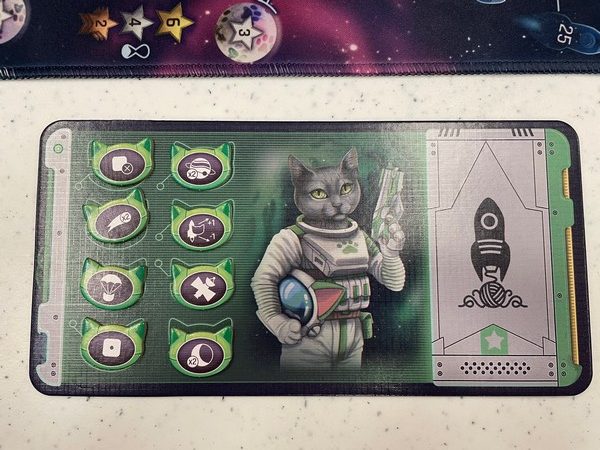
The trick on this one is that while the lead player is rolling the dice during the round, all players are placing one of their cats on the spaceship, trying to reach the greatest heights in space.
The type of cat you’re putting out there depends on what you are trying to accomplish. Or, if you’re like me and actually managed to get a lot of cats out there, what you have left.
Once each player chooses a cat, the player whose turn it is starts rolling the dice, and the spaceship starts moving.
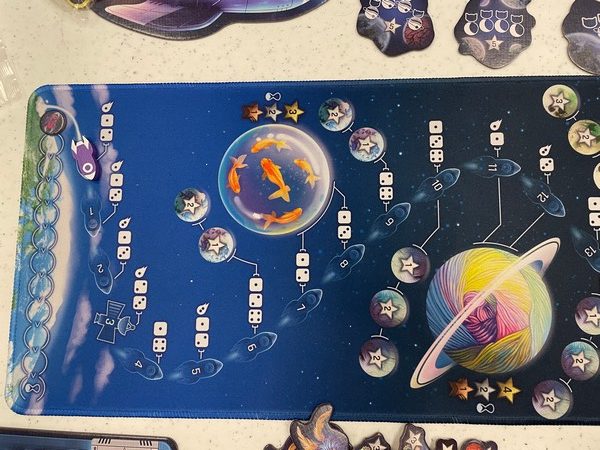
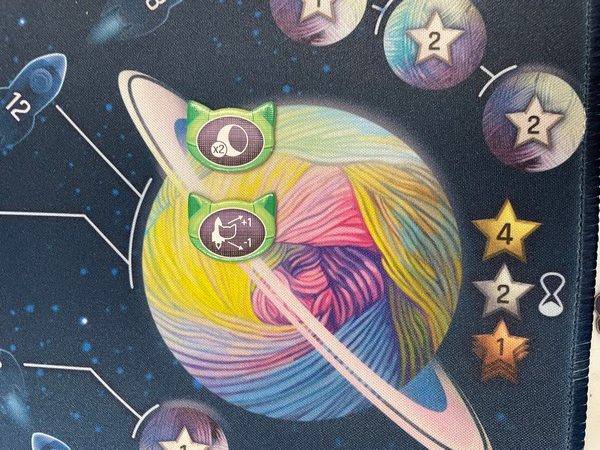
The map (a really nice player mat, actually, and I think it actually comes with the base game, not being an extra thing to buy) runs up through planets and moons, each space having a specific type of dice on it.
You roll the dice and then choose which dice to use to move the ship forward. But you can only use dice that are on the space you currently occupy.
So at the beginning, like above, you can only use a 1, a 2, or a flame.
Normally when you use a die to move the ship, the die gets removed from your dice pool. But flames go back into your dice pool.
Say you moved four spaces because you rolled two 2s. The current space you are on now requires ones and fours.
If you don’t roll any of those, you bust! The mission ends and everything goes back to the beginning.
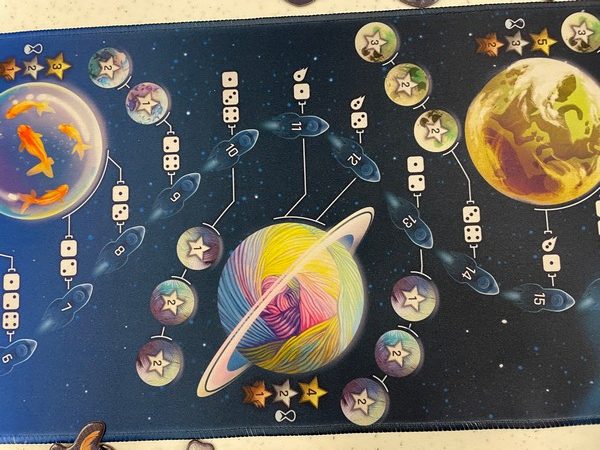
As long as you roll one of the numbers (or flame) on the space you are on, the ship continues to move forward.
Each time the ship moves forward, each player gets the chance to get off the ship rather than pressing their luck.
As long as you’re in a space with somewhere to get off.
In the picture above, all of the spaces have somewhere to leave. Maybe a planet, maybe a moon, whatever.
Leaving will possibly give you points (or with planets, you have to have a majority of cats there to get the most points).
The different cats may give you bonuses for being on a planet, or moon, or maybe actually allow you to parachute to safety when you bust (which hopefully is when you’re in a space to leave the ship, or else it’s a waste).
The game ends when somebody places their final cat or when a certain number of missions bust.
You then get points based on Moons you’ve landed on, planets, and other places where you have left your cats.

It’s a fun push your luck game with some interesting decisions regarding which cats you use and, depending on the cat you use, when to actually abandon ship.
It’s certainly a game I would love to play again, though it’s not something I need to play again.
If that makes sense.
Those are all the new to me games played in February!
Will next month have more?
With a convention, it’s likely. But maybe there will also be some older games.
Because I really need to appease my cult.
What new to you games did you play last month?
Let me know in the comments.
 Dude! Take Your Turn!
I always enjoy these posts, thanks so much for taking the time to put them together.
It’s great to hear your thoughts on Lord of the Rings: Duel for Middle Earth. That’s a game I have but have yet to get to the table. Sounds like you really enjoyed it as well, which seems to be the general reaction from people who play it. :)I really like the looks of Endeavor: Deep Sea, I think I would really like that one given the theme, and I’m a sucker for exploration in games. :)Unconscious Mind looks fascinating as well. I’d not heard of that one before at all, but I love the fact that it’s got such a unique premise, and it sounds like it’s got some meat behind it, which makes me think I’d enjoy it. Thanks again for all your work on these!
LikeLiked by 1 person
Thanks, Zilla!
Hopefully I’ll actually get a review done for Lord of the Rings soon. I am so bad. LOL
I would really like to play Unconscious Mind again. Endeavor I liked, but I’m ok if it doesn’t come out.
It’s definitely fun, though! Especially if you like exploration.
LikeLike
Lots of intriguing games this month! I’m not too much drawn to deckbuilders, but I love Star Wars, and from what you write it seems like the game is getting the feel right. I would definitely give it a try.
Contrarily, I enjoy 7 Wonders: Duel very much, but I’m skeptical about its use of the Lord of the Rings… from all I read about it, it just seems like the two sides play very similarly (when Sauron and the Fellowship should feel extremely different). I’m sure it’s a very clever game, and I’d try it, but I fear I am rather lukewarm about it.
I had the chance to play MLEM last year and found it whimsically amusing. It worked well at two players, but is probably better with more (at least your missions will get deeper into space). What are your feelings on player count?
LikeLiked by 1 person
I can see your point a bit, but I’d suggest giving it a try if you can. You might be surprised!
MLEM played great at 3. I think it would scale pretty well overall. I like that. “Whimsically amusing”. I agree!
LikeLike