Dude! Take Your Turn!
A Gaming Life
New to Me – June 2025
Ah, June.
Halfway through the year (at the end of it anyway) and it’s good to take stock of where I am in my boardgaming.
I’ve played more than half again the number of unique games as I did last year, meaning I (hopefully) will surpass that number.
The same goes with number of plays.
Maybe 2025 will be a good boardgaming year?
This also carries over to my “new to me” games, as I’m already two-thirds of the way there to last year.
Granted, two conventions helped with that and I only have one more this year.
But one can dream!
June was a great month for new to me games, with me playing eight of them (though one slipped barely under the wire on the last day).
Even better, only two of them are from 2025.
The rest are from 2023 and older, including a 2017 and a 1982!
Yes, that is an old game.
For that reason, the Cult of the New to Me was ecstatic this month.
I think they wanted to give me an award of some kind.

I was gracious and accepted it, because I am a nice cult leader.
I found out later that it was cardboard, but it’s the thought that counts.
Anyway, without further ado (all of my ado was slashed to bits by this psycho in a hockey mask anyway), let’s get started on this really long post!
Final Girl (2021 – Van Ryder Games) – 3 plays

Designers: Evan Derrick, A. J. Porfirio (and individual films may have other designers)
Artists: Tyler Johnson, Roland MacDonald (and individual films may have other artists)
Players: 1
This is a wonderful solo game where each time you play it, a new epic story or event that makes you go wow will happen.
However, I won’t say anymore here because you can see my review instead!
After Us (2023 – Catch Up Games/Pandasaurus) – 2 plays

Designer: Florian Sirieix
Artist: Vincent Dutrait
Players: 1-6
After Us is a post-apocalyptic game where humans are no longer around and tribes of apes (even if not all of them fit the technical definition of “ape,” as Mandrills aren’t technically “apes”) are inhabiting the land.
Essentially it’s a resource-collection and conversion card game where you are playing out a tableau of apes (I’m just going to say apes even though technically Mandrills aren’t, ok? Just deal with it) each round, ostensibly to gain resources and then convert those resources into a bunch of things.
Maybe more resources? Maybe points? Maybe just the ability to repeat an action?
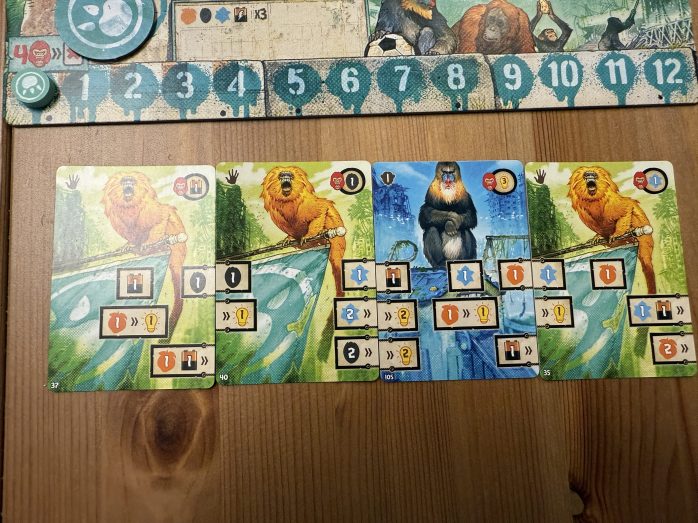
Each round, you’re playing the four apes from your hand, in any order but trying to complete the black boxes that will then give you the resources/actions on them.
If a box isn’t complete, then you don’t get it.
Then you choose a token denoting which ape you’re going to recruit to your tribe, which means you’re committed to that and you have enough resources to bring one in.
Or maybe you’re not recruiting at all but you want the benefit of the token.
You get the benefit on the token and then you can spend the resources (3 for Level 1, 6 for Level 2) to get that type of ape.
Once you bring one in (and only one per turn), you put it on top of your deck meaning it will be available for next round.

Each ape type is typically geared to give you one thing, though they all can give you a little of everything.
Chimps (on the right above) can tend to let you reactivate completed boxes again, but the one above also gives you points for spending a fruit, and maybe even points for doing something else (it needs a connection to another card).
Orangutangs give you batteries/energy. Gorillas give you Rage (which lets you delete cards from your deck, giving you the resources in the top right corner of the card you deleted), and Mandrills give you points.
There’s something to be said that Mandrills are the way to go, but I haven’t reached that point yet.
As soon as somebody reaches 80 points, that’s when the game ends.
I’m not sure where I am on this one. It feels a little soulless.
I need another play to do a review, but even then I’m not sure how I will feel.
I guess we’ll see when I get there!
People Power: Insurgency in the Philippines 1981-1986 (2023 – GMT Games) – 1 play
Designer: Kenneth Tee
Artist: Donal Hegarty
Players: 1-3
People Power is a relatively recent COIN game, and one of the increasing number of COIN games that is 3-player.
This one simulates the Filipino insurgency from 1981-1986 where one faction actively rebelled against the government while the Reformers just protested and tried to turn public opinion against the government.
Thus, I think it’s the second (?) one where one of the factions is completely peaceful (like Gandhi, though I haven’t played that one yet).

The map is a typical COIN map of the region, this time of the Philippines, but the disparate nature of the islands actually does inhibit movement from north to south.
As a COIN game, the deck has a bunch of cards and, depending on the scenario you are playing, there will be 1-3 interruption cards that will trigger “is the game ending?” and other aspects.

Unlike most (if not all, again, not that familiar with all the COIN games out there), this one has Election cards that trigger the next Filipino election, and each side will be able to choose a persona from their faction that will give them some benefit.
When Election time comes around, you look to see if anybody has met their victory conditions, and then a lot of resetting and stuff happens, along with factions being able to do a couple of free actions that might help them (though victory is determined first, so if these actions allow you to meet victory conditions, too bad!)
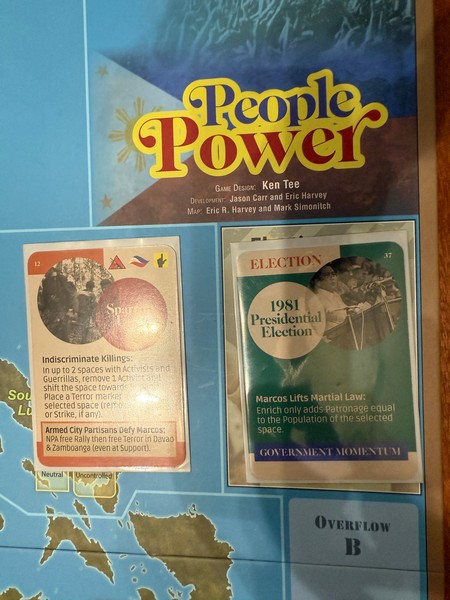
We played the full scenario with three elections, and actually finished in just over 3 hours, which is great for a COIN game.
The Election card has an effect that will carry forward until the next election, which is pretty cool too.
As is usual with a COIN game, a card is flipped and then, in the faction order determined at the top of the card, each player can decide what to do.

They may be ineligible because they took something major last round, in which case it just moves to the next player.
You can either do the event, or choose to do your own faction’s actions (and perhaps special ability, depending on what option you take/is left to you).
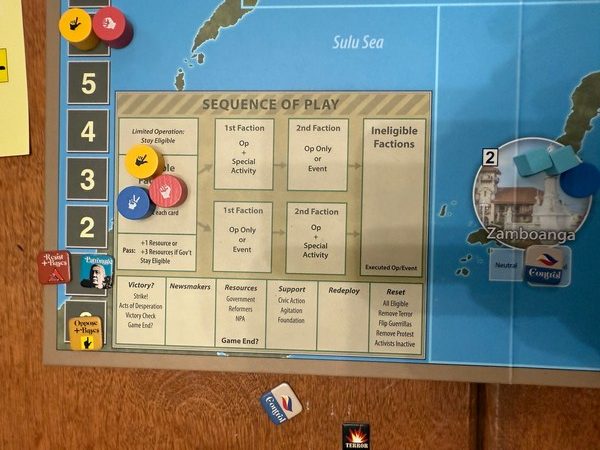
If you do anything other than Pass (to gain a resource, or three if you are the Government), then you are ineligible next round to do anything.
Which makes the choice to do an action so intricate.
This is just luck of the draw, but there were many times during my play where a juicy event came up for me that I couldn’t use, or a juicy event for my opponent(s) came up that I couldn’t stop them from taking it because I was ineligible.
But that’s the way COIN works. You have to be thoughtful!
People Power just cemented my desire to play more COIN games, and I wish I had more that fit into a good period of time like this one.
Four to six hours just isn’t conducive to our Sunday game days, but maybe conventions are when these should come out?
Anyway, People Power is an ideal introductory COIN game for those who might be interested but not sure.
One of my friends had never played a COIN game in his life, and he picked up on it fairly quickly.
Also, as noted in my Bottoscon post, it was noted that I was a white American-Canadian playing the Government forces while my two friends were Filipino-Canadian playing the rebel factions.
And it was ok!
I really enjoyed this one and hope to play it again soon.
Empire Builder (1982 – Mayfair Games) – 1 play
Designer: Darwin Bromley, Bill Fawcett
Artists: lots!
Players: 2-6
Empire Builder is an old game.
I mean, ancient in modern day game terms
But a friend wanted to play it and I thought “hell, why not?”
He had also done something for me earlier that morning, so I wanted to return the favour.
Empire Builder is a pick up and deliver train game kind similar to Steam in some respects, but all you are doing in this one is building routes and grabbing/delivering goods along your route.
What’s really unique about this one is the map and how you do your routes.
It’s in crayon!

Yes, the map is able to be drawn on with crayon and then you just erase it at the end of the game.
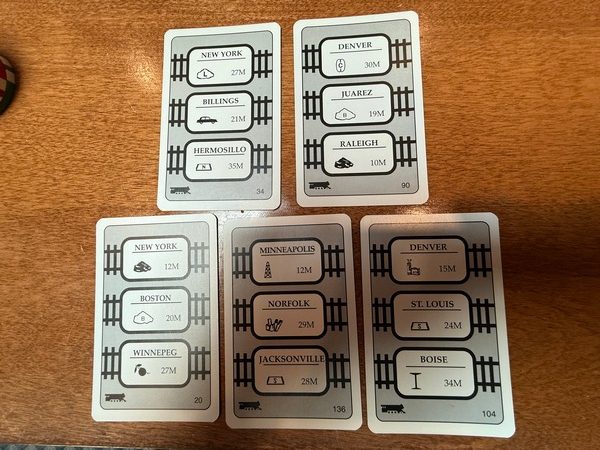
You are taking order cards and building out train routes to hopefully facilitate delivering them.
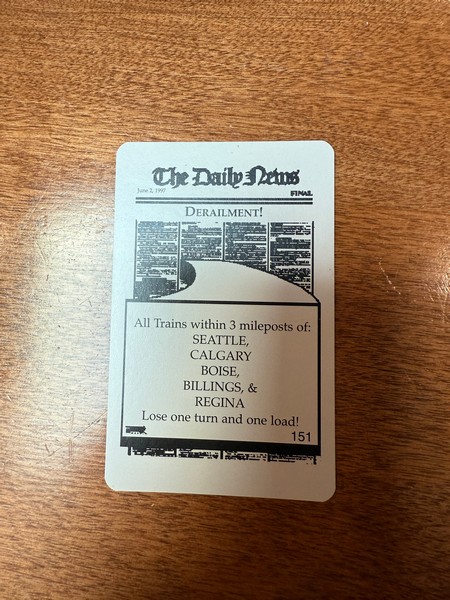
Sometimes when you draw a new order, it’s an event that will have some negative consequences.
Otherwise, you’re just trying to go to one place that carries the item you want to deliver, and then taking it to its destination.
Each turn (including two rounds at the beginning of the game), you can pay money to build routes to and from various cities on the map.
And you draw them in crayon.
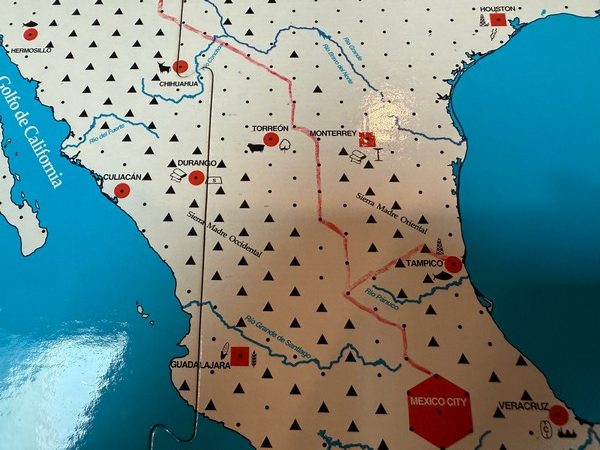
I love that!
The trick is to build routes for the goods you need to deliver, but you will often get a card with a lucrative contract and you need to build a new route to get there.
What I did wrong in our game is I increasingly had goods that need to be picked up or sold along a track going up the Pacific coast and then along the Canadian border.
Once I started getting goods that started in Mexico and needed to be delivered to Chicago, I should have branched out my train line to go across the country rather than using my tracks along the periphery.
I think that cost me a lot of time.
Once someone has a certain amount of money and they’ve connect six out of seven major cities, that triggers the endgame.
And whoever has the most money wins!
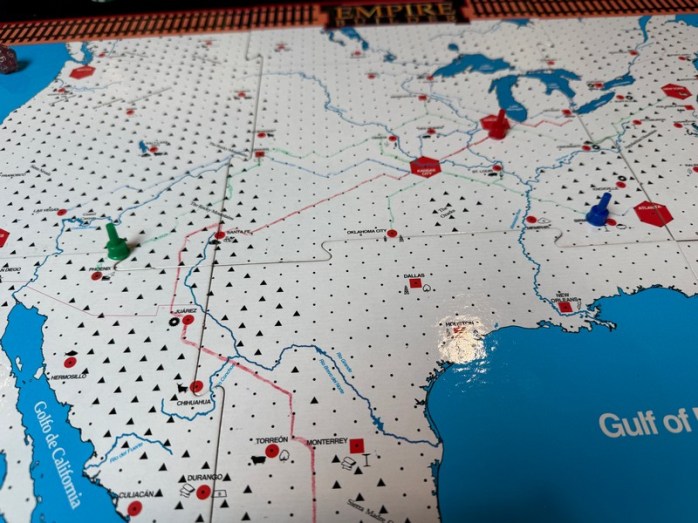
I’m not much of a fan of this type of game normally, so this isn’t something that I would want to play a lot.
But it was a really cool game that I’m glad I played.
Apparently there’s a new Kickstarter out (or coming out, I’m not sure) with a European version of this game?
I think that’s why my friend wanted to play this.
I was happy to do so.
For what it is (again, not my type of game), this was a very enjoyable three hours.
Skara Brae (2025 – Garphill Games) – 1 play

Designer: Shem Phillips
Artist: Sam Phillips
Players: 1-4
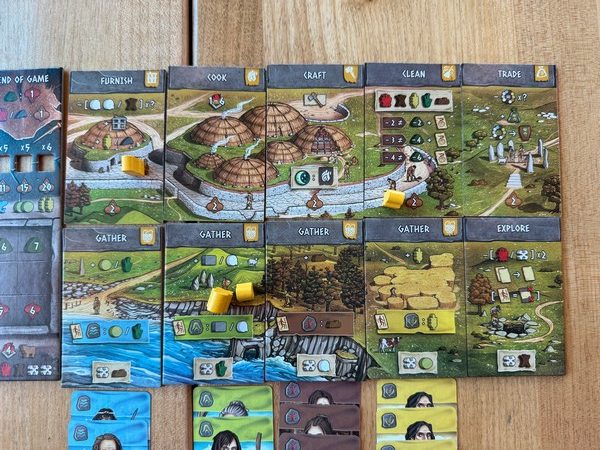
Skara Brae is a basic resource-conversion game that has 15 (!) resources to deal with.
Players are a civilization in ancient Scotland (in the Skara Brae area, which makes sense) and they have all of their village tiles that will let them do things.
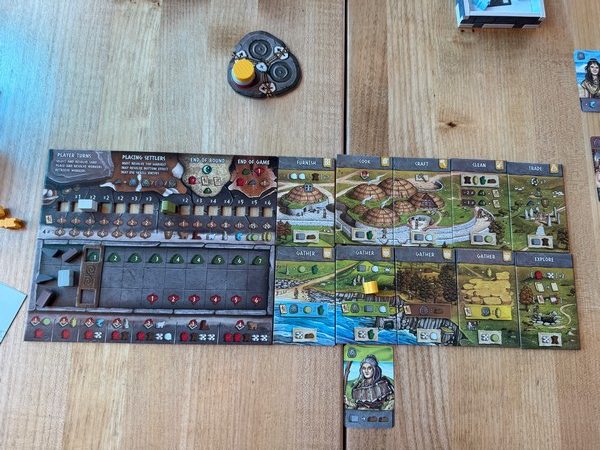
It has a rather unique turn structure.
Each round consists of three turns, and on your turn, you will draft a new person to put beneath your boards.

You will also see what people are coming up later in the round, so it gives you some decisions to make.
Unless somebody passes, turn order in each round goes like this: 1-2-3 and then next round 3-2-1. It alternates each round.
Except that if somebody passes, they are effectively delaying their turn until the end of the round, giving them fewer choices in people to draft.
But that means they will go first next round.
If you see something in a future round that you know you want and want to make sure you get, then you could pass, especially if the current cards to draft don’t really matter to you.
When you draft a person, they go beneath the tiles that are indicated on the card and you get to gain those resources based on how many cards you already have there.

Once everyone has drafted, they then can place their workers (an increasing number, beginning with one and each round you gain another one, so you’ll have two workers in the second round, etc).
The workers let you do the action on that tile, whether it’s to gain more resources, or maybe upgrade one of your tiles.
Maybe you might want to trade! Or add furnishings to your dwelling, or maybe clean up your dwelling.
That’s the other thing about the resources gained in this game.
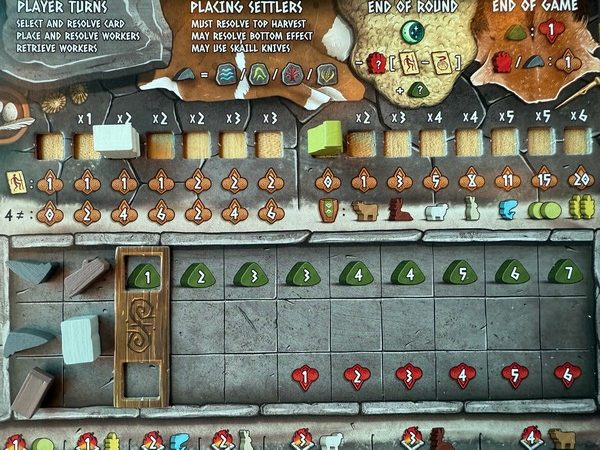
You have a storehouse with a bunch of columns and three rows.
Each resource takes up one space.
If you need space, you move the bar forward to make room for it.
At the end of the round, you will gain “midden” (essentially trash) equal to the green marker underneath the top opening on your bar, depending on where it is.
That will also take a space in your warehouse.
Even if you use up resources, you can’t move the bar backwards. The only way you can do that is to take a “clean” action, which will let you move it a number of columns depending on how many resources you spend and the strength of that action tile.
Of course, you have to have room to do that.
If you have resources taking up spaces in those columns, the bar can’t move.
Also at the end of each round, you have to feed all of the people you have drafted to work for you, minus any roofs that you have built (I guess they just need shelter, not food?)

You have to take a Cook action to have food available for them, though if you upgrade one of your action tiles, you get a free cook action before the round ends.
You better have stuff you can cook, though, or it won’t matter!
You are also trying to make your dwelling more beautiful by furnishing it, and also establishing trade with other villages, both of which will give you victory points.
All of the village tiles for workers are the same, except everybody will get one special tile just for themselves.
I do like that, being similar to Guild of Merchant Explorers where all the action cards are the same except the special ones you choose.

For me above, my special tile was “Explore” (bottom right) which would let me get extra villagers.
I’d still have to feed them, but they can be lucrative if you use them correctly (Narrator: he did not use it correctly).
Skara Brae is a game where things ramp up considerably.
In the first round, you have one worker to do something each round.
As rounds continue, you have a lot more you can do, and you have a lot more people to feed.
I enjoyed it, but it took a lot longer than I thought it would (though still within the time range on the box, so I should have paid more attention).
I’d have to play it a few more times to really get a handle on things, as well as enough to review it.
For now, it’s not near my favourite Garphill game, but was fun and I’m interested in exploring it further.
Lepidoptery (2025 – New Mill Industries) – 1 play
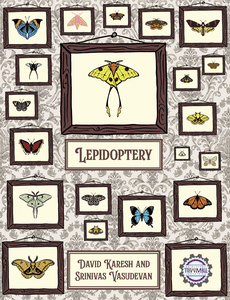
Designers: David Karesh, Srinivas Vasudevan
Artist: Imogen Oh
Players: 2
Lepidoptery is a 2-player card-shedding (or is it ladder-climbing? I get so confused) game with some Connect 4 aspects as well, which really intrigued me!
(Though I have to admit, when I bought it to help my BlueSky friend Daniel (from New Mill Industries) out after the whole tariff fiasco started, I was actually looking for a 3-4 player game, but when I read the description of it and Dan Thurot’s review of it, I completely overlooked that it was a 2-player game!)
The concept is very simple, and everything is made of cards.
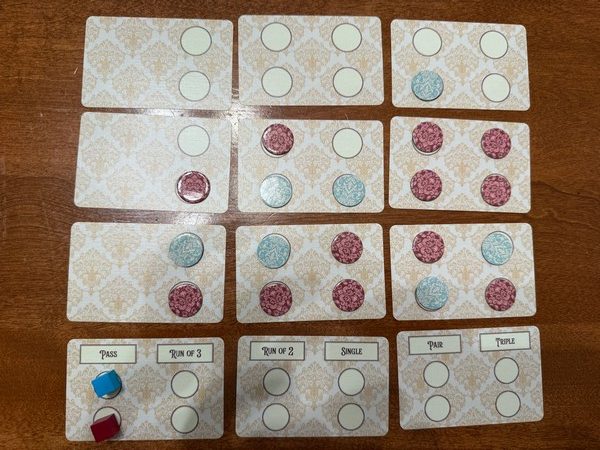
The game tracker as well as the cards themselves.
Each player draws 12 cards from their deck and then lays down cards in any of the formats that are at the bottom of that picture: a run of 3 cards in numerical order, a run of 2, a single card, a pair or a triple (3 of a kind).
They then put their cube on the space to show that’s what they played and put their disc in that column on the next highest open space.

The next player has to either lay down cards to beat that or pass.
They can beat it by either playing any sequence (including just one card!) that starts with a higher number than the previous one, or a sequence that starts with the exact same number as the previous one but has at least one more card in it.
Once it comes back to you, you must beat what the other player played (or what you played if they passed).
However, no matter what happens, you can’t play the same sequence again. You have to play a different one and then move your cube to that space.
The cubes just basically show what you can’t play this turn.
Anybody who passes causes both players to draw back up to 12 cards.

There are two ways to win: get a “connect 4” in any column or row or diagonally (like the picture up top, red won!).
Or, if that doesn’t happen, if you run out of cards, then you win as well.
When a column is filled, it doesn’t empty right away. But if a second column is filled, then the first one is emptied, letting you begin that column again.
My first play of it was quite good and I like how it’s a relatively short game.
You could probably get a couple games played inside of a lunch hour.
I do have to say that as simple as the game is, the rulebook does leave a little to be desired.
Most of it is pretty straightforward, but the “what beats what” explanation still left me baffled.
It took the brilliant tutorial on Boardgame Arena to actually realize how it was supposed to work.
I highly recommend checking that out if you’re interested in this game.
Trick & Snipers (2024 – Mob+) – 1 play
Designer: 宮野 華也 (Kaya Miyano)
Artist: 別府さい (Sai Beppu)
Players: 3-5
Trick & Snipers is a very fast trick-taking game for 3-5 players where you basically run through one round of emptying the deck.
Each player is dealt cards and then it’s a must-follow trick-taking game (learn about trick-taking games here!)
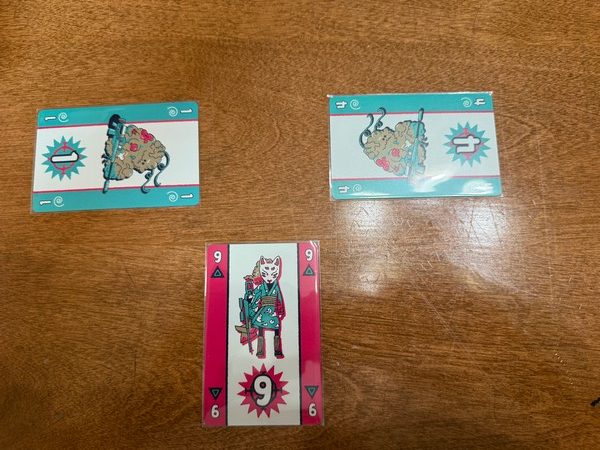
Tricks aren’t really worth anything unless nobody wins through the two standard ways of winning.
A player gets a point if they manage to take a 7 in a trick or if they can’t follow the led suit and the combined total of their card and the winning card is 13.
In the picture above, I got a point because of my red 9 and the winning blue 4, adding up to 13.
As soon as somebody gets 2 points, they win!
If nobody gets 2 points, then it is the total number of tricks won that determines the winner.
This is so light and fluffy that it would fly away in a small breeze.
It’s not bad as a 15-minute filler and the rules don’t take much to explain.
For me, I won’t turn it down if somebody wants to play it, but I have no real desire to play it again.
Pulsar 2849 (2017 – Czech Games Edition) – 1 play

Designer: Vladimír Suchý
Artist: Sören Meding
Players: 2-4
Pulsar 2849 snuck in under the radar right at the end of the month, mostly because my friend Cal wanted to get it played before deciding whether or not to trade/sell it.
I’ve been interested in this game since it came out in 2017, but it looked like so much of a table hog and I didn’t think we’d have room for it at our Sunday game days, so I never seriously looked at getting it.
Turns out that it’s not really that bad, especially compared to many other games nowadays.
Maybe the recent games taking up so much space has desensitized us to this?
Still, I was glad that we could fit it on the three tables at Tap & Barrel (they’re not paying me for this plug, but they should) because it was really an interesting game.
The theme is barely there, but essentially you are travelling around the galaxy(?) visiting planetary systems and pulsars, setting up gyrodynes to harness the power of the pulsar to send it…somewhere.
Who knows?
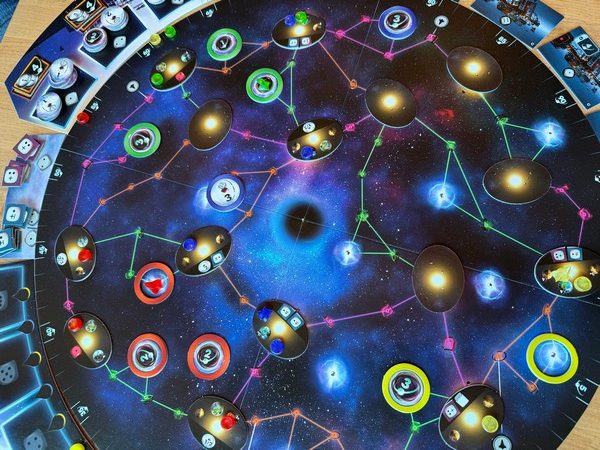
The board is the star system with all of planetary systems randomized.
What’s really cool about the game mechanics is how the dice drafting works.
The dice are rolled and placed in their respective spaces.

Then, the median space is determined (which space has the “middle” die, so in a 4-player game, the 5th die) and then the marker is moved one space to the left or right depending which side has more dice (if there are a bunch of six dice, then it would move to the right, for example).
Above, the median die is the 5, so the marker is placed on the 5 space. Then, there are 3 dice to the left (one, two and three) and only two dice to the right (two 6s), so the marker moves one space to the left.
Then, in snaking turn order, players draft a die, paying (or gaining) either initiative or production (the two tracks above the dice spaces) depending on how far the chosen die is from the yellow marker.
The snake is like Sagrada, so it goes 1-2-3-4-4-3-2-1.
You use the two dice you’ve drafted to do actions, whether it be research technologies, gain and produce transmitters, or maybe move your ship around the board.
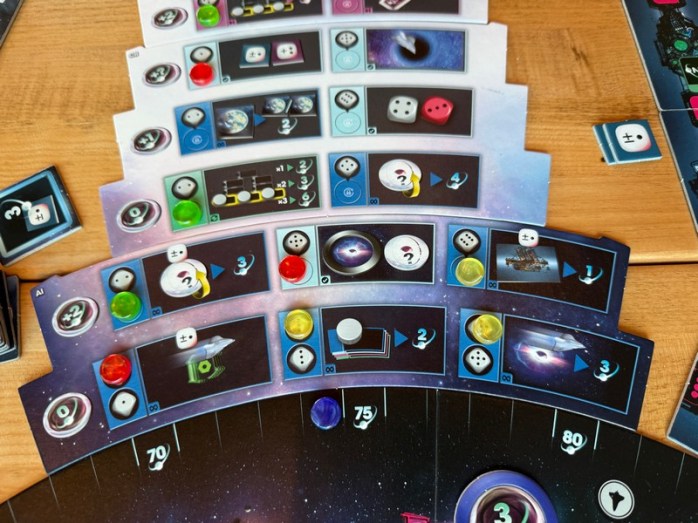
Each item (technologies and transmitters) has a die value that’s required to do them, and ship movement is just moving that number of spaces equal to the die you used.
Technologies will give you bonuses when you do certain things, like the middle space with my yellow marker, which gives you 2 points every time you research a new technology.
Flying around and exploring is good too, because it will allow you to establish bases and, if you visit pulsars, you can harness them for their energy.
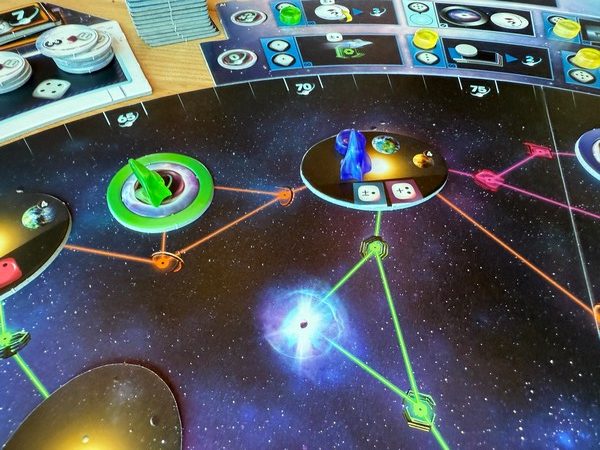
It does cost an action to both create and power up a gyrodyne, which is what harnesses that energy.
However, each powered gyrodyne will get you points each turn, equal to the points on it plus that round’s points, which will vary.
It can be a great way to gain points!
In my game, I focused on technologies and transmitters, gaining transmitters that gave me production income every turn.
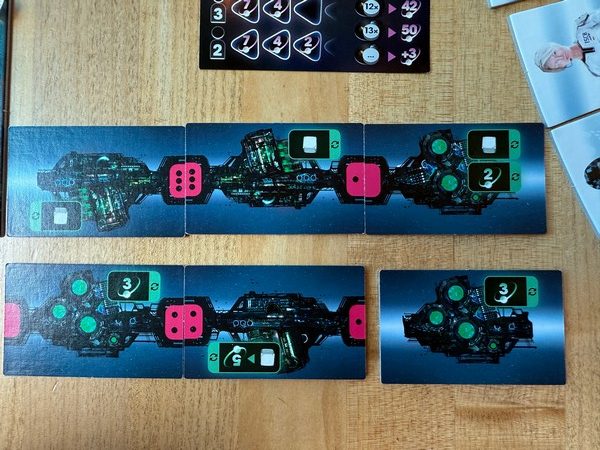
This allowed me to not worry about the production track as much as others did.
Any icon in green means production at the end of the round.
You can also gain bonus actions in a number of ways, one of which is to connect transmitters that have the red side to them, giving you a bonus die of that value that you can use on your turn.
Thus, sometimes you can do three actions in a turn.
At the end of 8 rounds, you total up all the points from the various things that give you endgame points, and determine who’s the winner!
Pulsar 2849 is one of the classic “concentrate on one or two things and do a little of everything else” games. Like I said above, I concentrated on technologies and transmitters, but others concentrated on completing missions on their main board and exploring the star system.

If you only do a little of everything, you are not going to score well.
I didn’t explore much, so I didn’t get the bonuses like the above planetary system which would get you a resource cube and a die modifier (or you can choose an Earth tile which will basically give you points and maybe another bonus).
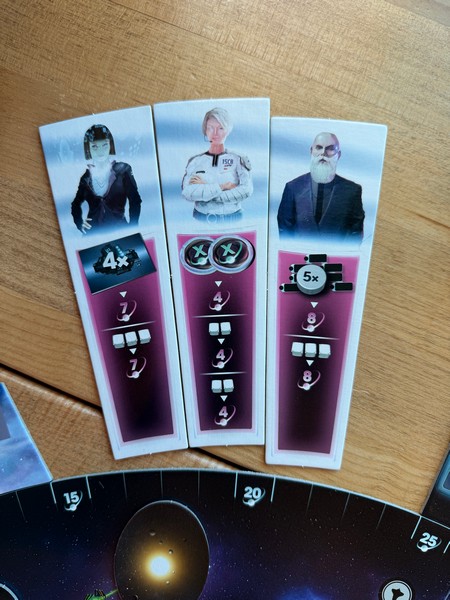
You do have to pay attention to the endgame goals at least a little bit.
I concentrated on one but the guy who won managed to get two of them done.
All of our scores were pretty close, though, which to me is a sign of a good game.
Each of us chose at least a slightly different path and while it was close, it just meant that one of us executed our plan a little better than the others.
I really want to try this one again just to see if my first impression is accurate.
If you don’t really like “do some things to get you points,” then you probably won’t care for it.
But I enjoyed it.
 Dude! Take Your Turn!
I wish People Power could be on Rally The Troops – we could play it 3-person like Vijayanagara!
LikeLiked by 2 people
I would love that. I actually get this one! 🙂
Maybe soon
LikeLiked by 2 people
Busy month for new stuff for me. I already talked about Res Arcana Duo, so I’ll skip that.
Sprawlopolis: really impressed with the design of this one from Button Shy. I think it will be a mainstay solo game going forward for a long time. Definitely going in the vacation/road trip bag.
Space Team: chaotic silly coop that my kiddo checked out from the library and liked, but I won’t be seeking it out again. It’s fine, but loud and more energetic than basically anything I play.
Orchard: Another print-and-play because I have One Deck Dungeon and the dice from that work great. I feel like I’m missing something with the strategy because I have trouble just clearing the victory bar. But I’m happy to play it more.
The Fox in the Forest: Checkout from the library. one quick play with my wife that was almost over in two hands. I enjoyed it and I would love to play more, but she doesn’t really like trick-taking games.
New Frontiers: Some of my coworkers who like Jump Drive but don’t like Race for the Galaxy glommed on to this one and we played it twice in a week. I would honestly rather just play Race, this was a little slow. Maybe if we keep it to 3 players it’ll flow a little better.
LikeLiked by 1 person
Nice group of games!
LikeLike
Lots of cool-looking games in there! Final Girl, Empire, People Power, Skara Brae…
LikeLiked by 1 person
What sounds coolest to you?
LikeLiked by 1 person
The crayoning aspect of Empire sounds very satisfying!
LikeLiked by 1 person
Yeah, I’d say you might like Empire Builder if that’s the case. 🙂
LikeLiked by 1 person
Pingback: 5 on Friday 11/07/25 – No Rerolls