Dude! Take Your Turn!
A Gaming Life
Witch One Will You Convict? – Witchcraft! Review
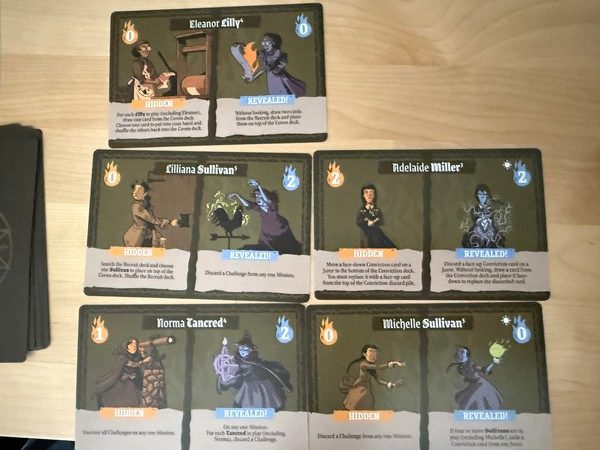
Solo games make a great thing to do when you’re working at home and want to take a lunch break to enjoy some games.
David Thompson, Trevor Benjamin, and Roger Tankersley already have a wonderful solo game called Resist! that almost brought a tear to my eye.
However, in 2023, they enhanced the system with a new game with some of the same mechanics but some deviations that make it very different.
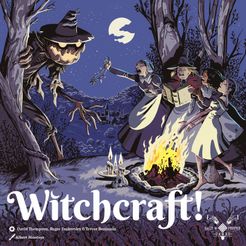
Witchcraft! (Why do these publishers put punctuation in the title?????) is a new design from the intrepid trio (and when I say “new,” I mean it came out in 2023) that feels somewhat familiar but yet totally a new game as well.
It was published by Salt & Pepper Games and has artwork from the always awesome Albert Monteys.
Gone is the pre-World War II Spanish Revolution setting.
Instead, Witchcraft (no more exclamation points, please) takes place in a pseudo-17th century village with some supernatural occurrences adding to the fantasy element.
The designers do give recognition to those women who, historically, were classified as witches and burned at the stake for nothing more than misguided suspicion.
But the game itself has a real coven full of families of witches, village elders who need to be convinced that nothing bad is going on, and potential supernatural happenings that need to be prevented even as the coven is trying to protect itself.
In many ways, Witchcraft is actually the better game, even if Resist is a more enriching experience, if that makes sense.
It’s almost a shame to have to compare the two games because while they do share similar mechanics, Witchcraft expands on them so brilliantly that it should really stand on its own two feet.
Both games have the deck of Witch/Maquis cards that are evenly split between being in your deck and being available to recruit.
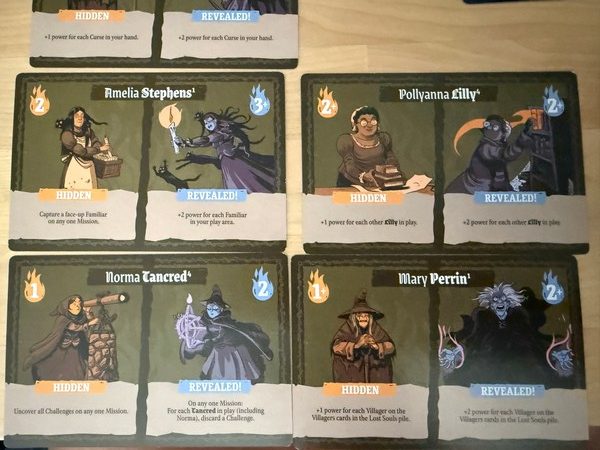
When you play a Witch on your turn, you will be choosing either their Hidden side or their Revealed side. Revealed is usually stronger but they will go to prison at the end of your turn, while Hidden witches typically will just go to your discard pile to be reused.
Both have bad cards (Curse/Spy) that will clutter your deck and, if the main deck of them is ever empty and you have to add one, you lose the game.

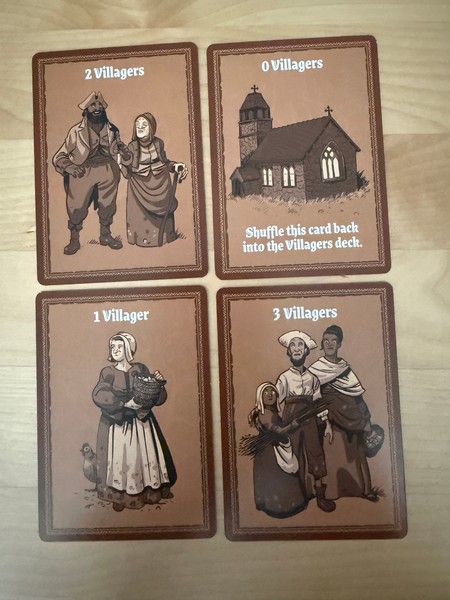
Both have villagers that can be killed by certain things and, if you lose five total villagers, you will lose the game.
Both have missions that you have to successfully complete to move the game forward, with Challenges that get in your way of doing that. If you fail two missions, you lose the game.
Sensing a pattern here?
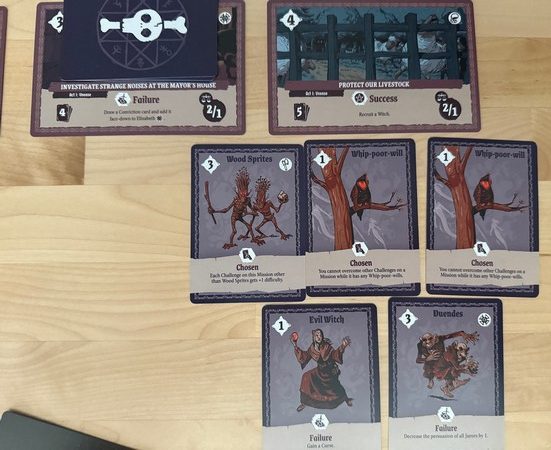
However, Witchcraft adds a bunch of things that just make the game so much more enjoyable for me (and hopefully that’s the last time I talk about the sister game).
First, there are no victory points in Witchcraft.
Instead, you randomly select three jurors that will be at the trial of your coven.

These jurors will have to be convinced of your innocence (or at least of your importance to the village to overlook your witchiness) by completing the missions that they bring to the game.
The fact that you have eight jurors to choose from means the game will feel different each time as you can mix and match them.
It feels even more different because each juror has three missions (so nine in total) that they bring to the game, along with five Challenge cards of their own that get added to missions. These fifteen Challenge cards (five for each juror) are added to the twenty common Challenge cards to be put on the different missions.
This brings a really great flavour to the game as what you are trying to do is tailored to which jurors you have picked.

Each juror’s Challenges have a Familiar that you can get to join you as well as a Possession Challenge that can make it easier or harder to convince them. This is in addition to some other Challenges that are unique to that juror, such as the Lost Soldiers (which annoyingly are put back on top of the deck if you fail to defeat them).

The Persuasion and Conviction mechanic in Witchcraft is brilliant.
Each juror will have two random face-down Conviction cards attached to them.
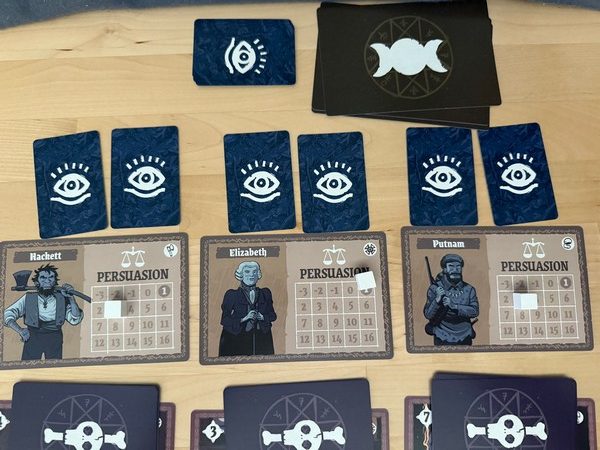
As well, they will have a Persuasion level (starting at one, unless you want to make the game easier or harder). Completing missions will let you add to their Persuasion.
Completing one of their own missions will actually add more, though you can add less persuasion to another juror if you wish.
Ultimately, the goal is to go to trial after you feel that you’ve convinced all three jurors of your innocence.
You then reveal their Conviction cards.

If their Persuasion (the white cube) is equal to or higher than the combined Conviction, they rule for you.
Otherwise, they rule against you.
I prefer this mechanic to the straight VP one, where you have to earn VP to a certain level and decide to stop when you feel you can’t go any further, with the level determining your win/loss status.
It feels more realistic in a way, and it’s more fun because there are ways to manipulate the Conviction cards, either before or after they’re revealed.
Some Challenges (like Possession) will let you uncover a Conviction card so you have an idea of what your goal is, while others may let you discard a face-up (or face-down) one and replace it.
Nice way to get rid of that pesky 6!
Another positive in Witchcraft is that some of the Challenges are actually beneficial to you if you meet them.
They can gain you a Familiar with will give you a power while they are in front of you, and some witches even are stronger if you have a Familiar.
Another one will let you recruit a Witch from your Recruit pile.
Not only are these positive effects, but they are also not negative effects.
Let me explain because that probably doesn’t make any sense.
When you are amassing your power to accomplish the mission and defeat the Challenges, most of the time you can’t do all of both.
You simply don’t have enough strength.
If a Familiar is one of the challenges, the only cost of not “defeating” that Challenge is that you don’t gain the Familiar.
There won’t be any negative effect on you otherwise.
One thing that made Resist very hard (ok, I lied about not mentioning it again) is that your deck always had the same number of Maquis cards in it, even if you gained more Spies.
Any Maquis who would let you recruit a new one or rescue one from jail also sacrificed itself to do so.
In Witchcraft, there are Challenges that let you recruit a witch, even at least one mission that does, and some of your witches let you recruit multiple witches even as they sacrifice themselves.

On the other hand, some Challenges have you exile a random Hidden witch, which means you might lose a witch for nothing.
That’s not good!
It makes things a lot easier when your deck is not limited in that way.
Of course, it is also easier to gain Curses to your deck as well.
Ultimately, Witchcraft is simply an easier game in mechanics, though it’s definitely not easy.
You are still going to be losing witches because you need their increased strength when they’re revealed because the Challenges and missions are just too demanding.
The initial draft of witches (which is in the main rules now instead of just a variant) lets you choose which witches are initially in your coven.
The witches now are also part of families, and often some of the witches are stronger or have better abilities when they are played with other witches of the same family.
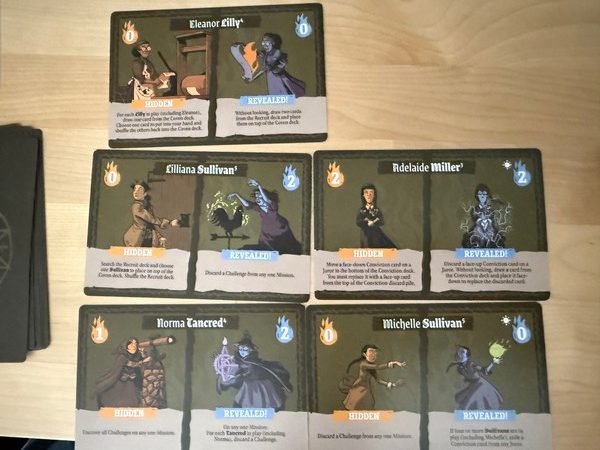
This also adds an interesting dimension to how you play your coven, and especially to how you choose it at the initial draft.
All in all, I think these additions make Witchcraft a marvelous game to play. It’s hard to win but it’s not so frustrating that you’re going to necessarily give it up because it’s just too hard.
My first two games were essentially draws, where I convinced two jurors but not all three.
That makes me want to keep playing the game more.
The juror and persuasion system makes the game feel deeper as well.
However, I didn’t feel as immersed as I did with Resist.
Witchcraft is a fictional game, even if it does have some semblance of history with how many women (especially single ones) were treated back in the day.
The supernatural events make it so that Witchcraft didn’t affect me as much as its sister game. I didn’t feel sad when I had to sacrifice a witch to prison.
It was just part of the game.
However, the mechanics of the game just drew me in so much that I definitely prefer playing Witchcraft to Resist (though part of that may be that I don’t want to feel sad).
Witchcraft is a masterpiece of a solo game. Hard, but not so hard that you just throw up your hands and want to give up.
The same mechanics every time but the jurors make it variable so you will still get different experiences each time you play.
Witchcraft is a game I highly recommend if you like (or want to try) solo games.
If you’re a fan of Resist, I even more highly recommend it, unless the main reason you like the earlier game is because of the theme.
I see myself playing Witchcraft very often when I’m home at lunch during remote work (the main time I play solo games).
It’s that good.
(This review was written after 3 plays)
 Dude! Take Your Turn!
I was very curious about this game when it came out but never got to play it. I’m glad it’s as good as it looked!
LikeLiked by 1 person
Have you played Resist?
LikeLiked by 1 person
I haven’t! Would also be curious about that, but Witchcraft! seemed a bit more polished (and your review tipped me even further in favor of Witchcraft!).
LikeLiked by 1 person
I’m glad to hear that!
LikeLike