Dude! Take Your Turn!
A Gaming Life
New to Me – September 2025
I love months where I play a bunch of games that I have no experience with.
September gaming was great for the number of plays, but even better for the new to me games that I got to play!
I especially love it when there’s a good mix of lighthearted, relatively short, interesting games and those games that make your brain burn if you’re not careful.
September was a good example of that mix.
Even better for the Cult of the New to Me was that the ages of the games were mixed too.
Yes, there were a few 2025s and most of the other games were 2022 or later, but two of them were from before COVID.
I guess that’s how we’re defining time frames now.
Pre-lockdowns and post-lockdowns.
Anyway, they decided to give me a temporary pass on rebelling, at least for this month.

But no promises for next month if I don’t get some older new to me games played in October.
Who knew that cult members could be so unruly?
So without further ado (all of my ado was lost on some cosmic joyride anyway), let’s begin!
Galactic Cruise (2025 – Kinson Key Games) – 1 play
Designers: T.K. King, Dennis Northcott, Koltin Thompson
Artist: Ian O’Toole
Players: 1-4
I’ve been dying to play this one for a while now, and have really been enjoying my Boardgame Arena asynchronous plays, but it was nice to finally get this one to the table.
Rather than listening to me blather on for a while, though, why not check out my first impressions post?
5 Minute Marvel (2018 – Korea Boardgames) – 4 plays (all in quick succession…it’s 5 minutes!)
Designer: Connor Reid
Artist: Alex Diochon
Players: 2-5
A really quick real-time Marvel card game.
Not much there, but check out my review of it to see if it’s something you might like!
Ecosystem: Coral Reef (2022 – Genius Games) – 2 plays

Designer: Matt Simpson
Artists: Mesa Schumacher, Martyna Szpil
Players: 1-6
Ecosystem: Coral Reef is a rather simple card drafting, tableau-building game where you are essentially drafting 20 cards to build an ocean floor with lots of different undersea creatures and flora, all giving you different points in relation to other things in your tableau.
Everybody starts with 10 cards and drafts one, passing the others, and then places that card into their 5×4 (or is it 4×5? I can never remember directions) tableau.
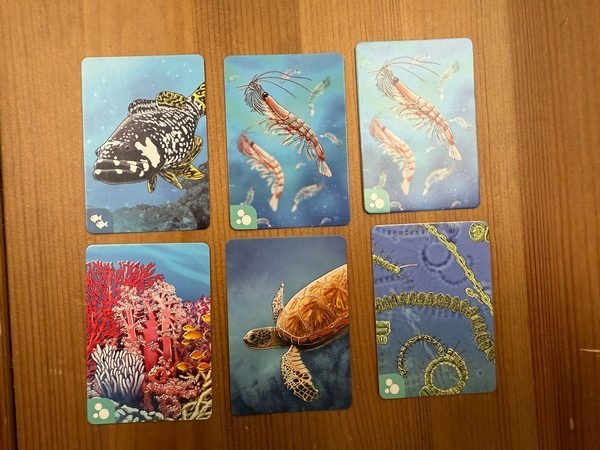
Of course, cards have to be placed orthogonally adjacent to a card already in your tableau.
You have to keep in mind the scoring criteria as you are placing, or else some of these cards are going to be worth zero points.
The scoring can be a bit complex to keep in mind, which is why this game may not be as beginner-friendly as it seems (though it is pretty beginner-friendly).
The only other weird thing about the cards is that the whale actually forces you to flip over a card, making it useless for your tableau.
Hopefully it’s a card that not only is not scoring but is also not helping another card score.
Even if it is, though, whales can get you a lot of points!
If you have a bunch of the cards that it wants.

Anyway, after the first ten cards, you deal out ten more cards and do the exact same thing except change the direction that you pass the cards.
All of the cards depend on some other type of card to score, either in your tableau (like whales and the krill) or in a row column (like sharks and prey in their rows and columns).
Eels score four points per adjacent prey, but only if they’re adjacent to coral.
You get the picture.
This game is extremely quick and plays up to 6 players, which is really great for a lunchtime work game.
However, since there enough cards for 6 players, 2-3 player games can be a bit dry because nowhere near all the cards come out.
You may have a game that’s almost completely without coral, for example.
Which makes an eel strategy kind of hard to do.
Anyway, it’s a fun game. Not top of the list but an enjoyable way to pass the time.
Bomb Busters (2024 – Pegasus Spiele) – 2 plays

Designer: Hisashi Hayashi
Artist: Dominique Ferland
Players: 2-5
Bomb Busters is an amazing deduction game where players are trying to cut the wires of a bomb to keep it from going off.
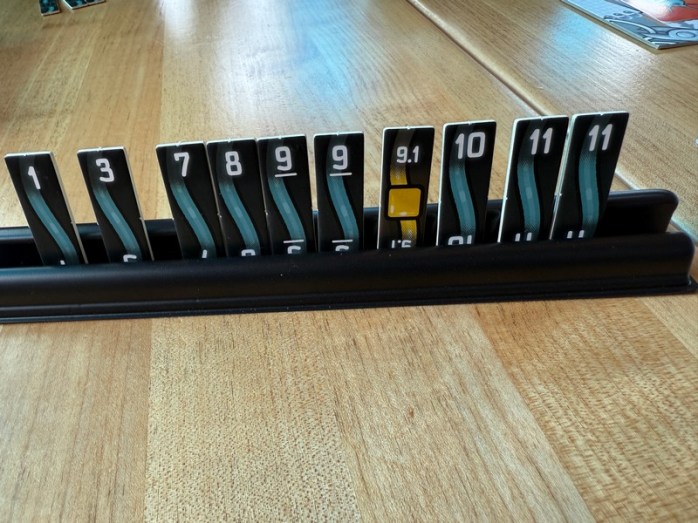
Each player has a number of shards of wire that need to be cut, and at the beginning of the game, they have made a public note of what one of them is.
Each piece is numbered 1-12 (or maybe 11?) but there are two yellow wires that are numbered with “.1” (so maybe “9.1” like in the pic above) and one red wire that’s at “.5” (so maybe 9.5?)
On your turn, you’ll look at what you have, look at others’ tableaus to see what they may have revealed, and ask them if they have a second shard to what you have.
So if your tableau was above, you could ask James “is this shard a 9?” and point to one of his.
If it’s not, then they put out an indicator of what it actually is and the timer counts down another space.

If it is, then both of you place your shard out in front of you.
If all four of that number have been revealed, then you may get a special power if that number’s power is out!
At the beginning of the game, the “possible” yellow and red shards are put out (as shown in the above picture) so you have an idea of where the bad stuff is.
The red pieces mean that Red could be either 8.5 or 10.5, while the yellow pieces mean that yellow could be 8.1 or 9.1.
What you are aiming to do is have the player with the red shard have only one shard left (the red one).
If they do, they can just cut that wire and you win!
If somebody guesses that shard when they are trying to match numbers, though, then the bomb goes off and everybody loses.
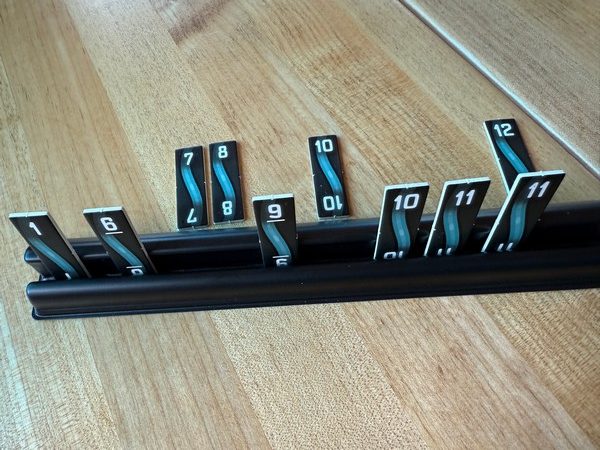
This is a really cool deduction game that I really enjoyed.
There are 61 (I think, but definitely a whole bunch) different missions that may have increasing difficulty, but it’s not really a campaign.
You can really mix and match if you choose.
I enjoyed this game so much that I’ve ordered it from my game store and hopefully they will get it in.
I love the deduction, but it’s not super-hard deduction.
You just kind of have to use the numbers that have been revealed and maybe get an idea of what numbers are still available.
If somebody has a revealed 8 and a revealed 10, maybe the shard between it is a 9?
Or it could be an 8, but not if all four 8s have been revealed already.
You just have to be careful if the red shard could be a 9.5, because that’s also between 8 and 10.
Loved this one a lot, and it’s quick enough that you can play multiple times within a lunch (or whatever).
Definitely want to play this again (obviously, or I wouldn’t be looking to buy it!)
EGO (2025 – Bitewing Games) – 1 play

Designer: Reiner Knizia
Artist: Marie Bergeron
Players: 2-5
Ego is a reimplementation of the classic Reiner Knizia game Beowulf (look at me comment like I know what I’m talking about, having never played the original).
In this game, we have met a couple of alien species and we are going out into space to meet them and try to charm them.
Of course, we could just mess that up too if we’re not careful.
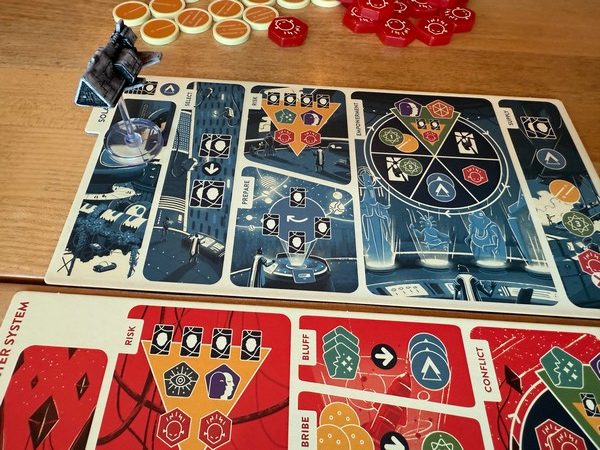
The game consists of players just going along the board, left to right and then down to the next level, with each player then doing whatever the new space requires.
These boards are randomized, so the layout of the boards won’t be the same each game. This adds a bit of variety to the game, and can also add some difficulty if you’re not careful.
Some spaces (like the first above) will let you trade some cards.
Then there’s a push your luck (or “risk”) space where you are flipping cards from the top of the deck, trying to get one of those two symbols.
If all the revealed cards have at least one of those symbols, then you succeed! You collect all the cards into your hand.
If at least one card does but not all, then you collect the cards that did but you also get the penalty shown.
If none of them did, nothing happens. The aliens are just confused about why the hell you’re bothering them with this shit, but they’re not upset.

Some spaces are then an auction that will let you play cards of the appropriate symbol to get a chance to do one of the depicted actions (or, for at least one alien, to avoid the worst of the available actions).
We ended up spending way too many cards on the first auction to get the best stuff, meaning we were always card-strapped throughout the rest of the game.
That’s all you do. Go space by space and do what it says.
Some spaces let you trade cards for other cards, or spend money to get “success” or whatever.
Some spaces have you draft new cards.
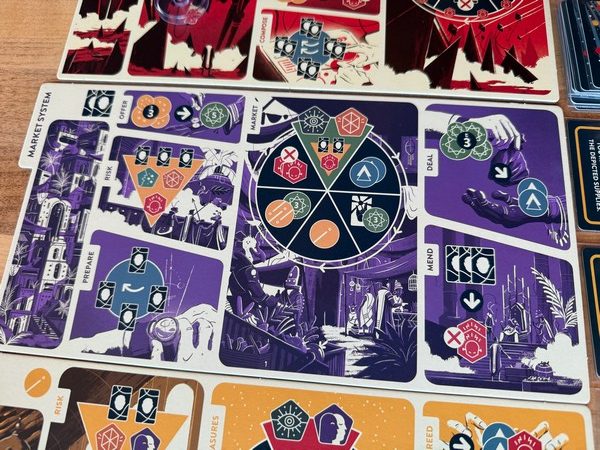
At the end, you typically have the chance to convert a bunch of the same symbol or token into success points, but you have to make sure during the game that you’re saving some.
Total success at the end of the game and whoever has the most is the winner!
A lot of people are saying that this is the best of the recent Bitewing Games Knizia trilogy, and I can’t really argue with that since I haven’t played the other two.
However, I do have to say that my initial play of Ego didn’t really grab me.
It’s fine and I’d love to play it again to see how different it might be (and to perhaps play it better without wasting as many cards), but it’s not something I’m dying to play again.
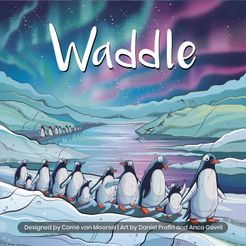
Waddle (2025 – Allplay) – 1 play
Designer: Corné van Moorsel
Artists: Anca Gavril, Daniel Profiri
Players: 2-5
Who knew area control could be done with a bunch of players in just 25 minutes?
Waddle did!
Waddle is an area control game where you are placing your penguins on certain spaces on the ice floe in order to score points by having the most pieces surrounding a certain spot.

The trick in Waddle, of course, is that penguins can help contribute to multiple scoring opportunities as well.
Like the purple and one orange penguin above will help surround space 14.
It’s not just placing penguins, though.
The action system is quite interesting as well.
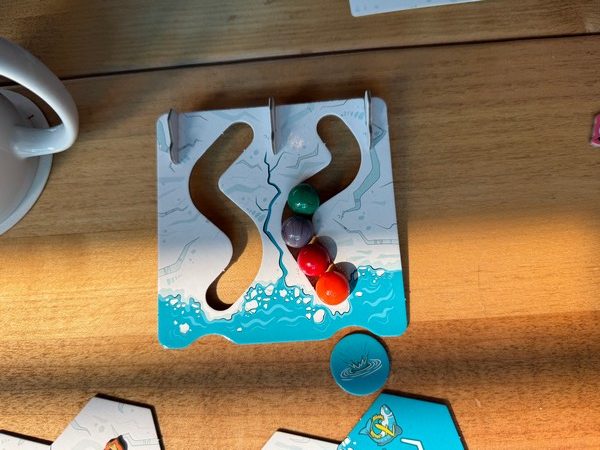
If you place a penguin, then you take your marble at the bottom of the slide and put it on top.
However, if you want to pass out of this space, you put your marble on the other slide.
If there’s already a marble there, yours goes above it, but you are basically setting the placement order for the next score.
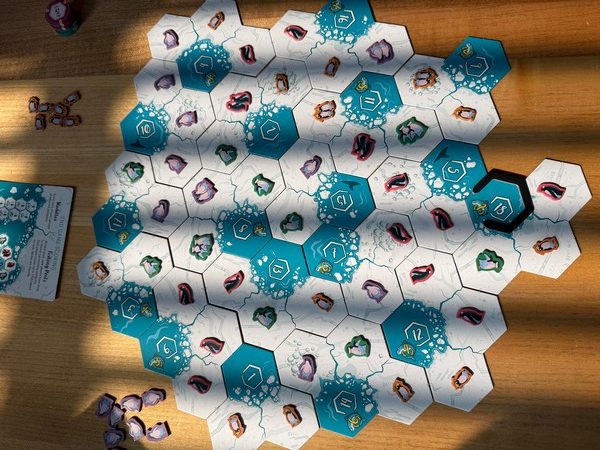
However, scoring spaces isn’t the only thing you’re trying to do.
You’re trying to link your penguins into as big of a continuous chain as possible.
That’s because each group of penguins will score.

This push and pull decision-making (do I place this penguin to help score this space, or maybe another one in the future, or do I make my group even bigger?) is really cool in a 20-minute filler game.
Even better, you sometimes have to decide whether or not to make a sub-optimum move for you in order to block Vicki from getting that 8-penguin grouping!
Each player also has two double-penguin counters to really make sure you gain that big score.
For what the game is, I really liked it.
Turns are quick and snappy but yet there is some thought into it as well.
Not to mention that there is literally no randomness other than when you form the ice floe at the beginning of the game.
The rest is up to you.
3 Chapters (2024 – Amigo) – 1 play

Designer: Joe Hout
Artist: Jan Bintakies
Players: 2-6
3 Chapters is kind of an advanced, multi-round Fantasy Realms with trick-taking added.
Ok, the mechanisms aren’t necessarily the same, but the “this card scores for each of this other card you have” or “this card scores if you have this card too” feel is definitely there.

This is basically a 3-round (or 3-chapter, I guess) game.
In the first round, each player will take a card and pass the others to their neighbour.
Chapter 2 is the trick-taking round.
The value in the top left of the card is its rank, and the highest rank wins the trick.
However, you don’t win the cards. Everybody gets to keep their cards.
Instead, you’re going to be winning a star (2 points).

However, each player may also get something for the card they played.
If you played Goldilocks and somebody else played the Three Bears, then you get 4 gems (2 points). If you played the Three Bears and win the trick, you get 3 gems (1.5 point). If somebody else played Goldilocks, you would get 3 hearts (3 points) instead.
After all the tricks are done, Chapter 3 consists of you just scoring your cards like in Fantasy Realms.
Say you had both Goldilocks and the Three Bears in your hand. The Three Bears wouldn’t score you anything because their ability is only in the trick-taking chapter.
But Goldilocks would still give you four gems if you had both cards.
Some cards (like the Big Bad Wolf above) don’t give you any points but they almost guarantee you to win the trick (which is 2 points) and also give you two symbols which may trigger points for other cards.
The only other endgame caveat is that whoever has the most gems gets four more gems (so two points).
At the end of the game, stars are worth two points, hearts worth one point, and a gem is half of a point.

Whoever has the most is the winner!
This is a really interesting twist on Fantasy Realms by adding the ability to score points during a new trick-taking round as well.
When drafting, you have to try and match up things that will give you points, or if they have a powerful trick-taking scoring ability, to try and make sure you play the card at the right time.
It also plays 2-6 players, which makes it an ideal gameday end game, or a great lunchtime game for work.
At only 30 minutes, you could even get through it twice!
Wonderland’s War (2022 – Druid City Games) – 2 plays
Designers: Tim Eisner, Ben Eisner, Ian Moss
Artist: Manny Trembley
Players: 2-5
Wonderland’s War has a bunch of mechanisms mish-mashed together into an insane mixture that’s actually kind of fun (whoops, sorry Dan. Didn’t mean to use that word).
It came out in 2022 and I’ve been dying to play it since then, but finally got the chance this last month.
Why twice?
Because we played a couple of the rules majorly wrong the first time!
Since we had the same group of people together the next week, we decided to try it again, the right way.
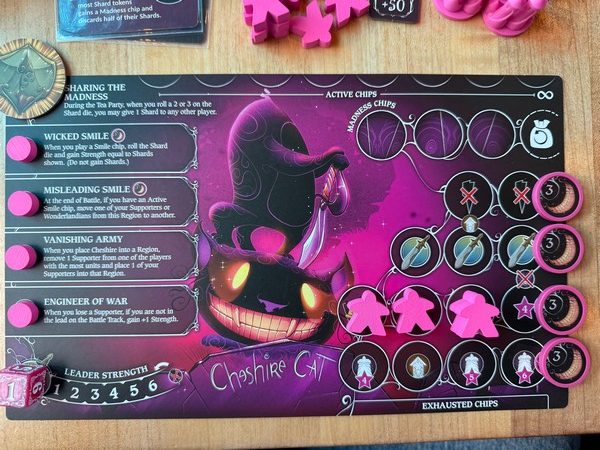
Wonderland’s War takes place in that chaotic realm of Wonderland, but all of the factions are fighting against each other for control (or for points, anyway).
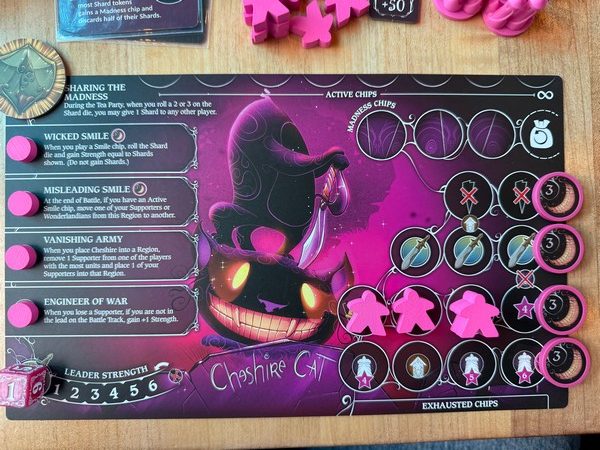
Each character has its own special power that can be unlocked during the game (on the left covered by discs).
The game’s basic mechanic is bag-building, with a push your luck element as well.
But first, there’s the Tea Party, which brings in card drafting.
You’re in Wonderland. You have to attend the Tea Party!
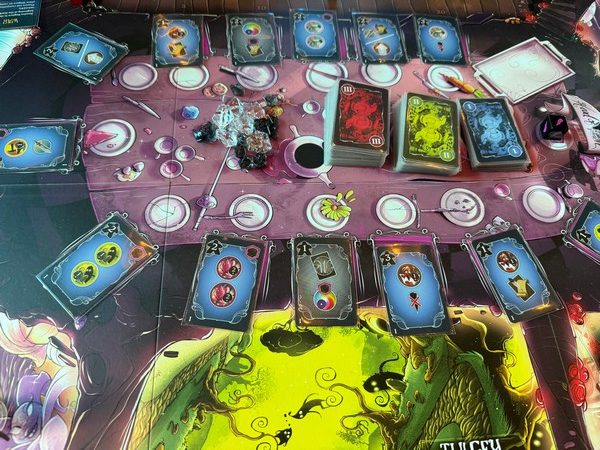
The first part of each of the three rounds is the Tea Party where you move around the table and take cards.

Each card will give you something, either some Ally discs for your bag, maybe getting rid of a Madness shard, a Wonderlandian that you can recruit to help you in battle, or maybe a quest.
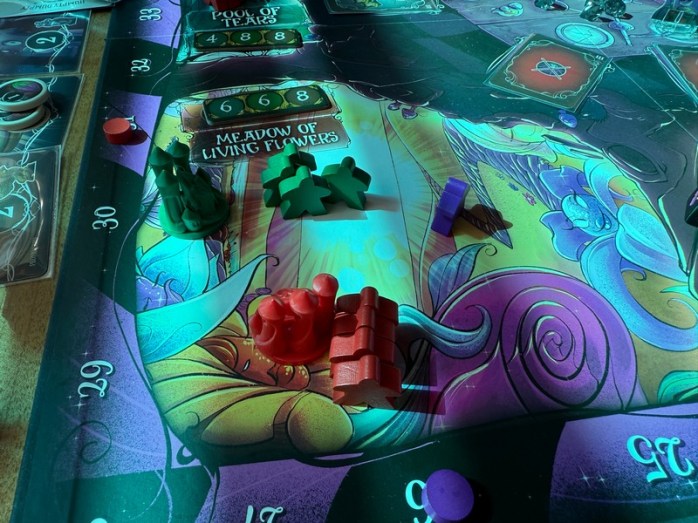
Many cards also let you put a number of your supporters out into one of the five regions of Wonderland that are under contention.
If you gain a Wonderlandian character, you will even put that character out onto the board in a region.

These characters will add to your battle strength and also have a special power.
Humpty Dumpty will be placed on the board with 5 strength, but also with the possibility of gaining more madness.
Other Wonderlandians (like the other two above) will just add discs with certain powers to your bag of discs.
After you’ve gained 4 cards, it’s time to put your leader out into one of the contested regions, and then the Battle phase begins.
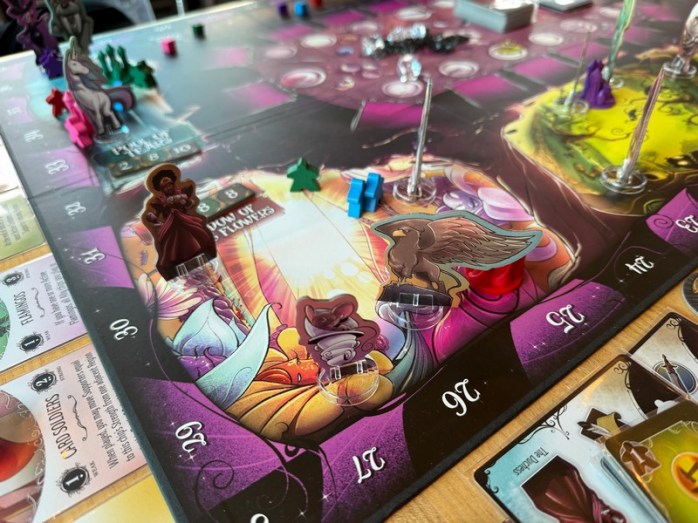
For each region where you have supporters (or Wonderlandians or your leader), you will be in a fight with whoever else is there.
Initial strength is determined and added to the Battle Track, then each player draws a disc from their bag.
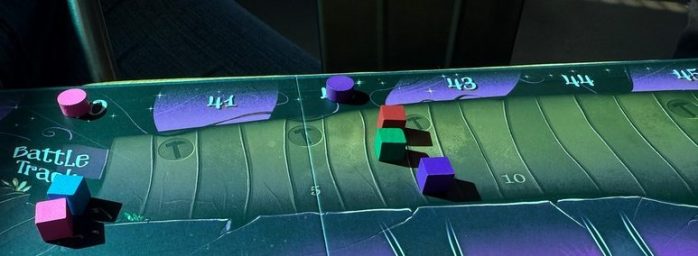
You add that discs strength to the track (and gain any special bonuses, if there are any) and then move to the next round.
After the first, if you decide to stop, you can stop and freeze your strength where it’s at.
This can be important if you have a quest that, for example, wants you to stop at a certain strength, or stop when you have played a certain number of chips.
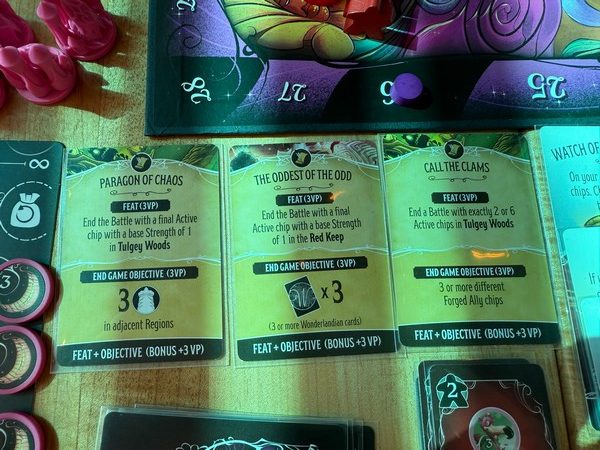
Whoever ends up winning the battle gets the victory points for that space in that round, with second place getting half.
Players not in the battle can wager on who will win.
If they are right, they gain a weak Ally chip (which isn’t bad!).
If they are wrong, they gain a madness shard.

Madness discs (the black discs at the top of the picture) are in your bag, with 3 at the start. You gain one after each Tea Party (Tea Parties are especially maddening!) and also, if you have the most shards, you get another one (though you do get to discard half your shards).
Shards are also -1 point at the end of the game.
If you pull a Madness chip, you get no strength and you lose a supporter in that region (or two if you draw that one).
If you run out of supporters, you bust! You gain no points and you can’t do anything else with the battle.
You do have a shield to block one Madness chip, but then it doesn’t reset until you bust (or some other effect tells you to).
You have to manage things!
This happens over three rounds (Tea Party, Battle). Doesn’t sound like much, but each battle can take a while, so both of our 5-player games went almost 2.5 hours.
Which isn’t bad, considering.
The teach can take a while too, though.
There are a lot of nuances that I didn’t touch on above (maybe if I ever review it), but I have to say that I did enjoy it.
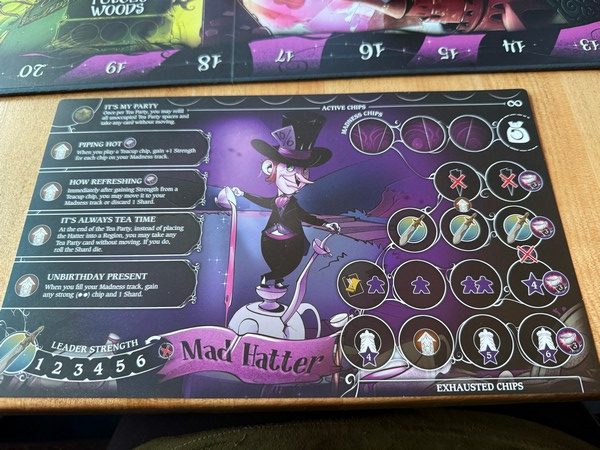
I do enjoy the asymmetric player powers, even more so when you can unlock your upgrades.
It is a truly chaotic game, so keep that in mind. You may not like that much chaos.
But there’s a lot of fun in there.
It’s definitely not an “area majority” game, no matter what BGG says, though.
I’d definitely play it again, but it’s no longer on my “truly want to play” list.
I do want to play it again at some point and do better than I did these two times.
Etherstone (2025 – Thundergryph Games) – 1 play

Designers: Virginio Gigli, Simone Luciani
Artist: Paolo Voto
Players: 2-4
This seems to be the month where I played a lot of “this game is like this other game, but better” games.
Etherstone has some cool similarities to Res Arcana, but actually is a lot more fun and forgiving in a way.
Of course, there are differences, including the dice that are rolled for each resource, which you can take as an action in order to get those resources and perhaps activate cards that you have played.
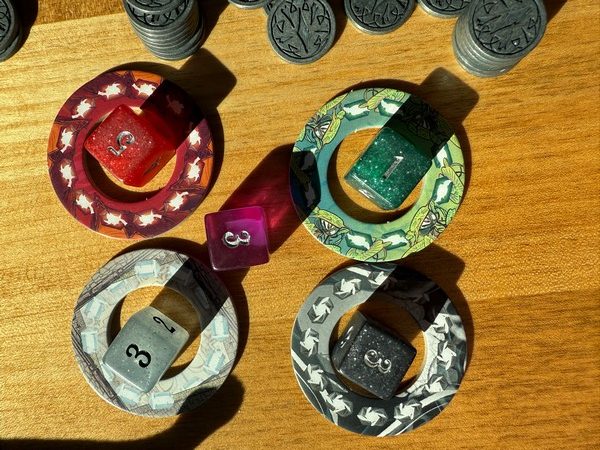
When you take a die, you get two of that colour resource. The purple die gives you any resource but costs a health.
In addition you can activate any cards you have played that have that number on them.

Drafting a 5 or a 6 will activate the Gizmo Master, for example, while drafting a 1 will activate the Forbidden Portal.
How did you get those cards?
Like Res Arcana, this is done via a draft.
The only cards that will be in this game are the ones that are dealt at the start.
You draft the cards for your hand and those are the ones that you will be able to play in front of you.
Unlike Res Arcana, though, the one thing you are going for in addition to playing your cards in front of you are the Threats.

Each Threat requires a certain amount of strength to defeat.
They will also get you victory points, though.
Strength is gained by tapping the cards in front of you when you decide to attack. Each player will have chosen a Leader and sometimes you will need the Leader to add its strength to your total.

However, if you do, the Leader will take damage based on the number in the bottom right of the Threat.
You can go to zero hit points, but then you take a Void Pact to reset back to the beginning.
Void Pacts are negative points, though some leaders (like the Unruly Combatant above) actually get something based on them.
The game will end when either somebody has played all of their cards or the Threat deck is empty, or perhaps the points token pool is empty.
I liked this game a lot. Res Arcana is well-regarded, but I actually preferred this one, at least after one play.
We’ll see how it holds up if I play it again, but for now it’s definitely cool.
Calimala (2017 – ADC Blackfire Entertainment) – 1 play
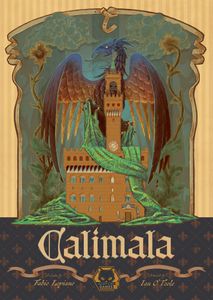
Designer: Fabio Lopiano
Artists: Harald Lieske, Ian O’Toole
Players: 2-5
Calimala is a game that changes completely depending on how many players you have in the game.
That’s because of the rather unique scoring system and action selection system that is in the game.
Players are cloth traders so they are trying to build up their warehouses to collect cloth, then build trading posts and ships to deliver this cloth to far-flung locations, both by land and by sea.
The actions you can take every turn vary depending on how they are laid out on the board at the beginning of the game.
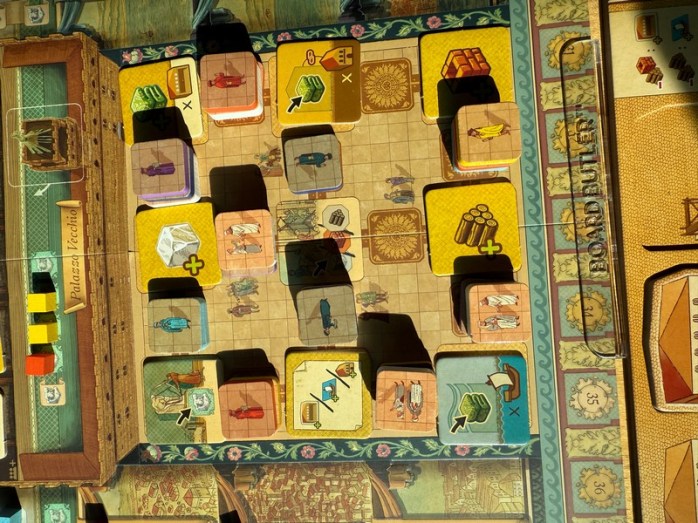
You place a worker between two spaces, and then do those two actions.
This can be anything from gaining resources to build warehouses/trading posts/ships, to producing cloth for those warehouses to adding something to the board to hopefully score when it’s going to score.
Thankfully you don’t have to gather resources in order to produce cloth.
It’s just produced by an action without combining anything.
However, you do need resources to build storehouses to keep it, and then produce ways to deliver the cloth.
What makes this game interesting is the scoring mechanism.

At the beginning of the game, the entire scoring grid is randomly laid out. This is the order when various things will score points depending on who has the majority in that particular area.
As an action (if you choose it), you can add resources to a cathedral in order to aid in its construction.

When that cathedral scores, whoever has the most contributions gets the most points.
There are also resource scoring tiles, which means you score based on how much of that resource you’ve contributed to all three cathedrals.
Finally, there are trading location scoring tiles, which consider how much cloth you’ve delivered to that location.
All of this is random!
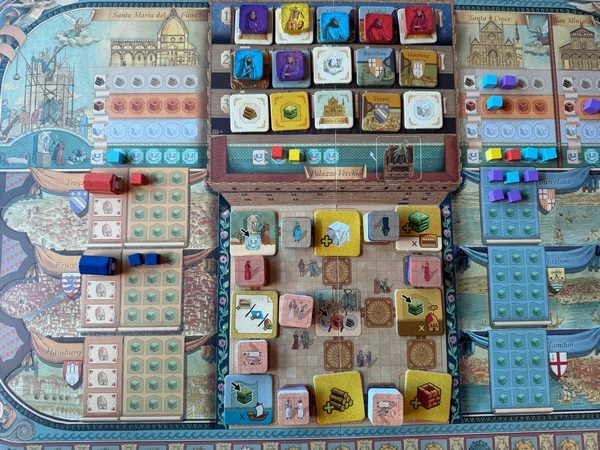
However, the worker placement/action selection mechanism is where this game shines (if it does).
When you place a worker between two actions, you get to take those actions.
However, everybody else who has a worker there also gets to take that action.
You can place a neutral worker there, in which case you get each action twice, but then you aren’t triggered when somebody else goes there (because it’s a neutral worker, not yours).
When the fourth worker is placed in that space, the bottom worker is removed and placed in the scoring area and the next scoring tile will trigger.
That’s the timer of the game.
Thus, the length of the game is player-controlled, and also the scoring. If somebody’s about ready to place another piece somewhere that’s just about to score, maybe you do an action that triggers scoring before they can do it?
As long as it benefits you.

Players will also gain a variety of action cards that they can do in addition to the actions from where they place their worker.
This can help you make a power move if you need to and you have the right cards.
After the game end is triggered (all scoring tiles have been activated), players will get an equal number of turns (so continue until you get to the first player) and then each player will have a final scoring card.

This card will indicate an area that will score again.
So if something has already scored, it may be worth it to keep contributing to that space because it might score at the end of the game.
This is more prominent in a 5-player game where 50% of the scoring cards will actually happen (there are only 10 and each player chooses one of two).
That’s where my main concern about this game comes in, though granted this is after only one play.
We played it at 5 players, and the first couple of scoring tiles activated before the 4th & 5th players could even do their second action.
It was so chaotic that it was almost impossible to plan for upcoming scoring tiles because it was very possible that it would already have scored by the time you took your next turn.
I was intrigued by the action selection system and the scoring system, but I think it needs fewer than 5 players to really shine.
I’d like to try it again with fewer, but as of this play, this is a “take it or leave it” game for me.
There you have it.
That’s a ton of new to me games!

Almost 4500 words later, I definitely am exhausted.
But it was a lot of fun (there’s that word again) writing it!
What new to you games did you play in September?
Let me know in the comments.
 Dude! Take Your Turn!
Lots of new games this month! Thanks for sharing. Outside of Galactic Cruise, this might be a relatively inexpensive “Dave made me buy it” month. I got through this post without adding new stuff, although they all look very fine. 🙂
LikeLiked by 1 person
I’m not doing my job, then!!!!!
Glad you liked. 🙂
LikeLike
Getting me to back Galactic Cruise was a lot of “doing your job”. That’s a hefty crowdfunding pledge. 😉
LikeLiked by 1 person
That is true. I couldn’t justify doing it myself, since I have at least one, maybe two friends who have it.
LikeLike
I love the variety of modern board games resulting in delightful phrases like “which makes an eel strategy kind of hard to do”!
I’d said that I played Wonderland’s War before, but I’d confused it with another game – Adventures in Neverland. Quickly researching the latter had me find out that it had been funded in 2020 on Kickstarter (I played it in 2023, I think), the publisher banged out an update every few months listing a new delay but promising production soon, and now cancelled it in June this year (leading to a flood of “1” ratings and “Scam” comments on BGG). Good thing I did not pursue this any further!
LikeLiked by 1 person
Oh wow, that sounds hideous!!!!
Glad you stayed away.
And I love that aspect of modern gaming too.
“This game is about getting butterflies home. This game is about sorting your sock collection.”
There’s even a card game about cleaning your house!
LikeLiked by 1 person
I play the original sock sorting and cleaning games at home 😉
LikeLiked by 1 person