Dude! Take Your Turn!
A Gaming Life
BGG Top Games – 1801 Through 1900

Last week, I mentioned that we were starting to get into the dregs of the Boardgame Geek Top 2000 games.
This week, that is just reinforced!
Though there is enough decent (ok, maybe “interesting” is the better word) stuff to talk about that it warrants another post.
We’ll have to see how the next couple of centuries go before I make a decision about pulling the plug on these.
The thing is, they’re so fun to write!
Even if they’re not that fun to read (be honest, I won’t judge or feel sad…much)
The top 2000 games, when there are thousands of games on the BGG database, are still probably decent games.
Maybe they’re just not hitting with me as much?
Why don’t you be the judge?
In this batch, I’ve played 8 games and own (or previously owned) 5.
I’ll try not to lie this time, but this might be a short post.
(spoiler alert: I lied again)
Here’s the page with this range of games on it, though keep in mind that games can move so they might not be there anymore!
Talking about games I’ve played, I have to start out with one of the worst games I’ve ever played.
And yet some people love it, and it’s even on (or close to) their Top 100!
Those long-time fans of the blog can probably guess (and no, it’s not Lucky Loop, which everybody agrees sucks).
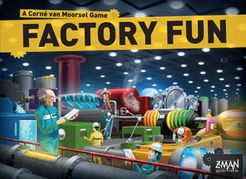
Factory Fun (#1876) is a terrible game for me because it’s a combination of real-time and trying to place things into a grid so that they form a coherent whole.
You are trying to build a productive factory, and you are doing that by drafting a factory piece each round.
In real time, which means there are a certain number of pieces out there (I think equal to the number of players) that you have to race to decide which one you want and then place it in your factory.
(Sorry, I don’t have any pictures of this monstrosity that I played many years ago, before I was taking boardgame pics)
My mind doesn’t do spatial relationships, and deciding how to fit things together efficiently, very well.
To try and do this in real-time, where everybody else is also trying to do the same and grab a piece?
I inevitably had to take the last piece and it inevitably didn’t fit into my factory without a lot of extra expense.
Let’s blurb this thing just so you get an idea.
“Players each start with a unique empty factory floor with a support pillar in the middle. During the game you purchase machines to place in your factory. Each machine takes 1 to 3 inputs from reservoirs (yellow, blue, red, and brown) and produces one output (of the same colors, or black end products). You must always connect all reservoirs and machines correctly by using the connectors (the pipelines). At the start this is easy, but becomes more puzzling during the game.
Players start with one of each color reservoir, and can sometimes acquire additional reservoirs. On the machine-tiles you see the revenue of each machine. Connecting machines to each other (input on output) makes more advanced products which brings extra profit. But building connectors and reservoirs costs money and you must try to have the most money at the end.”
In real-time!
Yeah, this isn’t for me at all.
Some people love it, and so might you.
So don’t let David Downer keep you from checking it out if you like that sort of thing.
But it will forever be at almost the bottom of my Top Games list (usually only hedged out by Lucky Loop).
Another game I’ve played and would like to get to the table again is Omen: A Reign of War (#1890).

This is a 2-player lane-battler, in a way, and one that I quite enjoy.
You are playing your cards to one of the cities between you.
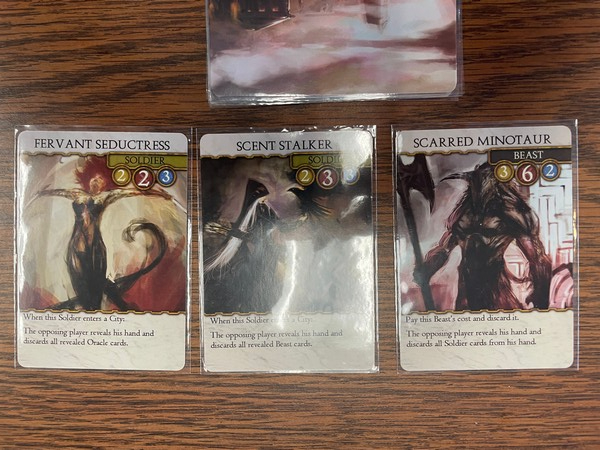
Essentially you are fighting the other player’s forces, with a battle occurring when there are a certain number of units (in total) at each city.
Cities become “war-torn” when a player has 3 units (Beasts count as 2) in a city, or if the total number of units between the two players is 4.
The winner of the city gets to keep it for 2 points, or can play the reward for its effect and still keep the card for one point.
You are also trying to qualify to complete feats, which will point you toward victory.

These you have to qualify for by satisfying certain conditions, like Athena’s Feat where you have to have at least one soldier (as opposed to Beast) in each city.
The end of the game is triggered if two of the three cities no longer have reward cards, or if a player has completed 5 of their 6 feats.
This is an interesting game, as all of John Clowdus’ games are.
I’d like to play it more, as I’ve only played it three times (and haven’t reviewed it yet! My bad).
Sadly, this is another case where I may not play it for a while because my work lunch situation sort of prohibits 2-player games.
But it is a cool game!

Fruit Fight (#1823) I’ve only played under its previous title, No Mercy, and that was a fun game.
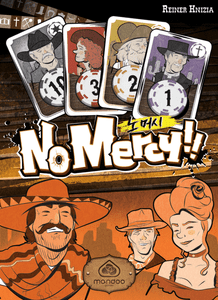
(Sorry, all of my pictures are of No Mercy).
This is a push your luck game by Reiner Knizia (the master!)
In the game, there is a deck of cards with cards numbered 1-10, with eleven cards numbered 1-5 and seven cards number 6-10.
On your turn, you draw from the deck, and not only keep that card, but all instances of that card that are in front of other players.

However, if you draw a card you already have, you lose everything in front of you (as long as you have at least 3 cards in front of you).
At the beginning of your turn, every card in front of you gets placed face-down and that’s your score.
So you’re only in danger for the current round.
Once the deck of 90 cards runs out, everybody totals their scores (the value of all the cards in front of you, so 10s are good!) and whoever has the most wins.
It’s a 20-minute game (if that) and it’s actually kind of fun.
I haven’t seen the actual Fruit Fight version or its cards, but the rules are the same, at least they seem to be.
Just the images are different.
I’d give it a try if you can! Just to see if there are any differences.
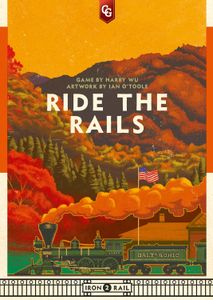
Ride the Rails (#1837) is kind of a light rail/stocks game.
In this case, you are delivering passengers and not cargo, but you are still building rail lines across the country and investing in stocks of the various train companies.
It’s not 18XX, so don’t worry about that.

Each round, a new railroad is revealed and that railroad will have its own placement rules for track.
You’re then going to be moving a passenger from one city to another, with each rail line used giving points/money to whoever is invested in that colour.
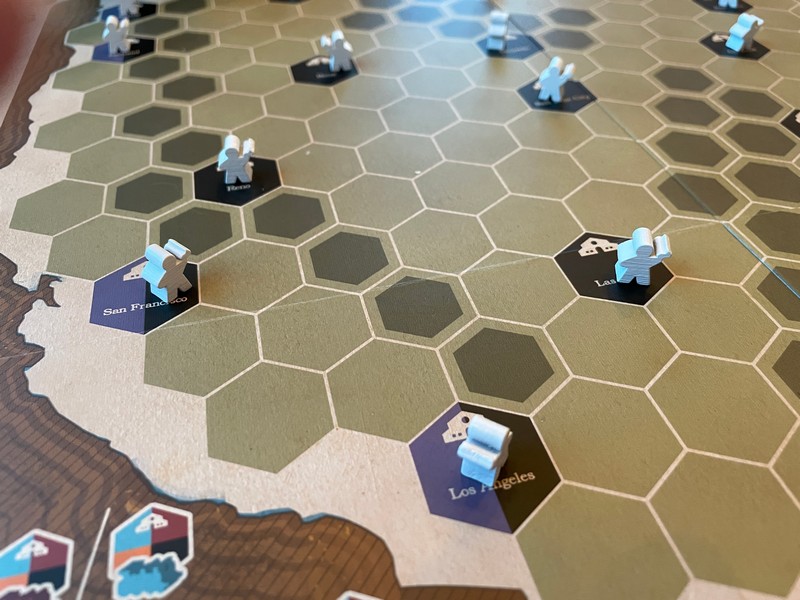
The funny (and least thematic) thing about this, is that if you have stock in rail lines criss-crossing the country, you might want to send that passenger from Atlanta all the way out west to Los Angeles, and then back to Boston (where they want to go), all because that will get you the most points.
At the end of the game, whoever has the most points wins!
I didn’t mind my play of this, but it’s not really my type of game. I don’t really do rail games where you are building track and investing, whether it’s kind of simple like this or the more complex 18XX games.
It was fine?
Nothing I need to play again, though.
Doesn’t mean you wouldn’t like it, though! It does feel like a quality game.
That’s it for games that I’ve played but not reviewed!
There are a few reviews in this century, though.
Le Havre: Inland Port (#1811) was one of the hardest reviews I’ve ever written, because I was just so “meh” on the whole game.
There wasn’t much to criticize but there also wasn’t much to praise.
The “base” (as in, non 2-player though it plays well at 2 anyway) game is considered an Uwe Rosenberg classic.
This 2-player version?
It’s fine, kind of.
It’s not inspiring at all.
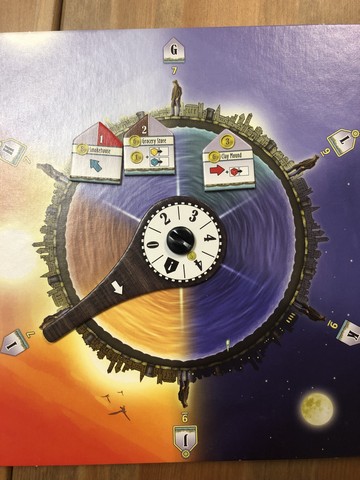
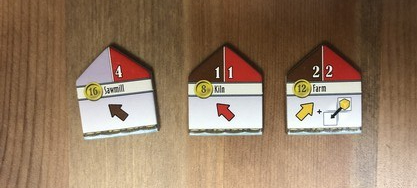
It does have an interesting resource-management mechanism, though it’s not so much resources as it is the buildings that you have purchased.
On your turn, you are either buying a building or utilizing one of your buildings.
As you can see on the rondel above, the buildings will get stronger and stronger as you don’t activate them.
When you buy a building it, goes right behind the arrow. You can’t use it.
However, as buildings aren’t used, they go further and further away from the arrow.
Then, you can activate them multiple times depending on the dial number in the space they are in.
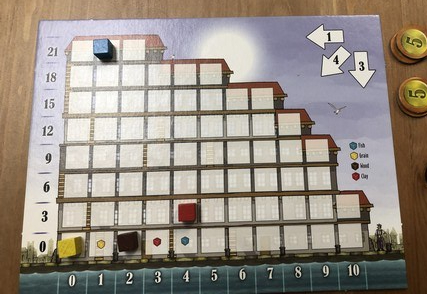
This will hopefully help you max out your resources, gain money, or whatever.
Activating the buildings will usually have you move resources horizontally, vertically, or even diagonally.
So you’re never “using” one resource.
You’re moving the cube, which could mean you have 3 less, or 2, or even 1.
Gaining is also the same way, where you could gain a couple or a bunch, depending on which way the cube is being moved.
It’s just…not that interesting of a game.
I played it three times (so I could review it) and each time, I was left with a mellow feeling of disinterest.
I wasn’t actively hating the game.
I just wasn’t feeling anything.
Who knows? You might like it.
Valley of the Kings: Afterlife (#1825), however, is a really enjoyable deckbuilder.
I’ve already said how much I love Last Rites, the third set of Valley of the Kings.
This one is really good too, but not as good as that one.
The original game is in the 1200s, meaning all of them are in reverse order of my taste! Especially because Last Rites is all the way down at #3237!

That’s an outrage.
Anyway, much like the other two, you are building your deck by buying cards from the pyramid.
The cards have abilities when you play them, but you don’t score any points for them unless you’ve entombed them.
They are out of play, but they get you points.
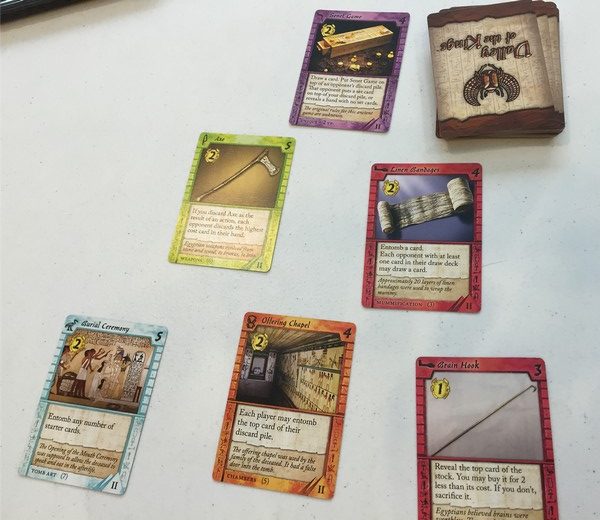
And you can only entomb one card a turn unless one of your other cards lets you do another (like the Linen Bandages above)!
So it’s a decision of how long you keep the cards in your deck versus scoring them.
I really enjoy this system, but the three were too similar for me to keep all of them, and Last Rites is the best in my opinion.
Cascadero (#1881) is a game I’ve only played once, but I did do a First Impressions post on it because I quite enjoyed it.
This is a relatively new Knizia tile-laying (kind of? More like pieces, than tiles) game and it has a lot of interesting mechanics.
The land is broken and El Cascadero (new ruler) needs to unite it.
He tasks his four ministers to go out and bring prosperity to this land.

You do this by placing envoys out in a chain, spreading them around a map and carrying the good word to the cities.
But they don’t trust single envoys.
You have to have at least two envoys adjacent to a city before you can score it.

Meanwhile, you can block the path of other players with a judicious placement of an envoy as well.
Doing all of this will move you up the various coloured success tracks, which will also gain you bonuses.

The fun thing is, whichever colour you are, you have to reach the top of your score track if you want even a chance of winning.
That’s because if you haven’t, you can’t!
It doesn’t matter how many points you have, you don’t qualify to win if you haven’t done that.
In the picture above, only blue or yellow can win (though I think that might be in the middle of a game, not at the end, so it turned out that others could as well).
I’ve only played it the one time, but I would definitely be interesting in playing it again to see if I can get it better.
Knizia always has some interesting games, even if I don’t necessarily like some of them.
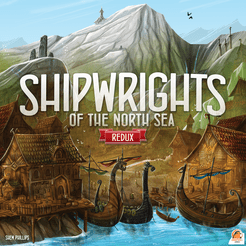
Shipwrights of the North Sea (Redux) (#1880) is the reworking of an earlier game that I had not played.
Apparently the original game was awful.
This one’s not bad!
It’s nowhere near my top Garphill game, but it’s a fun way to spend an hour.
You are, yes, building viking ships to give them a navy to go out and pillage the far shores.
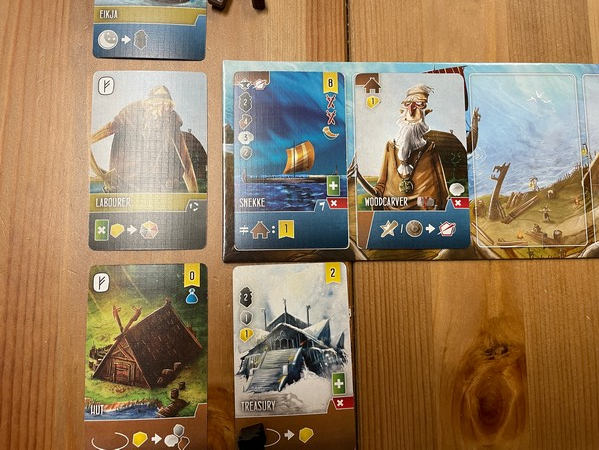
It’s a card drafting game too, where you gain six cards each round, taking one and passing the rest until you have six.
Once it’s time to take actions, you can do a number of things with the cards in your hand.
You can discard it for the effect above the red “X” (the Treasury above lets you draw another card), or you can gain resources such as wood, stone, sheep, or even workers.
Or you can actually spend the resources to build it (or get it ready to build if it’s a ship).
If it’s a craftsman, you can either place it onto your ship board to use to build the next ship, or you can hire them for one gold and place them under one of your buildings.
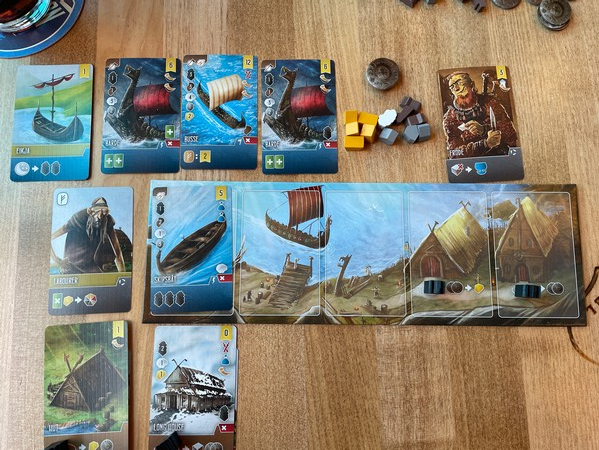
That makes them available for all of your ships, not just the next one.
The ships are what get you a bunch of points, depending on how resource-intensive they are to build.
They also give you either an ongoing effect, an instant effect, or endgame points.
Building ships, or hiring Jarls, will also move you along the tracks you need to move along.

These will give you bonuses depending on which track you are pushing.
they can give you trading benefits (which go under your ship cards to give income bonuses) or places to raid if you’re pushing the military.
I like the multi-use nature of the cards, the different tracks you can move up to gain you different bonuses, and the possibility of building really awesome long-term ships that take a lot, or a bunch of little ones.
Also, play is simultaneous.
You do the 7 Wonders type card drafting, and then you all do your thing with your cards at the same time (which could result in somebody inadvertently cheating because they forget a rule and nobody’s watching their turn).
All of this in about an hour (at least with three players who know the game), which makes it great for work.
This will never be my favourite game, but it hits the table at lunch a fair bit because we do enjoy it, it’s a bit crunchier than some of our other lunchtime games, and it just hits a sweet spot.
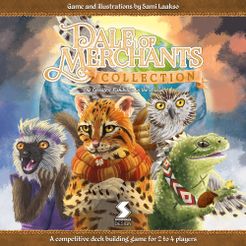
Finally, there’s the Dale of Merchants Collection (#1821), which is actually a big box to hold the three Dale of Merchants games along with some new cards and other extra stuff.
I own this, but I’ve only played Dale of Merchants 3 so I can’t really comment on this one.
Other than I like how much it holds!
And that it’s not a huge box, so it can still be carried around if I wanted to.
That’s all of the reviews and games I’ve played.
How about games I might want to play?
Before I get into that, I do have to say that there are a bunch of dice versions, and also roll and write versions (not to mention 2-player versions) of games that I’ve played.
Troyes Dice (#1818), Tokaido Duo (#1845), My Village (#1872), Masters of Renaissance: Lorenzo il Magnifico: the Card Game (#1849), all of these might be fun. I enjoyed the original games enough that I wouldn’t mind trying them out.
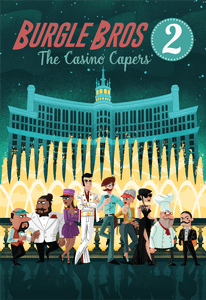
One that I wouldn’t mind trying is Burgle Bros 2 (#1806), because I did enjoy the original game quite a bit.
It’s a cooperative heist game where you are moving on multiple levels and trying to steal a big haul while avoiding the guards.
The second game is a Casino heist, so I don’t know that much about it.
Unfortunately, there is no blurb because the description on BGG is just “what’s new”, so let’s talk a bit about that.
Players get their own gear which can be used at any time, but it has to be equipped first. It can result in some amazing saves of your companions if you’re good.
Bouncers act like Guards from the original game, but these guys are tough. And, if their deck of cards that governs their movement runs out, they just start targeting whoever’s closest.
Finales add some excitement when you finally get the loot out of the safe.
Essentially (in the first game and apparently in the second), you are moving around tiles on multiple floors of the casino, going from room to room, trying not to trip alarms, and avoiding the guards (in this case, bouncers) as much as you can.
You have to crack the safe, but then you also have to clear out without getting caught.
It sounds cool, but nobody I know has it so I haven’t been able to play it yet.
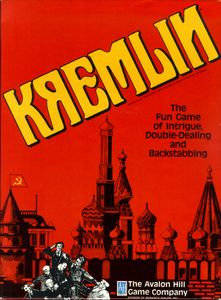
Another game I have a real soft spot for, because I owned it way back in the 1990s but never played it, is Kremlin (#1836).
This looked like such a hilarious game.
It came out in 1986, when Soviet leaders’ terms in office were sometimes only a few months, because when one died and someone took over, that someone was often dead shortly thereafter.
This is a game of political intrigue where you are not trying to become Communist Party Chief.
Instead, you are trying to have the most influence on the person who becomes Chief, thus making you even more powerful.
Here’s a blurb that describes all of that:
“At the start of the game, a number of politician cards are laid out to fill the positions of the politburo. Players then secretly note influence on ten politicians they hope to control during the game, indicated by a number from 1 to 10.
Gameplay is not clockwise, but proceeds phase by phase with the politician holding the relevant office performing the appropriate action by the player who reveals the greatest influence on the politician in question. Players attempt to remove politicians opposed to their interests by purging, exiling them to Siberia or by demoting them within the Politburo. One’s own preferred politicians can be promoted or pardoned of their previous ‘sins’.
But each action a politician takes causes him (or in one case, her) to age by one or more years (a measure of the aging effect of the stress of the job). Each turn, politburo members face a health check which can result in the politician becoming ill, or even dying. The ‘older’ a politician gets the more likely it is that he (or she) will become ill.
At the end of each turn, the Party Chief must be healthy enough to wave to the crowd at the October parade. Controlling a politician who succeeds at this three times makes you the winner.”
This sounded so great, so I bought it…and then never met anybody (much less the 3-6 people) who would want to play it.
One day, I would like to give this a try.
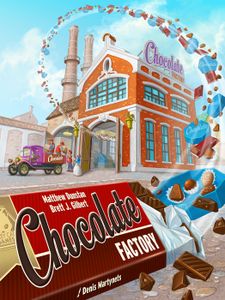
Finally, there’s Chocolate Factory (#1866), which is a game I have played on Boardgame Arena but not in the flesh.
I kind of got it on BGA, but I would still like to table it to see if it makes a bit more sense to me.
This is a classic euro game where you are trying to build a factory that produces the best chocolates around.
Let’s blurb this one:
“Players are each given a starting player board which will have two Factory parts which apply to a physical conveyer belt. The conveyer belt part of the player board contains long slot with an empty region in which to push square tiles along. The tiles will house the chocolate pieces players will manipulate throughout the game.
During the game players will initially draft new factory parts (to add to their player board) and specialists (one time use cards with special powers).
Then each player will “push” three times cocoa into their machines. During each “push” players will be able to use fuel and their factory parts to manipulate their Chocolate pieces. Careful consideration will be required for the spatial element of the game as Chocolate pieces can only be manipulated during a push by the Factory part that is adjacent to their tile.
Players score points by creating chocolates for public and personal objectives. The player with the most points at the end wins.”
The conveyor belt mechanism was really cool, as you definitely had to plan out your ingredients, when they would be able to form the chocolates that you wanted to make, and what orders you wanted to fulfill.
I’ve completely forgotten how to play, for the most part, but I’d definitely like to try it “for real.”
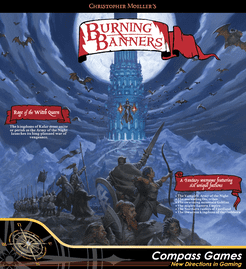
An honourable mention to Burning Banners (#1885), a fantasy wargame from Compass Games that looks really interesting and a bunch of my friends speak very highly of it.
I want to try it!!!!
All in all, not a terrible century?
But I certainly haven’t played the cream of the crop, I don’t think.
Or maybe I have?
That’s an even worse thought.
What do you own or have you played in this century?
Anything you want to (or desperately avoid)?
Let me know in the comments.
 Dude! Take Your Turn!
I’ve only played Axis & Allies (the original) from this century. Agreed that Kremlin and Burning Banners look great!
LikeLiked by 1 person
I wish I had played Kremlin back when I had it, all those years ago.
I feel sad now…
LikeLiked by 1 person
Can’t play them all… but at least it’s easier to get hold of the game again with the new edition published by the Dietz Foundation!
LikeLike