Dude! Take Your Turn!
A Gaming Life
New to Me – September 2026

September looked like it was going to be very dry in the “new to me games” system, with only one going into the last two weeks.
Once again, Abi saves the day!
Getting five new to me games played in the last two weeks made it so I actually had something to write about, which was great.
I was even able to stave off another revolt from the Cult of the New to Me members, because while four of the games were pretty new, two of them were at least a decade old.
That’s old in game terms!
They actually held a celebration for me.

That made me really uncomfortable, though.
They should follow my lead, not worship me like that.
I’m not that kind of cult leader.
Anyway, without further ado (all of my ado was destroyed in some falling tower anyway), let’s get started!
Falling (2026 – Capstone Games) – 1 play
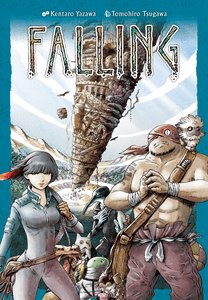
Designer: Kentaro Yazawa (矢沢 賢太郎)
Artists: 別府さい (Sai Beppu), Tomohiro Tsugawa
Players: 1-4
Falling is one of the new Capstone games that came out this year, and when I saw the email announcement, I thought it looked kind of interesting.
Not enough to buy it (I’m trying to be more frugal than I have been in the past), but enough to want to play it.
So when it came out on a game day Sunday, there was no way I wasn’t going to try it.
Essentially, you have a tower that is falling and players are explorers searching it for relics and other cool stuff, even as its continues crumbling after falling from the sky and crashing to the ground.
You’re going to be placing machines in the tower to mine it for resources, as well as victory points, even knowing that as the floors you placed them on reach the bottom, they will be demolished (though thankfully they do come back to you rather than being gone from the game completely).

It’s a game of moving upwards as far as you can and establishing all of your stuff, getting income from it every round.
At the end of each round, the bottom two floors will disappear, sending all of your stuff back to your player board.
During the round, you’ll be moving your balloon (or whatever the hell it is) upwards using gas, in order to try and reach the upper floors, which means you will be able to put machines out there that won’t disappear at the end of the round.

When you place machines, and even when you move up on the balloon track, you will be getting a bonus depending on which space you build/land in.
Your player board shows the income you will receive if the machines are still in the tower (though when they return, the space you put them in will also give you a bonus resource or whatever).

The game goes over four rounds, and it’s important to figure out exactly where you want to be in the penultimate round, because the tower collapses and you get income even in the final turn.
If you want the machines out there in that final phase, for points and/or resources, you want to make sure they’re high enough not to return.
Each round, you’re also going to be choosing a new action that you can spend an action token to do, like the above ones, which will give you two money (both in income as well as when you put an action token there), or spend a gas to get a brick and an iron, or 3 coins to get 3 gas and a point.
What I especially love is the scoring system.

The VP track is only 10 spaces round and then you go back to the beginning, but each time you wrap around, you draw a 10-point card that not only tells you that you have 10 points, but also gives you some kind of resource(s).

This is really neat, and the only thing that mars it is the fact that the cards that give you the really cool stuff are stiffer than the regular ones, so when you’re shuffling the deck, it’s really obvious where they are.
Also, in line with my “get stuff after you passed” post, this one has an interesting effect that, while you don’t get to do anything after passing, each turn that goes by where you have passed and others haven’t, you get an increasing amount of stuff.

The first player to pass will a crystal. If other players are still going, the next time it’s their turn, they’ll move down and get a gas, then an action token, then points.
This will also determine turn order for next round.
I like that.
It’s all an intriguing mix of actions and possibilities that I greatly enjoyed.
I doubt it would make my Top 50, but Falling is a game that I would love to try again, mainly to see if I can optimize things better than I did this time.
In our play, we were all very even, with me winning with a tie-breaker by being the highest in the tower at the end of the game.
Will that happen every time?
Probably not.
Automobiles (2016 – Alderac Entertainment Group) – 1 play

Designer: David Short
Artists: Kali Fitzgerald, Marco Primo
Players: 2-5
Automobiles has been sitting on my shelf of shame for a great number of years, pretty much since it first came out.
Which is sad, because that was 10 years ago!
I finally decided to bring it out this month, and it was actually kind of a hit.
It’s a bag-building racing game where the cubes you’re placing in your bag will help you in trying to race around the track and get to the finish line before the other players.

That’s what Automobiles is, a race around the track.
Three laps, though you can do a heat (shorter) run or a longer one (up to seven laps) if you really want to and have the time.
It’s all flexible!
Though a short heat really won’t let you get your bag-building engine running.
The idea behind this game is that you have a set bag of cubes that will let you move a certain number of spaces in the white, light grey, dark grey, or even black segments of the track.

There are then various different coloured cubes that you can purchase (you can also purchase the basic gear cubes if you want to) that will give you variable powers (depending on the cards that are drawn at the beginning of the game) when you actually use them.
Wear cubes are pretty much useless cubes that will clutter up your bag and not let you do anything, but you will have other cubes that will let you get rid of wear.
However, for the Fuel Injection Engine (as an example), while you are gaining two wear cubes, you will move twice as fast with your normal gear cubes than you would otherwise.
That’s some serious speed!

If you get things done efficiently, you could almost move around the entire track on your turn.
When you’re using your cubes, you place the ones that will be moving your forward out onto the track, rather than moving your car immediately.
This will make it so you can adjust things as you need to.
Also, there are “spaces” and “segments” on the track.
So if you are moving in the dark grey in the picture above, while there are four segments for cars to be in, you will actually move to the first spot in it, which will accelerate how you are moving around the track.

Each cube is worth money if you don’t use it. Thus, you can use your unspent cubes to buy even more cubes that will help you in the future.
I’m really sorry that it took me so long to play this one, because it’s actually really cool.
The Racing Season expansion adds a few things, including a “campaign” of sorts (which we will never do, I’m sure), but we definitely did use the new cube cards as well as the Drivers.
The Drivers really add to it, giving you a bit of an asymmetric power that we really enjoyed.

I have now played the entirety of Alderac’s “Planes, Trains, and Automobiles” trilogy of games (that can’t be a coincidence that they named them thus, can it?) and I’m happy I did.
I’ll definitely be bringing this out again.
Dewan (2025 – Space Cowboys) – 1 play

Designers: Johannes Goupy, Yoann Levet
Artist: Arthus Pilorget
Players: 2-4
Dewan is a game where you are expanding from your home base and placing encampments onto various location types in order to satisfy story tiles.
You do this with some judicious use of terrain cards, because you are drafting them into your hand and then playing them to place camps at a distance from a current camp.

This will block that hex from being camped on by the other players, but it also means that if they trace a path and do an encampment that goes through your camp, they have to pay you a card as well as discarding the terrain cards for their movement.
When you place a camp, you need to discard a card of the terrain type of your starting camp, every space you will be moving through, and then your final destination.
So to place the red camp on the bottom left, I had to discard two mountain cards (starting and ending spaces) and a woods card.
The whole idea behind this is to gain and then satisfy your story tiles.

You start with one, but then you will draw more as you place more camps.
For instance, the story on the right requires you to have camps next to three locks and two crystal spaces.
Building some camps will let you place a card under your player board, which could be a fire (which will give you points) or a lock symbol (which will help satisfy your goals) or whatever. Also, the terrain type on the card will work towards any story tiles that require that terrain.

When somebody has placed their last encampment, that triggers the end game. You just add up the points for your goal cards as well as the fires (1 point each and whoever has the most gets 4 more points), a point for each berry collected, and four points for each set of connected camps.
This last one encourages you to have two camps right next to each other, though you do have to spread out a bunch to meet other goals.
This game was fine. I enjoyed it, but it wasn’t anything hugely special.
I’d definitely play it again, but it’s not one I’m clamoring to.
Tiny Mountain Goats (2010 – Allplay) – 1 play

(AKA Mountain Goats, as the cover shows!)
Designer: Stefan Risthaus
Artists: Anca Gavril, Dennis Lohausen, Daniel Profiri, 別府さい (Sai Beppu)
Players: 2-4
This is the second game this month with Sai Beppu art!
Go figure, that is a weird coincidence.
I played a very tiny version of the game, which is why what I played is called “Tiny Mountain Goats“. It’s the same game, just smaller.
It still has the wonderful dice chaos of goats trying to get to the top of a mountain and stay there.

This time with cards instead of tiles! (I presume the “main” version has tiles or something, but maybe not).
Each player has a goat at the base of each numbered mountain.

Players then roll the dice and can move goats up the mountains using any combination of the dice.
You can spend a one to change any die to any other die face, but otherwise you just combine them.
So the above roll, you could move a goat up the 10 mountain, spend a 1 to change the other 1 to a 6 and then move up the 6 mountain (or a 5 for the 5 mountain).
Or you could move up the 7 and 5 mountains.
Or, you could even move up the 6 mountain twice, by using the 6 and then adding the 4+1+1 to get another 6.
Whatever you want to do.

As you move up the mountain, you get closer to the top. If you reach the top, you get a scoring tile for that mountain.
If you’re already at the top and you get that number again, you get another tile!

But if somebody reaches the top of the mountain, not only do they get a tile, they knock you all the way back to the bottom.
If you get a set of each mountain scoring tiles, then you will also get the set completion card.

Once a certain number of mountains no longer have a scoring tile, or when the set completion cards run out (which I can’t see happening, but maybe?), score all the tiles and set cards you have and that’s how many points you get.
Whoever has the most is King of the Mountain!
This was a lot of dice-chucking chaotic fun.
Hell, this one (well, the new Mountain Goats legacy game, anyway) even got the Heavy Cardboard seal of approval.
That’s big!
The game is quick, fun, and I’d definitely play it again.
Take Time (2025 – Libellud) – 1 play (with a caveat)

Designers: Alexi Piovesan, Julien Prothière
Artist: Maud Chalmel
Players: 2-4
Take Time is yet another example in the “cooperative game where you can’t talk” genre of games where you have to play cards blindly, getting only an indication of what the other players are wanting to do based on what they have played previously.
This one involves playing twelve cards around a clock in a way so that each space on the clock is sequentially higher than the one before it.

You’re playing a kind of campaign, or at least a string of games to make up a scenario of increasing difficulty (I’m not sure exactly how it’s broken down).
Since each round takes like 5-10 minutes at most, we played at least four times. I just counted it as one play because we were advancing to the next mission (or, when we starting losing, retrying that mission again).
In turn order, you’ll be playing a card face down to one of the six slots (multiple cards can be played in the same slot, you just add them together).

Each clock will have some requirements on certain spaces, though.
The clock above, for example, can’t have a 1,2 or 3 played on the first three spaces.
Some other clocks have a space where there has to be one dark and one light card.
Some clocks require the final space to be no higher than 24.
The hard part is that you play the cards face down, except that throughout the 12-card round, four of them can be placed face-up, in order to give an indication of what’s already at that space.

After the cards are dealt, you can discuss as much strategy as you want. But as soon as you look at your cards, you can’t say another word.

It’s interesting trying to deduce what should go where, and sometimes you’re screwed anyway because you only have low-value cards.
It’s very quick, you can probably get through a whole scenario in one sitting if you really wanted to.
I wasn’t enamored with this one, though. It was fine and I enjoyed our play. I’d willingly play it again.
But it doesn’t call to me to want to play it again.
Life of the Amazonia (2023 – Bad Comet) – 1 play

Designer: Jamie Bloom
Artist: Sophia Kang
Players: 1-4
Finally we get to a game that has been receiving Dice Tower kudos almost since it came out in 2023.
Life of the Amazonia is like Cascadia on steroids, which is probably why our initial play took 2.5 hours, but I’m sure that would come down a great deal with more plays (though BGG does list 150 minutes as the maximum time, which is 2.5 hours, so maybe not?)
This is another game where you are building an ecosystem and putting animals on it, though this time the terrain type actually makes sense with the animals (no salmon in the prairies!!!!).

It is also a bag-building game, which makes this even more interesting (if possibly a lot more random, though it is up to you how you want to fill your bag).
You’re going to be pulling five tokens from your bag and adding them to any saved token(s) you set aside from your last turn.

This will give you a bunch of different types of “currency,” which will allow you to either buy more and stronger tokens (with the money), go up one of the nature tracks (water or leaves), or maybe even get an animal in your ecosystem (the food plus either water or leaves, depending on the animal).
You can buy whatever you can afford, and you can always hold one token back for next turn (though one of the things you can pay water for is to increase that hold limit to two, or even three).

The tracks will always give you at least some benefit, either a tree or a water lily, or a new terrain tile to put out.
Landing on certain spaces will also give you other benefits as well.

The terrain tiles you can add are 7-hex ones that you can fit anywhere, depending on what you are trying to accomplish.
One big forest habitat? Or a bunch of little ones?

Like Cascadia, the animals that are available are the same each time, but how they score is different depending on which animal card you drew.
There are also one-time bonus action cards that you can purchase with water, or endgame scoring goals that you can purchase.

Those can get quite valuable sometimes.
The game end is triggered when five of the animals are no longer available.

It can look incredibly pretty on the table at the end of the game, with lots of trees, water lilies, and tons of animals occupying your ecosystem.
I enjoyed this one a lot, but it did burn my brain a bit.
More plays would probably help with that issue.
It will never be a lunchtime, but that’s ok.
It doesn’t have to fill the Cascadia niche.
It’s fine in its own niche.
I can understand the hype around this one.
That’s it!
Six new to me games, bringing the annual total for 2026 to 52.
I need to keep up this pace to have a year like 2024 (I doubt I can equal 2025’s 84 new to me games).
What new to you games did you play in September?
Let me know in the comments.
Your opinion on Dewan is the same as mine. It’s interesting that this game gets so much hype lately.
I never mind being agreed with! LOL
I wasn’t aware that it was being hyped so much.
My opinion might have been worse if it was. Kind of like Dungeon Crawler Carl.
That series of books (four books in) is fine, but not all that.
I’d probably feel better towards it if it wasn’t hyped out of all proportion.
Fully in line with my reputation as a party animal, I played a party game – Hitster, which has players arrange songs chronologically after hearing a snippet of them. I liked it!
As for non-party animals: Amazonia looks cool!
Oh, I’ve heard of Hitster. It sounds cool!
And Amazonia is definitely as good as people have said (though maybe not *as* good, as it’s on some people’s top 50s and I’m not sure yet it would go there)