Dude! Take Your Turn!
A Gaming Life
Lifting the Vale – Vale of Eternity Review
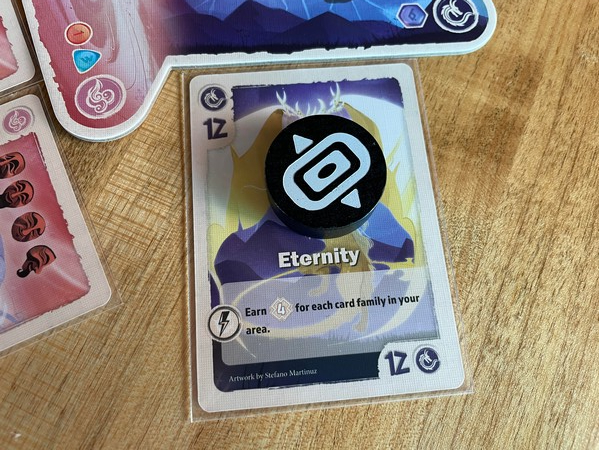
There’s something about relatively quick card games that just grabs me. I’m not sure what it is, other than getting the chance to play a bunch of games in a game day, maybe?
However, card games can become a bit rote with small variations of the mechanics that can just get a bit boring sometimes.
When a game offers a couple of interesting twists on those mechanics, though, I stand up and take notice.
The Vale of Eternity is one of those games.
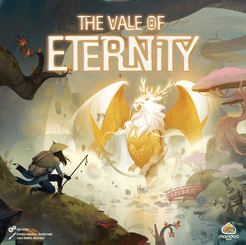
Designed by Eric Hong with artwork by Jiahui Eva Gao, Gautier Maia, Stefano Martinuz, Erica Tormen and Jens Wiese, the game was published by Mandoo Games (and Renegade Games Studios over here in North America) in 2023.
The Vale of Eternity is a card game where you are drafting cards each round, and then either summoning them to your tableau, “taming” them into your hand for later summoning, or selling them for crystals (I prefer to think of it as “releasing them and in gratitude they are giving you a gift,” but that’s just me).
The drafting system, summoning system, and the crystal/money system are all actually very interesting and what makes this game shine.
The reason for that is because I love when a game gives you limitations to what you can do and that you have to work within, without the typical “oh, I don’t have the money to do that” restriction.
Noted, there is that here too, but with a bit of turn from the usual.
Let’s go into the drafting first.
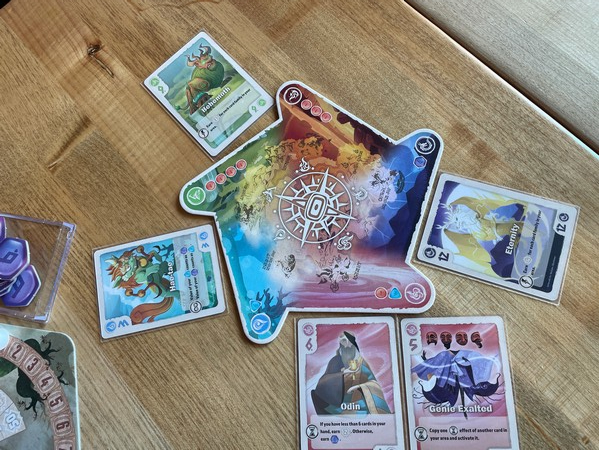
Each round, cards are dealt from the deck onto sections of the game board that match their families (colours). The number of cards is equal to double the number of players.
In turn order much like Sagrada, players will reserve one card with one of their tokens. Only one card in turn order, but then it rubber bands back to the first player (so basically a 1-2-3-3-2-1 format).
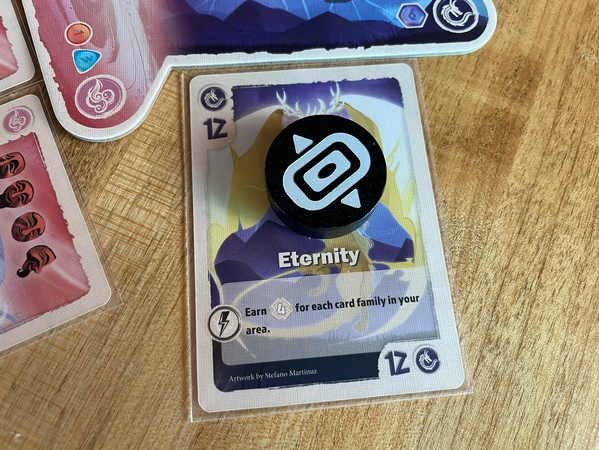
That’s all fine and dandy.
Then, in turn order, your actions are taken. You can sell (release!) a card, tame it into your hand, or summon it to your tableau.
This is where the crystals come in, and those two wonderful limitations.
Crystals are your “money” but this is definitely not an economic game.
In what economic game would you be limited into how much money you can have?
In Vale of Eternity, you are limited to four crystals at any one time (none of this “discard down at the end of your turn” BS). Sure, they can all be 6-value crystals so you have 24! Or they could all be 1-value and you have 4.
Either way, you have to pay to Summon a card from your hand.
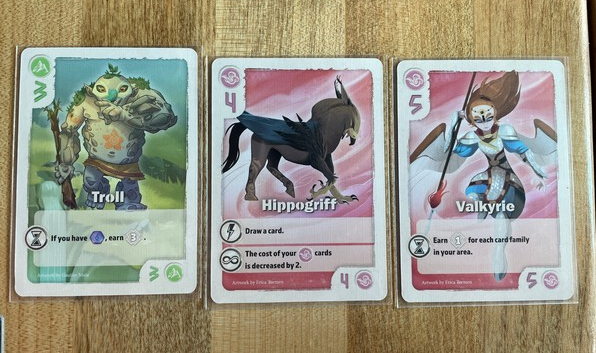
The cost is in the top left.
And there is no change.
You only have 6-value crystals and the card costs 3?
Too bad. Get rid of the 6.
If the card has a lightning bolt, then that effect happens immediately. Otherwise, it will have an effect that will happen during the Resolution phase (or perhaps an ongoing effect, like the Hippogriff above which gives you a discount on other pink cards for the rest of the game).
If you decide to sell a card, each Family has its own value of crystals that you will receive.

Remember that you can only have 4 crystals, so make sure you sell in the right order!
The pink Family will sell for a 3-chip and a 1-chip, while the reddish-brown ones will sell for three 1-chips, as an example.
Thankfully, you can do all of your taming (which just puts the card in your hand), summoning, and selling in whatever order you want, so you can try to make sure you don’t get any extra chips.
Sometimes it can’t be helped.
You can also remove a card from your tableau, but the cost for that is the current round number, so I don’t think that will happen very often unless you have crystals to kill.
It’s a thought, though.
Here’s where you get into another juicy limitation though, and where removing a card might be an idea (though I prefer to summon a card with a Remove ability rather than paying for it).
The current round number is the number of cards you can have in your tableau.
First round? You can summon one card. Doesn’t matter what you can afford.
Second round? You can summon one other card or, if you didn’t summon anything in the first round, you could summon two if you can afford it.
That requires a bit of thinking!
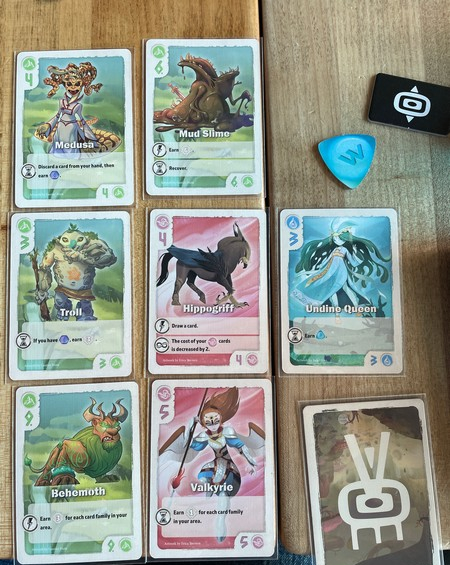
Of course, it depends on what cards come out, but typically all of the cards (or most of them, anyway) will come out at some point during the game.
It’s just a matter of deciding whether a card works for you at this particular time.
Also whether an opponent doesn’t snag it first, of course.
It’s these limitations that, to me, make the game much better than your typical card-drafting and tableau-building card games out there.
You have to actually work within those limitations in order to score successfully.
And score you will in this game, because one way that this is a typical tableau-building card game is that you are looking for those unique combinations that will build points off of each other in different ways.
After everybody has done their Action phase, the Resolution phase comes and you’ll get to trigger all of those wonderful cards you’ve summoned (the hourglass symbol on the card).
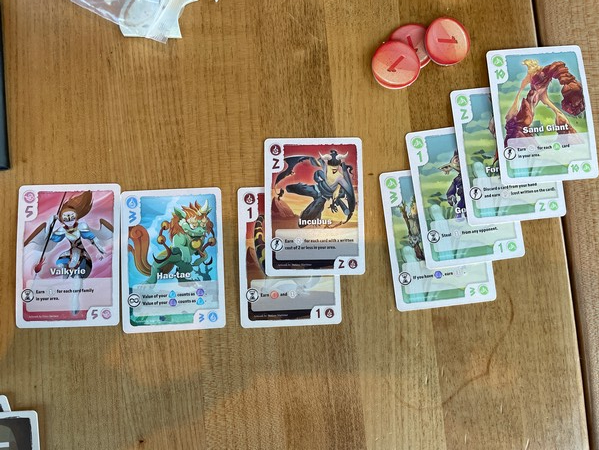
You can do that in any order, so if a card requires that you have a 6-value crystal to get points and another card will give you one, then you would obviously activate that other card first.
Thus, the points will build up.
The game goes over 10 rounds or, if somebody breaks 60 points, the game ends at the end of the current round.
I’ve played the game four times and I’ve never seen it go 10 rounds, though my two-player game did almost reach that (I think it was 9?).
If somebody gets a good tableau going, and you know somebody will, then it will explode just like Jump Drive can.
Which brings me to my one main negative for Vale of Eternity.
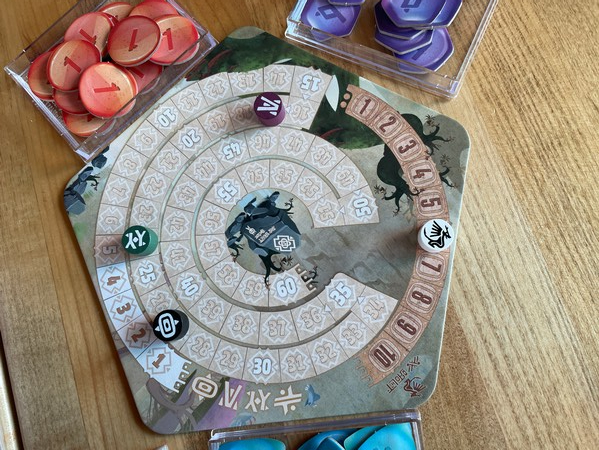
God save me from snaking scoreboards, where it’s so easy to move the points marker the wrong way!
Why do companies do this?
How many times have you had one of these games and you’re not sure what the proper score is because you might have moved Abi’s score marker the wrong way on the track three rounds ago?
I get that it’s often for cosmetic reasons, or in this case I think it’s to make score track fit on that pentagon.
But it aggravates me to no end.
That being said, the game itself is really great.
Yes, it has the DNA of a typical drafting tableau-builder.
Because of those limiting factors that make you have to really think about what you’re doing, though, that moves it a step up for me.
At an average play time of about 45 minutes (and a 26-minute 2-player game under my belt!), this makes a perfect lunch time game as well as a way to begin or end a game day.
It’s not a perfect game. There are some arguments about a couple of cards being very over-powered (I haven’t seen that yet, but give it time) and it does suffer from a smaller variety of cards so multiple plays might start to feel very similar (which I’m assuming the expansion will help with).
Some people may find it a bit rote because they don’t really care for the limitations I mention (or those limitations don’t elevate the game for them like they do for me).
But Vale of Eternity is definitely worth a try if you like tableau-building card games at all.
Especially if you like making combos!
Now excuse me while I go release that Undine Queen so that she’ll give me my reward.
I would never sell you, My Queen! Come back!
(This review was written after 4 plays)
 Dude! Take Your Turn!