Dude! Take Your Turn!
A Gaming Life
Review – Wayfarers of the South Tigris
There are games that are just complex for the sake of being complex.
The rules are really intricate, each phase has like 10 things to do, and everybody spends 10 minutes trying to figure out what to do on their turn.
Then there are games that are complex not because each turn is full of stuff, but because while you can only do one of three things, the options that you have (and which one is best to do) can really make your brain work.
Wayfarers of the South Tigris, designed by Shem Phillips and S J MacDonald, with art by Mihajlo Dimitrievski, is one of those latter games.

The game was published by Garphill Games and Renegade Game Studios in 2022.
This is the first in the South Tigris trilogy of games, all of which will involve dice in some way.
(The second, Scholars of the South Tigris), has already been Kickstarted and hopefully I’ll be receiving it by the end of the year!)
Of course, being a Garphill game, it does also have an abundance of cards.
How does this one fare, and hold up to the West Kingdom trilogy?
Let’s take a look.
If you want to skip the “how to” and go to the review, click here!
In the game, you are exploring the world from your base city of Baghdad, seeking out interesting things on the sea, on land, and in the stars.
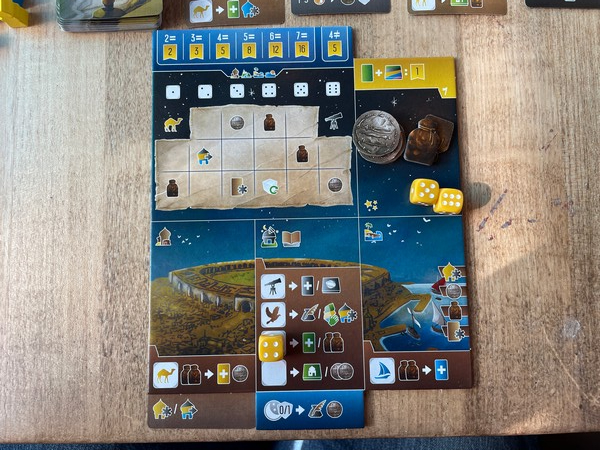
You start with a caravan that will include what symbols your dice can be when you place them, along with one city and one harbor.
The only dice to start with symbols are the 1 (Camel) and the 6 (Telescope). You can add upgrades to your caravan that will either give you more symbols (or make other dice have those symbols) or also adjust your dice.
The symbols that are on the caravan now are one-time bonuses you get when you cover them with an upgrade.
You start with three dice, some provisions and some silver. As the game progresses, you will get up to two additional dice.
The journal board is placed out in the center of the table and it will be ringed with cards.
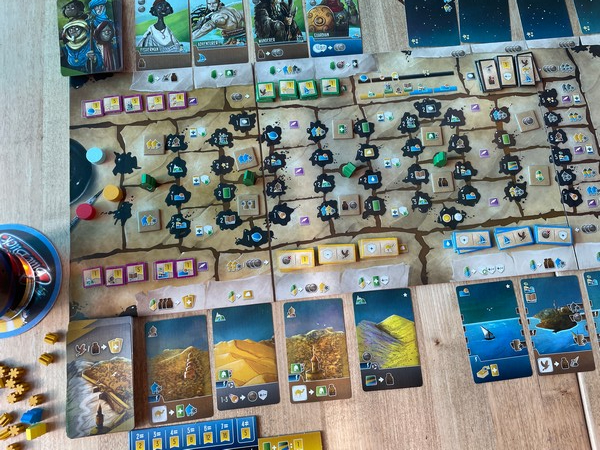
Lots of cards!
(There are also some cards off-camera on the right side)
I’ve never seen so many cards in a dice game.
Anyway, on your turn, you can do one of three things: place a die, place a worker (another Garphill staple!) or rest.

Placing a die on an action will let you do that action. Sometimes you need the die to have the proper symbol for that action, but others (like most on your main board) don’t require a symbol and can be any die.
The two actions at the bottom of the center part of your caravan (one of which has a 5 die on it already) can be any die. The two actions above those need either a pigeon or a telescope.
You can actually see in the above picture how the upgrades work when you get them.
Some actions require a camel or a ship. For this player, the “4” can be either a ship or a camel.
One of your actions will be to expand your land and sea tableau.
Doing this will let you add cards from the board into your tableau.
Land cards will go the left and sea cards to the right.
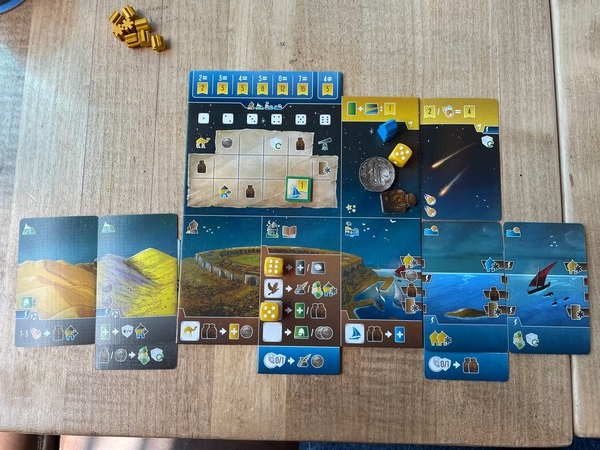
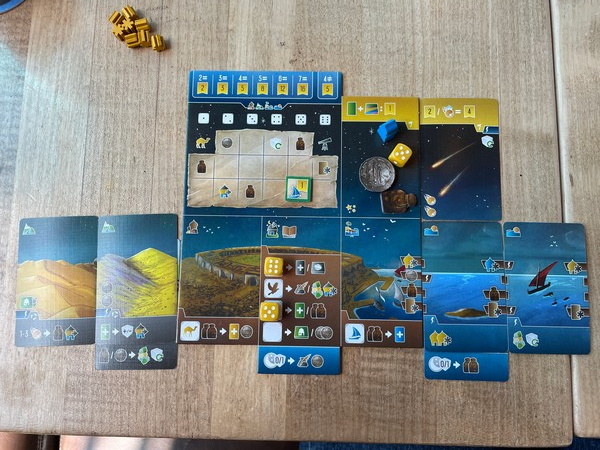
Harbors and cities give you more action options for your dice.
Vistas (the mountain symbol) will have ongoing effects when the conditions on the card are satisfied (like if you gain a City, you will also gain a provision or something like that).
Open sea cards (like the two above on the right) will give you a powerful one-time effect.
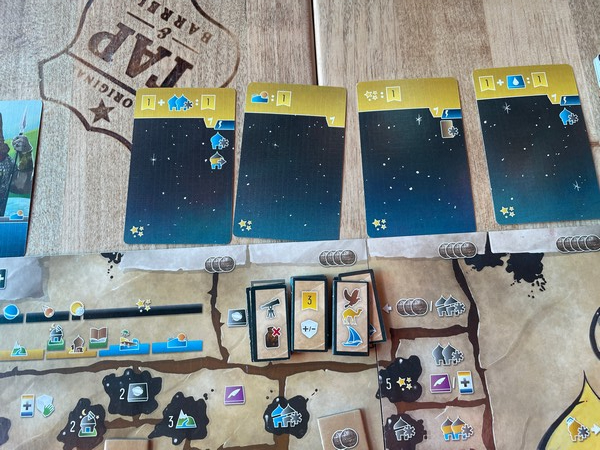
Then there are space cards you can buy. These will go above the land/sea cards that you have already explored (you can’t look up into the sky until you have actually reached that spot) and they will give you endgame scoring possibilities.
You can hire townsfolk that will modify your tableau cards.

Some will give you symbols for the action they are placed under. Others will give you Rest actions, and some will give you even more stuff when your Vista activates.
Each townsfolk will have a symbol indicating which type of card they can be placed under. You can’t hire a townsfolk unless you have the proper tableau card to tuck them under.
While I’m talking about cards, lets talk about the Guilds.

Guilds are places where you can place influence and use that influence for certain effects.
You can spend a blue influence to make any die a ship icon, useful for exploring the sea.
Yellow guild influence will let you adjust two dice +/- 1 (or one die can be adjusted twice).
Black influence will let you journal an additional time after your first journal (more about that in a minute).
Having majorities in these guilds at the end of the game will also give you 3 points.
Your second action option is to place a worker on a card in order to take the action where that card is currently placed.
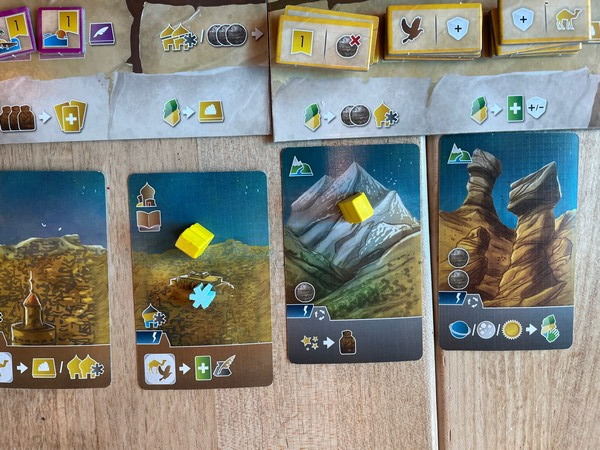
Placing the yellow worker as above on the right will let you gain two silver and gain one yellow guild influence.
Some actions/effects will let you place influence on cards. When anybody interacts with the card that has your influence on it (placing a worker, gaining it, removing the worker), they have to give you a silver or a provision (like the one on the left).
If you take a card with a worker on it, you also gain that worker.
Thus, workers are never “owned” by any player. They are only being rented.
Your final action option is to Rest.
Resting will let you reroll all of your dice.
Also, if you have 0 or 1 die remaining to use, any Resting actions will be triggered.
The default one is on your caravan already. It gives you a silver and lets you journal.
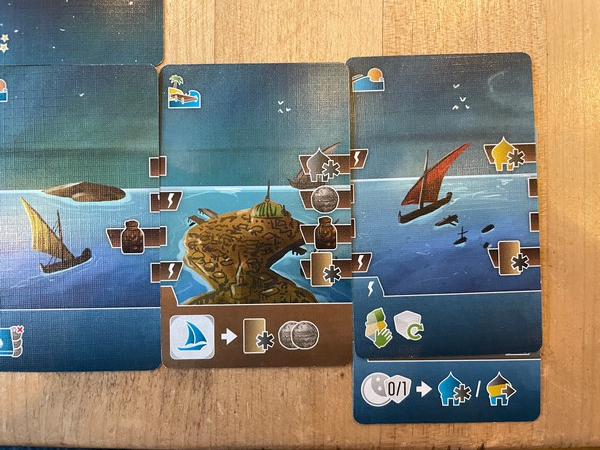
Other Resting actions are gained from tucking an appropriate townsfolk card under an open sea card in your tableau.
Above, this townsfolk will give you a blue guild influence or let you move an influence from one guild to another when you rest with just one die, or no dice, remaining.
What is journaling?
That’s the game clock, and it will also gain you benefits as you advance on it.

When you journal, you move your disc to the next adjacent spot on the journal board.
That’s assuming you meet the conditions of it, though.
For the purple disc to advance, the player either needs to have one blue upgrade in their caravan (to advance to the same space as the blue disc) or one green upgrade (to advance along the bottom path).
You have to be careful as you make your way through the journal.
It’s possible to get stuck if you haven’t planned well, unable to advance because you don’t meet any of the requirements.
That being said, you don’t need to reach the end of the journal track in order to win the game.
It does help, but it’s possible to accumulate a lot of points without journaling.
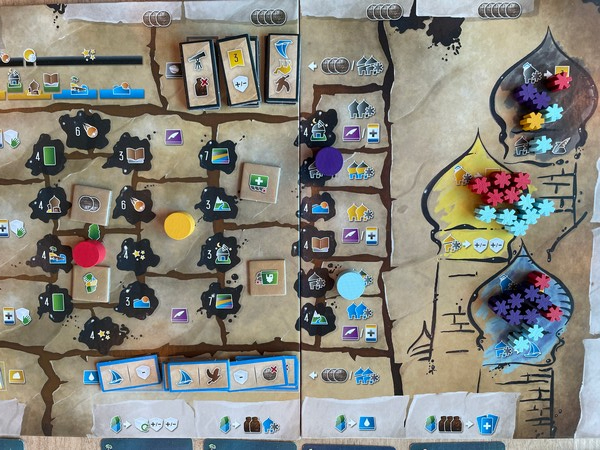
When somebody reaches the end of the journal, that triggers the end game. Each player (including the player who triggered it) gets one more turn.
You gain points for sets of main icons (vista, city, harbor and open sea), guild majorities, space cards and upgrades (along with Inspiration cards that have been gained that could modify your space card points).
Total up all the points you’ve gained and whoever has the most is the winner!
Did Wayfarers of the South Tigris find a beautiful oasis in the desert? Or did it get buried in sand, never to be seen again?
Before I say anything else about Wayfarers of the South Tigris, let me warn you right now.
This game is big.
Bigger than this review is long! And that’s saying something.

You will need a fair amount of table space in order to play this. The table needs to be either wide enough to accommodate the journal board and cards and then players underneath those, or long enough so the journal board can be out and then each player can expand on the four corners.
And if you explore a lot, your tableau will be quite long.
It is a table hog!
It’s also quite large in its decision space.
While you only have one of three actions, your choices will multiply as you play the game.
Analysis paralysis is a definite possibility.
But there is so much I like about this game, and much of it boils down to the choices and the avenues you can take to try and score points.
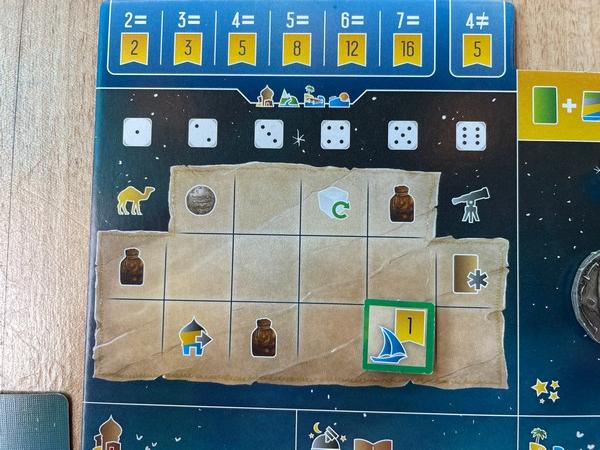
You get so many points for cards having the same basic icons (city, harbor, open sea and vista). But you also get 5 points for each set of four unique ones.
Can you get seven vistas? Then you’ll get 16 points! But you won’t have a lot of actions because vistas don’t give you action options.
Seven cities would give you seven different actions, but you only have so many dice to use and you won’t have any effects and little water.
It’s all on what you want to do and how the cards come out.
My last game, I got three sets of unique icons, giving me thee points for each icon (having three of the icon gets you three points) and 15 points for the sets.
But you may not be able to do that.
And then there are the space cards.

That’s another choice you have to make.
Or you can just get a bunch of them. The reason I did so in this case was because one of my space cards earned me a point for each stars space card.
The options are quite varied!
I think that’s one of the things MacDonald and Phillips do best; give players multiple avenues to score.
One thing I didn’t mention above were the inspiration cards.

These are placed above a space card.
If you meet the conditions on the inspiration card, then it doubles the reward for the space card it’s above.
For example, the leftmost card gives you that bonus if you have three planet space cards.
More choices!
The dice mechanic in the game is quite solid too.
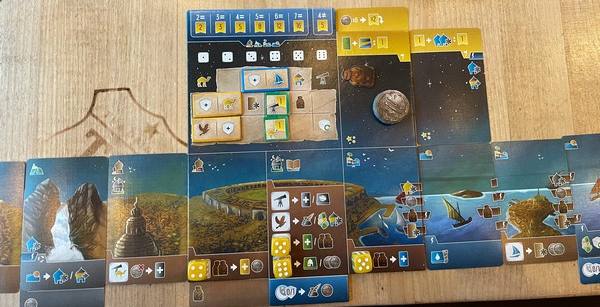
You can place upgrades in your caravan to help you manipulate your dice, or just make sure that your dice have the appropriate symbols.
The upgrades shown above, a 1 can be a camel & pigeon, or you can add one to it to make it a 2. For the 2, it can be a camel, or you can add one to it to make it a 3.
The blue upgrade will then let you make the 3 into a 4, and the four can be a ship, a telescope and a camel.
So basically you can do almost any action with a 1-4.
Any good dice game (that’s not a complete luckfest, anyway), needs a way to manipulate the dice. Between caravan upgrades and your yellow guild influence, there are plenty of ways to get the dice numbers you want.
You just may have to work at it a bit.
I also really enjoy how the townsfolk work in this game, having to be placed under one of your land/sea cards and then modifying how that card works.
It’s an ingenious way to keep townsfolk in the game, which I think they really want to do.
They seem to like townsfolk.

Which brings me to the whole worker aspect of the game.
Placing workers on cards to get the action of the card space works really well.
As cards are gained and moved to fill empty spaces, the action that the card represents changes.
Placing a worker on the Vigilante above lets you get a free green upgrade.
However, if somebody gains the Merchant, suddenly the Vigilante’s action is to gain one influence in all three guilds.
And I like how the workers are only temporarily yours (unless you hoard them, Sarah). Once you place a worker on a card, it’s no longer yours.
It will belong to whoever gets that card.
That’s so neat.
Journaling is the one thing that can really make or break this game, though. It is the clock and it also can get you a bunch of stuff.
But the fact that you have to be careful to make sure you can meet future requirements to advance means that new players really have to be reminded of that.
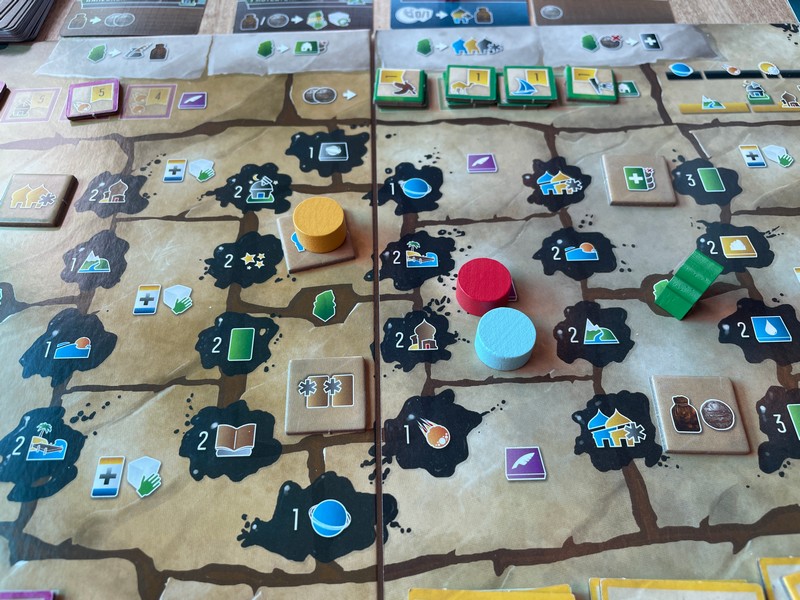
It can get frustrating if you find yourself stuck, even though it is possible to win without it.
The other thing to be aware of is the game length.
I’ve played it at 3 and 4 players, and it has always taken 2-3 hours. Be ready for a 3 hour game, just in case.
Sometimes that’s not what I want, so this game won’t get played that day.
But other times, I don’t mind that and the game is so compelling for me that the time just flows by like a nice, quiet brook.
What about the components?
I like that it doesn’t have the basic colours so often used in games.
Player pieces are purple, yellow, light blue and red.
The artwork is, as always, great. I love the Mico’s work usually and this one is no exception.
The journal boards are double-sided, giving you a bit of variety.
Each caravan is just slightly different but not really noticeable.
The insert for the box clearly shows that at least one expansion is coming as not all of the slots are used.
Is that a good thing or a bad thing?
I think what I like so much about this game is just how well all the mechanisms go together.

The dice rolling, the tableau-building, the worker placement (and rather unique worker placement mechanics at that!), it all gels into a nice stew with almost perfect seasoning.
Has this taken the place of Viscounts of the West Kingdom in regards to my Garphill Games ranking?
Maybe…I’ll need a few more plays to make that choice.
But it’s definitely up there.
If you have the time (and the table space!), give Wayfarers of the South Tigris a try.
You might just find that you’ve discovered a desert treasure trove.
(This review was written after 4 plays)
 Dude! Take Your Turn!
Pingback: October 2023 Gaming – Dude! Take Your Turn!
Pingback: Review – Scholars of the South Tigris – Dude! Take Your Turn!
Pingback: Top 50 Games Played of All Time – 2024 Edition (#10 – 1) – Dude! Take Your Turn!
Pingback: February 2024 Gaming – Dude! Take Your Turn!
Pingback: March 2024 Gaming – Dude! Take Your Turn!