Dude! Take Your Turn!
A Gaming Life
New to Me – June 2023
June has been a busy month, and not seemingly conducive to getting new board games played.
We missed a Sunday game day (Father’s Day) and for two of the other three Sundays, our main “new games” guy wasn’t able to come.
However, we maximized that one date to get three games in and we had another day where another guy brought a game that I had been wanting to try for a while.
Add a new solo game to the mix and we have five new to me games in June!
I’ve learned to try and get multiple new games in when I have the chance, at least until I’ve played a few. After that, game days can concentrate on old favourites.
I don’t want any more of these monthly posts to only have one game in them.
However, the Cult of the New to Me members were not necessarily happy with me. All of the games were from 2022 or 2023.

Who knew that Good Old Joe was a board gamer?
Hey, one of the games is a reskin of a 1998 game.
Doesn’t that count?
So without further ado (all of my ado was dug up by some nitwit evolutionist and sent to a museum anyway), let’s get started!
Darwin’s Journey (2023 – Thundergryph Games) – 1 play
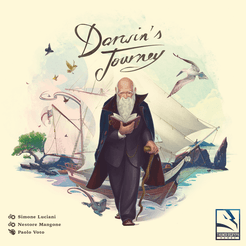
Designers: Simone Luciani, Nestore Mangone
Artist: Paolo Voto
Players: 1-4
Darwin’s Journey has a story about getting to the table in our game group.
Two of our members finally received the Kickstarter delivery of it, and mentioned it on our Discord channel.
But then they weren’t able to come for like 3-4 weeks!
Finally it managed to make it into the same room as us so I jumped on it.
I had heard some really good things about it.
It is kind of a standard worker placement game, but there are so many choices in it!

You are, of course, wandering around the Galapagos Islands trying to document and study the evolution of animals. You are also, of course tracking your theory of evolution as you go about doing this. And you want to publish, of course!
But you also want to travel among the islands.
You can’t do everything (which is like most of these types of games) so you have to try to concentrate on a couple of things.
While this is a standard worker placement game in many ways, one of the ways it is different than a lot of games is in the manner that you can power up your workers.
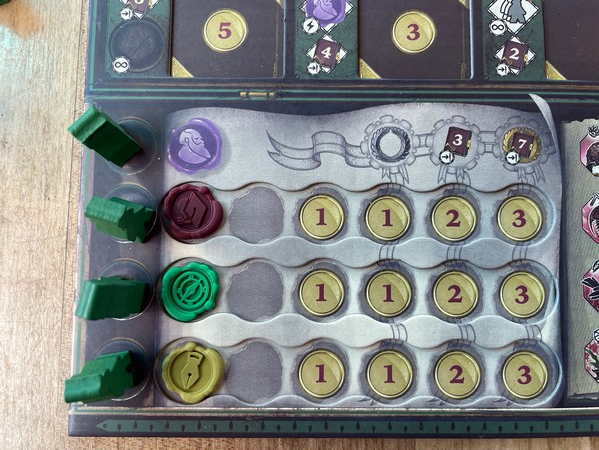
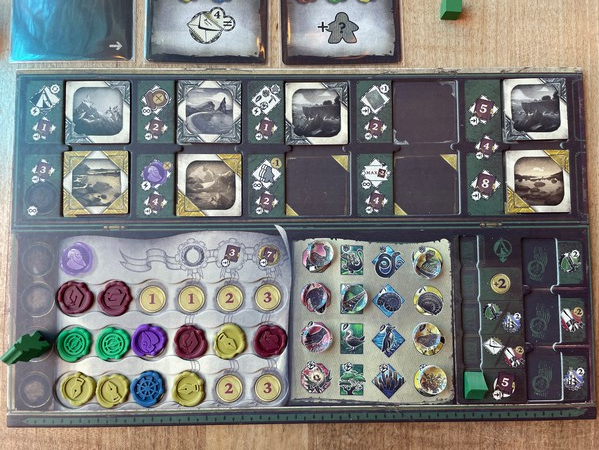
Each of your workers has a track on your player board.
You can train them using an action, which will allow you to buy wax seals (education, I guess?) that you then place on that worker’s row. This can make them more powerful when they do actions, but it also makes it so they can satisfy certain action requirements.
For instance, an action might require a worker who has two red and two green seals on it before you can do it.
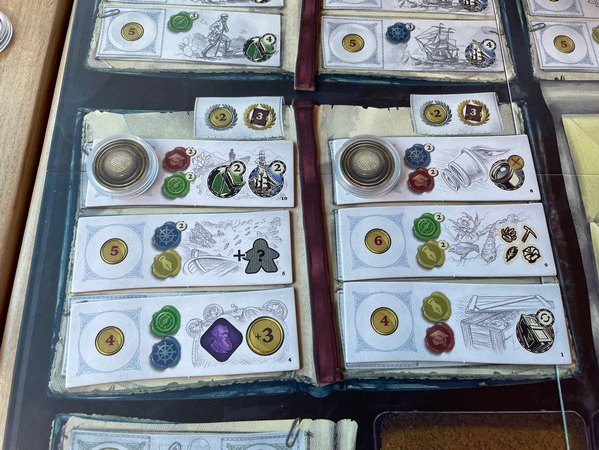
These actions will let you do more, but it will cost you because of that seal requirement.
Another, not necessarily new mechanism, but used in an interesting way, is the whole diary aspect of the worker placement.

Each action area is divided into diary pages.
The first action on one of these pages is free, but to take a subsequent action on the same page costs you some money.
Even better is the whole “lens” thing for opening up actions.
There is an action space to let you put a lens on a locked action. This opens the action space up for everybody to use.
However, if anybody uses it, since you unlocked it, you get a coin!
Since money is kind of tight, that’s pretty cool.
You can see how the lens thing works in the above picture.
During your travels among the Galapogos Islands, one thing you will get is animal specimens that work toward proving the Theory of Evolution.
Another action you can do with those specimens is to deliver them for study.
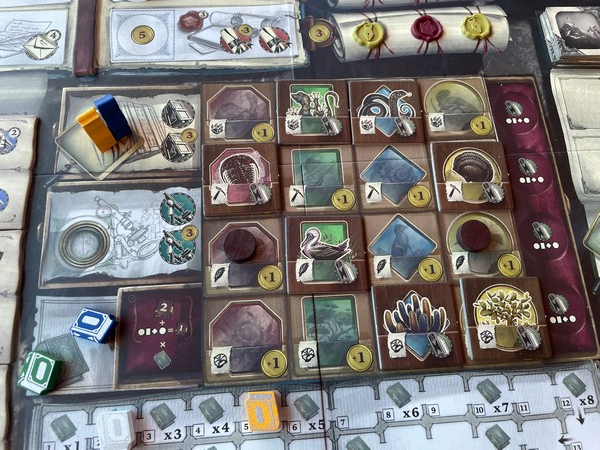
Doing so gets you Evolution marker placements and money. You look at the row and column that you placed your specimen in. The more specimens already there, the more Evolution markers you get. The fewer specimens, the more money you get.

Evolution markers move along the track and will get you a bunch of points at the end of the game for specimens delivered depending on how far along the track you’ve moved.
The further you move, the higher the point multiplier.
There are a bunch of other things going on. Sending correspondence back home that, if you have the most at the end of the round, will give you bonuses. Objectives and Crew Cards that will make your abilities more powerful or give you more options.
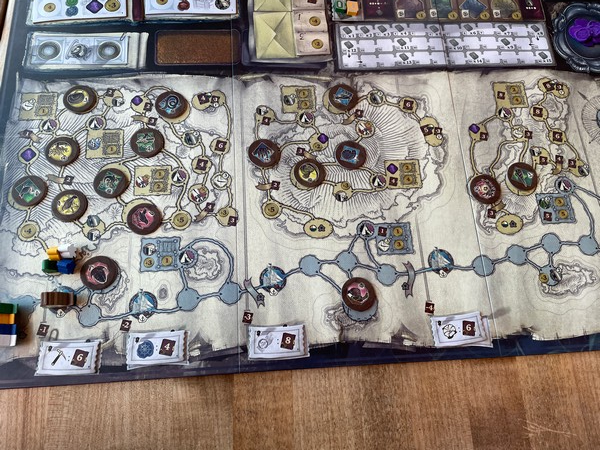
And there’s moving your ship to follow the Beagle (Darwin’s ship) along the bottom track. You have to keep up with the Beagle or your end of rounds points will be negatively affected.
The game is played over five rounds. Points are then added up for objectives and crew cards, the Evolution track, leftover coins and leftover Temporary Knowledge tokens.
Whoever has the most points is the winner!
There is so much to this game, but the first thing I have to say is that this game is beautiful to look at.

It has a very rustic, late 19th century look to it, but the artwork is top notch.
The board is very cluttered, but not in a bad way (unless you’re like my wife, who would call this game “too busy”). Everything is clearly set out, but it is a bit overwhelming sometimes.
The teach on this can take a while!
There’s so much stuff in it.
It’s definitely interesting but it’s also a bit intimidating. You can very easily find yourself dabbling a little bit and not really getting anything accomplished. You have to concentrate on a couple of things (while dabbling in the rest) or you won’t succeed.
The cool thing with our play was that three of us concentrated on different aspects of the game and we all came within 7 points (the fourth player was a ways back). The final scores were 120-117-113 (I had the 117).
This is a fun game that I would like to try again.
Pollen (2023 – Allplay) – 1 play

Designer: Reiner Knizia
Artist: Beth Sobel
Players: 2-4
Pollen is a new/old game.
What do I mean?
It’s a 2023 game, but it’s a complete reskin of Knizia’s classic Samurai game, just rethemed for bees and beetles and such.
So this actually counts as a 1998 game, right Cult members?
Anyway, it’s a very simple game.
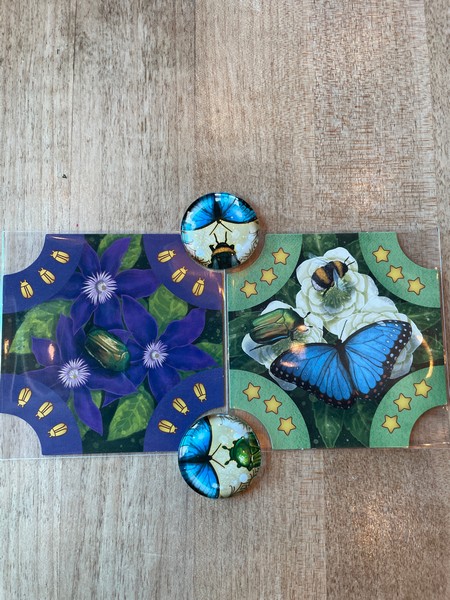
In it, you are playing flower cards (not tiles, like the original game) in a grid to try and attract one of three types of insect to them: butterflies, beetles, and bees (it’s the three B’s!!!!).

Sorry.
Ok, they are called “pollinators”.
When you play a card, you are trying to gain influence with one of the three pollinators.

Cards will either give you influence on a type of pollinator or they will have stars, which are wild.
When a circle is finally closed with a card play, you check each pollinator on the token and see who has the most influence with it bordering the tile. So the lone blue butterfly above, purple and indigo (?) have the most butterfly influence. Green has one (the star) and the other purple card doesn’t help since it has beetles on it.
The winner gets a scoring token for that pollinator.
With ties, nobody gets a token.
When a pollinator is scored, the player who placed the card puts the new pollinator token out (the next one coming is already known so there’s no mystery).
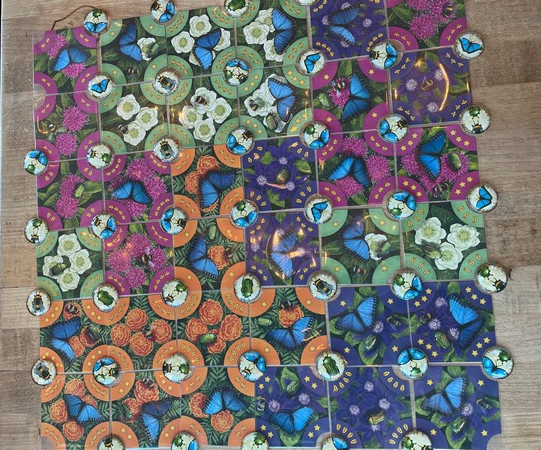
When all pollinator tokens have been placed or one of the pollinator scoring tokens runs out, the game ends.
In classic Knizia fashion, scoring is a bit strange.
If anybody has the majority of two of the pollinator tokens, they win!
If not, then all players who have the majority of one of the pollinators are eligible to win.
Then players who qualify to win set aside the tokens that qualified them and count the other tokens won.
Whoever has the most is the winner!
This was kind of an interesting game, but it’s not going to be a favourite. It’s something I’ll willingly play but I doubt I will suggest it again.
Each player has their own deck of cards (they’re all the same, though) and you draw cards into your hand to give you the choices to play on your turn.
It’s ok. I found it a bit tedious overall, the card plays obvious, but further plays might alleviate that.
But it is a perfect lunchtime game!
Order Overload: Cafe (2022 – Oink Games) – 1 play

Designer: Jun Sasaki
Artist: Jun Sasaki
Players: 2-6
Order Overload: Cafe, however, is definitely not a game for me.
It’s a memory game, which I am terrible at. My memory is not great at the best of times.
It is a cooperative game, so there is that.
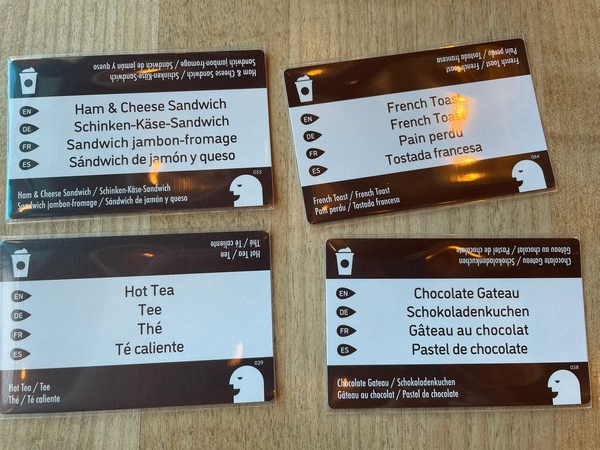
Order cards are laid out based on player count.
Everybody looks at the cards and tries to memorize them.
Then they’re shuffled and dealt out to all players.
In turn order, somebody names one of the menu items and whoever has that card in their hand places it on the table. (I think, though I am not sure, that if multiple people have it, it’s done in turn order).
As soon as somebody is wrong, they are out of the round.
The round ends if everybody is out or if a certain number of people are out of cards (I can’t remember what that is based on player count).
If everybody’s eliminated, the game ends!

If the round ends with people still playing, go to the next round, where it gets harder. More menu items to remember! All players are back in again.
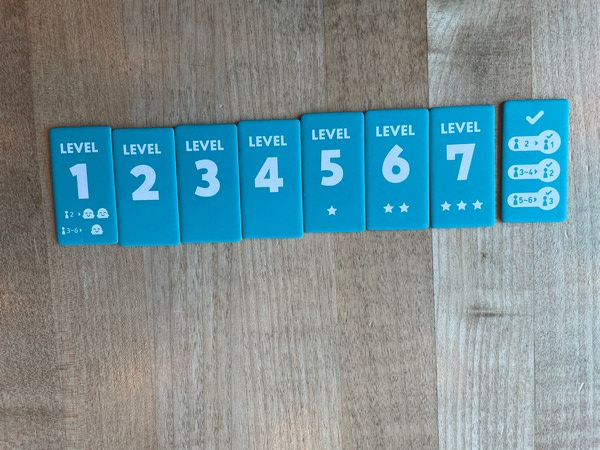
Each player has one of two special powers that they can use. I’m not sure if it’s once per game or once per round (I think once per game).

This can make it easier, possibly.
Memory games.
Sucky memory.
This game is not for me.
But I think we made it to round 5! (I forget)
If you like memory games, you’ll probably like this one, though.
Skies Above Britain (2023 – GMT Games) – 2 plays

Designers: Jerry White, Gina Willis
Artists: Antonis Karidis, Mark Simonitch, Jeremy White, Gina Willis
Players: 1
Now we get to the solo extravaganza from GMT Games known as Skies Above Britain.
People who read this blog know that I love Jerry White’s game, Storm Above the Reich, where players are running a German Luftwaffe squadron of fighters trying to fend off Allied bombers from bombing Germany.
Skies Above Britain (co-designed with Gina Willis) ups the ante on that game to 11 (or maybe even higher, if Spinal Tap had any imagination)!
In Storm Above the Reich (and its sister game), you are basically assigning fighters to attack an already-discovered fighter formation. You may have to deal with Escorts, but you’re dealing with individual planes (or counters, anyway) and you are automatically swarming through the bomber formation.
You also are told at the beginning of the mission whether or not the bombers are incoming, over the target, or heading home after already dropping their bombs.
Skies Above Britain has you, as British fighter pilots during the Battle of Britain, taking off to meet the bomber formation, hoping that you get to them before they drop their bombs.
It’s a lot more detailed as well.
There are a bunch of different phases in the game depending on how things work out. You can be dogfighting with German fighters, you can be intercepting the bomber formation, or you can be chasing it/meeting it.
The programmed instruction method of teaching all facets of the game works really well in teaching you the game.

You start with a squadron of 20 planes, of which you can send 12 up on any given patrol.
The 12 pilots will be divided into four squardons, which you’ll put on your squardon board.

You’ll be intercepting fighters and bombers as squadrons, or as whole formations (multiple squadrons)
On a patrol, you will have shuffled a number of Raid Vector markers and sorted them into the bombing raid. You turn over all of the Vector markers in a segment before trying to engage the bombers (though certain Vector results might let you engage sooner).

Once you have engaged the formation, you go to the Intercept map.

Here you will find out what kind of Escorts you have to deal with.
You can then order your formations/squadrons (depending on how many fighters you want doing each task) to try and intercept the bombers or maybe try to eliminate/suppress the fighter escorts.
Engaging the fighter escorts will results in dogfights, where either you have the advantage or perhaps the Luftwaffe does.

Combat in the game is card-based, just like White’s other fighter games.
In this picture, Yellow Squadron was jumped by a couple of Me-109 German fighters. They try the “Slip” maneuver (you only do maneuvers when you have fighters behind you) and draw a card.
In this case, the Slip didn’t work but the 109s disappeared, Yellow Squadron had to spend a fuel, and one of the three fighters took a hit.
You can either have Spitfire or Hurricane British fighters, and there is a deck of cards for each one. For each one, there is a deck for facing Germans head-on and tailing them as well as a deck for being tailed, each with different combat results.
The bombers are shown by bomber tiles, as outlined in the scenario you’re playing (each scenario has randomized tiles).

If your fighters intercept the bombers, you send your fighters after individual bombers.
For each fighter attack, you draw a card (there is a deck for Medium bombers and a deck for Light (Stuka) bombers) and based on what you are attacking (a tile adjacent to other tiles, an isolated tile, or maybe even an isolated bomber!), you look at that column.

Damage results (for both bombers and what you take from defensive fire) are applied and maybe you’ll destroy a bomber!
Or maybe one of your fighters will take a hit that knocks them out of the fight.
This all continues until either all of your pilots are out of action or they have returned to base (it is really easy to run out of ammunition and decide to return to base).
After the mission, fighters that took hits that put them out of action have to roll based on what type of hit knocked them out to see what happens to them.

They could land safely, they could crash or catch fire. If crash/fire, they could bail out (meaning they can’t join the next mission), they could be wounded, or they could die!
There is a lot more to this game, but I don’t have room to talk about it all.
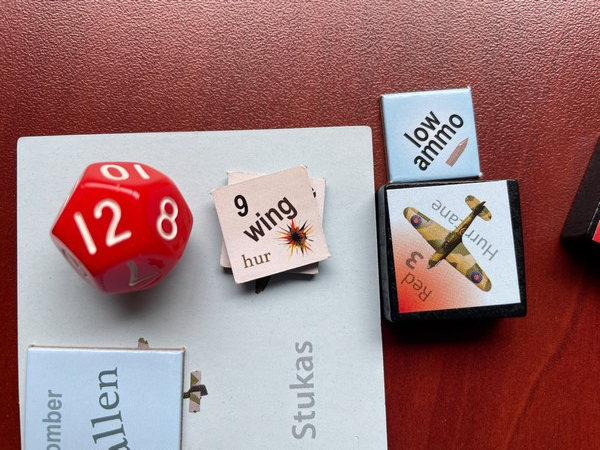
I’ve done two patrols so far (AARs will be coming at some point) and I am really enjoying this game.
However, it can be really complicated to get right at times.
Even going through the scenarios to learn the mechanics, I had the rulebook open and was paging through a lot in my first two missions after doing the scenarios.

I do have to say that the main player aid card is really helpful in this respect. Sorry I don’t have a picture of that.
So far, this is an amazing game. I won’t be doing a review until I get at least 3 missions in, and the next one won’t be until I return to work, so look for that in August some time.
For now, though, this is a great solo game, even better than Storm Above the Reich.
Smartphone Inc. (2018 – Arcane Wonders) – 1 play

Designer: Ivan Lashin
Artist: Viktor Miller Gausa
Players: 1-5
Smartphone Inc. is a game about producing and selling cellular phones around the world.
It’s basically a points/economic game with the world divided into regions that you are going to be selling to.

On your turn during each round, you will be secretly setting up the turn ahead, rearranging the pieces with icons on them so that you have the icons showing that you want to show.

These could include other tiles that you have produced during the game.
These icons will either set the price of your phones (the default is $5, but the +/- $ icons will raise or lower your prices), or maybe research that will let you add new technologies to your phones. They can just produce more of your phones, or maybe help you expand into other markets.

Researching will allow you to place research tokens into various technologies to give you a special ability, plus the ability to sell phones with that technology into markets that want them.
Not only will battery technology allow you to sell into markets that want that, but in this game (the research tiles are randomized), it will also give you one token to place into a new market for each “+$” icon in your grid each round.

Expanding into markets will give you more opportunities to sell.
If you are in South America, they want cheap phones! (the red number is the maximum amount they will pay for a phone) but they also want location technology, game controller tech, or battery tech. If you’ve researched that tech, you can sell your phones there no matter how much you are charging.
There is an interesting push/pull mechanic in this game, because the higher your prices, the more money you will make for each unit sold, but you will sell later in the turn. This gives those selling cheap phones a chance to flood the market.

Hopefully you’ve produced just enough phones for the markets you can service, because if you have goods left over at the end of the round, they go away (unless you have a technology that lets you keep them).
There’s also possibly (again, they are randomized) a technology that lets you sell three units without having a market for them.
This is good if you have produced too much, but it doesn’t help you with area majorities.
At the end of each round, depending on how many players are in a market, whoever has sold the most phones in each market will get a certain number of points.
But the money you sell the phones for is also points, so if you can find the market for them, selling fewer phones at a high price is almost as good!
At the end of the game, whoever has the most points (which again, money earned during the game is points as well as gaining points in other ways) is the winner.
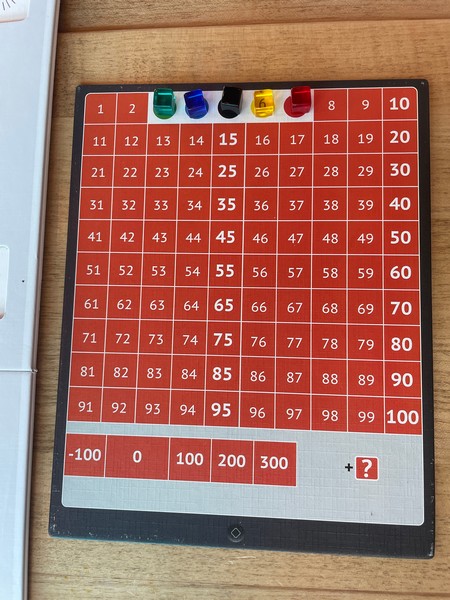
I really enjoyed this game, but it’s not a game I would want to play too often, or at least not too many times in a short period.
It has the same math calculation game play that Power Grid has, especially in the last round or two where you are trying to figure out the best way to spread your markets and which markets you are going to sell to.
It’s fun, and I really did like it, but too much of that in a short period of time just short circuits my brain.
I’d definitely suggest giving this one a try!
If you don’t mind math.

So what new to you games did you play in June?
And what do you think of these games? Have you played any? Hate them with a red hot passion? Love them to death?
Let me know in the comments.
 Dude! Take Your Turn!
A lot of new games! I still need to play my copy of “Darwin’s Journey” and waiting for more reports on “Skies above Britain”.
LikeLiked by 1 person
I haven’t decided whether to do a review of Skies prior to any AARs so I don’t have to explain how to play, or whether to jump into,the AARs even though I have to explain a bit more.
LikeLiked by 1 person
Pingback: 5 on Friday 07/07/23 – No Rerolls
Pingback: Friday Night Shots – Tiebreakers – Dude! Take Your Turn!
Pingback: Top 50 Games Played of All Time – 2024 Edition (#40-31) – Dude! Take Your Turn!