Dude! Take Your Turn!
A Gaming Life
Review – Paladins of the West Kingdom
This review has been a long time coming.
I first played Paladins of the West Kingdom back in 2019, and actually had played it three times by January 2020 (for most games, especially longer, more complicated games, I want to play a game at least three times before reviewing it).
And then the pandemic hit, isolation caused my mental health to plummet, and I never wrote the review.
By the time I was thinking about writing it, it had been so long since playing it that I didn’t think it was fair to do it.
Now, however, I have played it five times this year and thus here it is!

Paladins of the West Kingdom is a game designed by Shem Phillips and S J MacDonald, with artwork by Mihajlo Dimitrievski. It was published in 2019 by Garphill Games and Renegade Game Studios.
It’s part of the West Kingdom trilogy of games, and the last one that I haven’t reviewed yet!
Back in 2022, when I did my Top 25 Games Played of all time, it had fallen down to #25, partially because it had been so long since I had played it. There were a few other reasons too, but I wanted to revisit the game and see what happened.
Will my Top 25 change as far as the West Kingdom games go?
Let’s just say that there is the possibility of some movement when I do another Top 25 next year.
Or maybe not!
What do I think of it now?
Let’s take a look.
(Click Here to skip the “how to play” and get to the meat of the review)
In Architects of the West Kingdom, you’ve built this lavish city for the king, gaining prestige and being the envy of architects everywhere in Europe.
In Paladins of the West Kingdom, you are using the paladins that the King has sent you to help in defending that city, fortifying it, establishing garrisons in the surrounding areas, and defeating outsiders who may be coming to take it all away from you.
Or you could also be converting them to your cause, sending out monks to spread the good word, and absolving yourself of the sins that you’ve committed (or the corruption you’ve gained). You are also building up your city even more to make all of these tasks easier, and recruiting townsfolk to help you in your task (or possibly even sending them out on quests).

The game goes over seven rounds. The first three rounds, you will receive a King’s Order that will tell all players what the King wants you to do to gain victory points. Starting with Round 3, there will be a new King’s Favor every round that will give players another unique action that only they can do.

Each player will have a player board where all of their garrisons, commissioners and absolve tokens will be. Along with the action spaces to use all of this great stuff.
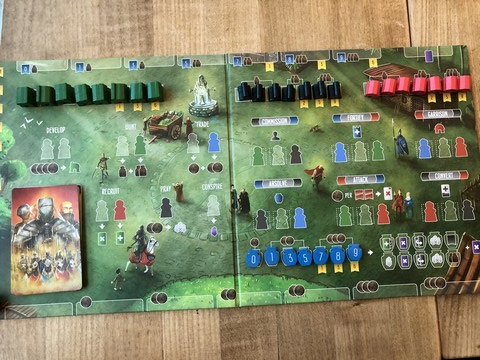
Actions require workers. This is a worker placement game, right?
No!
Well, not exactly.
You will be placing workers on your turn, but you don’t start with any.
How do you get them?
You go to the pub, of course!
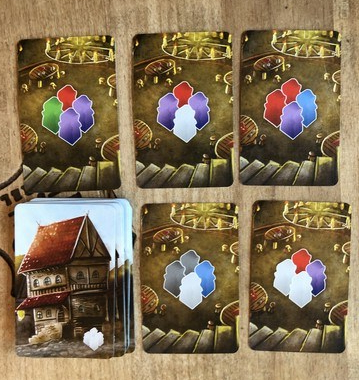
Each round, in turn order, you will be drafting four different coloured workers from the pub, as shown on the available cards.
You will also be choosing a Paladin from your deck of Paladins to play this round. Without promo paladins, you will be playing one Paladin, placing one on top of your deck, and one at the bottom of your deck. (With promo Paladins and with the expansion, that changes somewhat).

This Paladin will also give you two workers and also a bonus for the round.
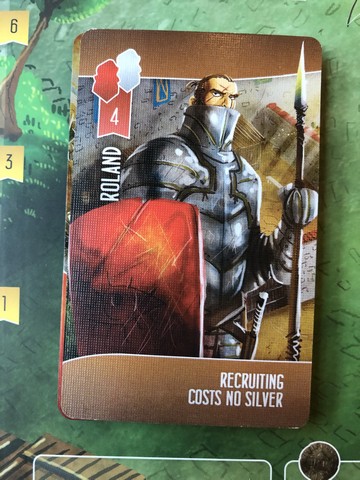
Roland will give you a red and white worker and also make it so recruiting townsfolk to help you won’t cost you any silver this round.
He also gives you a temporary strength boost of 4, but I’ll get to that in a minute.
Once everybody has workers, starting with the first player for the round, players will take turns playing workers to actions on their board (or the King’s Favors when they are out).

Each action usually requires two different coloured workers and then a worker that can be any colour.
The Garrison action above requires a blue worker, a red worker, and any coloured worker.
However, you can make these actions cheaper by “developing” your city, building houses that will take up one of the worker’s spaces and make it cost fewer workers.
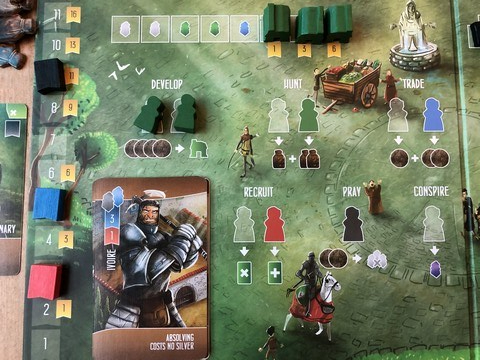
The good thing about developing is that it always gives you another worker (though it costs two). You will always gain the reward shown when you remove something from your player board.
When you do the Commission or Garrison action, you will be placing a piece out on the main board, depending on your Strength or Faith level, taking up one of the spaces so nobody else can go there. These will give you a bonus or some kind.

You also gain attributes, which is kind of the point of the game (or one of them, anyway).
Players have three attributes they are trying to increase by doing these actions: Influence (blue), Strength (red) and Faith (black). These are on the left side of your board.
To do each action will require a certain number of one attribute and it will get you a boost in another one.

For example, Commissioning requires a certain level of Faith (black) depending on where you want to put your monk. However, it will always give you one Influence (blue) boost.
Fortifying requires a certain level of Influence but will always give you at least one Strength (red) boost.
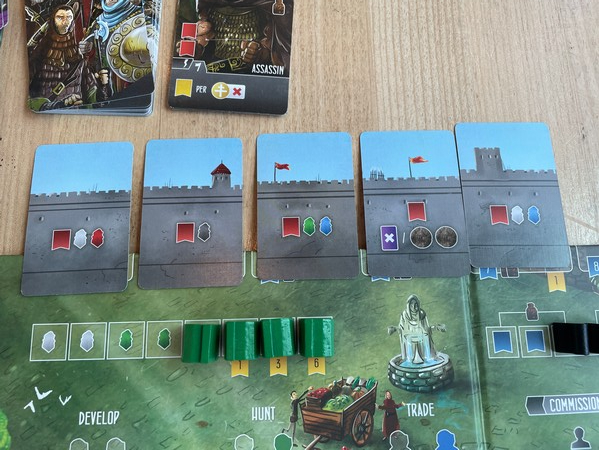
These actions will also cost either provisions or silver (unless your Paladin says otherwise) so you have to keep that in mind too.
You can also hire (or dismiss to go on a quest) townsfolk.
If you hire them, their abilities will benefit you the rest of the game (as long as you do the action, of course).
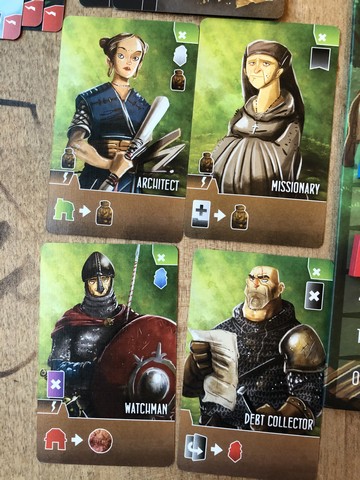
If you dismiss them, you get the benefit on the top right of the card and they go away.
If you hire them, some do have an immediate effect as well (the lightning bolt right above their effects).
Outsiders are coming to your town, and you can either defeat them (that was mean of you!) or convert them (which will give you endgame victory points).
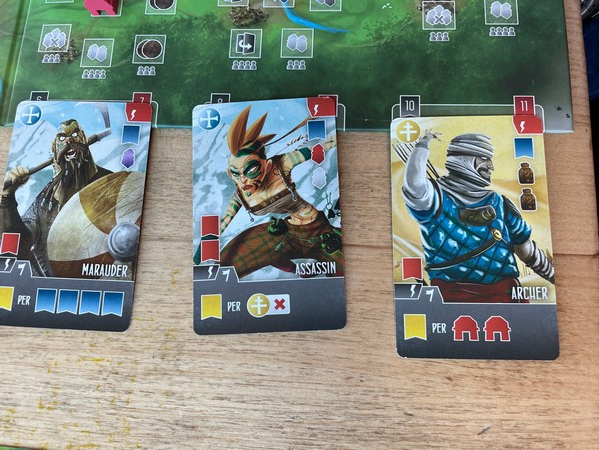
Attacking them will get you the immediate bonus at the top right of the card (which always includes at least one Influence).
Converting them will give you Strength and then points (the Archer gives you one point per two Garrisons you’ve deployed).
It’s all very intricate.
Of course, you can hire Criminals (purple workers) as part of your tavern run, or maybe by spending a worker to Conspire.

Criminals will give you a Suspicion card, which will possibly give you some tax money. There will be a certain amount of tax money out on the board depending on player count.
Once that runs out, there will be an Inquisition. Whoever has the most Suspicion cards will gain a debt and discard half of their Suspicion cards (rounded down, so you can never get rid of your last one this way).
At the end of the game, everybody totals all of their points and whoever has the most is the winner!
There is, of course, a lot more to the game, but that’s the basics.
Is Paladins of the West Kingdom a visitor that you’re always excited to see? Or is it like a visit from the in-laws?
One of the keys to Paladins of the West Kingdom is those attribute tracks.
It’s good that the actions on your action board tell you what attribute you need to use and which attribute will be improved when you do the action.
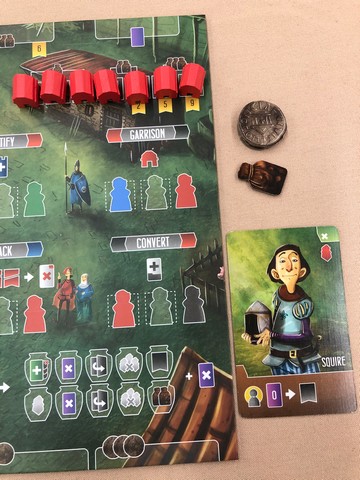
(though to tell the truth, some people still never figure that out)
I do love the intricacies of that push and pull, and I find myself often lamenting the fact that I’m one short on an attribute to do the action I want to do.
This game is a puzzle, in a way, in that you’re figuring out the most efficient way to bump your tracks.
You also have to find some other way to get points. Each action will give you points in some way, either if you do the action at least five times or for Converting Outsiders, they will give you endgame points.
The only action that doesn’t give you points directly is Attacking Outsiders (and really, that’s how it should be, you warmonger!), but it can give you points indirectly depending on the Outsiders you convert.
The Assassin, pictured a couple pictures above, gives you points for attacking certain types of Outsiders.
Money and provisions are very tight in this game, either costing workers or making you have to get Townsfolk who give you them for doing certain actions.
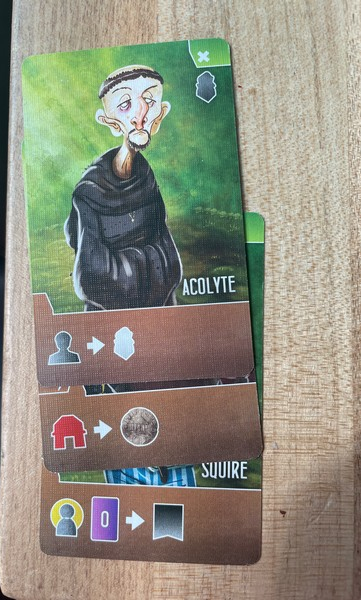
It sometimes makes you feel like you’re in a box, trying to get out.
And workers!
If you don’t have a way to get extra workers, then you only have 6 on your turn, plus the up to three that you can save when you pass at the end of the round.
Townsfolk help greatly with that because you can get a pretty good engine going if you’re careful. Some actions will give you workers if you place markers on the spaces that give them to you as well.
But sometimes your engine will just sputter. You’ll use your six workers and then have to pass (or maybe even save some of them and pass sooner) while the other players keep playing and playing.
King’s Favors can be very important in relation to turn order, because these open up action spaces that are almost always snapped up right away.

Thus, if you’re first player at the beginning of the game, you will be the first player for two of the five King’s Favors that come out.
They’re almost always the first spaces chosen because they have powerful bonuses.
Spending a red worker and a silver to flip a Debt or destroy two Suspicion cards?
Powerful!
Of course, the more Favors there are, the harder the choice of which one do you want to go to?
That may be a balancing thing.
Many people do see the turn order as unbalanced because of this, and it can be annoying when a King’s Favor is flipped and it’s exactly what the current first player wants to do on their turn.
With the exception of the King’s Favors, this is very much a multiplayer solitaire game, with the only interaction being the board spaces for your Garrisons and Commissions and whether or not you take the space(s) that an opponent wants.
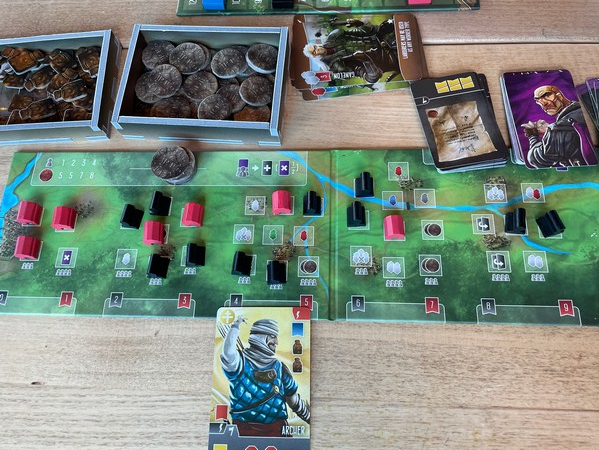
Also you are vying for Townsfolk and Outsiders, but that’s not usually as much of an issue (except when somebody converts the Outsider you were just about to Attack!)
But your player board actions are your own and most of your actions can’t be blocked by other players.
The genius of this game, though, are the Paladins.
In the base game (which this is a review for), you have 12 Paladins so you will be seeing all of them. You won’t be playing them all, but you will have the ability to play each one.
The choice is which ones you feel you won’t need during the game.

Sometimes they come out in an order that isn’t helpful at all (which becomes more of an issue when including promo Paladins and the expansion, which brings the Paladin count to 20 and you will be removing some from the game entirely).
You have to think tactically a little bit in that you want to take advantage of your Paladin’s ability.
Or maybe you just want their attribute boost.
The decision on which one to put at the bottom of your deck and possibly never use can be agonizing.
There is a lot going on in Paladins of the West Kingdom, which can lead to a lot of analysis paralysis in trying to decide what you want to do.
Which brings me to my major knock against the game: game length.
Depending on the players, this can be a 2-3 hours game just with the base game.
Add the expansion (review for that forthcoming since I’ve played it a couple of times) and it could be 3-4.
Yes, if all players know the game well and can make their decisions quickly, the game can be shorter.
But it’s not likely, and the way our group plays games, most players will not have played it for at least a little while and will have to remember tactics. There will always be thinking involved.
If you have the time for it, and like the puzzle, Paladins of the West Kingdom is a phenomenal game.
You have to concentrate on a couple of things and then do a few other things not quite as much in order to do well. If you try to spread yourself too thin, you will not do well at all.

And that’s ok!
That seems to be most games I’ve played recently.
With those caveats, and as long as you don’t mind multiplayer solitaire (for the most part), this is a really good game to try out.
For me, Shem and S J have hit another one out of the park.
Or at least a triple.
(This review was written after 8 plays)
 Dude! Take Your Turn!
And I feel bad because I’ve played Regiments for almost 13 months and, even though I’ve mentioned playing it numerous times on my own blog, I have yet to write a proper review of it.
LikeLiked by 1 person
Yeah, I know that feeling! Though I have more trouble reviewing video games than I do board games anyway.
And yeah, I should probably start playing Second Front again. I kind of fell away from it.
LikeLiked by 1 person
Re Second Front…I have owned that for a while now, and I still don’t know if I like it or not.
What was kinda cool is that in one of the training missions, you and I are on the same scoreboard. (I think it’s the one where we’re Russian infantrymen storming a German position.)
LikeLiked by 1 person
That is one of those games which I would love to play some day…
LikeLiked by 1 person
It’s a good one! Have you played any of the West Kingdom games?
LikeLiked by 1 person
Shame to admit but I have not played any 😦 Definitely, it is on my radar.
LikeLiked by 1 person
Always good to catch up on one’s blogging plans! And it does look like an intriguing game.
LikeLiked by 1 person
The expansion makes it even better! I hope to get that review done in the next week or so.
LikeLiked by 1 person
Pingback: Friday Night Shots – Player Interaction – Dude! Take Your Turn!
Pingback: Friday Night Shots – Convention Game Behaviour – Dude! Take Your Turn!
Pingback: September 2023 Gaming – Dude! Take Your Turn!
Pingback: Expansion Review – Paladins of the West Kingdom: City of Crowns – Dude! Take Your Turn!
Pingback: October 2023 Gaming – Dude! Take Your Turn!
Pingback: Review – Scholars of the South Tigris – Dude! Take Your Turn!
Pingback: Top 50 Games Played of All Time – 2024 Edition (#40-31) – Dude! Take Your Turn!
Pingback: Friday Night Shots – Player Count – Dude! Take Your Turn!