Dude! Take Your Turn!
A Gaming Life
Expansion Review – Paladins of the West Kingdom: City of Crowns
I received the Kickstarter version of Paladins of the West Kingdom: City of Crowns a long time ago, but I was having trouble getting the base game to the table.
There was no way I was going to get the expansion out without playing the base game again!
But given the recent multiple plays of it recently, I actually managed to get City of Crowns to the table twice!
I finally figured I could write a review of this excellent expansion.

City of Crowns was designed by Shem Phillips and S J MacDonald, with art by Mihajlo Dimitrievski. It was published by Garphill Games and Renegade Game Studios in 2021.
Did the base game really need an expansion?
Maybe, maybe not.
But the expansion they gave us is really, really good.
I already explained how to play the game in my review of Paladins of the West Kingdom, so I won’t go into that much detail here.
I’ll just talk about the additions.
The first thing that City of Crowns adds that I find so very valuable is an extra workshop.
Yes, in addition to drafting a townsfolk at the beginning of the game, you also get to place a workshop on one of your spaces prior to the game beginning!
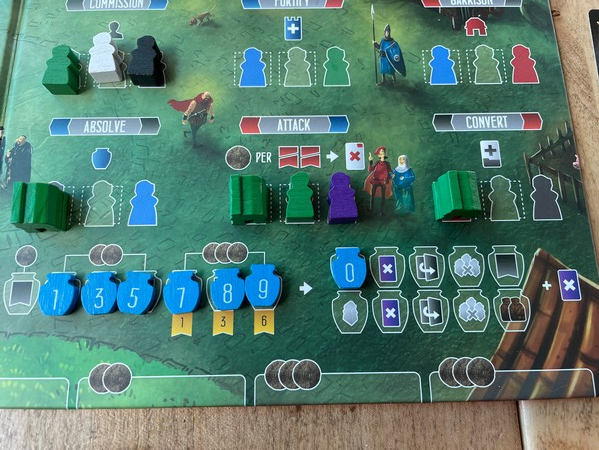
(This pic is later in the game, but illustrates how placing a workshop will make your action cheaper)
This is such a great addition because it gets you started with one action being cheaper to do than the other ones (probably one that coincides with your secret King’s Order, which is another addition I’ll mention shortly).
(I guess here is “shortly”)
You also get dealt a secret King’s Order in addition to the three King’s Orders that go out on the board. If you fulfill this King’s Order, you get 6 points.

(Those are the King’s Orders on the board, but one of these could be your secret one!)
Funnily enough, in both of my plays with the expansion, I haven’t actually even come close to fulfilling mine.
But it does give you a possible avenue!
The big addition to the game, however, is the Diplomacy attribute (a fourth one that you can keep raising and it will get you points) that allow you to do the Muster and Negotiate action on your turn.
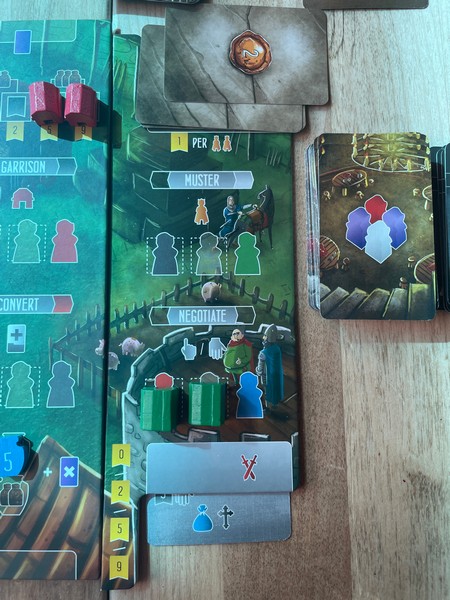
This also involves an addition to your player board.
The board addition will allow you to interact with the new addition to the board out on the table.

Some of it involves the Diplomat (the orange guy), which is another addition to the game.
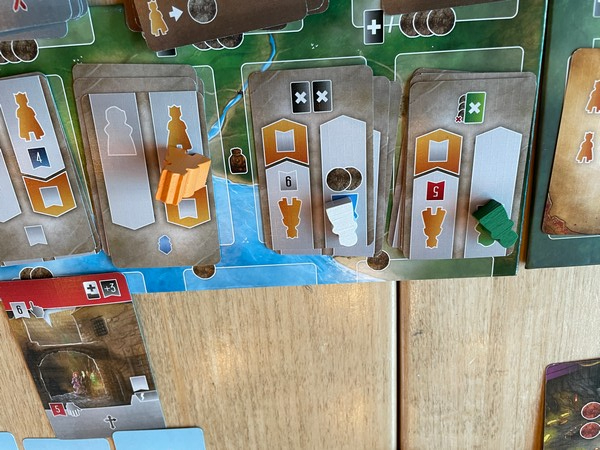
These new cards give players a new place to put a worker to get some action. However, unlike most spaces (including the King’s Favors), the worker stays there, blocking the space, even after clean-up.
In the picture above, the white worker is on a space that will let you pay 2 silver to destroy two debts. The green worker allows you to hire a Townsfolk for free.
The new Muster action allows you to interact with these cards and take them.
That’s basically a “for each pair of cards you have, you get a point” action, but you also get to do the action again and gain the worker if there is one there.
You also get a Diplomacy boost (pretty much the only way to do it, though not totally).
You have to have the required value on the card in order to do it (the “free Townsfolk” card requires 5 Strength to do).
You also can’t take the card where the Diplomat (the orange figure) is. The cost for this is provisions based on the distance between the card you want and where the Diplomat is. You then move the Diplomat to the new card, so nobody can take the new one without somebody taking a different card first.
The other new action on your player board is the Negotiate action.

This actually gives you two choices.
For both, you are dealing with the cards underneath and on top of the new main board extension.
The “finger pointing up” (Entrust) action allows you to do one of your player board actions (depending on the card) with a boost in the required attribute.
The bottom right card above gives you an Absolve action at +2 Influence. You just have to have 0 Diplomacy (later cards require a lot of Diplomacy).
This is a way to do some of your board actions without spending the workers the action requires (though the Negotiate action does require other workers).
The card above on the bottom left allows you to attack an Outsider at +3 Strength.
Or you could do the hands down action (Enlist).
This is a set collection aspect of the game. You get points based on the sets of different symbols that you have collected using this action.
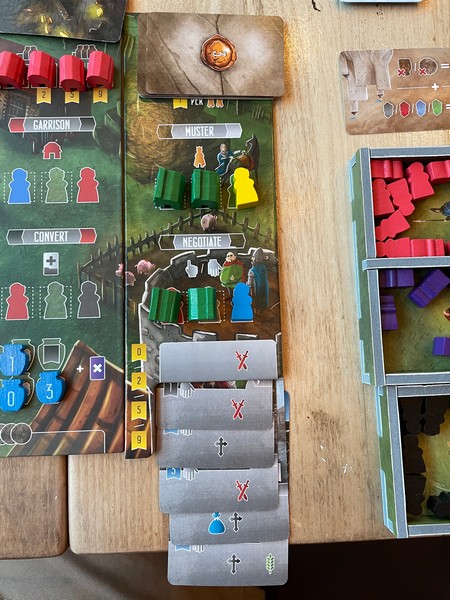
The sets above got me 17 points (9 for the first set of 4, and then 2 each for two sets of two)
However, if you collect 3 of the same symbol, you’ll collect an Ally card that gives you a benefit.

Thus, you are incentivized to spread things out to get points, but you get Allies with specializing.
What to do???
No matter which way you go, you do get a Diplomacy each time you do Negotiate to take the card.
What the “Entrust” Negotiate action does is make it so you can do one of your board actions but just pay some silver to do it instead of whatever your board says it will cost (like provisions, or maybe more silver than the Negotiate action will cost!).
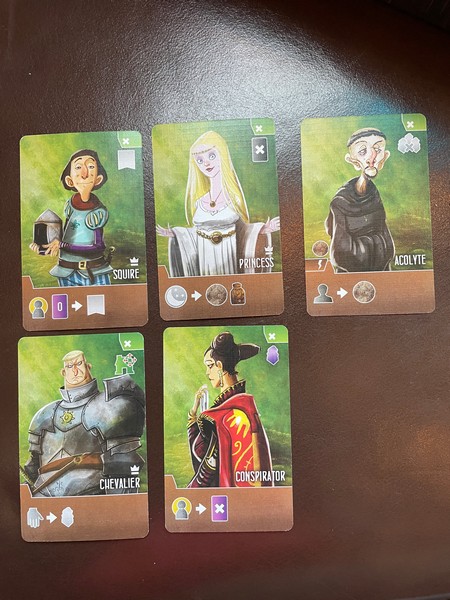
Of course, the expansion also adds a few new paladins to use the new mechanisms, as well as some other stuff as well.
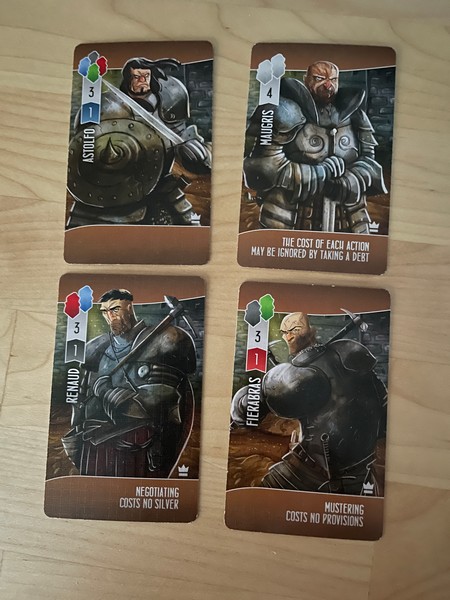
The bottom two of course benefit the Mustering and Negotiate actions.
However, the other two are quite good as well.
Making the cost of action be taking a debt rather than spending money/provisions can be a godsend if you have a way to flip debts.
The other Paladin gives you 4 workers instead of 2 and gives you 3 Diplomacy (along with 1 Influence), making it a lot easier to do multiple actions on your turn.
All four Paladins give you a Diplomacy boost, which is nice.
This expansion does make choosing your Paladins a little more difficult, especially if you have the promo Paladins as well.
Now, you choose 4 Paladins at the start of your turn, play one, put one on top of your deck, put one on the bottom of your deck, and remove the final one from the game.
You will never see that Paladin again.
That’s a hard choice sometimes!
(There are two other ways you can do Paladin-selection: both involve not using a certain number of Paladins during the game, but they are decided at the beginning of the game. I prefer to make the tactical choice during the game, however).
That’s all there is that’s new.
Does City of Crowns make the Paladins more noble and handsome? Or does it make them evil and hideous-looking?
After my two plays of the City of Crowns expansions, I have to say that I love what it adds to the base game.
It gives you more options but also gives you more ways to do the actions that the base game gives you.
The Entrust action is the best example of that.
Say you are trying to concentrate on Converting Outsiders to gain points.
You’ve already done that a number of times, so now Converting will cost you a bunch of silver.
However, Converting using the Entrust action in the picture above will only cost you 2 silver instead of what the regular Converting action cost would be.
And you get +3 Faith!
Yes, you do have to make sure you are getting plenty of Diplomacy, but it can still supplement whatever actions you are trying to concentrate on.
In my second game with City of Crowns, I ended up maximizing my Diplomacy to 20, and I managed to also maximize my Commissioning as well!
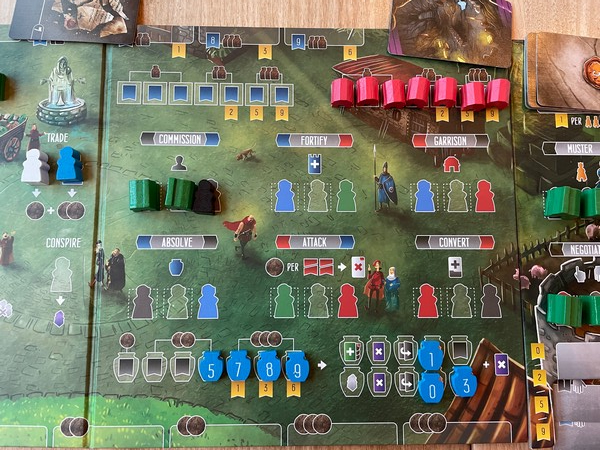
I did some basic Commissioning actions, but at least a couple of my
Commission actions were through Entrusting.
Considering what the King’s Orders were on the main board, I was able to satisfy all of them doing it this way.

Of course, my personal King’s Order was Garrisoning, and I didn’t do that once!
I am such a bad subject.
I mentioned it above, but the “free workshop at the start” is such a valuable rule because it gives you a head start on one of the actions that you can take.
If you know what direction you are going, that can be invaluable.
The Muster action and the cards involved with them are also a great addition because they give an extra space to place a worker, and then give you a way to get some Diplomacy.
It does seem a bit minor that you only get 1 point for each two cards you get, but being able to collect the worker and do the action again is very powerful.

As long as the action is a good one.
Depending on your players, the expansion will add some game length to an already very long game, mainly due to increased analysis paralysis time.
You have so many more choicies that it will take you a bit of extra time to figure out exactly what you want to do.
It increases the complexity of the puzzle.
And it’s already a complex puzzle!
The expansion also increases the footprint of the game, to a much larger degree.
Unfortunately, the new Negotiate board has to be on the end of the main board because it adds a Townfolk space.
You can’t just put it off to the side like you can the other main board (the one where you put Garrisons/Commissions).
You should definitely make sure you have room for this one before you put it out there.
Considering game play, though, I can’t really find any major faults.
I like the new actions and possibilities City of Crowns offers. I really enjoy the new Paladins and Townsfolk, as well as Outsiders.
One new thing I forgot to mention is that each of the decks (Townsfolk/Outsiders/Negotiate cards) has the top card face-up.
This means that there will always be at least one card you can deal with in a round (since taken cards are not replenished until the end of the round). No more “all of the cards are gone! I guess I can’t do that action.”
And the expansion adds one more Townsfolk/Outsider slot anyway!
While City of Crowns does add another whole decision space, it actually doesn’t add that much rules overhead, so it’s pretty easy to add to the game without a whole lot of explanation.
I certainly wouldn’t add it with new players, though.
City of Crowns makes an already great game even better.
And what more can you ask from an expansion?
(This review was written after 2 plays with the expansion)
 Dude! Take Your Turn!
Great write up. The last Garphill game I played was Raiders of the North Sea. But reading this it sounds like I’m missing out!
LikeLiked by 1 person
Well, I think you are, but I have a friend who doesn’t like much of the Garphill output.
I do think you should try them, though! I think they’re great
LikeLike
Another game which I would love to play…
LikeLiked by 1 person
Pingback: Top 50 Games Played of All Time – 2024 Edition (#40-31) – Dude! Take Your Turn!