Dude! Take Your Turn!
A Gaming Life
First Impressions – Cascadero

Another first impressions post, mainly because I doubt this game will come out to our game days again, other than maybe one more time (I prefer to review a game after 3 plays).
These first impressions posts are not reviews exactly, because I’ve only played the game once (and sometimes that one play might be slightly wrong, like this one).
But I want to let you know some information about a game so you can maybe make your own decision about wanting to try it.
As I mentioned in my Harmonies first impressions post, my opinion could change with more plays and, if I play it enough to review it, I will either mention it in an amendment to this post or, if my opinion changes drastically, write up a new review.
This week’s first impressions post is about a brand new Reiner Knizia game called Cascadero.

It’s designed by Knizia with artwork by Ian O’Toole (wow, two masters on the same game? Can the space-time continuum handle it?) and published by Bitewing Games in 2024.
Bitewing games is coming up with some really cool productions recently. Definitely a publisher to keep an eye on.
How does this compare with other Dr. Knizia games?
Cascadero has many of the Knizia hallmarks that we all know and love.
Some area control, an interesting scoring mechanism that is different than a lot of other games, and one that basically makes it so that you have to fulfill a condition or you can’t score at all.
Boardgame Geek calls it a tile-placement game, but you are really just trying to chain paths from one city to another in order to be able to score those cities.

You’re not placing tiles, but more you’re placing envoys to form a path between cities.
There are 5 different colours of city on the board, and you’re trying to connect cities for your trade routes.
But there’s been a lot of strife in the land, so just having one envoy come calling won’t make them open their city gates.
You have to have at least a chain of two from one city to another! Because while one person isn’t trustworthy, two people are (though if they’re working for the same malevolent organization, why would two be better than one? I don’t know).
And if the town you’re coming from vouches for you, I guess that’s good enough.
On your turn, you’re just going to be placing an envoy into an empty hex. Hopefully you’re working toward linking two cities, but you never know. Maybe you’ll put one out in the middle of nowhere?
I’m not going to judge how you play games.

When you connect a city, you will move up on the track with the same colour as the city you just connected (not the one you’re connecting from; presumably you’ve already scored that one, unless that was where your route started from with no previous connection).
The scoring tracks are the really interesting part of the game, and they are what makes even choosing your starting colour important (James is always green, for example).
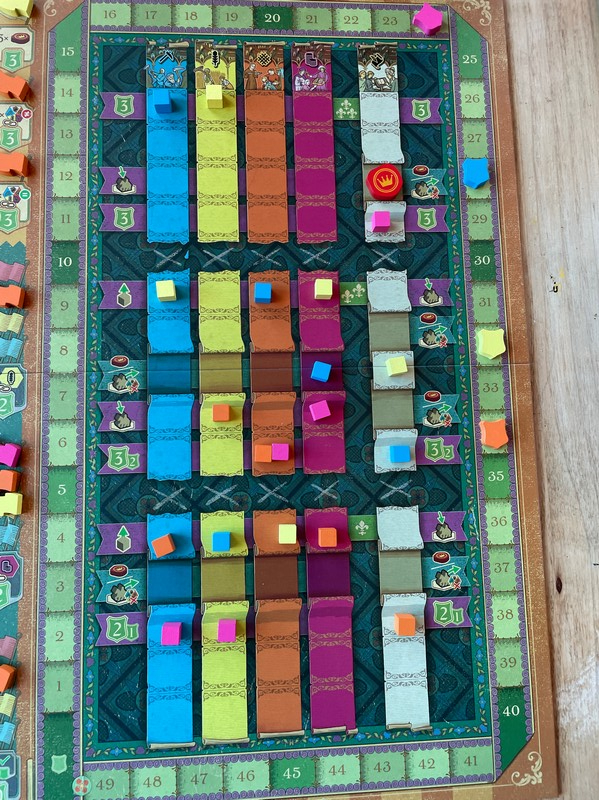
Moving up the tracks will give you bonuses or points (or both), and some of them you have to land exactly on in order to get that bonus (something we played wrong).
You can move up any track and get the bonuses.
But you can only win the game if the track matching your colour reaches the very top (and there is no green, so James wasn’t too confused).
There’s Knizia being clever again.
The chaining on the board is very cool, and the interaction is high.
There is a lot of blocking because if you can’t trace a path from one city to the other, you can’t score that city.
But maybe James wants to connect that city too?
He places his envoy and suddenly I can’t connect the cities I want to anymore!
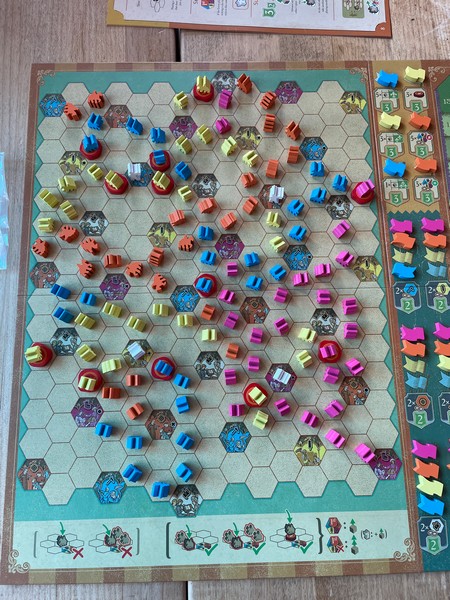
That’s annoying.
There are also in-game goals that will get you points, connecting a certain number of cities of the same type in the same envoy chain, or maybe other combinations.

The game end is also very intriguing.
If somebody reaches 50 points, the game will end.
Otherwise, it will end when somebody has to place an envoy and they don’t have any left (another thing we did wrong, where we ended the game when somebody placed their last one).
In our game, only two of the four of us actually reached the top tier of the scoring in our colour, so only two of us qualified to win. And of course Abi was the one who ended up winning (though I wasn’t too far behind).
This was a really fascinating game!
Lots of player interaction in the sense that you are blocking routes. I know most of the interaction in worker placement games is taking a spot that another player wants.
This takes that to a whole new level. I can’t count the number of times I wanted to place an envoy somewhere and get a city but I was totally blocked by another player (I’m looking at you, Vicki).
That’s what’s great about this game. Nobody is going to place an envoy just to fuck with you. However, the board space is so constricted, with cities everywhere, that they can’t help it. Placing something to help them hurts you.
The Knizia scoring weirdness is also very cool.

It’s awesome how player colour matters in this game, because you have to max out your track or you can’t win.
It’s a distant relation to other Knizia scoring rules like how in High Society, where you can’t win if you have the least money in hand.
I love these scoring touches where it’s more than just points. It depends on how you get them and where you do.
I’d love to play Cascadero again, especially doing it correctly with the track movement (that’s the main thing we did wrong, other than how the game ends).
The production is really nice, the artwork is wonderful, and the decisions in this game are just amazing.
There is no luck in this one at all other than maybe who is first player. Everything is based on where you put your envoys and what colour you are.
Obviously I can’t say it’s a classic after one play, but it is something that I will jump at the chance to play again if it’s offered.
 Dude! Take Your Turn!
Yeah, did not like. Too much “ìn your face-ness” for me – and it’s easy to fail to score; meaning you’ve wasted 2 hrs playing this game for no result. That’s forgivable in Clank! thanks to the theme, but makes no sense here…
LikeLiked by 1 person
Fair enough! One reason it may not hit the table again 🙂
LikeLike
Mechanically, it sounds intriguing!
…thematically, I don’t get what it is supposed to be about. So, I guess, typical Knizia 😀
LikeLiked by 1 person
Yep, that is true!
LikeLiked by 1 person
I played this the other day with my wife. Felt like a more mature Blue Lagoon. I really enjoyed the simplicity of play, and combining a number of track movements together feels great.
However, Steph had trouble understanding how points work because there isn’t a direct between placing pieces and scoring. You either have move up tracks, or figure out how to grab the achievements.
I’m looking forward to playing it again, and at a larger player count. Because I think you can get away with things in the two player game that you wouldn’t when playing with four players.
LikeLiked by 1 person
I can’t imagine playing this at 2 players. I think it would definitely be better at higher counts. But that’s just me. The scoring isn’t the most intuitive either, but it’s still interesting. Thanks for stopping by!
LikeLike