Dude! Take Your Turn!
A Gaming Life
Review – Civolution
(Edit: 11/10/25: I’ve upgraded this post to a review of the game, rather than a “first impression,” since I’ve now played it four times. I would not change a word of it, though. I did manage to score 194 points in one game! But have hovered in the 130-140 range in the other three.
Now that I own the game, I do love the storage solution provided by the publisher. Everything is clearly marked and there are even marks in the box for where everything goes.
It’s a bit of a bear to teach and to set up, so if you have any new players, keep that in mind as well. If you just have one newbie, have one expert set up the game while you’re teaching. Win-win!
I’ve left the post below fully intact with no edits)
Welcome to another First Impressions post, this time about Stefan Feld’s latest point salad monstrosity (I say that with affection), Civolution.
As I mentioned in my Friday Night Shots post about doing first impressions posts, this isn’t a review because I’ve only played the game one time. My feelings may change, especially if I had an especially good/bad experience the first time.
These are just my initial feelings about the game.
In this case, my copy of Civolution is waiting for me with a bunch of other pre-orders, so I don’t even have my copy yet. We played a friend’s copy this last weekend.
I am hoping to play the game enough times to eventually review it (or at least update this post if none of my feelings have changed), but I know it will be a long while before I get that many plays of it in and I’d like to comment on it while it’s hot.
With that being said, Civolution has art by Dennis Lohausen and was published by Pegasus Spiele in 2024.
Feld is very famous for designing games where almost everything you do can get you a few points, so the trick is to find out what is going to get you the most points.
A friend of mine said (paraphrased) “You can get points in a Feld game for just remembering your name.”
Given my first play of Civolution, I think I have forgotten my name!
Is it Bruce?
Baldric?
Earl?
I don’t know!
Will that affect my impression of the game?
Let’s take a look.
Feld games generally have a lot of different avenues to get points, ways that if you concentrate on a couple of them, you can do very well.
I think he must have watched Spinal Tap before designing this game, because Civolution cranks that up to 11.
The game is huge (in table space and in decision space)!
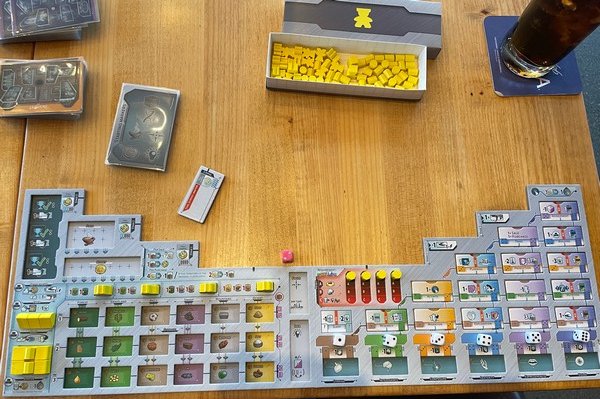
Yes, it can be a table hog, though we managed pretty good at the restaurant, only taking up three full tables.
The above picture is just my console!
Imagine that multiplied by three or four players.
With the map, track board, and turn board too.
As I said, the decision space is also huge.
There are tracks that you want to go up, some of which will give you more points than others (which ones is randomized).

There is a world that you are trying to spread your tribes out on and explore.
You want to build stuff on some of these tiles as well, but funnily enough for a civilization-building game, there aren’t actually a lot of building types to worry about.

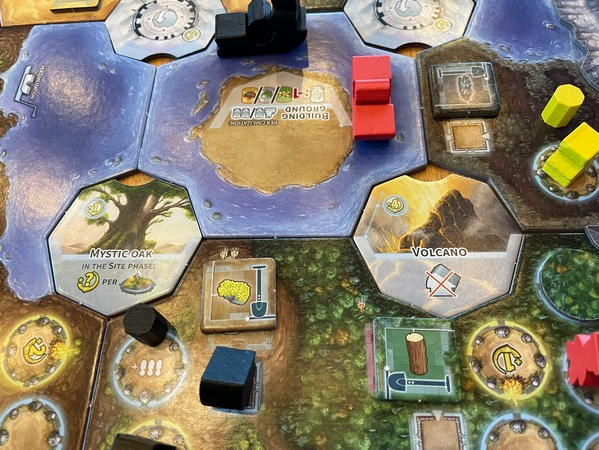
The map is divided into randomly placed map tiles with three areas on them (the bottom left tile has desert, swamp, and grassland (the green one)). Even if two of the same area types are adjacent due to the way the tiles are placed out, they are considered separate areas for all game purposes, rather than one huge area.
The “my territory” designations are based on the tribes you have in encampments.
Farms, for example, will feed every tribe you have in an area, but they don’t count as “your area” if all of your tribes have left.
Settlements and Statues can only be built on those brown “building grounds” (like the one surrounded by water in the map above, though others will be revealed during the game) where you have tribes in an adjacent territory. Tribes will never actually go there, so they are not “your area.”
There is no area control in the game, though. If you have a tribe in an area, then it’s “yours” even as it also may be “his” or “hers” or maybe “theirs” if you’re playing a team.

Or Alf’s.
Sorry, Alf.
That’s an interesting dynamic for a civilization-building game, where you’re not fighting for control at all.
The worst you can do is “weaken” an opponent’s tribe (tipping it over, like they fell asleep) when you migrate or procreate (don’t ask), which means it can’t score and can’t migrate without being strengthened again.
So let’s get the elephant in the room out of the way first (thanks, Cal).
Yes, there are dice in this game.
Like many other Feld dice games, luck can play a factor, though there are a lot of ways to mitigate those dice rolls.
My dice rolls required a lot of mitigation.

But there are so many possible actions you can do that you can always do something, even if it’s not the most beneficial to you at this point in time.
I love the turn sequence in this game.
On your turn, you can either use two of your dice to take an action, or (if you have three or fewer dice left) you can “reset.”
Resetting will let you reroll all your dice and get you other stuff as well. Maybe a food or an Idea.
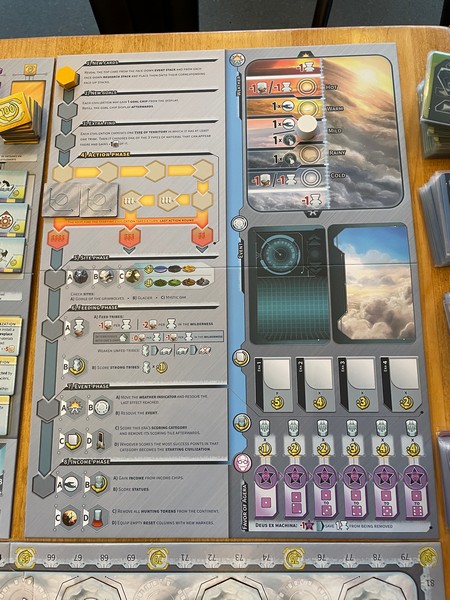
The number of actions in a round is based on how many resets players do, as each round has a limited number of resets (total, not per player) as shown in the yellow/orange area above.
A marker moves to the next yellow (or orange if a reset triggers the end of the round) space when a reset happens. When it reaches an orange space, then you will finish the current round (there is a first player assigned each round) and then each player gets one more turn.
This can include a reset if necessary/desired!
The main decision space, though, is what couple of things you want to concentrate on to get points.
Because there are a lot of them.
As I mentioned, your action will be using two dice to do an action from your console of available actions.

This can be anything from exploring the world to producing goods where your tribes are, to playing cards to your console!
Or maybe you want to mutate your species to make it more expressive or dexterous or whatever.
The dice are placed like the two dice in the Trade action above.
Each module requires two dice of certain numbers to be placed there to activate.
You can use “Ideas” (if you have them) to modify the dice if you don’t have the right numbers.
Or “focus” markers can actually take the place of any die that you need, though it can be hard to get those markers.
That’s the main action, but there are so many things that you can do that Civolution really burns the brain in trying to figure out what would be best.
Hell, there are 22 module actions that you can take!
One of the things you can do and which will help you score points is to play cards to your console. All of these “play card” actions require a 6 die along with one other die (number depends on the type of card you want to put out).
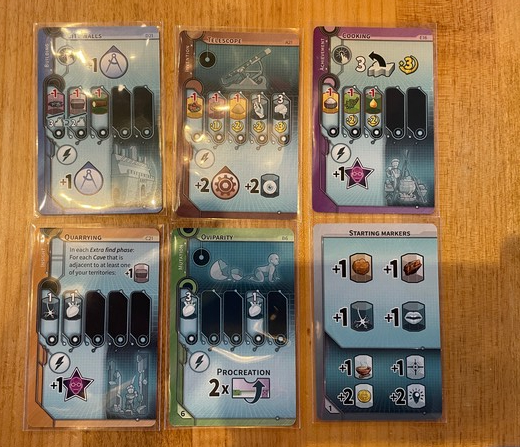
They also will most likely have a cost (or at least a “you must have…”) requirement in order to play them, which can increase based on what stage you are playing the card to.
These cards may give you special abilities, or another Activity you can do with the Activity module, or maybe an ongoing effect.
There are five different types of cards (the sixth in the picture above is a starting resources card).
Most of them will give you an instant benefit as well as potentially an ongoing effect (though if the instant benefit is great, there may not be an additional effect).
They go into your console like this.

Each column can only have one type of card (or other tile, like goal tiles or attribute chips) in it, but if you fill a row, you will get another big benefit.
Other tiles you can get, like Attribute tiles (which we actually didn’t realize went onto the console!), completed goal tiles, and income tiles, will also fill these spaces in your console.

At the end of the game, you will get points for each item in there based on the Stage it’s at (bottom is Stage 1, etc).
Of course, moving up the tracks will also give you points and benefits when you do so, so maybe that’s a valid strategy as well?
Or how about exploring the world?
An explore action will flip the hexagonal tiles that your tribe is adjacent too, and those will give you points (and potential benefits or penalties).

You want to spread to as many areas as you can, not only to get points for all the tribes you have, but also for endgame points regarding how many areas you are in.
Heck, when you move a tribe into a new area, it’s very possible to score one or two points just for doing that!
Stefan, Stefan, Stefan. Always looking for ways to allow players to score.
There is just so much in this game that it’s hard to talk about it all without writing a book.
As with most of these games, though, you need to concentrate on a couple of things and maybe dabble in the rest, or you will find yourself spread too thin.
Sure, anything you do will get you points. But these points build on each other, and if you’re only doing one or two steps of everything, then those points won’t build.
And then you’ll forget your name.

Even as I said my first play burned my brain, I was just so intrigued with the game and all of the action possibilities.
I love the action mechanisms, but the choices just may freeze those who aren’t ready for them.
Twenty-two different action possibilities?
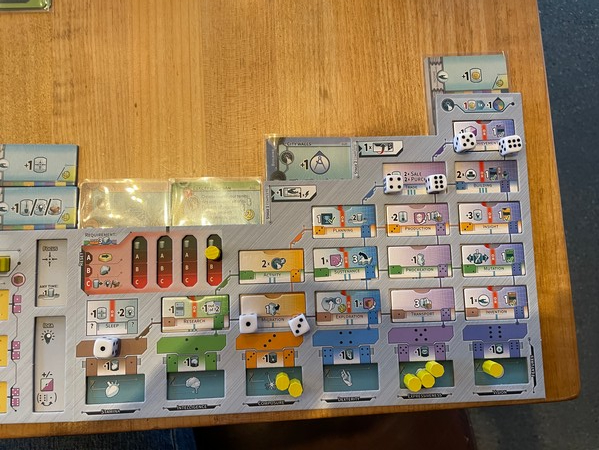
But it’s a good burn.
Each action module can be upgraded three times, making the action stronger. There are many ways to upgrade these modules, but you will find yourself wondering just which one you should when the time comes.
Oh, I can’t forget that you also have to feed your tribes, so if you take a “spread all over the land” strategy, you better have a way to produce food.
Or build all three of your farms.
Or both!

Gaining different types of resources is also important, as you will need them to do a bunch of different things (building, playing cards, etc).
I first became enthralled by this game watching the Heavy Cardboard playthrough, but sitting down to it was another thing.
I was almost overwhelmed.
But then I was just chomping at the bit to get started and figure out what I was going to do.
And then I promptly forgot my name and only scored 131 points.
131 points?
In a Feld game?
That shall not stand!
I need to play this again.
My first impression of Civolution is that it can be a bit much for the uninitiated.
But for me?
I really want to get this to the table again.
(Edit 10/5/25: This is a First Impressions post, but after 4 plays, nothing has really changed in my thoughts, so go ahead and read this as a review! I did manage to score 194 points in one game! But have hovered in the 130-140 range in the other three.
Now that I own the game, I do love the storage solution provided by the publisher. Everything is clearly marked and there are even marks in the box for where everything goes.
It’s a bit of a bear to teach and to set up, so if you have any new players, keep that in mind as well. If you just have one newbie, have one expert set up the game while you’re teaching. Win-win!)
 Dude! Take Your Turn!
I had a chance to play it at Essen 2024; I passed, hearing how complex it can be (me Dave, who normally can easily swallow 60 pages rulebook). I am still tempted by this..
LikeLiked by 1 person
It’s actually very straightforward as far as rules go. There’s just so much to think about!
LikeLike
Certainly a game from the deep end of the pool! I wonder how many plays one needs until feels that one knows what one is doing. You’ll let us know when you arrive there 🙂
LikeLiked by 2 people
LOL yes, I will. Hope you’re having a merry Christmas!
LikeLiked by 1 person
And the same to you and yours!
LikeLiked by 1 person