Dude! Take Your Turn!
A Gaming Life
Friday Night Shots – Table Talk
Hey everybody!
It’s Friday, and it’s two Fridays since our last visit to the bar.
Sorry for missing last week. Things got away from me a little bit and I just wasn’t in the correct headspace to write.
However, I have my Captain Jack and Diet Pepsi set up, the music’s playing softly, and I have a fine visitor like you coming in!
Sit down and take a load off, my last Friday of vacation.
I’m trying to pretend I’m not sad about that.
Anyway, tonight let’s discuss the appropriate level of table talk in a board game.

This was inspired by a thread on Boardgamee Geek entitled “Is Trying to Manipulate Part of the Game?“
This thread was posted in the Terraforming Mars forum, talking about things like “If someone plays an Asteroid, is it ok for people to talk about who the player should choose to eliminate plants from?”
The original poster actually said:
“When someone plays an Asteroid, neither player should tell them who has plants or even that they forgot to do the action.
Likewise, when one of the players is close to having a second reward but a other person who does not have one can have it, we should not talk about it.”
He then wanted to get the designer’s opinion about this.
Of course, he got everybody else’s opinion as well.
This struck me and I decided that I would like to talk about it a little bit (and then I promptly decided I wasn’t up for writing so that got delayed until this week).
When playing games, what do you think is the appropriate amount of table talk allowed?
Let’s leave off convention or other types of tournament play, where no table talk should be allowed (as far as the game play goes…if you like to chat while playing, go ahead!).
But in a casual game, how much is too much?
Let’s use the original poster’s initial question.
If you’re playing Terraforming Mars and somebody dumps an asteroid onto Mars, is it appropriate to say “hey, Sarah’s got tons of plants” prior to the the decision being made?
Or “James has a huge Terraforming Rating lead right now, maybe take his plants instead of mine?”
For me, in a casual game, there is nothing wrong with this. While Terraforming Mars is not a negotiation game, that doesn’t mean there can’t be a little talk sometimes.
A lot of times at our table, this doesn’t really matter anyway. One person will say “I took James’ plants last time I did this. This time, I’ll take yours.”
But sometimes it does, and it’s not a game-changer, so why worry about it?
The question becomes a bit more hazy when you’re talking about helping people, reminding them of something they may have missed.
I’ll always (if I see it) remind people if they missed getting something that they should have received.
“You just placed a greenery in that space. Don’t forget your plant.”
But when it comes to something that would get in my (or other people’s) way, I’m less inclined to point it out.
I won’t say “hey, you have 3 greeneries, you qualify for this Milestone”
I’m even less inclined if I have 2 greeneries and I may be gunning for it!
In a way, the situation when I’ll point something out is almost like that infamous quote from the US Congress about pornography: “I’ll know it when I see it.”
I think it kind of boils down to whether the missed item is a resource or a game mechanic (that’s not quite the right term, but my brain is a little fuzzy right now).
Missed resources? I’ll remind you.
If you missed an option of something you can do (maybe that’s a better way to put it), I’m not necessarily going to tell you.
The BGG thread turned into a long argument about a lot of things. I check BGG threads a few times a day, and when there were 27 replies from the last time I checked, I just marked them “read” and left. So I don’t know where the argument stands now (knowing the Internet, it’s probably devolved into an argument about Capitalism or something).
But the beginning of the thread is quite interesting.
Many of the responders at this point did come down on the topic where I do, which is that it’s up to the players at the table.
Above, I detailed what I think, and my game group is pretty much the same way (though they don’t do it as often as I do, which either means they don’t actually feel the way I do or they just aren’t paying as close attention as I do).
But if I’m playing with others, maybe at a convention or something, then I would bow to the consensus at the table.
And if I’m playing with Cal, who knows everything, all bets are off…
(I’m just kidding Cal)
Anyway, all of this morphs into something else if it’s a learning game for at least one person.
If I’m teaching the game, I am more apt to point out possibilities. “Hey, don’t forget milestones” (though I wouldn’t necessarily say “you qualify for this one, you might want to take it.”).
I also periodically mention things as a reminder even if it’s not the proper time for it (because I don’t really want to help players specifically, instead giving a general reminder). I may say “don’t forget that you can dismiss townsfolk to get their icon” in Viscounts of the West Kingdom at any point, not just when somebody’s taking their action.
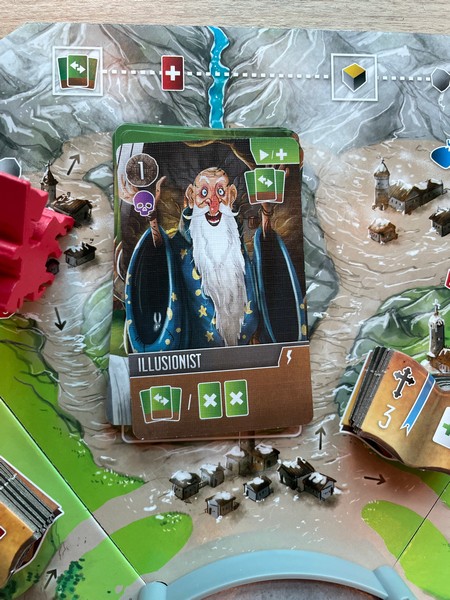
I may do it when I’m taking an action, even though I’m not dismissing a townsfolk.
Just as a reminder.
I’m more likely to be helpful if it’s a learning game, but I don’t want to script it for the player, so I may not point out a specific thing they are missing.
Though if they are having trouble deciding what to do, I may lay out their options for them.
“Well, with what you have there, you can do this action and it would allow you to do this. Or you can do this one and give you these resources. Or…”
Again, that depends on the player, though.
Cal, not so much.
I’m mostly joking there, of course (sorry, Cal). But sometimes it does depend on the person. If the player seems to be getting the game (or is an experienced enough gamer that they are able to see intricacies of a game a lot of the times, even on the first play), I may not be as open when I mention something.
I may do the open suggestions like I mention above, but I won’t do the specific ones.
If a player seems to be having trouble grokking the game, I may explain more or be more helpful when it comes to making suggestions.
Ultimately, though, it is up to the player.
You can only handhold so much before it becomes boring to them.
When I’m being taught a game, I don’t mind having options illustrated for me.
But I don’t want you to tell me what would be best.
Ok, that might have been a ramble, but lets sum up before I finish my drink and get out of here.
A learning game: Definitely more can be said during the game. Table talk should be encouraged.
Everybody knows how to play: Some table talk, mainly missed resources and things like that, but no encouragement as far as what player options are.
“Negotiation” when it comes to negative effects or attacks: Sure, why not? I’m not a threat to you, but Tartan is! Why are you attacking me?
Tournament game (I’m also including my Combat Commander ladder games here): no table talk at all. Sure, you can point out rules errors if you’re watching or playing (“You can’t move to that last hex as you don’t have enough movement points”) but definitely don’t make any kind of suggestions or “don’t forget you can do this action” statements.
What are your limits for table talk? Do you agree with me? Disagree? Hate me with the strength of 1000 suns?
Let me know in the comments.
(This post brought to you by Canadian Club whiskey, the number 12345 and the letter ß )
 Dude! Take Your Turn!
I’m with you on this one – leave it to the table (unless there are tournament rules), always point out automatic things that are forgotten (like the plant from the greenery), options only if the player is new (and might feel like it – as you point out, personalities are different).
If everybody at the table is familiar with each other well enough and knows they are into that, I also enjoy a more raucous table – “Take that, you scoundrel!” – “Now he shows his true colors! See the violence inherent in the system! Help, help! I’m being repressed!”
LikeLiked by 1 person
LOL yes, we do some trash talking too, when appropriate. That’s always fun 🙂
LikeLiked by 1 person
I like your approach; generally, obvious omissions should be pointed out as a fair play approach; in familiar group – or negotiation game – more open discussions are also welcome.
LikeLiked by 2 people
I didn’t really address 2-player games, especially war games. Do you feel the same about those?
LikeLiked by 2 people
Yes, I usually point to my colleagues obvious mistakes – especially when we learn the game. But then we know it well – we usually treat this as a mistake on the battlefield 🙂 For me, playing the game is not for result (unless tournament) but for fun of it.
LikeLiked by 1 person
Fully agreed! And I think I would be the same way.
LikeLiked by 1 person
It depends on the speed and confidence of the player. If they’re struggling, I’ll put all the info, choices and what I would do on the table. Whether it affects me or not.
I find games to be more interesting when everyone knows what they’re doing. Rather than someone forgetting something. Otherwise, it feels like a hollow victory ya know?
The obvious caveat is when memory is a core mechanic.
LikeLiked by 1 person
Excellent point I forgot! Memory being a mechanic definitely means no help. And being silent as a mechanic also means no table talk!
LikeLike
Pingback: ≫ July 2023 Gaming – Dude! Take Your Turn!