Dude! Take Your Turn!
A Gaming Life
Star Realms App Update – Colony Wars
One of the best card game implementations for digital boardgames has to be the Star Realms app. This 2-player card game has you trying to reduce your opponent to zero Authority (sort of like a teenager does to his parents) meanwhile buying more ships and bases in order to do even more damage to your opponent (or buy stronger cards).

Like many deck-builder games, it has a row of cards you can purchase with the cards in your hand, which you add to your deck to make it stronger.
I won’t bore you with the details, however.
What I will bore you with is that there is a huge update coming on Wednesday, May 17 that you need to be aware of.
Wait, that didn’t come out right…
Kickstarter: The Flow of History
Every once in a while, it’s cool to browse the crowdfunding announcements for board games, just to see what may be coming down the pike. Most of them don’t sound that interesting, and I had never backed anything until the recent Pursuit of Happiness expansion.
But then I saw an ad for a game called The Flow of History, designed by Jesse Li with art by Desnet Amane, SY Li and Adam P. McIver, being published by Tasty Minstrel Games. History? I’m a History guy. Card game? Hell yeah, card games are cool. Building rival civilizations? Despite the current political climate, I’m pretty cool with that too.
After a few days of thinking about it (and a switch from IndieGogo to Kickstarter), I decided to pull the trigger and back it.

Here’s why.
Review – Epic Spell Wars: Duel at Mt. Skullzfyre
Apparently, being a wizard isn’t all the fun and games that our good friend Mr. Potter has shown us.
Sure, he had to face off and defeat He Who Shall Not Be Named, but he managed to do so while not using one bad word or double entendre.
But that’s not the wizard reality!
I know this, because I’ve played Epic Spell Wars of the Battle Wizards: Duel at Mt. Skullzfyre (yes, that is the whole name, and yes, I didn’t want to make the URL of this review take up the entire tweet by putting the whole name in the title).

AEG’s Destination Fun pack coming in June
I’m a big fan of the Trains deck-building game from Alderac Entertainment Group (AEG). It’s a very popular game, and I can definitely see why. I even have enjoyed (and currently own) Planes, though that one isn’t as popular. Finally, while I don’t own it (yet), I have loved playing Automobiles online at the Yucata site, and it will be in my collection one day.
Are you sensing a theme here?
Yes, all three games are from AEG and have nothing to do with that 1980s movie of the same name if you put them all together in the proper way.
Coming in June, there will be expansions out for all three games.
Christened the Destination Combo Fun Pack, it will include lots of great stuff if you are fans of all three games.
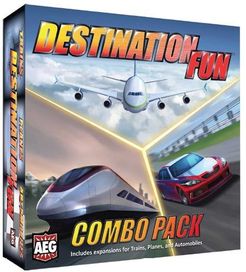
The contents look really neat.
More 80’s – The Thing Coming to Your Table
I didn’t realize with yesterday’s Rambo post that this would actually be becoming a Thing, but apparently it is.
Yes, the 1980s are invading the 2010s, and they are winning.
The Thing: Infection at Outpost 31 is a new game coming out by Mondo with Project Raygun (a “designer collectibles” division started by USAopoly).

There is more detail about it on Mondo’s web site, but it looks really cool.
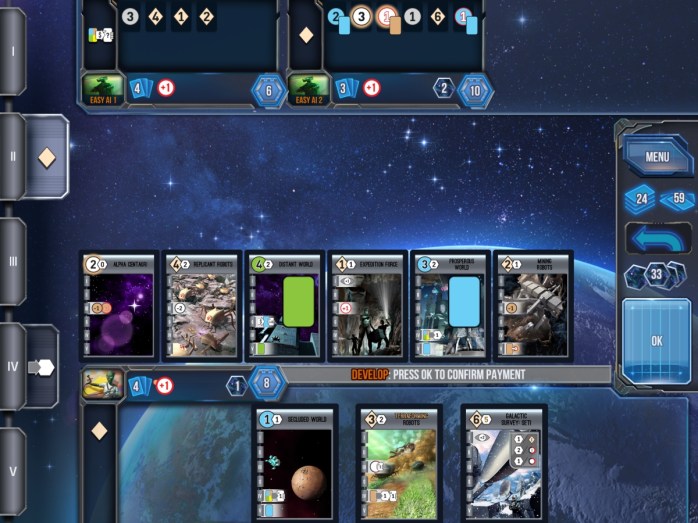
Race for the Galaxy app is real – and it’s Marvelous
As promised (and this is so rare in the boardgame App world!), Race for the Galaxy came out for iOS and Android on May 3.
Released by Temple Gates Games, this app is probably a new benchmark in digital board game development. It’s pretty, it plays well, it has asynchronous multiplayer, three levels of AI (including the infamous Keldon AI for the highest difficulty, which will kick your butt and then give you a wedgie for good measure).
The layout is gorgeous.
The 80s are Returning!!! – Rambo Kickstarter Upcoming
You can tell that many current game designers grew up in the 1980s.
We’re in that sweet spot where 35-45 year-olds are really getting into game design, and why not use something that we grew up when designing a game?
First, there was (in 2016) Legendary: Big Trouble in Little China, a game based on a very niche movie that has a cult following.
Then there is the upcoming Big Trouble in Little China: the Game that is coming out sometime soon (or maybe it came out and I missed it?)
But now, somebody’s coming to kick Jack Burton’s ass.
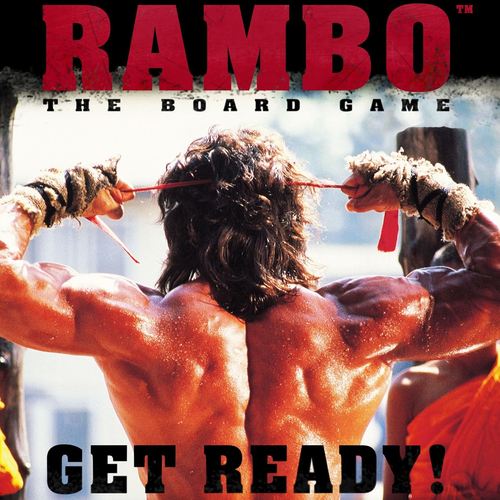
That’s right, Rambo’s coming.
Should Your Kids Play Board Games?

There’s plenty of controversy regarding whether or not (and how much, if so) your kids should play video games.
But what about board games?
I just saw an interesting blog post on Twitter by “Dr. Corriel” called “8 Reasons Your Child Should Play Board Games” and it is a really good article.
I especially like Reason #2: “They Teach Children How to Lose”. Because if I had kids, I’d be teaching them that again and again and again and…
Ahem. Sorry. Actually, I wouldn’t that often, but it is a good thing for kids to really learn. Because it’s a big bad world out there, and sometimes you’re not going to be successful. It’s best to learn that early.
As an addendum to that, I think that teaching a child how to lose will also teach them how to win. By that, I mean winning graciously. Because if a child knows how to lose and how it feels to lose, then they may remember that when they win and their sibling is on the losing end.
Or their poor father.
Sorry, projecting again.
I do believe that seriously. I don’t have a medical degree, so I could be wrong, of course.
But it makes sense to me.
Anyway, go over to Dr. Corriel’s blog and read the whole post. It’s interesting and I think has some great reasons to game with your kids.
Let me know what you think in the comments below (and let her know on her blog as well!)
Dead of Winter – Warring Colonies are Coming!
Zombie games have become old hat (but it’s not “plaid”), but there are still some interesting things out there in the genre.
One of the more interesting recent games is Dead of Winter: A Crossroads Game from Plaid Hat Games.
It came out in 2014, but there is an expansion out already in 2016 that I haven’t had a chance to play: Dead of Winter: The Long Night. This is a standalone expansion, so doesn’t even require the base game.
Now, Plaid Hat Games has announced a second expansion, called Warring Colonies (h/t: TopTableTop on Twitter)

I’ll let Plaid Hat’s post tell you all about it, but I will give you a couple of teasers.
It will play 4-11 players in a team variant where two different colonies compete with each other. Sometimes they’ll have to cooperate though, as some crises may need both sides to join together briefly or ruin can come to both.
A Long Wolf variant where one person is a team by themselves! And if it’s a male Wolf, he’ll probably have the shaggy beard to go with it.
Tons of new survivors, Crossroads cards, Crises, and…hell, I’ll let them say it:
Warring Colonies comes with a mountain of content, much of which supports the new team variant for 4-11 players, in which two colonies compete over the same locations for limited resources and power.
I’ve played the base game a few times and really enjoyed it. This sounds even better, though I can’t imagine how much table room this is going to take up.
Warring Colonies is “coming soon” (ain’t that always the way?) and pay attention to their blog for more previews. It will require the base game and, for the Warring Colonies variant, will require The Long Night as well.
And definitely check out the article for a lot more detail.
Keeping Track of Your Game Plays
Are you one of those people who keeps track of your games played? You want to know how many times you’ve played a game, how many times you’ve played it against certain opponents, how many times Bob has kicked your ass at a game?
Not everybody is like that, but I certainly am. I like to keep track of everything so I can see just how many times I’ve been able to get a certain game to the table. Or just how many times I’ve played it so I know whether I can do a review of it (for example).
Previously, people would enter this information into an Excel spreadsheet or a Word document or something. Maybe they’d even use Google Docs.
If you have an iPhone or an iPad, however, you don’t even have to do that! (and, hopefully soon, Android users will be able to as well).
Welcome to Boardgame Stats, one of the best utility apps out there for any gamer.

This app lets you do everything that you may want to do as a board game statistics nut. You can see when you play most often, how many players you mainly play with. You can check out your stats against a particular player.
 Dude! Take Your Turn!